
Key Takeaways
- Forming a GmbH requires a minimum share capital of €25,000, a upfront financial commitment that creates a higher barrier to entry than in many competing EU jurisdictions.
- Under the GmbHG and HGB, incorporation documents must be notarized before a German notary, adding mandatory cost and procedural delay that cannot be bypassed through online-only formation methods.
- Germany's combined corporate tax burden — federal corporate tax, solidarity surcharge, and municipal trade tax (Gewerbesteuer) — typically results in an effective rate of 28–33%, placing it among the higher-taxed business environments in Western Europe.
- Once a company reaches 500 employees, Germany's co-determination laws (Mitbestimmungsgesetz) require employee representation on the supervisory board, imposing a governance structure that limits unilateral shareholder control over strategic decisions.
Germany operates under one of the more heavily regulated corporate frameworks in the European Union, and the disadvantages of incorporating in Germany span areas that range from capital requirements to labor law obligations. The GmbH Act (GmbHG) and the Commercial Code (HGB) together form the legislative backbone that governs company formation and ongoing compliance.
Not every disadvantage applies equally across all business types. The specific friction points your entity encounters will depend on its legal structure, workforce size, and the sector it operates in.
This article is most relevant to foreign investors and non-EU entrepreneurs evaluating a GmbH or UG formation, who may be unfamiliar with German administrative and regulatory requirements before committing to a local presence.
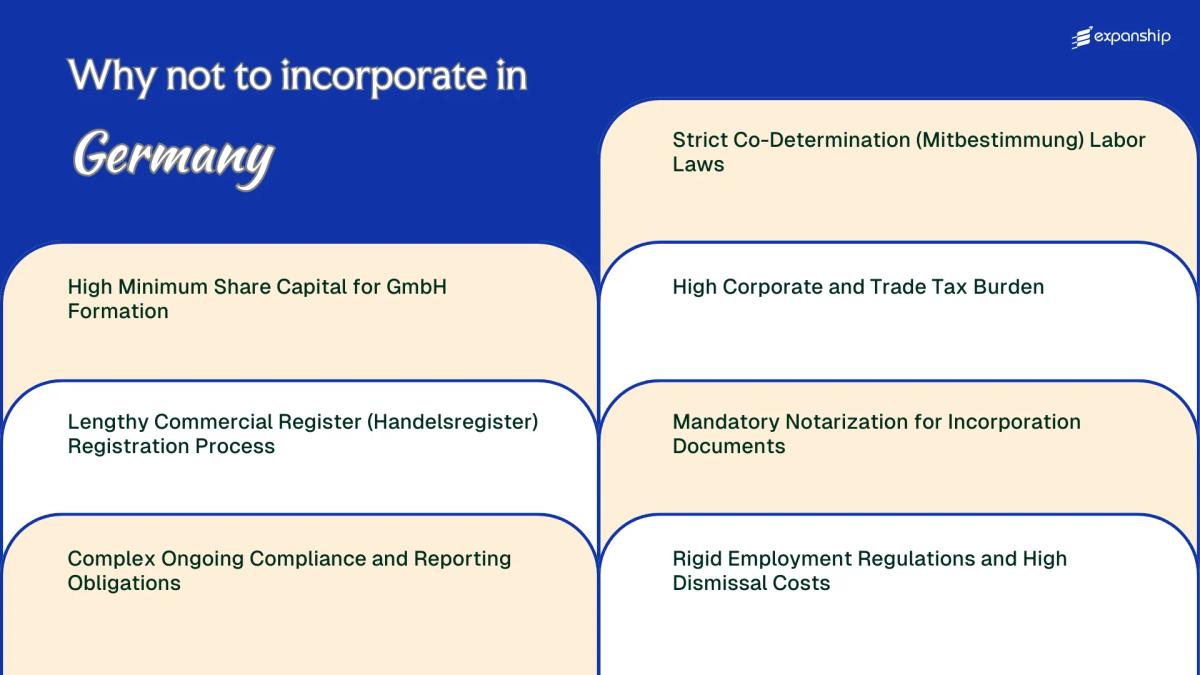
High Minimum Share Capital for GmbH Formation
Forming a Gesellschaft mit beschränkter Haftung requires a minimum share capital of €25,000 under Section 5 of the GmbH-Gesetz (GmbHG). Germany GmbH minimum share capital requirements place an immediate financial burden on founders before the business generates any revenue.
Capital Tied at Formation
At least half of the subscribed capital, €12,500, must be paid in before the Handelsregister will register the entity. For a foreign entrepreneur with limited initial liquidity, this upfront cash requirement can delay or block market entry entirely.
The remaining unpaid capital stays as a contingent liability on the shareholders. If the company later faces financial distress, shareholders can be called to contribute the outstanding amount.
Structural Disadvantage Against Lighter Alternatives
Comparable EU jurisdictions allow formation with nominal capital; the UK's private limited company, for example, requires just £1. That gap means your initial working capital in Germany is effectively reduced by the amount locked into the statutory minimum.
The Unternehmergesellschaft (haftungsbeschränkt), or UG, permits lower starting capital but mandates annual profit retention until €25,000 is accumulated, extending the financial constraint over time.
Capital deposited to satisfy the GmbHG minimum cannot be freely withdrawn after registration; it must remain available to cover company liabilities, permanently restricting your operational cash flow from the outset.
Lengthy Commercial Register (Handelsregister) Registration Process
Germany Handelsregister registration challenges begin before your company can legally operate. Unlike jurisdictions where online self-registration takes days, entry into the Handelsregister requires a notarized application submitted through a notary to the competent local court (Amtsgericht), which then processes the filing at its own pace.
Processing times vary significantly by court and region. Some Amtsgericht offices complete registration within two to three weeks; others take two to three months, particularly in high-volume courts serving major commercial cities.
This unpredictability creates direct operational friction for foreign founders:
- You cannot open a full business bank account or sign binding contracts under the company name until registration is confirmed, freezing your commercial activity.
- Lease agreements, supplier contracts, and employment offers are all held in limbo, generating delays that carry real financial costs.
- Advisors and local agents must be retained throughout the waiting period, adding professional fees on top of an already slow process.
- If the court requests corrections or additional documentation, the timeline resets, with no guaranteed response deadline imposed on the Amtsgericht.
The slow company registration process in Germany has no statutory maximum processing period under current Handelsregister procedures, meaning courts face no binding deadline to complete your filing.

Company Incorporation in Germany
Incorporate your business in Germany with full support through the Handelsregister process, notarization requirements, and local compliance obligations.
Complex Ongoing Compliance and Reporting Obligations
Germany company compliance obligations drawbacks extend well beyond the formation stage. Once a GmbH is operational, the firm faces a dense layer of recurring statutory requirements that collectively consume significant time and professional resources.
Annual financial statements must be prepared in accordance with the Handelsgesetzbuch (HGB), Germany's Commercial Code. Unlike simplified regimes available in some EU member states, even small GmbHs must file balance sheets and profit-and-loss accounts with the Unternehmensregister, the federal business register, within twelve months of the financial year-end.
| Obligation | Regulatory Basis | Burden for Foreign-Owned Entity |
|---|---|---|
| Annual financial statement filing | HGB §§ 242-289 | Requires HGB-compliant accountant; IFRS experience does not substitute |
| Trade tax return (Gewerbesteuererklarung) | Gewerbesteuergesetz (GewStG) | Separate municipal filing; rate varies by municipality, complicating forecasting |
| Corporate tax return (Korperschaftsteuer) | KStG | Filed with Finanzamt; penalties apply for late submission |
| VAT returns (monthly or quarterly) | UStG | Foreign owners often require a local fiscal representative |
| Transparency register notification | Geldwaschegesetz (GwG) | Beneficial owners must be registered; updates required within two weeks of any change |
The German corporate filing obligations restrictions also apply to the Transparenzregister under the Geldwaschegesetz. Any change in beneficial ownership must be reported within two weeks, a requirement that foreign parent companies frequently underestimate.
For entities that grow beyond certain thresholds, the ongoing compliance costs Germany business owners face increase substantially. A GmbH exceeding two of three size criteria under HGB § 267 (balance sheet total above EUR 6 million, revenues above EUR 12 million, or more than 50 employees) triggers medium-sized company obligations, including a mandatory audit by a Wirtschaftsprufer.
Strict Co-Determination (Mitbestimmung) Labor Laws
Germany Mitbestimmung co-determination drawbacks extend well beyond internal governance inconvenience — they structurally limit how foreign-owned companies can operate once headcount crosses statutory thresholds. Under the Mitbestimmungsgesetz (MitbestG) of 1976, any company with more than 2,000 employees must assign employee representatives to half of all supervisory board seats. For a foreign parent company accustomed to full board authority, this is a direct loss of unilateral decision-making power.
Even below that threshold, the Drittelbeteiligungsgesetz requires one-third employee representation on supervisory boards for entities with 500 to 2,000 employees. This means the co-determination obligation activates long before a business reaches large-enterprise scale.
Board decisions on restructuring, site closures, or executive appointments can be delayed or contested through this structure. Foreign investors often underestimate the procedural friction this introduces when rapid operational changes are needed.
- Supervisory board composition must comply with MitbestG once headcount exceeds 2,000
- One-third employee representation applies from 500 employees under Drittelbeteiligungsgesetz
- Employee representatives hold equal voting rights on the supervisory board, not advisory roles
- Works councils (Betriebsräte) retain separate co-determination rights on operational matters, independent of board-level rules
- Foreign parent entities are not exempt; thresholds apply to German-registered legal entities
A deadlock between shareholder and employee representatives on a German supervisory board is broken by a second vote from the board chair — who is typically a shareholder representative — making tie-breaking a formal statutory mechanism, not an informal arrangement.
High Corporate and Trade Tax Burden
Germany's combined corporate tax burden ranks among the highest in the EU, creating a meaningful cost disadvantage for foreign-owned entities from the moment they become profitable.
The Structure of the Tax Obligation
A GmbH or AG faces three overlapping levies: corporate income tax (Körperschaftsteuer) at 15%, a solidarity surcharge (Solidaritätszuschlag) of 5.5% on that amount, and the trade tax (Gewerbesteuer). The Gewerbesteuer rate varies by municipality under §16 GewStG, but effective combined rates typically fall between 28% and 33%, with cities like Munich and Frankfurt pushing toward the higher end.
Why This Creates a Structural Disadvantage
For a foreign investor comparing EU incorporation destinations, this stacking effect is material. Ireland's corporate rate sits at 12.5%, and even the EU average remains below Germany's effective combined rate, meaning your entity retains substantially less post-tax profit under the same revenue conditions.
The trade tax base also includes add-backs for items such as financing costs and lease payments, which can push taxable income above commercial profit — a technical feature of the Gewerbesteuer that disproportionately affects capital-intensive or asset-light businesses relying on intercompany financing.
Managing Germany's Tax Burden as a Foreign Investor
Understand the full scope of corporate and trade tax obligations before you commit to a German structure.
Mandatory Notarization for Incorporation Documents
Incorporating a GmbH requires mandatory notarization of the articles of association under Section 2 of the GmbH-Gesetz (GmbHG), and this Germany mandatory notarization incorporation drawback adds both cost and delay that foreign founders rarely anticipate. A licensed German notary (Notar) must authenticate all founding documents before the Handelsregister will accept the registration application.
- Notary fees are calculated according to the Gerichts- und Notarkostengesetz (GNotKG) and scale with share capital, meaning higher-capitalized entities face disproportionately larger authentication costs.
- You must coordinate with a German-qualified notary in person or through a formally authorized representative, creating a logistical obstacle for foreign founders who are not physically present in Germany.
- Any subsequent amendment to the articles of association, including changes to the business purpose or shareholder structure, triggers a repeat notarization requirement, generating recurring fees throughout the company's life.
- The Unternehmergesellschaft (UG) offers an exemption using a standardized template, but this removes the flexibility to tailor founding documents to your specific operational needs.
Rigid Employment Regulations and High Dismissal Costs
Germany employment regulations create one of the most restrictive termination environments in the OECD, and for foreign employers, the financial exposure is significant before a single redundancy notice is issued.
The Kündigungsschutzgesetz (KSchG), or Dismissal Protection Act, applies to businesses with more than ten employees. Once an employee passes their probationary period (typically six months), termination must be justified on personal, behavioral, or operational grounds — and even then, it is subject to challenge before a labor court (Arbeitsgericht).
Wrongful dismissal claims are common, and settlements routinely involve severance payments calculated at 0.5 to 1.0 gross monthly salaries per year of service. Your business carries this exposure even when termination is operationally necessary.
Statutory notice periods under the Bürgerliches Gesetzbuch (BGB) scale with tenure, reaching up to seven months for employees with 20 or more years of service. During that window, full salary obligations continue regardless of whether the role is being wound down.
The KSchG does not apply to firms with ten or fewer employees, which creates a hard operational ceiling — scaling beyond that threshold materially increases your dismissal risk and legal costs.
A foreign-owned GmbH with 15 employees deciding to downsize by five positions could face combined notice period payroll costs, Arbeitsgericht litigation fees, and negotiated severance exceeding €80,000–€120,000, depending on employee tenure and salary levels — before any restructuring objective is achieved.
Overcoming These Incorporation Challenges
Overcoming these incorporation challenges in Germany requires structural preparation rather than reactive adjustments once problems arise. Foreign founders who understand the regulatory architecture in advance are better positioned to manage costs, timelines, and compliance obligations.
- Adopt the Unternehmergesellschaft (UG) structure as a capital-light entry point before converting to a GmbH once operational reserves allow the €25,000 minimum share capital threshold to be met.
- Engage a German notary (Notar) before incorporating, as notarization of the articles of association and shareholder list is a statutory requirement under the GmbHG.
- Register with the Handelsregister promptly through the competent Amtsgericht to avoid delays in obtaining legal standing.
- Establish internal co-determination thresholds tracking from the outset, as Mitbestimmung obligations under the Betriebsverfassungsgesetz activate at specific headcount levels.
- Appoint a tax advisor familiar with Gewerbesteuer apportionment to manage trade tax exposure across multiple municipal jurisdictions.
These steps address procedural and structural requirements embedded across multiple German statutes and regulatory bodies. The overarching framework is administered through a network of Amtsgerichte, the Bundesanzeiger, and the Finanzamt, each with distinct filing and disclosure obligations.
Germany's Overall Business Appeal
Germany's business environment, despite drawbacks like high share capital requirements, notarization obligations, and a significant tax burden, continues to attract foreign investment on the strength of its legal stability, central European position, and access to one of the continent's largest consumer markets. The structural barriers to entry are real and measurable. For businesses whose operating model can absorb those costs, the underlying market credentials remain credible.
| Pros | Cons |
|---|---|
| Access to a large domestic market of approximately 84 million consumers | GmbH formation requires a minimum share capital of €25,000 |
| Legal system grounded in the Bürgerliches Gesetzbuch provides high contract certainty | Handelsregister registration can take several weeks, delaying operational start dates |
| Membership in the EU single market and eurozone simplifies cross-border trade | Combined corporate and trade tax (Gewerbesteuer) rates frequently exceed 30% |
| Strong IP protection and an established commercial court system | Mandatory notarization of incorporation documents adds cost and procedural complexity |
| Highly skilled, well-educated workforce | Co-determination rules under the Mitbestimmungsgesetz impose board-level labor representation at scale |
| Stable regulatory environment with predictable enforcement | Dismissal protection under the Kündigungsschutzgesetz raises the cost of workforce adjustments |
Incorporating here means accepting a defined set of structural constraints in exchange for operating within a stable, high-credibility jurisdiction. That trade-off will suit some business profiles and not others.
Compliance Services for Companies in Germany
Keep your German entity in good standing with the Handelsregister, Finanzamt, and other regulatory bodies. Our compliance support covers annual filings, reporting obligations, and ongoing statutory requirements.
Conclusion
The cons of Germany company incorporation are real and measurable. A GmbH requires €25,000 in minimum share capital, notarized incorporation documents, and registration through the Handelsregister before the entity can operate. Trade tax (Gewerbesteuer) compounds the federal corporate tax burden, and Mitbestimmung obligations expand significantly as headcount grows. Structural requirements are fixed by the GmbHG; there is limited flexibility to work around them. For businesses that proceed with full awareness of these constraints, professional support in managing the statutory, tax, and labor compliance obligations becomes a practical necessity rather than an optional consideration.
Expanship's Germany Expansion Support
Expanship's Germany expansion support services are built around the specific administrative and legal weight that incorporation in Germany carries. From preparing notarized founding documents and coordinating with the Handelsregister to managing ongoing obligations under the Handelsgesetzbuch, Expanship works to reduce the operational burden these requirements place on your team, not to sidestep them.
Our firm supports businesses at each stage of the process, from initial registration through to post-incorporation compliance.
- We prepare your company registration documents and coordinate notarization requirements on your behalf.
- A registered office and local agent are provided to satisfy German legal presence requirements.
- Our team handles government filings and liaises directly with the relevant German authorities.
- Post-incorporation compliance management keeps your entity in good standing with ongoing obligations.
- We facilitate introductions to banking institutions familiar with international business clients.
- Tax registration and liaison with the Finanzamt are coordinated as part of your setup.
Reach out to Expanship Germany to discuss your incorporation requirements.
Frequently Asked Questions (FAQ)
Notarization is mandatory for GmbH and AG formations under the GmbHG (GmbH-Gesetz) and AktG respectively, meaning a German notary must certify the articles of association before the company can be entered into the Handelsregister. This requirement cannot be waived or substituted with a simple statutory declaration as in many other EU member states. Foreign founders must either travel to Germany or grant a notarized power of attorney to a local representative, which adds both time and cost to the process.
German GmbHs are required to publish annual financial statements in the Bundesanzeiger (Federal Gazette) under the Handelsgesetzbuch (HGB), and failure to do so can result in fines issued by the Bundesamt für Justiz (Federal Office of Justice). Fines typically start at EUR 2,500 and can escalate for continued non-compliance, with enforcement actively pursued rather than left to chance. The obligation applies regardless of company size, though the depth of disclosure required varies between small, medium, and large classifications under the HGB.
Co-determination requirements under the Betriebsverfassungsgesetz (BetrVG) and the Mitbestimmungsgesetz apply based on employee headcount, not the nationality or ownership structure of the business. A subsidiary with 500 or more employees in Germany must establish a supervisory board with employee representatives occupying one-third of seats; at 2,000 or more employees, that proportion rises to half. Smaller entities below these thresholds are not subject to full co-determination, though works council rights under the BetrVG can still apply once a business has five or more permanent employees.
The Gewerbesteuer is levied on top of corporate income tax and the solidarity surcharge, and its rate varies by municipality since each Gemeinde sets its own multiplier (Hebesatz). In practice, combined corporate and trade tax rates in major German cities typically fall between 30% and 33%, with Munich and Frankfurt sitting at the higher end of that range. Unlike corporate income tax, the Gewerbesteuer is not fully deductible as a business expense for federal tax purposes, which compounds the effective burden.
A foreign founder cannot complete GmbH registration entirely remotely under current standard procedures, as the notarization of the articles of association requires either physical presence before a German notary or the use of a notarized and apostilled power of attorney. Germany introduced a limited online notarization pilot under the DiRUG reform (Gesetz zur Umsetzung der Digitalisierungsrichtlinie), which came into force in August 2022, but its application remains restricted and not uniformly available for foreign founders without a German electronic identity. The Handelsregister filing itself is submitted by the notary, so the bottleneck is the notarization step rather than the register application.
Dismissal protections in Germany are among the strictest in the EU, primarily governed by the Kündigungsschutzgesetz (KSchG), which applies to businesses with more than ten employees once a worker has been employed for more than six months. Terminations must be justified on operational, personal, or conduct-based grounds, and unjustified dismissals routinely result in reinstatement orders or severance settlements through the Arbeitsgericht (labor court). Severance is not automatically mandated by statute but is frequently awarded in settlement to avoid prolonged litigation, making dismissal a financially and procedurally costly exercise compared to jurisdictions like the Netherlands or Ireland.
If a GmbH's net assets fall below the EUR 25,000 share capital threshold, the managing directors (Geschäftsführer) are legally obligated under Section 49(3) GmbHG to convene a shareholder meeting immediately. Continued operation while balance sheet over-indebtedness or illiquidity exists can expose Geschäftsführer to personal liability for payments made after insolvency triggers arise, under Section 15a of the Insolvenzordnung (InsO). This personal liability risk is a material concern for foreign nationals serving as directors of German subsidiaries.
Legal Disclaimer
The information provided in this article is for general informational purposes only and does not constitute legal, tax, or professional advice. While we strive to ensure the accuracy and timeliness of the content, laws and regulations are subject to change, and the application of laws can vary widely based on specific facts and circumstances.
Readers should not act upon this information without seeking professional counsel tailored to their individual situation. Expanship and its authors disclaim any liability for actions taken or not taken based on the content of this article.
For specific advice regarding your business setup, compliance requirements, or any legal matters, please consult with qualified legal and tax professionals in the relevant jurisdiction.