
Key Takeaways
- Curaçao's limited network of double taxation treaties forces most foreign-owned entities to manage withholding tax exposure without bilateral relief, increasing the effective cost of cross-border profit repatriation.
- Companies operating under the Curaçao eGaming licensing framework face a structurally demanding compliance environment, as the licensing authority imposes ongoing technical, financial, and anti-money laundering obligations that require sustained operational resources.
- Substance requirements under Dutch Caribbean tax rules mean that entities unable to demonstrate genuine local management, staffing, and operational presence risk losing preferential tax treatment and face potential reclassification by Dutch Kingdom oversight bodies.
- Repeated inclusion of Curaçao on FATF and EU non-cooperative jurisdiction monitoring lists has materially narrowed correspondent banking relationships, making it harder for incorporated entities to maintain functional international payment infrastructure.
Curaçao operates under an evolving regulatory framework, shaped by its status as a constituent country of the Kingdom of the Netherlands and subject to ongoing oversight from both local and supranational bodies. The disadvantages of incorporating in Curaçao span areas including tax compliance, banking access, licensing obligations, and international perception — each examined individually in the sections that follow.
Not all of these drawbacks apply equally to every structure. A holding company registered under the Civil Code faces different exposure than an operating entity in financial services or e-gaming.
This article is most relevant to foreign investors and business owners from outside the Dutch Caribbean region who are evaluating Curaçao company formation drawbacks before committing to a specific jurisdiction or legal structure.
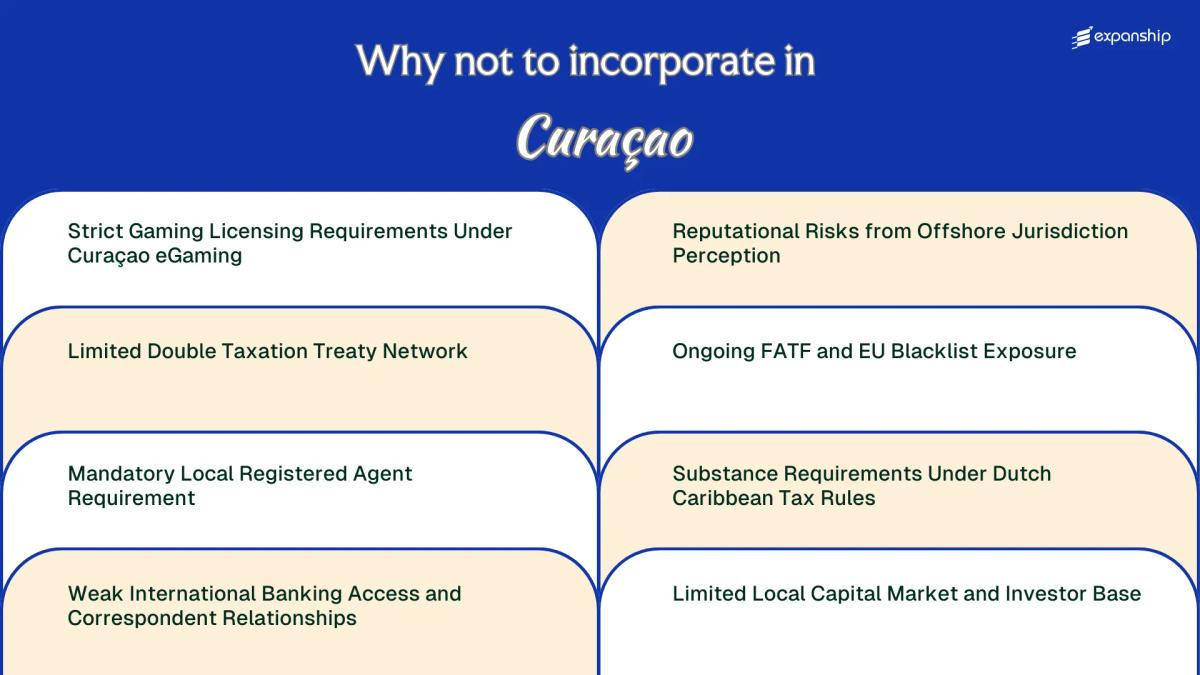
Strict Gaming Licensing Requirements Under Curaçao eGaming
Curaçao eGaming licensing restrictions create one of the most operationally demanding compliance environments for foreign gaming operators. The 2023 National Ordinance on Games of Hazard (NOOGH) overhauled the previous master license structure, introducing direct licensing through the newly established Gaming Control Board (GCB).
Structural Licensing Burdens Under the GCB
Under the reformed framework, each operator must obtain an individual B2C or B2B license directly from the GCB rather than sublicensing from a master license holder. This eliminates the lower-cost entry route that previously existed, raising both the time and financial threshold for market access.
Meeting GCB requirements means demonstrating technical standards, responsible gambling protocols, and anti-money laundering compliance independently. Foreign operators without established local infrastructure find this particularly difficult to satisfy without retaining specialized local legal and compliance personnel.
Ongoing Regulatory Cost as a Drawback
Annual license fees and mandatory reporting obligations under the NOOGH add recurring costs that compound with third-party audits. These Curaçao gaming license drawbacks are especially burdensome for smaller operators whose compliance budgets cannot absorb sustained regulatory overhead.
The elimination of the sublicense model means foreign operators can no longer rely on a master license holder's existing approvals, requiring full independent compliance from the outset.
Limited Double Taxation Treaty Network
Curaçao's double taxation treaty limitations present a concrete structural problem for cross-border businesses. The island maintains a narrow treaty network, primarily through the Tax Arrangement for the Kingdom of the Netherlands (BRNC/BRK framework), which covers intra-Kingdom relations rather than providing broad bilateral treaty access with major trading economies.
This restricted coverage means dividend, interest, and royalty payments flowing out of your entity to non-treaty jurisdictions are subject to withholding taxes without reduction. Standard statutory rates apply in full, raising the effective cost of repatriating income.
The practical burden this creates for a foreign business owner includes:
- Withholding taxes on dividends paid to shareholders in non-covered countries cannot be reduced, directly eroding investor returns
- Royalty flows to IP-holding structures in non-treaty jurisdictions attract full withholding, making IP arrangements more expensive to operate
- Without treaty protection, your business may face double taxation in both Curaçao and the recipient country, with no formal relief mechanism
- Structuring around these gaps requires additional intermediate entities, generating legal, accounting, and maintenance costs
Treaty-equivalent protections under EU directives, such as the Parent-Subsidiary Directive, do not apply since the jurisdiction sits outside the EU's direct legislative scope.

Company Incorporation in Curaçao
Set up your company in Curaçao with end-to-end support, from entity selection to registration and ongoing compliance management.
Mandatory Local Registered Agent Requirement
The Curaçao registered agent requirement restrictions are not merely administrative formalities. Under the Civil Code of Curaçao and the framework administered by the Curaçao Chamber of Commerce and Industry (Kamer van Koophandel), every locally incorporated entity must maintain a registered office address and appoint a qualified local agent. Foreign founders cannot self-administer this function from abroad.
This dependency creates a structural cost that persists for the entire life of the company. Approved registered agents are typically licensed corporate service providers charging annual fees that your business cannot avoid, regardless of whether the entity trades actively or remains dormant.
| Obligation | Restriction / Cost Implication |
|---|---|
| Registered office address | Must be a physical address in Curaçao; virtual-only arrangements face scrutiny |
| Agent qualification | Must be a licensed local provider; foreign directors cannot self-appoint |
| Annual maintenance fee | Typically ranges from USD 800 to USD 2,500 per year depending on service scope |
| Dormant entity obligation | Fee applies regardless of trading activity or revenue generation |
| Replacement process | Requires formal notification to the Chamber of Commerce, adding administrative delay |
Because the agent acts as the official point of contact for regulatory correspondence, your business loses direct control over how and when compliance notices are received and forwarded. Any delay on the agent's part can translate directly into a missed regulatory deadline.
The requirement applies uniformly to Naamloze Vennootschap (NV) and Besloten Vennootschap (BV) structures, with no exemption available for wholly foreign-owned entities.
Weak International Banking Access and Correspondent Relationships
Curaçao offshore banking access problems are well-documented among foreign founders who attempt to open accounts shortly after incorporation. Major international banks, particularly those headquartered in the United States and European Union, apply heightened due diligence to entities registered in the jurisdiction under de-risking policies tied to perceived offshore risk.
Correspondent banking relationships present the most concrete obstacle. Global correspondent banks have progressively severed or restricted ties with local financial institutions, reducing the cross-border payment infrastructure your business can realistically rely on.
The Central Bank of Curaçao and Sint Maarten (CBCS) supervises the local banking sector, but its regulatory authority does not compel foreign correspondent banks to maintain relationships with locally licensed institutions. That distinction matters because your firm's ability to receive and send international payments depends on networks the CBCS cannot control.
Opening a business account with a reputable bank outside the island, citing a Curaçao-registered address, frequently results in outright refusals or prolonged compliance reviews.
- Correspondent banking access is not guaranteed by local licensing or CBCS compliance status
- Foreign banks may apply enhanced due diligence or refuse accounts based on jurisdiction of registration alone
- Payment processing delays can affect operational timelines without any local regulatory breach on your part
- Some international payment platforms restrict or exclude entities incorporated in offshore jurisdictions from onboarding
Even a fully licensed and CBCS-compliant Curaçao entity can be denied a business bank account by a European bank without any specific regulatory finding against the company itself.
Reputational Risks from Offshore Jurisdiction Perception
Curaçao offshore jurisdiction reputational risks are a genuine operational concern, not just a perception problem. Banks, investors, and institutional counterparties form judgments about your entity based on where it is registered.
How Offshore Classification Affects Business Credibility
Foreign companies incorporated under the Curaçao Civil Code often face automatic scrutiny from European and North American partners who associate the jurisdiction with tax minimization structures. This offshore Curaçao business credibility problem can surface during due diligence reviews, where counterparties request additional documentation or simply decline engagement without explanation.
Correspondent banks in particular apply enhanced due diligence to entities from jurisdictions perceived as low-transparency, which compounds the banking access difficulties your firm may already face. The reputational burden is not uniform; businesses with clear commercial substance and audited financials tend to face less resistance than holding entities or structures without identifiable operating activity.
Practical Consequences Across Industries
Curaçao company perception challenges extend beyond banking into trade finance, insurance underwriting, and professional services procurement. Suppliers and institutional clients in regulated industries may require additional certifications or legal opinions before entering contracts with your entity.
For industries outside gaming and finance, the absence of a strong bilateral regulatory reputation means your business carries the jurisdiction's general offshore label without the compensating recognition that larger financial centers typically provide.
Assessing Reputational Exposure Before Incorporating in Curaçao
Speak with our corporate advisors about how jurisdiction perception may affect your business relationships and what structural considerations apply to your specific situation.
Ongoing FATF and EU Blacklist Exposure
Curaçao FATF blacklist exposure risks are a direct operational concern for any company registered there, since listing events trigger automatic due diligence burdens from foreign banks, partners, and regulators. The jurisdiction has faced EU blacklist scrutiny as a non-cooperative tax jurisdiction, forcing corporate clients to justify their structure to counterparties who apply blanket restrictions based on listing status alone.
- Placement on the EU list of non-cooperative jurisdictions requires financial institutions in EU member states to apply enhanced due diligence to transactions involving your entity, increasing compliance costs and processing delays.
- Correspondent banks frequently restrict or terminate relationships with firms incorporated in listed jurisdictions, compounding the banking access problems your business already faces structurally.
- The Financial Intelligence Unit Netherlands Antilles (FIU-NA) administers AML reporting obligations under local law, and failure to meet these standards directly informs international assessments of the jurisdiction's compliance standing.
- Even temporary listing periods can permanently damage commercial relationships, as counterparties rarely reverse enhanced screening procedures after a jurisdiction is removed from a blacklist.
Substance Requirements Under Dutch Caribbean Tax Rules
Curaçao substance requirements drawbacks are most acute for holding companies and IP-holding entities that exist primarily on paper. Under the Dutch Caribbean tax framework, specifically the National Ordinance on Profit Tax (Landsverordening op de Winstbelasting 1940, as amended), entities seeking preferential tax treatment must demonstrate genuine economic activity within the jurisdiction.
For a foreign business owner, meeting these thresholds means incurring real operational costs. Your company must maintain qualified local staff, office space, and management decision-making on the island, none of which can be fulfilled through a mailbox address or a single nominal director.
Curaçao economic substance compliance challenges are particularly burdensome for asset-holding structures, where the underlying business function is passive by design. Satisfying the local activity test for such entities often requires contracting local service providers or hiring resident employees, which adds recurring overhead with no corresponding operational benefit.
The requirement applies broadly across sectors but carries stricter scrutiny for intra-group financing and IP arrangements, which tax authorities have identified as high-risk categories for profit shifting.
A foreign-owned IP holding company paying EUR 18,000 annually in local staffing and office costs purely to satisfy substance rules, with no actual business conducted on the island, faces an ongoing compliance overhead that directly reduces the net tax advantage the structure was designed to create.
Limited Local Capital Market and Investor Base
Curaçao capital market limitations are structural, not circumstantial. The island has a population of roughly 150,000, and its local stock exchange, the Caribbean Securities Exchange (CSX), lists only a small number of securities with thin trading volumes.
For a foreign business owner, this translates directly into restricted access to equity financing and institutional debt from within the jurisdiction. If your growth strategy depends on local capital raises or attracting regional institutional investors, the available pool is insufficient to support meaningful funding rounds.
Most serious capital formation for entities incorporated here happens offshore, requiring you to build investor relationships entirely outside the jurisdiction. That dependency adds friction, cost, and structural complexity that would not exist if you were incorporated in a larger financial centre.
The CSX operates under the supervision of the Centrale Bank van Curaçao en Sint Maarten (CBCS), which regulates securities markets under the National Ordinance on the Supervision of Securities Trade. The ordinance's scope and the exchange's limited issuer base mean that accessing public markets locally is not a practical option for most foreign-incorporated businesses.
If your business model requires local capital market access or depends on attracting institutional investors from within the jurisdiction, the structural depth of the CSX and the restricted Curaçao investor base mean that funding strategy must be built entirely around offshore relationships before incorporation.
Navigating These Incorporation Challenges
Navigating Curaçao incorporation challenges requires structural preparation rather than reactive adjustments after formation. The disadvantages covered in this blog, from substance requirements to banking access gaps, share underlying causes that a well-planned setup can partially address.
- Appoint a licensed local registered agent registered with the Curaçao Chamber of Commerce to satisfy the mandatory local presence requirement.
- Establish genuine economic substance by documenting local management decisions, payroll, and operational expenditure in line with the Dutch Caribbean substance rules.
- Apply for an eGaming licence directly through the Curaçao eGaming licensing authority if your business operates in online gaming.
- Review the current FATF and EU listing status of the jurisdiction before opening correspondent banking relationships to anticipate account restrictions.
- Assess your investor funding strategy independently of local capital markets, given the limited depth of the island's domestic investor base.
These steps operate within a regulatory environment that is subject to ongoing reform, including the transition to the new Curaçao Gaming Control Board framework. Structural decisions made at incorporation carry long-term compliance implications that cannot be easily reversed.
Curaçao's Overall Business Appeal
Weighing the disadvantages covered against the jurisdiction's structural advantages, Curaçao remains a credible choice for foreign business owners — particularly those in international trade, digital services, and holding structures. The Curaçao business incorporation pros and cons picture is not uniformly negative, but the friction points are real and require deliberate planning.
| Pros | Cons |
|---|---|
| The territorial tax system under the Landsverordening op de Winstbelasting limits corporate tax to locally sourced income. | The double taxation treaty network is limited, increasing withholding tax exposure on cross-border payments. |
| The jurisdiction operates an established legal framework under Dutch-derived civil law, providing structural familiarity. | Ongoing FATF and EU blacklist exposure creates compliance uncertainty for international counterparties. |
| A regulated eGaming licensing framework exists under Curaçao eGaming, providing a legal pathway for online gaming operators. | Substance requirements under the SOIB rules demand genuine local economic presence, raising operational costs. |
| Formation costs and timelines are generally lower than comparable European jurisdictions. | Correspondent banking relationships remain constrained, complicating account access for offshore-structured entities. |
Perception of the jurisdiction as an offshore centre carries weight with banks, institutional partners, and payment processors regardless of the entity's actual compliance standing.
Compliance Services for Companies in Curaçao
Maintain your Curaçao company's good standing with timely filings, substance documentation, and regulatory reporting under local requirements.
Conclusion
Curaçao offshore company drawbacks summary points to a jurisdiction that offers a structured legislative framework through the Curaçao Civil Code and National Ordinance on Profit Tax, yet carries structural limitations that affect a meaningful share of incorporation decisions. Banking access remains a persistent obstacle, with correspondent banking relationships difficult to establish and maintain. Exposure to EU and FATF grey-listing processes introduces ongoing compliance uncertainty that cannot be fully mitigated at the entity level. Understanding these constraints in full, before committing to a structure, shapes the decisions that follow.
Expanship's Curaçao Corporate Services
Incorporating in Curaçao involves specific obligations that carry real administrative weight — from satisfying substance requirements under the Dutch Caribbean tax framework to managing exposure on FATF and EU watchlists. Expanship's Curaçao corporate services are structured to reduce the operational burden of these requirements, supporting your business through the compliance layers this jurisdiction demands rather than around them.
Beyond formation, Expanship covers the full lifecycle of your corporate presence in Curaçao.
- Your company registration and document preparation are handled with attention to local formalities under Curaçao civil law.
- A local registered agent and registered office address are provided to satisfy the mandatory local presence requirement.
- Government filing and liaison with the Curaçao Chamber of Commerce and relevant regulatory bodies are managed on your behalf.
- Post-incorporation compliance management keeps your entity in good standing over time.
- Banking introduction assistance connects your firm with institutions familiar with Curaçao-registered entities.
- Tax registration and liaison with the Belastingdienst Caribisch Nederland are coordinated as part of your setup.
Reach out to Expanship Curaçao to discuss your incorporation requirements.
Frequently Asked Questions (FAQ)
The substance requirements under the Curaçao National Ordinance on Profit Tax apply broadly to entities claiming local tax residency, particularly those using the preferential rates available to exempt companies or holding structures. A firm that cannot demonstrate genuine local management, decision-making, and operational presence may be reclassified or denied the tax treatment it was structured to obtain. This is not a formality — tax authorities have increased enforcement scrutiny on shell-like arrangements.
A business incorporated in Curaçao frequently struggles to open accounts with major international banks, as correspondent banking relationships between Curaçao-licensed institutions and US or European banks have deteriorated significantly over the past decade. Transactions routed through Curaçao entities may face delays, rejection, or enhanced due diligence requirements from receiving banks. For businesses that depend on fast cross-border payments, this is an operational constraint, not merely a reputational inconvenience.
Curaçao's treaty network is significantly thinner than jurisdictions like Malta, Cyprus, or Mauritius, which maintain extensive bilateral tax treaty coverage. Following the dissolution of the Netherlands Antilles in 2010, Curaçao retained limited treaty access, and the Tax Arrangement for the Kingdom of the Netherlands (BRK) governs its relationship with the Netherlands rather than a full bilateral treaty. For businesses with cross-border income flows into multiple markets, this gap materially increases withholding tax exposure.
Under Curaçao corporate law, a company without a locally licensed registered agent is non-compliant and can face administrative dissolution. The registered agent is legally responsible for maintaining the company's registered address and certain compliance filings, so the relationship is not optional. Lapsing this requirement does not simply trigger a fine — it can render the entity structurally invalid under local law.
Institutional investors subject to anti-money laundering regulations in their home jurisdictions often apply enhanced due diligence to entities incorporated in Curaçao, which is widely categorized as an offshore financial center. This can slow deal timelines, increase legal costs associated with structuring opinions, and in some cases result in outright disqualification from investment mandates that prohibit exposure to certain offshore jurisdictions. The reputational burden falls on your entity from the moment counterparties see the registered address.
Yes, because Curaçao operates within the Kingdom of the Netherlands framework, adverse FATF findings related to the broader Caribbean constituent countries can influence how compliance officers at foreign financial institutions assess Curaçao-based entities. Curaçao's own anti-money laundering framework is overseen by the Centrale Bank van Curaçao en Sint Maarten, and deficiencies identified in that framework directly affect the risk rating assigned to companies domiciled there. A higher risk rating translates into stricter correspondent banking requirements and more intensive onboarding scrutiny.
Legal Disclaimer
The information provided in this article is for general informational purposes only and does not constitute legal, tax, or professional advice. While we strive to ensure the accuracy and timeliness of the content, laws and regulations are subject to change, and the application of laws can vary widely based on specific facts and circumstances.
Readers should not act upon this information without seeking professional counsel tailored to their individual situation. Expanship and its authors disclaim any liability for actions taken or not taken based on the content of this article.
For specific advice regarding your business setup, compliance requirements, or any legal matters, please consult with qualified legal and tax professionals in the relevant jurisdiction.