

Key Takeaways
- Foreign entities incorporating in Colombia must register with the Cámara de Comercio and comply with the Colombian Commercial Code, a multi-step process that creates meaningful administrative lead time before operations can legally commence.
- Colombia's corporate tax environment imposes a standard rate plus additional surcharges that push the effective burden on certain taxpayers well above headline figures, requiring active management through DIAN to avoid penalties on filing obligations.
- Under the Código Sustantivo del Trabajo (CST), employers face mandatory contributions covering severance, social security, and legally mandated benefits that substantially increase the true cost of each hire beyond base salary.
- Repatriating profits or transferring capital out of Colombia requires prior registration of the foreign investment with Banco de la República, and failure to maintain this registration can restrict access to the official foreign exchange market.
Colombia operates under a detailed and actively enforced regulatory framework, where corporate governance, taxation, and foreign investment each fall under distinct institutional oversight. The disadvantages of incorporating in Colombia span several operational and compliance dimensions that foreign investors consistently encounter after entity formation.
Not every business will face each challenge equally. A manufacturing firm, a service-based SAS, and a foreign branch each carry different exposure to the friction points covered in this article.
This article is most relevant to foreign nationals and international companies pursuing direct market entry through a locally incorporated entity, rather than those operating through distributors or cross-border contracts. The primary legal reference governing commercial entities is the Colombian Commercial Code, which establishes the foundational rules for company formation and operation in the country.
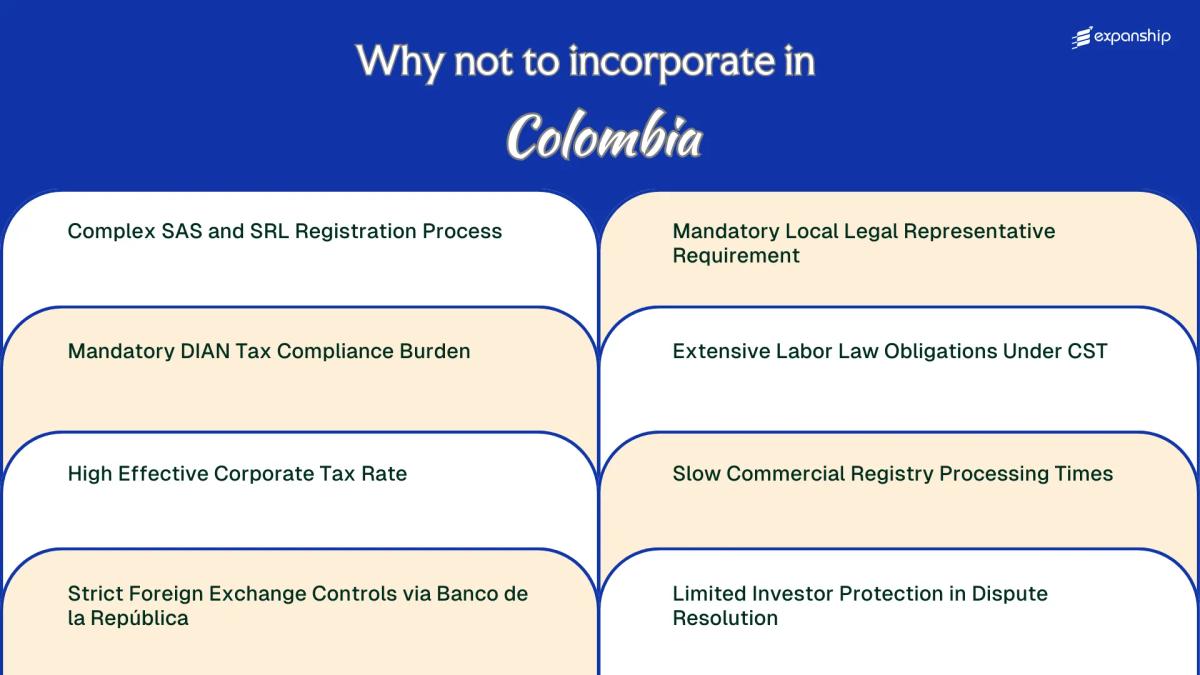
Complex SAS and SRL Registration Process
Registering a business in Colombia involves procedural layers that extend well beyond filing a single document. Colombia SAS registration challenges stem from a multi-agency process that demands careful sequencing before your company can legally operate.
Dual-Entity Complexity and Documentary Requirements
Both the Sociedad por Acciones Simplificada and the Sociedad de Responsabilidad Limitada require registration with the Cámara de Comercio, but the SRL's requirement for a public deed authenticated by a notary adds time and notarial fees that the SAS avoids. Even the SAS, despite its simpler structure, requires a private document that meets specific statutory content requirements under Law 1258 of 2008, and any deficiency triggers a formal rejection that resets your timeline.
Foreign shareholders face an additional layer: authenticated and apostilled documentation from their home country must accompany the registration file.
Sequential Dependency Creates Operational Delays
Before you can open a corporate bank account or invoice clients, your firm must first obtain a Registro Único Empresarial (RUE) from the chamber of commerce, then register with DIAN for a NIT tax identification number. These steps cannot run in parallel, meaning each stage gates the next, and a delay at one point cascades across the entire setup timeline.
A deficiency notice from the Cámara de Comercio or DIAN resets your registration sequence entirely, leaving your business unable to operate or generate revenue until the process restarts and completes.
Mandatory DIAN Tax Compliance Burden
The DIAN tax compliance burden in Colombia falls heavily on foreign-owned entities from the moment the business becomes operational. The Dirección de Impuestos y Aduanas Nacionales (DIAN) administers a filing calendar that requires registered companies to submit multiple declarations throughout the year, including VAT returns, income tax, and industry and commerce tax at the municipal level.
Failing to meet DIAN deadlines triggers automatic penalties calculated as a percentage of the unpaid or undeclared amount, compounding the cost of any administrative oversight.
Foreign business owners face specific friction points that translate directly into recurring operational costs:
- Maintaining a local accountant or tax advisor is effectively non-optional, since DIAN filings require detailed knowledge of Colombian accounting standards (NIIF)
- The electronic signature system (firma electrónica) tied to the RUT registration creates access barriers for non-resident directors
- Municipal industry and commerce tax rates vary by locality, forcing multi-location businesses to track separate obligations per municipality
- DIAN audits can examine up to five prior fiscal years, extending your exposure window considerably
Smaller firms with limited Colombian revenue still carry the same structural filing obligations as large corporations. There is no simplified regime that meaningfully reduces administrative frequency for foreign-owned commercial entities.

Company Incorporation in Colombia
Understand the full compliance framework before registering your entity with the Colombian Chamber of Commerce and DIAN.
High Effective Corporate Tax Rate
The high corporate tax rate in Colombia sits at 35% of net taxable income under Article 240 of the Tax Statute (Estatuto Tributario), a rate that applies to most standard legal entities including the SAS and SRL structures foreign investors commonly use. That base rate alone exceeds the OECD average of approximately 23%, making the tax burden structurally heavier before any surcharges are applied.
Financial institutions face an additional surcharge of 5 percentage points, pushing their effective rate to 40%. For other sectors, the 35% base rate combines with the Industry and Commerce Tax (ICA), which varies by municipality and can add between 0.2% and 1.4% of gross revenue, regardless of profitability.
| Tax Component | Rate / Range | Applicable to |
|---|---|---|
| Corporate income tax (Art. 240 ET) | 35% of net taxable income | Most legal entities |
| Financial sector surcharge | +5% (40% total) | Financial institutions |
| Industry and Commerce Tax (ICA) | 0.2% to 1.4% of gross revenue | All operating entities by municipality |
| Minimum presumptive income tax | 0.5% of net equity | Entities with low declared income |
The presumptive income rule under Article 188 of the Estatuto Tributario compounds the issue. If your declared taxable income falls below 0.5% of the entity's net equity, DIAN taxes the higher presumptive figure, penalizing early-stage businesses that have not yet reached profitability.
Colombia's effective tax rate drawbacks extend to dividend distributions as well. Non-resident shareholders face a 20% withholding tax on dividends paid from profits that were already taxed at the corporate level, creating a layered extraction cost that reduces actual returns on foreign-held equity.
Strict Foreign Exchange Controls via Banco de la República
Colombia foreign exchange controls restrictions are governed primarily by Resolution 1 of 2018 issued by the Banco de la República, the country's central bank and foreign exchange authority. All cross-border capital flows must be channeled through the foreign exchange market and formally registered, creating a layer of regulatory obligation that has no equivalent in most OECD jurisdictions.
Foreign investment brought into the entity must be registered with the Banco de la República through a mandatory declaration process. Failure to register at the point of entry can block your ability to repatriate profits or recover capital later, effectively trapping funds within the country.
Capital repatriation risks in Colombia are particularly acute because unregistered foreign investment loses its legal right to be converted and transferred abroad. The registration requirement isn't a one-time formality — it must be maintained accurately over the life of the investment.
- All foreign currency inflows must be channeled through an authorized intermediary financial institution
- Foreign investment must be declared to the Banco de la República at the time of entry, not retroactively
- Dividends and profits can only be repatriated if the original investment was properly registered
- Any modification to the investment structure, such as a capital increase, triggers a new declaration obligation
- Violations can result in sanctions under Law 9 of 1991 and Decree 1068 of 2015
Even a legitimately profitable business can be legally barred from sending dividends abroad if the initial foreign investment declaration was filed incorrectly or missed entirely.
Mandatory Local Legal Representative Requirement
The Colombia local legal representative requirement applies to all foreign companies registering a branch or establishing a legal presence through the Cámara de Comercio. Under Article 44 of the Commercial Code, every registered entity must designate at least one local representative with full authority to act on the firm's behalf and accept legal notifications.
Structural Obligation and Its Scope
This representative must be a natural person resident in Colombia, meaning you cannot fulfill this role remotely or through a foreign-appointed officer. If your designated representative resigns or becomes unreachable, the entity faces potential administrative exposure until a replacement is formally registered.
Liability and Operational Risk for Foreign Firms
The representative can be held personally liable for tax obligations, labor claims, and regulatory infractions tied to the entity. This mandatory representative risk in Colombia creates a dependency that is difficult to manage when the relationship breaks down, since DIAN and other authorities direct enforcement actions through this individual rather than through the foreign parent.
The requirement applies regardless of company size or business volume, which means even a dormant or low-activity entity must maintain a compliant local representative at all times.
Addressing Colombia's Mandatory Legal Representative Requirement
Understand the structural obligations and liability exposure that come with designating a local representative for your Colombian entity.
Extensive Labor Law Obligations Under CST
Colombia's labor law obligations represent one of the more demanding compliance environments for foreign employers, with the Código Sustantivo del Trabajo (CST) imposing a dense set of mandatory requirements that directly increase your operational cost base.
- Employers must pay a 13th-month salary bonus (prima de servicios) in two installments annually, adding a mandatory payroll cost that has no equivalent in many OECD jurisdictions.
- Mandatory severance pay (cesantías) must be deposited into a government-approved fund each February, creating a recurring cash-flow obligation tied to each employee's total annual salary.
- Social security contributions covering health, pension, and occupational risk insurance are split between employer and employee, with the employer's share totaling approximately 30% of gross salary.
- Terminating an employee without just cause under the CST triggers mandatory indemnification payments calculated against the employee's salary and length of service.
- Foreign-owned firms with more than ten employees face collective bargaining obligations that can further restrict workforce flexibility.
Slow Commercial Registry Processing Times
Colombia commercial registry processing delays create tangible scheduling risks for foreign incorporators. Registration is handled by the local Cámara de Comercio (Chamber of Commerce), and while the process is decentralized across regional chambers, inconsistent processing speeds between offices mean your timeline depends heavily on where the entity is being registered.
Bogotá's Cámara de Comercio handles the highest volume of filings, and backlogs are a documented pattern rather than an exception. A registration that theoretically takes a few business days can stretch to several weeks when documentation is queried, corrected, or returned due to procedural objections.
Until registration is complete, your business cannot legally operate, open a corporate bank account, or obtain a tax identification number (NIT) from DIAN. Each delay compounds into lost operational time.
- Errors in corporate documents trigger formal rejection cycles, restarting the queue
- Notarized documents must meet specific Cámara de Comercio format requirements, which vary by chamber
- Apostilled foreign documents add additional verification steps that extend turnaround further
A foreign-owned SAS being incorporated in Medellín requiring notarization, apostilled foreign shareholder documents, and one resubmission due to a drafting objection could realistically take 4 to 6 weeks before obtaining a valid NIT, delaying bank account opening and any contracted commercial activity by the same margin.
Limited Investor Protection in Dispute Resolution
Colombia investor protection dispute risks are a genuine structural concern, not merely a procedural inconvenience. Foreign investors often find that local commercial courts are slow, and cases can take years to reach resolution through the ordinary judiciary.
Domestic arbitration is available under Law 1563 of 2012 (the Colombian Arbitration Statute), but institutional arbitration centers such as the Centro de Arbitraje y Conciliación of the Cámara de Comercio de Bogotá carry costs that can be prohibitive for mid-sized disputes.
International arbitration clauses in shareholder agreements are enforceable, but enforcement of foreign arbitral awards against a local Colombian entity still requires the exequatur process before the Supreme Court of Justice (Corte Suprema de Justicia). This adds time and legal expense even after you have already won an award.
For treaty-based protections, Colombia has a limited network of bilateral investment treaties (BITs) with investor-state dispute settlement clauses. Your home country may not have an active BIT with Colombia, leaving you without access to ICSID arbitration or equivalent mechanisms.
If your shareholder agreement or corporate bylaws do not explicitly designate an international arbitration seat and governing rules before a dispute arises, you will default to Colombian domestic jurisdiction under the Code of Commerce, with no guaranteed path to neutral arbitration.
Overcoming Colombia's Incorporation Challenges
Overcoming Colombia's Incorporation Challenges
Overcoming Colombia incorporation challenges requires structural preparation before the entity registration process begins, not adjustments made after problems surface. The regulatory obligations imposed by DIAN, Banco de la República, and the Código Sustantivo del Trabajo do not allow room for reactive compliance.
- Pre-register your foreign investment with Banco de la República before transferring capital into the country to avoid exchange control violations.
- Appoint a domiciled legal representative who meets the residency requirements before submitting your SAS or SRL application to the Cámara de Comercio.
- Register with DIAN and obtain your RUT immediately upon commercial registry approval to begin meeting tax filing obligations from incorporation.
- Account for the 35% corporate income tax rate and applicable surcharges in your financial projections before committing to a legal structure.
- Draft employment contracts in full conformity with the CST prior to hiring any local staff.
Each of these steps corresponds directly to a formal compliance requirement under Colombian law. The measures reduce exposure to regulatory penalties, but they do not eliminate the structural complexity inherent in operating within this jurisdiction's framework.
Colombia's Overall Business Viability
Colombia's overall business viability for foreign companies is not in question — the country holds the third-largest economy in Latin America, maintains a functioning commercial legal framework, and has attracted sustained foreign direct investment across multiple sectors. The disadvantages covered in this blog are real and measurable, but they do not uniformly disqualify the jurisdiction for every foreign operator.
| Pro | Con |
|---|---|
| SAS structure offers flexible capital and governance arrangements under Law 1258 of 2008 | Registration through the Cámara de Comercio involves multi-step filings that extend setup timelines |
| Colombia's double taxation treaty network reduces withholding exposure for qualifying cross-border income | The effective corporate tax burden, combining the standard rate with the surcharge, sits above regional averages |
| A large domestic consumer market and Andean trade access support long-term commercial returns | DIAN compliance obligations, including electronic invoicing and transfer pricing documentation, carry ongoing administrative costs |
| The Banco de la República operates a structured foreign exchange system with defined channels | Mandatory registration of foreign investments and repatriation procedures add friction to capital movement |
| Local legal employment is governed by a codified framework under the Código Sustantivo del Trabajo | Mandatory employer contributions and severance obligations under the CST increase total labor costs significantly |
Dispute resolution timelines through the ordinary court system remain a concern, and the requirement to appoint a local legal representative adds a fixed compliance dependency for any foreign-owned entity.
Compliance Management for Companies in Colombia
Ongoing DIAN filings, corporate record maintenance, and regulatory reporting obligations for foreign-owned entities operating in Colombia.
Conclusion
The disadvantages of Colombia company formation are real and measurable. DIAN's tax compliance obligations, the Banco de la República's foreign exchange reporting requirements, and the Código Sustantivo del Trabajo's labor cost structure each add operational weight that does not ease once the firm is established. These are not temporary frictions but structural features of the corporate environment. Understanding the full scope of Colombia incorporation drawbacks before committing to a legal entity here positions your business to make decisions grounded in accurate expectations. External specialists with direct experience in Colombian regulatory procedures remain a practical option for managing these obligations.
Expanship's Colombia Expansion Support
Expanship's Colombia expansion support is structured around the specific regulatory obligations that make incorporation here operationally demanding. From coordinating NIT registration with DIAN to managing filings with the Cámara de Comercio and handling foreign investment declarations through Banco de la República, the firm helps reduce the administrative weight your business carries during and after setup.
Expanship's service scope covers the full incorporation and post-registration cycle across Colombia.
- Preparing and filing company registration documents with the relevant Commercial Registry
- Providing a registered agent and local office address for your entity
- Liaising directly with government bodies including DIAN and Cámara de Comercio on your behalf
- Managing ongoing compliance obligations after your firm is incorporated
- Facilitating introductions to banking institutions suitable for your business structure
- Handling tax registration and coordination with local fiscal authorities
To discuss your incorporation requirements, contact Expanship Colombia directly.
Frequently Asked Questions (FAQ)
Yes, all commercial entities registered in Colombia, including the widely used Sociedad por Acciones Simplificada, must appoint a local legal representative domiciled in the country. This individual carries personal legal liability for the company's regulatory obligations, which creates both a hiring challenge and a meaningful risk exposure that you cannot contractually eliminate.
DIAN imposes graduated sanctions under the Estatuto Tributario for late or incorrect filings, with base penalties that can reach up to 200% of the unpaid tax amount in cases of tax evasion. Even administrative lateness without fraud attracts fixed monetary penalties, and repeat infractions can trigger audits that freeze company operations.
Colombia's regime is among the more prescriptive in the region. All foreign investment must be registered through the Banco de la República's foreign exchange declaration system (declaración de cambio), and repatriation of profits requires documented compliance with that registration, meaning delays in filing directly affect your ability to move funds offshore.
The filing is returned with observations, and you must correct and resubmit from the beginning of the queue, which extends an already slow process. Commercial registry processing times in Colombia's major cities, including Bogotá's Cámara de Comercio, routinely run longer than comparable registries in Chile or Peru, and rejections for incomplete documentation are common when foreign applicants prepare filings without local legal support.
Beyond base salary, Colombian labor law mandates employer contributions to social security (salud and pensión), occupational risk insurance (ARL), and parafiscal contributions to SENA, ICBF, and the family compensation fund (caja de compensación), which collectively add approximately 50 to 60% on top of each employee's gross salary. For a foreign business building a local team, that cost base is frequently underestimated at the incorporation planning stage.
Relying solely on domestic courts carries real risk. Colombia's judicial system is known for case backlogs that can extend commercial disputes over several years, and enforcement of foreign judgments involves a separate exequatur process before the Corte Suprema de Justicia that adds further delay and cost. International arbitration clauses in contracts, referencing bodies such as the Centro de Arbitraje y Conciliación of the Bogotá Chamber of Commerce, provide a more predictable alternative.
Yes, the process is more involved. Foreign shareholders must apostille or legalize all corporate documents from their home jurisdiction, obtain a tax identification number (NIT) from DIAN before the registration can be completed, and submit a foreign investment declaration to Banco de la República after the entity is formed. Each of those steps adds time and third-party dependency that domestic incorporations do not face.
Legal Disclaimer
The information provided in this article is for general informational purposes only and does not constitute legal, tax, or professional advice. While we strive to ensure the accuracy and timeliness of the content, laws and regulations are subject to change, and the application of laws can vary widely based on specific facts and circumstances.
Readers should not act upon this information without seeking professional counsel tailored to their individual situation. Expanship and its authors disclaim any liability for actions taken or not taken based on the content of this article.
For specific advice regarding your business setup, compliance requirements, or any legal matters, please consult with qualified legal and tax professionals in the relevant jurisdiction.