

Key Takeaways
- Colombia's Free Trade Zone regime under Decree 2147 of 2016 cuts the corporate income tax rate to 20%, a 15 percentage point reduction from the standard 35% rate that directly lowers the cost of operating capital-intensive or export-oriented businesses.
- The Sociedad por Acciones Simplificada, established under Law 1258 of 2008, allows a single foreign shareholder to incorporate with no minimum capital requirement, removing formation barriers that remain in force across several neighboring jurisdictions.
- Foreign investors can lock in the tax and regulatory conditions applicable at the time of investment through Legal Stability Agreements under Law 963 of 2005, providing contractual protection against adverse legislative changes over the agreement period.
- Bilateral and multilateral trade agreements with partners including the United States and the European Union extend preferential market access to Colombian-registered entities, creating measurable advantages for businesses structured around cross-border export operations.
Incorporating a company in Colombia gives foreign investors access to a structured legal framework governed by a dedicated national registry system. The Cámara de Comercio, operating under the Registro Único Empresarial y Social (RUES), is the primary body through which businesses register and maintain their standing. Colombia is an independent republic located in the northwest of South America, bordering both the Pacific Ocean and the Caribbean Sea, which positions it as a bridge between North and South American markets.
Foreign nationals can hold 100% ownership in most sectors, and the legal framework under Law 9 of 1991 and subsequent foreign investment statutes reflects a general openness to foreign direct investment. The country operates a territorial-based tax system, with residency and source rules that affect how domestic and foreign income is treated. The Sociedad por Acciones Simplificada (SAS) is the entity most commonly chosen by foreign businesses establishing a presence here.
This article examines the principal advantages that make Colombia a considered choice for company formation.
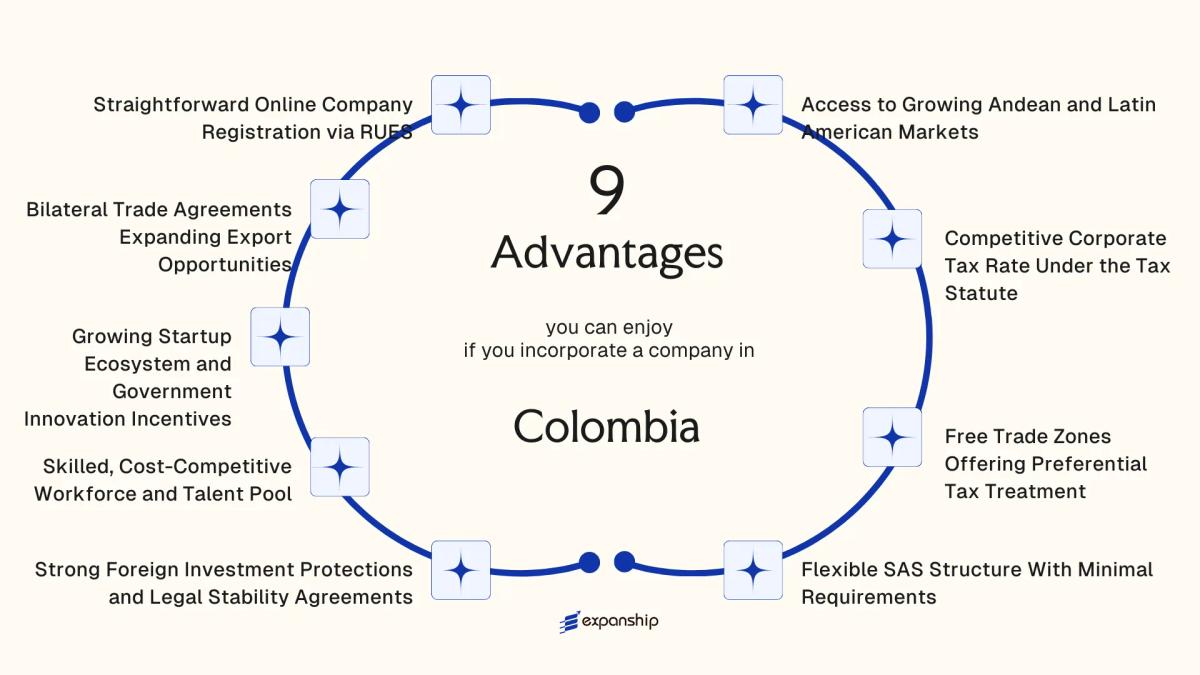
Access to Growing Andean and Latin American Markets
Colombia's geographic position at the northern tip of South America places your business within reach of over 650 million consumers across the region. Colombia access to Latin American markets is a structural advantage, not an incidental one.
Pacific Alliance Membership and What It Unlocks
Colombia is a founding member of the Pacific Alliance, a trade bloc established in 2011 alongside Chile, Mexico, and Peru. Tariffs on roughly 96% of goods traded among member states have been eliminated, which means a company incorporated in Colombia can export within the bloc at minimal cost compared to firms operating outside it.
Andean Community and CAN Framework
Through the Andean Community of Nations (CAN), your entity also benefits from preferential treatment across Bolivia, Ecuador, and Peru under Decision 598 and related integration instruments. This Andean market entry through Colombia gives firms access to regional supply chains and procurement markets that are otherwise subject to standard third-country tariff schedules.
Colombia's dual membership in both the Pacific Alliance and CAN creates overlapping preferential access that few regional alternatives can replicate.
A single Colombian entity can service multiple Andean and Pacific Alliance markets under preferential tariff conditions without requiring separate regional subsidiaries.
Competitive Corporate Tax Rate Under the Tax Statute
Colombia's general corporate income tax rate is set at 35% under the Estatuto Tributario, the country's primary tax statute. That figure sits above some regional peers, yet the statutory rate alone does not capture what foreign investors actually pay once sector-specific reductions and treaty provisions apply.
The practical advantage lies in how the tax code is structured around targeted reductions rather than blanket exemptions. Businesses operating in designated sectors, including the orange economy, software development, and certain agricultural activities, may access reduced rates or temporary income tax holidays under provisions codified in the Estatuto Tributario. These reductions are not informal incentives; they carry specific legal basis and defined eligibility criteria.
Colombia corporate tax rate advantages become more tangible when treaty benefits are factored in. Your firm may reduce withholding on dividends, royalties, and interest payments through Colombia's expanding network of Double Taxation Agreements, which currently covers key trade partners including Spain, Switzerland, Japan, and Chile.
Several structural features make the tax position of a Colombian entity more manageable than the headline rate suggests:
- Dividends distributed from already-taxed profits face a lower withholding rate than in comparable jurisdictions
- Tax losses can be carried forward indefinitely under current rules, reducing future taxable income without a statutory time limit
- The thin capitalisation rules follow defined thresholds, giving you predictability when structuring intercompany debt

Company Incorporation in Colombia
Register your Colombian entity with full compliance support under the Estatuto Tributario and RUES framework.
Free Trade Zones Offering Preferential Tax Treatment
Colombia free trade zones tax benefits stand out as one of the more structurally significant incentives available under national law. Companies operating within a Zona Franca (ZF) are subject to a reduced income tax rate of 20%, compared to the standard corporate rate of 35% that applies to ordinary entities under the Tax Statute (Estatuto Tributario). That 15-percentage-point gap directly reduces your firm's annual tax burden, which is particularly relevant for manufacturing, logistics, and export-oriented businesses with high taxable income.
Two principal ZF categories exist: multiuser zones, where multiple businesses share a designated area, and single enterprise zones (Zonas Francas Permanentes Especiales), which allow a qualifying project to obtain ZF status at its own site. The single enterprise route removes the geographic constraint of locating within a shared park, giving your business more operational flexibility.
| Entity Type | Applicable Tax Rate | Legal Basis |
|---|---|---|
| Standard Colombian company | 35% | Estatuto Tributario |
| Zona Franca user company | 20% | Law 1004 of 2005 |
| Single enterprise ZF (ZF Permanente Especial) | 20% | Decree 2147 of 2016 |
Eligibility is governed by Law 1004 of 2005 and regulated by Decree 2147 of 2016, with DIAN serving as the tax authority that enforces the applicable rate. Authorization is granted by the Ministry of Commerce, Industry and Tourism. Qualification criteria include minimum investment thresholds and job creation commitments, which vary depending on the ZF type and sector.
Flexible SAS Structure With Minimal Requirements
The Colombia SAS company structure advantages begin with a foundational legal framework designed to reduce administrative friction for founders. Enacted under Law 1258 of 2008, the Sociedad por Acciones Simplificada (SAS) can be formed by a single shareholder, whether an individual or a corporate entity, without requiring multiple partners. That single-founder allowance removes a structural barrier that exists in many civil law jurisdictions where minimum shareholder counts are mandatory.
Liability is limited to each shareholder's capital contribution, shielding your personal and overseas assets from the company's obligations. Unlike a traditional Sociedad Anónima, the SAS is not required to maintain a supervisory board (junta fiscalizadora) unless it meets specific size thresholds under the Código de Comercio.
Registered with the Cámara de Comercio, the entity's articles of incorporation can define custom governance rules, including weighted voting rights and flexible profit distribution terms. This contractual freedom lets you structure the firm around your operational model rather than adapting your model to a rigid statutory template.
Keep these points in mind:
- A single shareholder is permitted; no minimum capital requirement applies
- Liability remains capped at the subscribed capital contribution
- Supervisory board appointment is only mandatory above prescribed legal thresholds
- Articles must be registered with the Cámara de Comercio to confer legal existence
- SAS entities cannot list shares on a public stock exchange under Law 1258
A SAS can be legally constituted through a private document rather than a public notarial deed, which is the default requirement for most other Colombian corporate forms.
Strong Foreign Investment Protections and Legal Stability Agreements
Colombia foreign investment legal protections are anchored in constitutional and statutory frameworks that treat foreign capital on equal footing with domestic investment. Under Article 100 of the Political Constitution and Law 9 of 1991, foreign investors hold the same rights as Colombian nationals in most economic sectors. That parity removes a layer of regulatory risk that exists in jurisdictions where foreign ownership triggers separate, less favorable treatment.
Legal Stability Contracts Under Law 963
Law 963 of 2005 established legal stability contracts, known in Spanish as contratos de estabilidad jurídica. These agreements, signed between the Colombian state and qualifying investors, freeze specified tax and regulatory conditions for a defined contract period, historically ranging from three to twenty years. For a foreign firm making a substantial capital commitment, that contractual lock-in significantly reduces exposure to adverse legislative changes after the investment is made.
Eligibility requires a minimum investment threshold set by the government, and the contracts cover only the legal provisions explicitly listed in the agreement. That specificity is an advantage: the scope is defined and enforceable, not subject to broad administrative interpretation.
International Investment Treaty Network
Beyond domestic law, the country has signed bilateral investment treaties (BITs) with numerous partners, including the United States, United Kingdom, and several EU member states. These treaties typically guarantee protections against expropriation without compensation, and many include investor-state dispute resolution through international arbitration. Access to that neutral forum gives your business a credible enforcement mechanism outside the domestic court system.
Structure Your Investment in Colombia With Legal Certainty
Understand which statutory protections and stability mechanisms apply to your specific investment structure in Colombia.
Skilled, Cost-Competitive Workforce and Talent Pool
Colombia skilled workforce advantages for businesses are grounded in measurable labor market realities, not perception. The country produces over 300,000 university graduates annually across fields including engineering, finance, law, and technology, creating a sustained pipeline of formally trained professionals. Average professional salaries remain significantly below those in North America and Western Europe, which directly reduces your payroll burden without requiring a compromise on qualification levels.
- Minimum wage is set annually by the national government under the Labor Code (Código Sustantivo del Trabajo). For foreign firms, this provides predictable baseline labor costs that are straightforward to model into operational budgets.
- Cities such as Medellín and Bogotá have developed concentrated talent clusters in software development and business process outsourcing, meaning you can recruit sector-specific professionals without relocating them from remote areas.
- English proficiency has increased steadily among business graduates, particularly in major urban centers, which reduces communication friction for foreign-owned entities managing distributed teams.
- Under Law 789 of 2002, apprenticeship contracts (contratos de aprendizaje) allow companies to hire trainees at reduced cost during a defined learning period, offering a structured mechanism for talent development at lower initial expense.
Growing Startup Ecosystem and Government Innovation Incentives
Colombia startup ecosystem benefits for investors are increasingly backed by structured government programs, not just market momentum. iNNpulsa Colombia, the national agency under the Ministry of Commerce, Industry and Tourism, channels public funding into early-stage firms and innovation projects, giving foreign-backed startups access to non-dilutive capital that is rare to find through private markets alone.
Law 1834 of 2017, the "Orange Economy Law," created a dedicated legal and fiscal framework for creative and knowledge-based industries. Qualifying businesses can access tax exemptions on income generated from eligible activities for a defined period, which directly reduces the effective tax burden during the years when a startup is most capital-sensitive.
Under Law 1955 of 2019 and subsequent regulations, accredited companies conducting research, technological development, or innovation may deduct up to 100% of qualifying project costs from their taxable income, with an additional tax credit mechanism for certified investments.
A tech firm investing COP 500 million in a certified R&D project could apply a tax credit of up to 25% of that amount against its income tax liability, resulting in a COP 125 million direct reduction in taxes owed for that fiscal year, subject to MINCIENCIAS certification.
Certification through MINCIENCIAS (the Ministry of Science, Technology and Innovation) is the qualifying condition. Without it, the deduction and credit mechanisms do not apply.
Bilateral Trade Agreements Expanding Export Opportunities
Colombia bilateral trade agreements export advantages are a material consideration for any business planning to use the country as an export base. The firm has signed over a dozen trade agreements covering roughly 60 countries, including the United States, the European Union, Canada, and members of the Pacific Alliance.
Under the United States-Colombia Trade Promotion Agreement (TPA), which entered into force in 2012, the vast majority of U.S. tariffs on Colombian goods were eliminated immediately or phased out over short schedules. For a company manufacturing or processing goods locally, this translates directly into cost-competitive access to one of the world's largest consumer markets without the tariff burden that competitors operating outside the agreement face.
The Pacific Alliance framework, which connects Colombia, Mexico, Chile, and Peru, reduces tariff barriers across member states and coordinates customs procedures. This gives your business preferential terms across four connected economies under a single regional arrangement.
Key agreements currently in force include:
- U.S.-Colombia TPA (2012)
- EU-Colombia-Peru Trade Agreement (2013)
- Canada-Colombia FTA (2011)
- Pacific Alliance trade framework
Preferential tariff rates under these agreements apply only to goods that meet the specific rules of origin requirements defined in each treaty; your products must qualify under those criteria to benefit.
Straightforward Online Company Registration via RUES
The Colombia RUES online registration advantages begin with speed. RUES, the Registro Único Empresarial y Social, is the national business registry platform that consolidates company formation across all Chambers of Commerce (Cámaras de Comercio) in the country. Foreign founders can initiate and complete registration without being physically present, reducing the time from decision to operational status.
A Sociedad por Acciones Simplificada (SAS) can be incorporated through RUES with a single shareholder, no minimum capital requirement, and a private document rather than a public deed, unless real estate is contributed as capital. This means you avoid notarization costs that are mandatory in many civil law jurisdictions and are not required to engage a local notary for the standard formation process.
The digital process connects directly to the DIAN (Dirección de Impuestos y Aduanas Nacionales) for tax identification (NIT) assignment, which happens as part of the same registration flow. Rather than filing separately with multiple agencies, a single submission through the Cámara de Comercio triggers parallel processing across the tax authority.
Registration fees are calculated based on the entity's net assets or initial capital, and the tariff structure is published annually by each Chamber. This transparency allows you to calculate incorporation costs accurately before committing.
- No mandatory minimum paid-in capital for an SAS
- No public deed required for standard SAS formation
- NIT issued as part of the RUES process
- Registration valid nationally, not limited to one municipality
Why Colombia Stands Out Against Regional Competitors
Comparing Colombia against its closest regional peers reveals patterns that matter to foreign investors making a shortlist decision. Peru, Chile, and Mexico target similar investor profiles, offer FTAs with overlapping partners, and each operates a simplified incorporation vehicle. The comparison below focuses on structural parameters where the Colombian framework holds a neutral or measurably favourable position, drawing on factors covered in this blog rather than repeating their mechanics.
What the table makes visible at a glance is harder to convey in prose: the Sociedad por Acciones Simplificada (SAS), governed by Law 1258 of 2008, can be incorporated by a single foreign shareholder with no minimum capital requirement, while Chile's SpA and Peru's SAC each impose procedural or capital conditions that add friction. Free Trade Zone access under Decree 2147 of 2016 compounds that structural advantage by offering a 20% corporate tax rate to qualified operators, a rate that sits below the standard regimes in both Chile and Mexico.
| Parameter | Colombia | Chile | Peru | Mexico |
|---|---|---|---|---|
| Primary incorporation vehicle | SAS (Law 1258/2008) | SpA | SAC | SAS de CV |
| Minimum capital requirement | None | None | None | None |
| Single foreign shareholder permitted | Yes | Yes | Yes | Yes |
| Standard corporate tax rate | 35% | 27% | 29.5% | 30% |
| Free Trade Zone preferential rate | 20% (Decree 2147) | Not equivalent | Not equivalent | ~20% (IMMEX-linked) |
| Legal Stability Agreements available | Yes (Law 963/2005) | No direct equivalent | No direct equivalent | No direct equivalent |
| Online registration portal | RUES | Yes (Registro de Empresas) | Yes (SUNARP) | Yes (SE portal) |
| Bilateral Investment Treaties (approx.) | 12+ | 30+ | 30+ | 30+ |
Compliance Services for Companies in Colombia
Maintain good standing with Colombian regulatory requirements, including DIAN filings, Supersociedades reporting, and annual renewal obligations.
Conclusion
Incorporating a company in Colombia offers a convergence of structural and regulatory advantages that few markets in the region replicate at the same scale. The benefits of incorporating in Colombia are grounded in enforceable legal instruments: from Legal Stability Agreements under Law 963 of 2005 to the simplified SAS formation framework under Law 1258 of 2008, the architecture is designed to give foreign investors a predictable operating environment.
Two features stand out as particularly consequential. Free Trade Zones governed by Decree 2147 of 2016 reduce the corporate income tax burden to 20%, compared to the standard 35% rate, a differential that directly affects capital allocation decisions. The SAS structure, which requires no minimum capital and permits a single shareholder of any nationality, eliminates several formation barriers that persist in neighboring jurisdictions.
The right fit depends on your industry, ownership structure, and how your entity will generate revenue inside the country. A firm operating in manufacturing will extract different value from the FTZ regime than a services business focused on bilateral trade under the agreements with the United States or the European Union.
For any business owner conducting a serious jurisdiction analysis, the combination of accessible entity formation, treaty-backed investment protection, and a qualified talent pool at competitive labor costs creates a case that warrants direct evaluation against your specific operational requirements. The next step is translating that case into a correctly structured, registered entity.
Start Your Colombian Company With Expanship Today
Incorporating in Colombia with Expanship means your entity formation, compliance obligations, and post-registration filings are handled with direct knowledge of how Colombian authorities operate. From structuring a Sociedad por Acciones Simplificada under Law 1258 of 2008 to fulfilling annual reporting requirements with the Superintendencia de Sociedades, Expanship manages the regulatory touchpoints that foreign business owners typically encounter after registering through the RUES platform.
Expanship's Colombia company formation services cover the full scope of what a foreign founder needs to become operational and remain compliant:
- Preparation and legalization of incorporation documents, including the founding statutes and public deed where required
- Registered agent and registered office provision to satisfy the local address requirement under Colombian commercial law
- Filing coordination and liaison with the Cámara de Comercio and DIAN for tax identification registration
- Ongoing compliance management, including annual renewal filings and corporate secretarial support
- Banking introduction assistance to support the opening of a peso-denominated or foreign currency account with a local financial institution
These services are designed to reduce the administrative burden on foreign principals who are managing entity setup from outside the country, where coordinating with multiple Colombian authorities simultaneously would otherwise require local representation.
Reach out to Expanship Colombia to discuss your specific incorporation requirements.
Frequently Asked Questions (FAQ)
The general corporate income tax rate under Colombia's Tax Statute (Estatuto Tributario) is 35%. This rate applies to resident companies on their worldwide income. Certain sectors or special regimes, such as companies operating within a Free Trade Zone, may qualify for a reduced rate of 20% instead.
Companies that obtain Free Trade Zone (Zona Franca) status under Law 1004 of 2005 are subject to a preferential income tax rate of 20% rather than the standard 35%. Qualification requires meeting specific criteria related to investment thresholds, job creation, and the nature of the business activity. Not every company qualifies automatically; the application is reviewed and approved by the Colombian Ministry of Commerce, Industry and Tourism.
Yes, foreign investors can enter into Legal Stability Agreements (Contratos de Estabilidad Jurídica) with the Colombian state, which lock in the specific legal conditions that were in place at the time of investment. These agreements are governed by Law 963 of 2005 and protect the investor if a subsequent legal reform would otherwise alter those conditions unfavorably. A fee is charged for entering into such a contract, generally calculated as a percentage of the investment value.
Registration through the Registro Único Empresarial y Social (RUES) can often be completed within a few business days once all documentation is in order. The timeline depends on the completeness of the submitted documents and the workload of the relevant Chamber of Commerce, which processes filings through the RUES system. Pre-registration steps, such as obtaining a tax identification number (NIT) and drafting the SAS incorporation document, should be factored into the overall timeline.
A company incorporated in Colombia can access preferential tariff treatment under several trade agreements, including the Free Trade Agreement with the United States (in force since 2012), the EU-Colombia-Peru Trade Agreement, and agreements with countries such as Canada, South Korea, and members of the Pacific Alliance. The specific benefits available depend on the goods or services being traded and whether applicable rules of origin are met. These agreements are administered and monitored by the Ministry of Commerce, Industry and Tourism.
Yes, iNNpulsa Colombia, a government agency under the Ministry of Commerce, Industry and Tourism, administers programs that provide grants, co-financing, and support for innovation-driven and high-growth businesses. Additionally, Law 2069 of 2020 established a broader entrepreneurship framework that includes tax benefits and simplified procedures for emerging companies. Eligibility criteria vary by program, and applicants must typically demonstrate an innovation component or growth potential.
Legal Disclaimer
The information provided in this article is for general informational purposes only and does not constitute legal, tax, or professional advice. While we strive to ensure the accuracy and timeliness of the content, laws and regulations are subject to change, and the application of laws can vary widely based on specific facts and circumstances.
Readers should not act upon this information without seeking professional counsel tailored to their individual situation. Expanship and its authors disclaim any liability for actions taken or not taken based on the content of this article.
For specific advice regarding your business setup, compliance requirements, or any legal matters, please consult with qualified legal and tax professionals in the relevant jurisdiction.