

Key Takeaways
- Foreign investors must structure their entity — whether a WFOE, Sino-foreign joint venture, or domestic LLC — in compliance with the Company Law of the People's Republic of China (amended 2023), with registration administered through the State Administration for Market Regulation (SAMR).
- Businesses operating in sectors covered by the Foreign Investment Negative List are subject to additional requirements beyond the standard registration framework, which can affect permissible ownership structures and capital arrangements.
- Beneficial ownership disclosure carries a mandatory compliance obligation under China's Anti-Money Laundering Law, requiring entities to identify and report ultimate beneficial owners to the relevant authorities.
- All incorporation applications must satisfy structural, financial, personnel, and documentation requirements simultaneously, as incomplete submissions result in rejection by SAMR rather than a staged review process.
Entity formation in China is governed primarily by the Company Law, most recently amended in 2023, with registration administered through the State Administration for Market Regulation (SAMR). Incorporation requirements in China span structural, financial, personnel, and documentation categories, each of which carries specific obligations depending on the entity type and ownership structure.
Failure to satisfy these obligations results in rejection of the registration application or, where an entity is already operating, potential suspension of business licenses and regulatory penalties.
Requirements can differ meaningfully based on whether the entity is a Wholly Foreign-Owned Enterprise (WFOE), a Sino-foreign joint venture, or a domestic limited liability company. Sector-specific regulations, particularly in industries subject to the Foreign Investment Negative List, may impose additional conditions beyond the standard China company registration requirements.
This article is primarily relevant to foreign investors and multinational businesses setting up a company in China for the first time, or restructuring an existing cross-border operation.
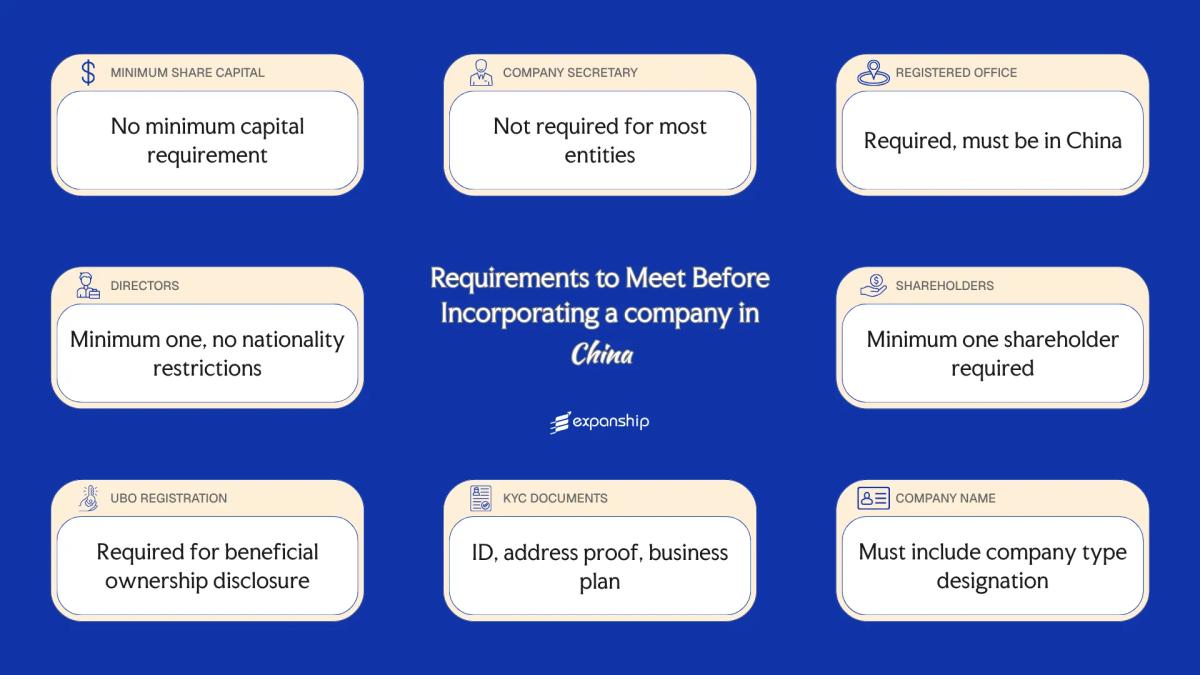
Minimum Share Capital Requirements in China

Since 2014, China minimum share capital requirements have been largely liberalized under amendments to the Company Law, removing the previously prescribed statutory minimums for most company types. The State Administration for Market Regulation (SAMR) handles company registration and enforces capital disclosure at incorporation.
Registered capital must be stated in the articles of association and filed with SAMR. Under the current subscription-based system, shareholders commit to capital contributions within a self-determined timeframe rather than depositing funds upfront, though the 2023 Company Law amendments introduced a statutory outer limit for contribution timelines.
| Parameter | Detail |
|---|---|
| Minimum Authorized Share Capital | No statutory minimum for most entity types |
| Maximum Authorized Share Capital | No statutory maximum |
| Minimum Paid-Up Capital | No statutory minimum |
| Paid-Up Requirement at Incorporation | Not required at time of registration under the subscription system |
| Accepted Currency | Renminbi (RMB/CNY); foreign currency permitted for foreign-invested entities |
| Accepted Forms of Contribution | Monetary funds, physical assets, intellectual property, land use rights |
| Timeframe to Deposit Capital | Must be completed within 5 years of incorporation under the 2023 Company Law |
No statutory minimum does not mean registered capital is irrelevant. SAMR records your committed capital figure publicly, and courts, creditors, and counterparties treat it as a binding liability until fully paid in.
Company Secretary Requirements in China
Under Chinese corporate law, there is no statutory requirement for a dedicated "company secretary" role in the same form as common law jurisdictions. Instead, company secretary requirements China-adjacent functions are distributed among specific internal officers, most notably the legal representative, whose appointment is mandatory for all registered entities under the Company Law of the People's Republic of China.
The legal representative acts as the primary authorized signatory and bears personal liability for certain corporate obligations. China corporate secretary obligations, in practice, fall to the board of supervisors or a designated supervisor in smaller firms, who monitors financial conduct and officer compliance on behalf of shareholders.
Qualification criteria for those serving in these governance roles include:
- The legal representative must be a natural person; a corporate entity cannot hold this position.
- No Chinese citizenship or residency is strictly required, though foreign nationals face additional registration steps with the State Administration for Market Regulation.
- Supervisors must not simultaneously serve as directors or senior managers within the same company.
- Individuals with criminal convictions related to economic crimes are disqualified from serving as legal representative.
- State-owned enterprises are subject to additional qualification rules under separate regulations administered by the State-owned Assets Supervision and Administration Commission.

Incorporate a Company in China
Set up your legal entity in China with guidance on corporate structure, officer appointments, and regulatory registration across all required authorities.
Registered Office Requirements in China
Registered office requirements in China mandate that every company maintain a physical address within the jurisdiction where it is registered, as stipulated under the Company Law of the People's Republic of China. Failure to maintain a compliant business address compliance China rules require can result in administrative penalties, suspension of business licenses, or removal from the enterprise registry maintained by the State Administration for Market Regulation (SAMR).
- A physical address is required; virtual offices are generally not accepted as a registered address by SAMR.
- The address must be located within the same administrative region where the entity is registered.
- A valid lease agreement or property ownership document must be submitted to support the registered address.
- The registered address is publicly disclosed on the National Enterprise Credit Information Publicity System.
- Any change of address requires formal filing with the local SAMR office and an update to the business license.
- The address must be a specific, verifiable location; P.O. boxes are not permitted.
Director Requirements in China

Upon appointment, directors of a Chinese company assume statutory duties under the Company Law of the People's Republic of China, including fiduciary obligations to act in the interests of the company and personal liability for losses caused by wilful misconduct or gross negligence. These director requirements in China apply to both domestic and foreign-invested entities registered with the State Administration for Market Regulation (SAMR).
| Parameter | Detail |
|---|---|
| Minimum Number of Directors | A limited liability company (LLC) requires a minimum of 1 director; a joint-stock company requires a board of at least 3 directors. |
| Maximum Number of Directors | LLCs may have up to 13 directors on the board; joint-stock companies have no rigidly fixed statutory upper limit but board size is governed by the company's articles of association. |
| Local/Resident Director Required | No statutory requirement for a resident director exists under the Company Law. |
| Nationality Restrictions | Foreign nationals may serve as directors; no nationality restrictions are imposed under the Company Law. |
| Minimum Age Requirement | Directors must be at least 18 years of age. |
| Corporate Directors Permitted | Corporate directors are not permitted; only natural persons may serve as directors. |
| Director Must Be a Shareholder | No requirement for directors to hold shares in the company. |
| Publicly Listed on Registry | Director information is filed with SAMR and is publicly accessible through the National Enterprise Credit Information Publicity System. |
| Disqualification Conditions | Individuals with criminal convictions for corruption, bribery, or property-related offences, as well as former directors of bankrupt companies found personally liable, are disqualified under the Company Law. |
Unlike many common law jurisdictions, China does not require any director to be a local resident, meaning a company can be validly incorporated and fully compliant with a board composed entirely of foreign nationals residing abroad.
Shareholder Requirements in China

Shareholder requirements in China vary by entity type under the Company Law of the People's Republic of China. A Limited Liability Company (LLC) permits between one and fifty shareholders, while a sole shareholder structure is permitted, forming what is classified as a wholly state-owned or single-member LLC.
Nationality and Residency Restrictions
No mandatory residency requirement applies to shareholders of a Foreign-Invested Enterprise. Foreign nationals and overseas entities may hold equity, though sector-specific restrictions under the Negative List administered by the National Development and Reform Commission can cap or prohibit foreign ownership in designated industries.
Corporate Shareholders
Corporate entities are permitted to act as shareholders. Both domestic and foreign companies may hold equity stakes, subject to verification of their legal standing and compliance with applicable foreign investment regulations.
Shareholder Liability
Liability is generally limited to each shareholder's subscribed capital contribution. Under specific circumstances, such as capital withdrawal or abuse of the corporate form, courts may pierce the corporate veil and extend personal liability.
Register of Shareholders
An internal register of shareholders must be maintained by the company. Shareholder information is also filed with the State Administration for Market Regulation upon registration and following any subsequent equity transfers.
Guidance on Shareholder Structuring for Your China Entity
Get structured advice on meeting shareholder requirements when setting up a company in China, including foreign ownership considerations and registration obligations.
UBO / Beneficial Ownership Disclosure Requirements in China
Beneficial ownership disclosure China requirements are governed primarily by the Anti-Money Laundering Law and supplementary regulations issued by the People's Bank of China (PBOC), which define a beneficial owner as any individual holding 25% or more of equity or exercising effective control over an entity.
- Identify all natural persons meeting the 25% ownership threshold or those exercising ultimate control over the company.
- Submit beneficial ownership information to the financial institution maintaining the entity's account, as part of customer due diligence procedures under PBOC rules.
- Report any changes to beneficial ownership to the relevant financial institution within a reasonable period following the change.
- Retain supporting documentation that substantiates the UBO determination for inspection if requested by regulators.
| Parameter | Detail |
|---|---|
| Ownership Threshold for UBO Status | 25% equity interest or effective control |
| Filing Authority | People's Bank of China (PBOC) via financial institutions |
| Disclosure Deadline at Incorporation | No statutory deadline at incorporation; disclosure occurs at account opening |
| Publicly Accessible Register | No |
| Penalties for Non-Disclosure | Administrative penalties under the Anti-Money Laundering Law; amounts vary by violation severity |
| Ongoing Update Obligation | Yes; updates required upon material changes to ownership or control |
KYC / Document Requirements in China
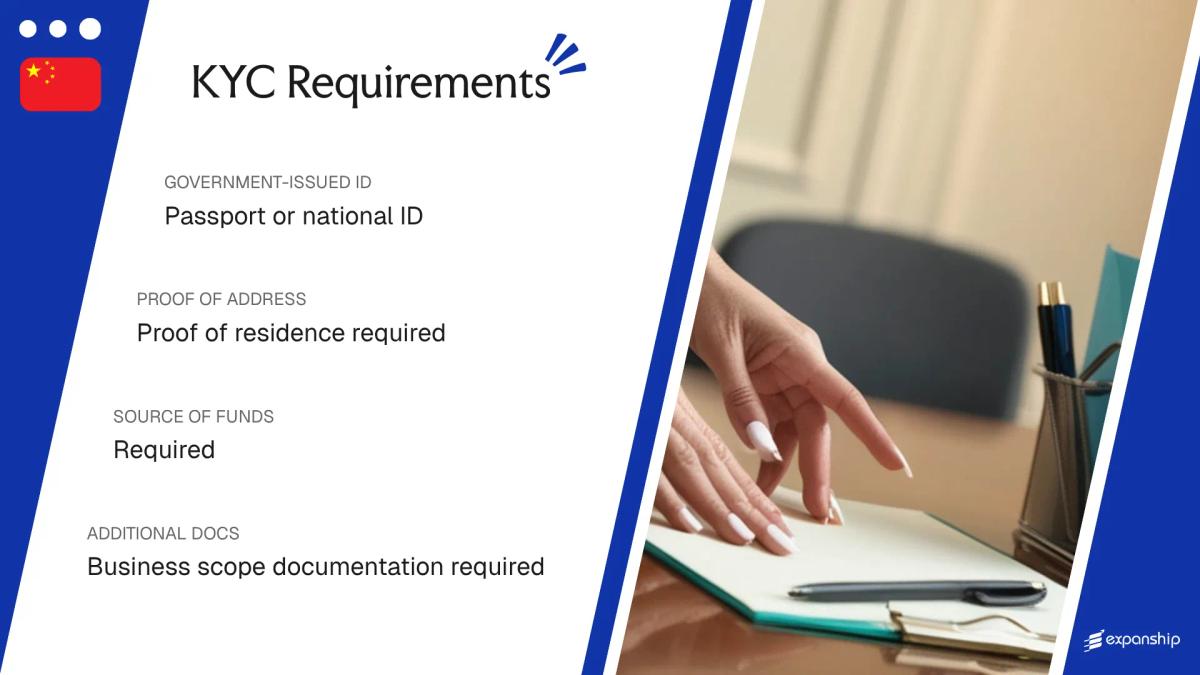
Satisfying KYC requirements during China company registration is governed primarily by the Anti-Money Laundering Law of the People's Republic of China, enforced by the People's Bank of China. All parties with ownership or control over the entity must be identified and verified before the company can be formally registered with the State Administration for Market Regulation.
Individual / Personal Documents
- Valid passport or national identity card for each individual director, shareholder, or beneficial owner
- Proof of residential address dated within three months, such as a utility bill or bank statement
- Completed personal information declaration form as required by the registration authority
- Recent passport-sized photographs may be required depending on the local Administration for Market Regulation office
Corporate Documents
- Certificate of incorporation of the parent or shareholder entity, certified as a true copy
- Articles of association or equivalent constitutional document of the corporate shareholder
- Register of directors of the corporate entity, confirming current appointed officers
- Proof of the corporate entity's registered address, such as an official utility bill or government-issued document
Source of Funds Documentation
- Bank statements covering a minimum of three to six months prior to incorporation
- Audited financial statements of the investing entity where available
- Capital verification documentation may be required for certain company types
Notarisation and Apostille Requirements
- Foreign-issued documents must be notarised in the country of origin before submission
- China is not a party to the Hague Apostille Convention, so documents require full legalisation through the Chinese embassy or consulate
- Official translation into Mandarin Chinese by a certified translator is mandatory for all foreign-language documents
The most common cause of incorporation delay is submitting foreign corporate documents that have not been consularly legalised through the appropriate Chinese diplomatic mission.
Company Name Requirements in China
China company name requirements are assessed by the State Administration for Market Regulation (SAMR) or its local counterparts before registration is confirmed. Each proposed name is checked against an existing database of registered entities to confirm it is not identical or confusingly similar to one already on record.
Names must be in Chinese characters; purely foreign-language names are not accepted for registration purposes. A legally mandated suffix indicating the entity type, such as 有限责任公司 (Limited Liability Company), must be included.
Certain words require government pre-approval before they can appear in a business name, including terms that imply national or governmental affiliation. Words that are politically sensitive, ethnically discriminatory, or contrary to public order are prohibited outright.
Name reservation is available through SAMR's online business registration system prior to formal incorporation. A reserved name is generally held for a fixed period, after which it lapses if the registration process has not been completed.
Compliance Services for Companies in China
Stay aligned with SAMR regulations and ongoing statutory obligations for your Chinese entity.
Conclusion
China company incorporation requirements span multiple regulatory layers, governed primarily by the Company Law of the People's Republic of China and administered through the State Administration for Market Regulation. Registered capital structures, director residency considerations, and UBO disclosure obligations under the Anti-Money Laundering Law each carry specific compliance implications for foreign investors. Once these requirements are understood, the practical work shifts to document preparation, entity structuring, and coordinating with local authorities to complete registration within the prescribed timelines.
Expanship's Corporate Formation Services in China
Expanship's China corporate formation services are structured around the specific requirements that govern entity establishment in the country, from SAMR registration and capital verification procedures to the restrictions that apply to foreign-owned structures. Your firm's administrative burden during setup is real, and Expanship's role is to manage the procedural workload so your internal team can stay focused on operations.
Beyond initial registration, Expanship supports the full scope of your China company registration services needs:
- We prepare and file all incorporation documents with the relevant Chinese authorities, including SAMR submissions.
- A registered office address and local agent are provided to satisfy statutory presence requirements.
- We liaise directly with government bodies and regulatory agencies throughout the filing process.
- Post-incorporation obligations, including annual inspections and ongoing filings, are managed on your behalf.
- Banking introduction support is available to help your entity establish a corporate account in China.
- Tax registration and coordination with local tax bureaus are handled as part of the formation process.
To discuss your requirements, contact Expanship China.
Frequently Asked Questions (FAQ)
Under the 2023 amendments to the Company Law, shareholders who fail to contribute registered capital on schedule can face liability for losses suffered by the company or its creditors as a result of the shortfall. The revised law also introduced a statutory maximum contribution period of five years for newly incorporated entities, tightening the previously open-ended flexibility. Persistent non-compliance can result in SAMR taking enforcement action, including compulsory reduction of the registered capital to the amount actually paid in.
A foreign national can serve as both sole director and legal representative of a wholly foreign-owned enterprise (WFOE) or a joint venture, provided they hold a valid passport and meet SAMR's identity verification requirements. There is no nationality restriction on this role, but the legal representative must be an individual, not a corporate entity. That person bears direct personal liability for certain compliance obligations under Chinese law, which is a meaningful distinction from the director role in many other jurisdictions.
Chinese company law does not impose a mandatory company secretary requirement equivalent to what exists in Hong Kong or Singapore. Mainland Chinese entities, including WFOEs and joint ventures, are instead required to designate a legal representative who holds statutory signing authority and regulatory accountability. For larger stock companies, a board secretary role exists under the Company Law, but this is a governance position distinct from the compliance-focused company secretary function familiar in common law jurisdictions.
Beneficial ownership disclosure in China operates across two distinct channels. SAMR requires disclosure of ultimate beneficial owners through the enterprise information registration system, particularly following the People's Bank of China's anti-money laundering framework, while financial institutions conduct their own parallel KYC verification under separate AML obligations. Unlike jurisdictions with a single centralised UBO register, China's disclosure obligations are fragmented across regulatory bodies depending on the nature of the business activity and the banking relationships involved.
A valid registered address is a continuous legal requirement in China, not just a condition at the point of incorporation. If SAMR discovers that the registered address is no longer valid, the company can be flagged on the National Enterprise Credit Information Publicity System as abnormal, which restricts its ability to conduct government filings, bid on contracts, and open or maintain bank accounts. Rectifying an abnormal status requires submitting proof of a valid new address and formally updating the registration with the local SAMR bureau.
The beneficial ownership disclosure obligation applies to both domestic companies and foreign-invested enterprises, but the practical scrutiny tends to be more intensive for FIEs given the cross-border ownership structures involved. Under the People's Bank of China's anti-money laundering regulations, financial institutions are required to identify and verify the natural persons who ultimately own or control any legal entity customer, regardless of whether it is domestic or foreign-invested. For complex offshore holding structures, the chain of ownership must be traced to an individual, and nominee arrangements do not exempt a company from this obligation.
Legal Disclaimer
The information provided in this article is for general informational purposes only and does not constitute legal, tax, or professional advice. While we strive to ensure the accuracy and timeliness of the content, laws and regulations are subject to change, and the application of laws can vary widely based on specific facts and circumstances.
Readers should not act upon this information without seeking professional counsel tailored to their individual situation. Expanship and its authors disclaim any liability for actions taken or not taken based on the content of this article.
For specific advice regarding your business setup, compliance requirements, or any legal matters, please consult with qualified legal and tax professionals in the relevant jurisdiction.