

Key Takeaways
- Foreign investors entering restricted sectors must navigate the Negative List framework, which imposes hard caps on foreign equity ownership and, in certain industries, mandates a Chinese majority shareholder regardless of commercial preference.
- Since the Foreign Investment Law came into force in January 2020, foreign enterprises remain subject to overlapping administrative layers — including SAMR registration requirements — that extend incorporation timelines well beyond those typical in comparable jurisdictions.
- Profit repatriation from China requires compliance with State Administration of Foreign Exchange (SAFE) currency controls, meaning foreign investors cannot freely transfer earnings abroad without clearing mandatory documentation and approval thresholds.
- The legal representative of a foreign-invested enterprise bears personal liability for the company's regulatory compliance failures, creating a structural exposure that many foreign nationals are unaware of when appointing local nominees to that role.
Foreign investment in China operates within one of the world's most heavily regulated corporate environments, shaped by multiple overlapping legislative and administrative frameworks. The disadvantages of incorporating in China span regulatory, financial, and operational dimensions — the specific risks of setting up a business in China that this article examines.
Not every disadvantage applies equally across all structures. The drawbacks your firm encounters will differ depending on whether you are establishing a Wholly Foreign-Owned Enterprise, a Joint Venture, or a Representative Office, and the industry sector you operate in.
The primary legislation governing foreign corporate entry is the Foreign Investment Law, which came into force in January 2020. This article is most relevant to foreign investors entering China for the first time, particularly those operating in restricted or sensitive industries.
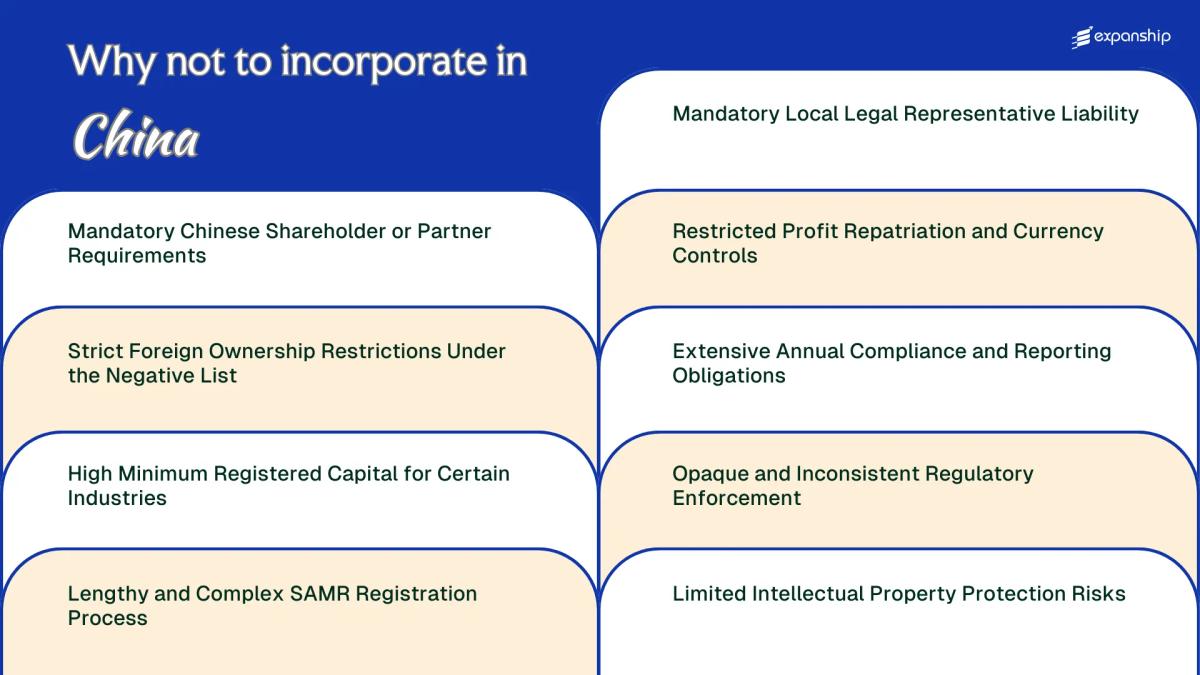
Mandatory Chinese Shareholder or Partner Requirements
Some restricted sectors under China's Negative List require a local Chinese partner to hold a minimum equity stake, effectively making a wholly foreign-owned enterprise (WFOE) structurally unavailable. Meeting China mandatory Chinese shareholder requirements forces your business into a joint venture arrangement where governance, profit allocation, and strategic decisions are shared with a party whose interests may not align with yours.
Structural Loss of Control in Joint Venture Arrangements
Under the Negative List administered by the Ministry of Commerce (MOFCOM) and the National Development and Reform Commission (NDRC), certain industries mandate that Chinese partners hold 51% or more of equity. A foreign investor in such a sector cannot unilaterally decide on reinvestment, staffing, or IP licensing without the Chinese partner's agreement.
Disputes between joint venture partners are resolved under Chinese law, which frequently disadvantages foreign investors who lack local legal standing, established relationships with regulators, or the ability to exit the structure without significant financial penalty.
Dependency Risk and Partner Vetting Failures
Selecting the wrong local partner creates operational exposure that compounds over time. A partner with conflicting commercial interests or undisclosed regulatory liabilities can block resolutions and delay filings with the State Administration for Market Regulation (SAMR).
Once equity is locked in under a joint venture contract, restructuring requires mutual consent, making it procedurally difficult and costly to remove an uncooperative partner.
If your Chinese joint venture partner holds a controlling stake, they retain veto power over core business decisions, and exiting the structure without their cooperation can result in protracted legal disputes under Chinese law.
Strict Foreign Ownership Restrictions Under the Negative List
China foreign ownership restrictions under the negative list directly cap how much equity a foreign investor can hold in specific sectors. Governed by the Special Administrative Measures (Market Access Negative List) issued jointly by the National Development and Reform Commission (NDRC) and the Ministry of Commerce (MOFCOM), the list prohibits or restricts foreign entry across dozens of industries.
Restricted sectors include telecommunications, media, education, and financial services. In many cases, foreign equity is capped at 25%, 49%, or 51%, meaning your business cannot hold a controlling stake.
For a foreign investor, these caps create concrete operational problems:
- Minority equity positions force reliance on a Chinese partner for board decisions, limiting strategic control over the business
- Sector-specific caps can prevent your firm from consolidating financial statements with the Chinese entity under home-country accounting standards
- Restricted ownership structures often require complex contractual workarounds, such as Variable Interest Entity (VIE) arrangements, which carry their own legal uncertainty under Chinese law
The Negative List is reviewed periodically, but many sensitive sectors have seen only incremental liberalization.

Company Incorporation in China
Understand your options for establishing a foreign-owned entity in China, including permitted structures and sector-specific requirements.
High Minimum Registered Capital for Certain Industries
China minimum registered capital requirements vary by industry, and in sectors where thresholds are set by law, the figures are high enough to constitute a genuine entry barrier for foreign firms.
| Industry | Minimum Registered Capital | Implication for Foreign Investor |
|---|---|---|
| Banking (foreign-funded) | CNY 1 billion | Prohibitive for all but the largest financial institutions |
| Securities companies | CNY 500 million | Locks out mid-size foreign asset managers |
| Insurance companies | CNY 200 million | Requires substantial upfront commitment before operations begin |
| Futures trading | CNY 100 million | Capital tied up with no guarantee of regulatory approval |
| Private equity funds (certain types) | CNY 30 million+ | Exceeds what many emerging-market fund managers can deploy |
These thresholds are set under sector-specific regulations, including rules administered by the National Financial Regulatory Administration and the China Securities Regulatory Commission, not by the general company registration framework under the Company Law. That distinction matters because the capital must be fully committed and verifiable before your entity can receive the relevant operating license.
For most general industries, registered capital requirements were removed or made flexible following 2014 Company Law amendments. The high capital rules survive specifically in regulated sectors, targeting the businesses where foreign participation is most commercially significant.
Capital subscribed in these sectors cannot be freely redeployed once contributed. Your firm's liquidity is constrained from the date of registration, before a single transaction occurs.
Lengthy and Complex SAMR Registration Process
The China SAMR registration process challenges foreign businesses in ways that go beyond paperwork. The State Administration for Market Regulation (SAMR) oversees the formal incorporation of all business entities, and the process involves sequential approvals, document authentication, and coordination across multiple agencies before a business license is even issued.
Pre-approval requirements add significant time before registration formally begins. Documents originating abroad must be notarized in the source country and then authenticated through apostille or Chinese consular legalization, depending on treaty status.
Translated documents must meet specific formatting standards accepted by local SAMR offices, which can vary by municipality. A rejection at any stage restarts that phase, not the entire process, but the cumulative delays can push timelines well beyond initial estimates.
Foreign-invested enterprises also require coordination with the Ministry of Commerce (MOFCOM) filing system for record purposes, adding another procedural layer that domestic incorporations do not face.
- SAMR registration requires pre-legalized and translated foreign documents before submission
- Municipal SAMR offices may apply document standards inconsistently across regions
- MOFCOM filing is a separate obligation for foreign-invested entities, parallel to SAMR registration
- Rejection of any document set requires resubmission of that stage with corrected materials
- Processing timelines are not legally guaranteed and can extend without formal recourse
You can review SAMR's official guidance on entity registration requirements directly on their portal.
China's online registration system, while available domestically, remains largely inaccessible to foreign nationals without a Chinese national ID, meaning most foreign incorporators must engage a local agent and cannot self-file.
Mandatory Local Legal Representative Liability
Every incorporated entity in China must designate a legal representative, and China legal representative liability risks are among the most serious structural exposures a foreign investor can face under the current framework.
Who Bears the Liability
Under the Company Law of the People's Republic of China, the legal representative (法定代表人) acts as the official agent of the entity and is personally accountable for its conduct. This individual's name appears on the business license issued by the State Administration for Market Regulation (SAMR), making them directly identifiable to courts, tax authorities, and regulators.
Personal consequences are concrete. A legal representative whose company defaults on tax obligations or court judgments can be subject to exit bans under enforcement measures administered by the courts and State Taxation Administration, preventing them from leaving the country.
Practical Exposure for Foreign Business Owners
Foreign companies often appoint a local nominee to serve in this role, which creates a separate dependency risk. If that individual withdraws cooperation or disputes arise, replacing a legal representative requires board resolutions, notarized documents, and a formal SAMR registration amendment, a process that can stall operations for weeks.
The exposure is not limited to active misconduct. A legal representative can face personal liability for regulatory violations even when they had no operational involvement in the underlying decision.
Support for Managing Legal Representative Obligations in China
Understand the structural risks tied to the legal representative requirement and how to approach appointment decisions for your China entity.
Restricted Profit Repatriation and Currency Controls
China profit repatriation currency controls create significant friction for foreign investors seeking to move earnings out of the country. The State Administration of Foreign Exchange (SAFE) governs all cross-border capital flows, and its requirements impose both procedural delays and financial costs on your business.
- Dividends can only be repatriated after completing an annual audit and tax clearance, meaning your capital remains locked in-country until all Chinese statutory filings are verified.
- SAFE regulations require foreign exchange conversion of RMB profits before transfer abroad, exposing your business to exchange rate risk during mandatory processing periods.
- Withholding tax on dividends paid to foreign parent companies is levied at 10% under China's standard rate, directly reducing the net value of repatriated earnings.
- Transfer pricing documentation requirements under the Enterprise Income Tax Law add compliance costs each time intercompany payments cross the border.
- Payments categorized as royalties or service fees face additional SAFE scrutiny, with approvals sometimes withheld pending justification of commercial substance.
Extensive Annual Compliance and Reporting Obligations
China annual compliance obligations for foreign companies extend well beyond a single annual filing. Foreign-invested enterprises (FIEs) must complete annual reporting through the National Enterprise Credit Information Publicity System (NECIPS), submit audited financial statements prepared under Chinese Accounting Standards (CAS), and file separate reports with the State Administration of Foreign Exchange (SAFE) if cross-border transactions are involved.
The annual audit requirement alone demands engagement of a locally licensed CPA firm. That cost, combined with mandatory filings to the State Taxation Administration and social insurance authorities, creates recurring overhead that scales with operational scope.
Failures or delays in NECIPS reporting can result in placement on the "abnormal operations" list, which restricts your firm's ability to execute contracts, open bank accounts, or pass future regulatory approvals.
- Annual CAS-compliant audit by a China-licensed auditor
- NECIPS annual report submission deadline: June 30 each year
- SAFE foreign exchange reporting for cross-border payments
- Tax reconciliation filings with the State Taxation Administration
A foreign-owned WFOE with one Beijing office and no Chinese revenue could still face estimated annual compliance costs of USD 8,000–15,000 covering mandatory audit fees, tax filings, and SAFE reporting, before any operational expenses are counted.
Opaque and Inconsistent Regulatory Enforcement
China regulatory enforcement inconsistency risks are a structural problem, not an occasional friction. Regulations issued at the central government level are frequently interpreted and applied differently by provincial, municipal, and district-level authorities, leaving your business exposed to outcomes that cannot be reliably predicted from the text of the law alone.
The State Administration for Market Regulation (SAMR) and sector-specific bodies such as the National Financial Regulatory Administration (NFRA) each maintain their own enforcement priorities. Local bureaus often apply informal standards that diverge from national policy, and those informal standards are rarely published.
For foreign-invested enterprises, this creates a specific operational risk: compliance in one city does not guarantee compliant status in another. Penalties, license suspensions, and operational restrictions can be imposed with limited advance notice or transparent justification.
- Enforcement intensity frequently shifts in response to political campaigns rather than legal thresholds
- Foreign firms are sometimes held to stricter interpretations than domestic competitors in the same sector
- Rectification orders can require operational changes within compressed timeframes
Regulatory treatment of your business can vary significantly based on the local government's relationship with your industry at a given point in time, meaning written legal compliance does not guarantee operational continuity.
Limited Intellectual Property Protection Risks
China intellectual property protection risks remain a well-documented concern for foreign businesses, despite legislative reforms introduced under the 2019 revisions to the Patent Law and Trademark Law. Enforcement authority is split across multiple bodies, including the China National Intellectual Property Administration (CNIPA) and the courts, creating inconsistent outcomes across provinces.
Patent and trademark registration does not guarantee protection in practice. Local courts have historically shown reluctance to award damages that reflect actual commercial loss, reducing the deterrent effect of litigation for foreign rights holders.
China operates a first-to-file trademark system. A foreign firm that delays registration risks having its brand pre-emptively filed by a local party, forcing costly cancellation proceedings or rebrand requirements.
IP theft risks doing business in China are compounded by mandatory technology transfer requirements in certain regulated sectors, where joint venture structures expose proprietary processes to local partners with fewer contractual constraints than equivalent arrangements in other jurisdictions.
Strategies to Overcome These Barriers
Overcoming China incorporation barriers requires structural decisions made before registration, not adjustments applied after problems arise.
- Review the negative list published by the National Development and Reform Commission to confirm your intended business scope against current foreign ownership restrictions.
- Structure equity arrangements to meet any mandatory joint venture thresholds applicable to your industry under the Foreign Investment Law 2019.
- Register your intended business scope precisely with the State Administration for Market Regulation, as scope determines capital requirements and licensing obligations.
- Apply for a State Administration of Foreign Exchange account to establish a compliant framework for cross-border profit repatriation from the outset.
- File all required annual inspection reports and financial disclosures within the deadlines set by SAMR to avoid penalties tied to ongoing compliance obligations.
- Register trademarks and patents with the China National Intellectual Property Administration before commencing commercial operations.
These steps address procedural and structural requirements embedded across multiple regulatory bodies and statutory instruments. The foreign investment framework in this jurisdiction continues to evolve, and measures that are sufficient today may require revision as updated negative lists or SAFE regulations take effect.
China Still a Viable Market for Expansion
Despite the disadvantages covered throughout this blog, China market expansion viability despite risks remains a serious consideration for foreign businesses. The world's second-largest economy, with a consumer base exceeding 1.4 billion people, continues to attract foreign direct investment across manufacturing, technology, and consumer goods sectors.
| Pro | Con |
|---|---|
| Access to a domestic consumer market of over 1.4 billion people | Foreign ownership is restricted or prohibited in sectors listed under the Negative List |
| Established manufacturing and supply chain infrastructure | Profit repatriation is subject to SAFE currency controls and documentation requirements |
| Growing middle class driving demand across multiple sectors | Inconsistent regulatory enforcement creates unpredictable compliance exposure |
| Special Economic Zones offer preferential tax treatment in designated areas | Intellectual property protection remains unreliable despite formal legal frameworks |
| Foreign-invested enterprises can operate as wholly-owned entities in permitted sectors | The SAMR registration process is lengthy and administratively intensive |
Regulatory complexity and enforcement inconsistency are real operational costs, not theoretical risks.
Corporate Compliance Services for Companies in China
Meet your annual reporting, filing, and regulatory obligations under Chinese corporate law.
Conclusion
The China company formation drawbacks summary presented across this blog reflects a market that carries genuine structural weight for foreign investors. Currency controls administered under SAFE, joint venture obligations in restricted sectors, and the personal liability exposure carried by the legal representative are not incidental inconveniences — they are embedded in how the regulatory system functions. Foreign business challenges in China stem largely from policy architecture rather than administrative inefficiency alone. Structural guidance tailored to your industry and intended entity type can materially affect how these constraints apply to your specific situation.
Expanship's China Expansion Services
Handling SAMR registration, MOFCOM approvals, negative list restrictions, and annual reporting under China's corporate compliance framework is operationally demanding. Expanship's China company formation services are built around reducing that burden, helping your business move through the procedural requirements without missteps that cause delays or rejections. Our role is to support the process, not to change the underlying regulatory reality.
Beyond formation, our service scope covers the full incorporation and post-registration cycle:
- We prepare and file all company registration documents with the relevant authorities on your behalf.
- Registered agent and office addresses are provided to meet local presence requirements.
- Our team handles government filings and liaises directly with bodies such as SAMR and tax bureaus.
- Post-incorporation compliance management keeps your entity in good standing year-round.
- We facilitate introductions to banking partners familiar with foreign-invested enterprise accounts.
- Tax registration and coordination with local authorities is managed as part of our standard process.
Reach out to Expanship China to discuss your specific requirements.
Frequently Asked Questions (FAQ)
Yes, every registered entity in China, including Wholly Foreign-Owned Enterprises (WFOEs) and Sino-foreign joint ventures, must appoint a legal representative. That individual holds personal liability for the company's legal obligations and can be barred from leaving the country if the firm faces unresolved regulatory or tax disputes, a restriction enforced through exit bans coordinated between the State Administration for Market Regulation (SAMR) and immigration authorities.
The direct cost varies, but the process requires submitting audited financial statements, tax clearance certificates, and foreign exchange approval through the State Administration of Foreign Exchange (SAFE). Delays are common and can span several months, effectively locking capital inside China during that period. For businesses with tight cash flow cycles, this is a material operational constraint, not merely an administrative inconvenience.
Failure to file annual reports through the National Enterprise Credit Information Publicity System can result in your entity being placed on the Abnormal Business Operations list maintained by SAMR. Once listed, your company loses the ability to bid on government contracts, open bank accounts, or conduct certain regulated transactions, and directors may face personal credit penalties under China's corporate credit scoring framework.
China's IP enforcement is materially weaker in practice than in jurisdictions such as Germany, Singapore, or the United States, despite domestic legislation including the Patent Law and Trademark Law. Counterfeiting, trade secret theft, and unauthorized replication of proprietary technology remain documented problems, particularly for foreign firms without local legal counsel actively monitoring registrations. Courts have improved in recent years, but enforcement outcomes remain inconsistent across regions.
In sectors listed under the Negative List, there is no legal mechanism to avoid a Chinese partner requirement, and structuring arrangements designed to circumvent these rules, sometimes called Variable Interest Entity (VIE) structures, carry substantial regulatory and legal risk following tightened scrutiny from Chinese authorities. Outside of restricted sectors, a WFOE can be formed without a local partner, but the scope of restricted industries is broad enough that many foreign businesses will encounter this barrier.
SAMR will reject the registration outright if the declared registered capital does not meet the statutory minimum for the relevant industry or business scope. Beyond the floor requirement, the registered capital figure also determines the scope of business activities your entity is permitted to undertake, so undercapitalizing to reduce initial costs can restrict operational permissions later. Some sectors, including banking, insurance, and certain financial services, impose minimums that reach into the hundreds of millions of RMB.
The inconsistency affects foreign companies across sectors, but firms operating in technology, media, education, and financial services face disproportionate exposure because regulatory interpretations in those industries shift more frequently and with less advance notice. The absence of a consolidated administrative ruling system means that a business decision approved by one provincial-level authority may be challenged by another, and there is no reliable mechanism to obtain binding advance rulings that would protect your entity from retroactive enforcement.
Legal Disclaimer
The information provided in this article is for general informational purposes only and does not constitute legal, tax, or professional advice. While we strive to ensure the accuracy and timeliness of the content, laws and regulations are subject to change, and the application of laws can vary widely based on specific facts and circumstances.
Readers should not act upon this information without seeking professional counsel tailored to their individual situation. Expanship and its authors disclaim any liability for actions taken or not taken based on the content of this article.
For specific advice regarding your business setup, compliance requirements, or any legal matters, please consult with qualified legal and tax professionals in the relevant jurisdiction.