
Key Takeaways
- Foreign investors operating outside China's Negative List — as defined under the Foreign Investment Law that took effect in 2020 — can establish a Wholly Foreign-Owned Enterprise with full operational control and without mandatory joint venture requirements.
- Qualifying businesses that achieve High-Tech Enterprise status can access a reduced corporate income tax rate well below the standard 25% rate set under the Enterprise Income Tax Law, materially lowering the ongoing tax burden for eligible technology-oriented entities.
- China's Special Economic Zones offer preferential tax treatment and regulatory conditions that vary by location, meaning the specific SEZ where a company registers directly determines which fiscal advantages apply.
- With a consumer base exceeding 1.4 billion people and growing domestic demand across multiple industries, companies incorporated in China gain direct market access at a scale that no comparable single jurisdiction can offer.
Incorporating a business in China places your firm at the center of one of the most consequential commercial environments in the world. As an independent sovereign nation and the world's most populous country, China operates under a codified legal framework governing foreign commercial activity, with company registration administered by the State Administration for Market Regulation. Foreign investors most commonly establish a presence through a Wholly Foreign-Owned Enterprise. The country's tax posture is territorial and treaty-based, shaped by an extensive network of double taxation agreements alongside domestic corporate tax provisions under the Enterprise Income Tax Law.
Foreign direct investment into China is formally governed by the Foreign Investment Law, which came into effect in 2020 and replaced three earlier statutes. This legislation establishes a Negative List system that defines restricted and prohibited sectors, with industries outside that list generally open to full foreign participation.
This article examines the key advantages that China company formation offers to foreign investors and internationally operating businesses.
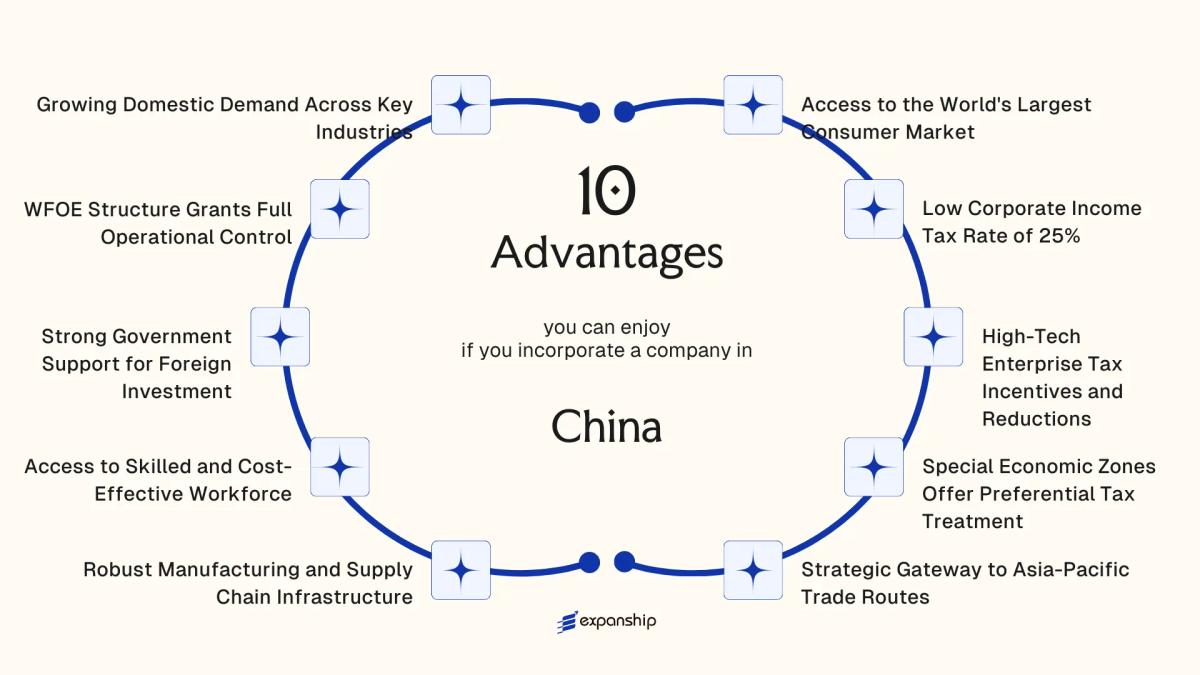
Access to the World's Largest Consumer Market
China largest consumer market access for businesses is one of the most cited reasons foreign firms pursue incorporation within the jurisdiction. With a population exceeding 1.4 billion and a middle class that surpassed 400 million people, the domestic demand base your business can address is unlike any other single national market.
Scale That Translates Into Revenue Opportunity
Retail sales of consumer goods in China have consistently reached tens of trillions of yuan annually, driven by urban consumption in Tier 1 and Tier 2 cities. Incorporating locally, rather than exporting into the market, positions your entity to engage consumers directly and qualify for domestic distribution channels that are otherwise restricted to foreign-registered firms.
Legal Standing to Sell Directly to Chinese Consumers
A Wholly Foreign-Owned Enterprise (WFOE), governed under the Foreign Investment Law of 2020 and administered by the State Administration for Market Regulation (SAMR), grants your business full legal standing to contract, invoice, and collect revenue in renminbi. Without this local registration, foreign companies cannot hold a Chinese business license, which is a prerequisite for direct retail and e-commerce operations on platforms such as Tmall or JD.com.
A locally registered entity gives you direct access to domestic sales channels and the legal capacity to transact in renminbi, removing the structural barriers that limit foreign-based companies selling into this market.
Low Corporate Income Tax Rate of 25%
Under the Enterprise Income Tax Law (EITL), enacted in 2007 and applicable to both domestic and foreign-invested enterprises, the standard corporate income tax rate is set at 25%. The China 25% corporate income tax rate advantage becomes immediately visible when you measure it against comparable economies: the United States federal CIT rate stands at 21% plus state-level taxes, Germany's combined rate reaches approximately 30%, and France applies a standard rate of 25% with additional levies that push the effective burden higher. At face value, 25% is competitive. The decisive factor, however, is how the EITL structures the base — foreign enterprises incorporated as resident companies are taxed on worldwide income, but the rate itself applies uniformly without the layer of surcharges common in many European systems.
For a foreign investor establishing a Wholly Foreign-Owned Enterprise or a joint venture, this uniform rate provides predictability that matters for financial modelling and repatriation planning. Your tax liability calculation starts from a defined, codified position rather than a patchwork of supplementary assessments.
Several structural features make the standard 25% rate a practical baseline worth understanding:
- The rate applies identically to foreign-invested and domestic enterprises, eliminating a historical disadvantage that existed before the 2007 EITL unified the dual-track system
- Taxable income is determined after allowable deductions, including R&D expenses, which can be deducted at an enhanced ratio under current regulations
- Resident enterprise status, achieved through effective management location, subjects your entity to the full rate but also to the full treaty network China has built with over 100 countries

Company Incorporation in China
Set up a foreign-invested enterprise in China with guidance on entity structure, registration requirements, and tax positioning from day one.
High-Tech Enterprise Tax Incentives and Reductions
Qualified companies in China can access high-tech enterprise tax incentives that reduce the standard corporate income tax rate from 25% to 15%. That 10-percentage-point difference directly increases retained earnings, which matters particularly for capital-intensive R&D operations where margins are reinvested into product development.
The High and New Technology Enterprise (HNTE) designation is governed under the Enterprise Income Tax Law and administered jointly by the Ministry of Science and Technology, the Ministry of Finance, and the State Taxation Administration. Certification is valid for three years and requires the entity to meet thresholds related to R&D expenditure as a share of revenue, the proportion of revenue derived from qualifying high-tech products or services, and the composition of technical staff within the workforce.
| Parameter | Requirement |
|---|---|
| Standard CIT Rate | 25% |
| HNTE Preferential Rate | 15% |
| Certification Validity | 3 years (renewable) |
| R&D Expense Deduction | Up to 200% super-deduction for qualifying expenditure |
| Administering Bodies | MoST, MoF, STA |
Beyond the reduced rate, qualifying firms can apply an enhanced R&D super-deduction under Circular 97 and related guidance, allowing eligible research expenditures to be deducted at up to 200% of actual costs. For a foreign-invested enterprise channeling substantial resources into product innovation, that deduction meaningfully lowers taxable income before the preferential rate even applies. The combined effect gives your business a structurally lower tax burden during the years when R&D spending is at its highest.
Special Economic Zones Offer Preferential Tax Treatment
China Special Economic Zone tax benefits give foreign businesses access to reduced tax burdens that are not available under the standard national regime. Designated zones such as the Shanghai Free Trade Zone, Hainan Free Trade Port, and the Greater Bay Area each operate under distinct preferential frameworks established through State Council approvals and locally administered regulations.
Within the Hainan Free Trade Port, qualifying enterprises benefit from a reduced corporate income tax rate of 15%, significantly below the standard 25% rate. For businesses in encouraged industries, this difference compounds over time, directly reducing retained earnings available for reinvestment.
Free trade zone tax advantages in China extend beyond income tax. Certain FTZs offer import duty exemptions on equipment and raw materials used in production, reducing capital expenditure at the operational setup stage.
- Confirm your business activity falls under the FTZ's encouraged industry catalogue
- Verify the specific zone's administration body, as each FTZ has its own management committee
- Check whether your entity structure (WFOE, JV, or partnership) qualifies under the applicable zone regulations
- Review zone policies via the Ministry of Commerce for current incentive schedules
Eligibility for preferential rates typically requires physical operational presence within the zone, not merely registered address.
The Hainan Free Trade Port is legislatively mandated to achieve zero tariffs on most imported goods by 2025 under the Hainan Free Trade Port Law enacted in 2021.
Strategic Gateway to Asia-Pacific Trade Routes
China's position as a China strategic gateway Asia-Pacific trade benefits hub is grounded in treaty architecture, not geography alone. As a signatory to the Regional Comprehensive Economic Partnership (RCEP), which came into force in January 2022, businesses incorporated here gain preferential access to a trade bloc covering 15 nations and approximately 30% of global GDP. For a foreign-owned entity, this translates to reduced tariff exposure across markets in Southeast Asia, Japan, South Korea, Australia, and New Zealand under a single framework.
RCEP as a Commercial Mechanism
Tariff schedules under RCEP are phased, meaning the trade route advantages for businesses compound over time as elimination timetables progress. Your entity's country of incorporation determines which preferential rates apply, making the choice of where to register commercially consequential, not merely administrative.
Port Infrastructure and Trade Corridor Access
Seven of the world's ten busiest container ports by throughput are located in this country, including Shanghai, Shenzhen, and Ningbo-Zhoushan. For a firm moving physical goods, this concentration of port capacity reduces transit times and freight costs across Asia-Pacific corridors. Asia-Pacific market access through China carries particular weight for businesses supplying regional e-commerce platforms or manufacturing-dependent supply chains, since proximity to these ports directly affects landed costs and delivery windows for end customers.
Plan Your Market Entry Strategy in China
Speak with our team about structuring your China entity to capture RCEP trade benefits and Asia-Pacific market access.
Robust Manufacturing and Supply Chain Infrastructure
China's manufacturing infrastructure advantages for businesses extend well beyond low unit costs. The country operates an integrated production ecosystem where raw materials, components, tooling, logistics, and finished goods manufacturing exist within close geographic proximity — a structural feature that reduces lead times and lowers input costs in ways that dispersed supply chains cannot replicate.
- Over 30 designated national-level economic and technological development zones (ETDZs), administered under the Ministry of Commerce, concentrate industrial suppliers, manufacturers, and logistics providers in single corridors. Your firm can source materials and subcontractors without the delays and tariff friction that cross-border supply chains introduce.
- China operates the world's largest network of industrial clusters by output volume. Electronics production in Shenzhen, textiles in Hangzhou, and automotive components in Wuhan represent established supplier bases that took decades to form. A foreign entity entering these clusters gains immediate access to specialized subcontractors.
- Port infrastructure at Shanghai, Ningbo-Zhoushan, and Shenzhen handles combined container throughput exceeding 100 million TEUs annually. Physical proximity to these terminals directly reduces export logistics costs for manufacturing-oriented firms.
- The "Made in China 2025" state initiative has directed capital into precision manufacturing, robotics, and semiconductor production, meaning the supplier base your business accesses today is technically more capable than a decade ago.
Access to Skilled and Cost-Effective Workforce
China skilled workforce advantages for foreign companies are grounded in scale and structure. With over 900 million working-age individuals and annual university graduates exceeding 11 million, the talent supply across technical, engineering, and manufacturing disciplines is substantial. For a foreign-invested enterprise (FIE), this means access to qualified candidates without the recruitment constraints common in smaller labor markets.
Average manufacturing wages in China, while rising, remain competitive relative to output per worker. Cities like Chengdu, Wuhan, and Xi'an offer lower labor costs than coastal hubs, while still producing graduates from top-tier institutions such as Wuhan University and Sichuan University.
Vocational education is regulated under the Vocational Education Law of the People's Republic of China, which mandates industry-aligned training programs. This produces a pipeline of workers pre-trained in precision manufacturing, electronics, and logistics, reducing onboarding costs for firms in those sectors.
A 2023 report by the International Labour Organization noted that China's labor productivity in manufacturing has grown at an average rate exceeding 6% annually over the past decade, indicating that cost-per-unit output has improved alongside wage growth.
Strong Government Support for Foreign Investment
China government support for foreign investment benefits is codified in the Foreign Investment Law (FIL), which took effect on January 1, 2020. The FIL legally prohibits forced technology transfer, guarantees equal treatment of foreign-invested enterprises under government procurement, and establishes a complaints mechanism for foreign businesses through designated contact points.
MOFCOM, the Ministry of Commerce, administers the Negative List system, which defines sectors closed or restricted to foreign capital. Anything outside that list is fully open. Your business operates under the same rules as domestic firms in those open sectors, which removes a layer of institutional friction that existed under earlier approval-based regimes.
Two lists govern market access:
- The National Negative List, which applies across all regions
- The Free Trade Zone Negative List, which carries fewer restrictions and applies within designated FTZ areas
Provincial-level Investment Promotion Agencies provide additional localized support, including assistance with site selection, introductions to local authorities, and in some cases, negotiated incentive packages for qualifying industries.
The equal-treatment guarantees under the FIL apply to sectors outside the Negative List; businesses operating in restricted or prohibited categories remain subject to separate regulatory conditions regardless of FIL protections.
WFOE Structure Grants Full Operational Control
A Wholly Foreign-Owned Enterprise (WFOE) is a limited liability company incorporated under China's Company Law, owned entirely by foreign shareholders without requiring a local Chinese partner. For foreign investors, the China WFOE full operational control benefits begin at the ownership level: decisions on staffing, pricing, profit distribution, and business strategy rest solely with the foreign parent or individual shareholder.
No Mandatory Joint Venture Requirement
Prior to the Foreign Investment Law that took effect on January 1, 2020, many sectors required foreign investors to partner with a domestic Chinese entity. The WFOE structure bypasses this requirement in sectors not listed on the Negative List (currently administered under the Special Administrative Measures for Foreign Investment Access). Your business retains full authority over proprietary technology, internal processes, and trade secrets without contractual exposure to a third-party partner.
Direct Control Over Profit Repatriation
A WFOE can convert RMB profits into foreign currency and remit them abroad after fulfilling tax obligations and completing the required filing with the State Administration of Foreign Exchange (SAFE). This means your returns are not subject to a partner's consent or a negotiated dividend-sharing formula.
Scope of Business Operations
The approved business scope, recorded in the WFOE's business license issued by the State Administration for Market Regulation (SAMR), defines the activities the entity may legally conduct. Structuring this scope accurately at incorporation gives you direct control over what revenue streams the entity can generate without requiring a separate affiliated entity.
Growing Domestic Demand Across Key Industries
China's growing domestic demand advantages for businesses stem from structural demographic and economic shifts that have direct consequences for revenue potential. The urban population has grown steadily under policies tied to the National New-Type Urbanization Plan, and urban households now account for the majority of consumer expenditure across goods and services. For a foreign firm operating through a registered entity, this means addressable customers are concentrated in accessible metropolitan markets.
Sectors seeing measurable demand expansion include:
- Healthcare and pharmaceuticals, driven by an aging population and the Healthy China 2030 initiative
- Electric vehicles and clean energy products, supported by national subsidy frameworks and purchase incentive programs
- Premium food and beverage, where import-registered products command price premiums among higher-income urban consumers
- Digital services and fintech, where mobile payment infrastructure has normalized electronic consumer transactions at scale
Disposable income among urban residents has risen consistently over the past decade, and that trajectory has a direct effect on unit economics for consumer-facing businesses. A foreign-invested enterprise structured as a Wholly Foreign-Owned Entity can sell directly to end consumers without a local distributor taking margin, which means your firm captures a larger share of each transaction.
The 14th Five-Year Plan (2021-2025) explicitly targets domestic consumption as a primary economic driver, creating a policy environment where certain product categories benefit from state-directed market development. Sectors aligned with these priorities face fewer structural headwinds from regulatory bodies such as the National Development and Reform Commission when seeking market entry approvals.
Why China Stands Out Against Competing Markets
Assessing which competing markets are most relevant requires looking at where foreign investors genuinely hesitate between options. India, Vietnam, and Singapore are the jurisdictions most commonly evaluated alongside China by businesses targeting Asian manufacturing bases, consumer markets, or regional headquarters structures. Each presents a distinct trade-off in market size, tax treatment, and operational control that the comparison below makes measurable.
What the table reveals is less about raw numbers and more about structural positioning. India's corporate tax rate is comparable, but its regulatory environment for wholly foreign-owned entities involves more sectoral restrictions under the Foreign Exchange Management Act. Vietnam attracts manufacturers, yet its domestic consumer base remains a fraction of what foreign firms can access through the Chinese market. Singapore offers tax efficiency and ease of incorporation, but it functions primarily as a holding or regional hub rather than a direct access point to a billion-plus consumer economy. For businesses where China vs competing markets advantages for investors is the operative question, the distinction often comes down to whether market access or structural simplicity is the priority.
| Parameter | China | India | Vietnam | Singapore |
|---|---|---|---|---|
| Standard Corporate Tax Rate | 25% | 25.17% (base + surcharge) | 20% | 17% |
| Full Foreign Ownership | Permitted via WFOE (most sectors) | Sector-restricted; FDI caps apply | Permitted; sector conditions apply | Permitted |
| Domestic Consumer Market Size | 1.4 billion | 1.4 billion | ~98 million | ~6 million |
| Free Trade Agreement Coverage | 20+ bilateral/regional FTAs | Selective; fewer major FTAs | RCEP, CPTPP member | Extensive FTA network |
| SEZ / Preferential Zone Regime | Yes (multiple, legislated) | Yes (SEZs under SEZ Act 2005) | Yes (Export Processing Zones) | Partial (MAS-regulated sectors) |
| High-Tech / R&D Tax Incentives | 15% rate for HNTE-certified firms | Yes (weighted deductions) | Yes (qualifying sectors) | Yes (Pioneer Status scheme) |
| Regulatory Body for Foreign Firms | MOFCOM / SAMR | DPIIT / RBI | MPI / DPI | ACRA |
Compliance Services for Companies in China
Maintain your Chinese entity's legal standing with ongoing compliance support, including annual filings, licence renewals, and regulatory reporting under SAMR requirements.
Conclusion
China's position as a destination for foreign incorporation rests on a combination of structural and fiscal factors that few markets can match at equivalent scale. The preferential tax treatment available through High-Tech Enterprise status, the autonomy granted by a Wholly Foreign-Owned Enterprise structure, and direct access to a consumer base exceeding 1.4 billion people represent the clearest advantages covered throughout this blog. Each of these benefits is grounded in enforceable policy, whether through the Enterprise Income Tax Law, MOFCOM registration procedures, or the designated frameworks governing Special Economic Zones.
One of the benefits of incorporating in China is that these advantages do not apply uniformly across all business types or sectors. An entity seeking manufacturing efficiencies operates under different conditions than a firm targeting domestic consumer demand. Eligibility thresholds, sector restrictions under the Foreign Investment Law 2019, and the specific SEZ where a company registers will all shape which benefits apply and to what degree.
For foreign investors whose business objectives align with what the regulatory environment here supports, the case for formation is grounded in verifiable legal and commercial structures. The practical next step is understanding how those structures apply to your specific industry, ownership model, and operational timeline.
Start Your China Company Formation With Expanship
Starting your China company formation with Expanship means working with a team that understands the full regulatory architecture governing foreign-invested enterprises in China. From selecting between a Wholly Foreign-Owned Enterprise (WFOE) and a Joint Venture structure to meeting the Ministry of Commerce (MOFCOM) and State Administration for Market Regulation (SAMR) requirements discussed throughout this blog, Expanship manages the process with direct knowledge of the applicable rules.
Expanship's service scope for foreign businesses entering the Chinese market covers:
- Company name pre-approval and Articles of Association preparation in compliance with SAMR standards
- Document notarization, apostille, and consular legalization for foreign-origin corporate records
- Registered address provision and resident agent services meeting local address requirements
- Government filing, MOFCOM registration, and SAMR incorporation liaison
- Post-incorporation compliance management, including annual reporting and tax registration with the State Taxation Administration
- Corporate bank account introduction assistance with domestic and international banks operating in China
Each of these services addresses a specific procedural requirement that foreign investors must satisfy before commencing operations. Expanship does not replace legal counsel but handles the administrative and filing elements that determine whether an incorporation proceeds on schedule.
To discuss your specific structure and timeline, contact Expanship China directly.
Frequently Asked Questions (FAQ)
The standard corporate income tax (CIT) rate in China is 25%, as established under the Enterprise Income Tax Law of 2007. Foreign-invested enterprises are taxed at the same rate as domestic companies, with no separate tax schedule for foreign entities. Reductions are available through specific schemes: High and New Technology Enterprises (HNTEs) that meet qualification criteria under the relevant HNTE certification process may be taxed at a reduced rate of 15%.
Companies established in designated Special Economic Zones (SEZs), such as those in Shenzhen or the Hainan Free Trade Port, may qualify for preferential tax treatment that differs from the national standard rate. The Hainan Free Trade Port, for instance, offers a reduced CIT rate of 15% for enterprises in encouraged industries. Eligibility conditions, including substance requirements and industry classifications, are set by local authorities in coordination with national tax regulations.
Registration timelines vary depending on the business scope, the municipality, and whether all documentation is in order, but the process generally takes between four and eight weeks from submission to approval. The procedure involves filing with the State Administration for Market Regulation (SAMR) for business registration, followed by additional steps such as opening a capital account and completing tax registration with the local tax bureau. Delays most commonly occur when business scope descriptions require additional review or when submitted documents require notarization and apostille from the investor's home country.
A WFOE does not require a Chinese resident as a shareholder; the entity can be wholly owned by foreign individuals or legal persons. However, a legal representative must be appointed, and while this person does not need to be a Chinese national, they must be a natural person and bear legal responsibility for the company under Chinese corporate law. This role carries meaningful personal liability, so the appointment decision warrants careful consideration.
Post-incorporation compliance is overseen by several bodies, depending on the nature of the obligation. The State Administration for Market Regulation (SAMR) handles annual reporting and business license maintenance, while the State Taxation Administration (STA) and its local branches manage tax filings. Foreign-invested enterprises are also required to report to MOFCOM through the Foreign Investment Information Reporting System, a requirement introduced under the Foreign Investment Law that came into effect on January 1, 2020.
Accessibility varies significantly by industry sector rather than by a single blanket comparison. China's Negative List has been progressively shortened over recent years, opening more sectors to full foreign ownership, while some competing markets maintain fewer formal restrictions but have smaller consumer bases or less developed supply infrastructure. For manufacturing-oriented businesses or those targeting the domestic consumer market, China's combination of industrial ecosystem depth and market scale presents conditions that most regional alternatives cannot match at equivalent cost and proximity.
Legal Disclaimer
The information provided in this article is for general informational purposes only and does not constitute legal, tax, or professional advice. While we strive to ensure the accuracy and timeliness of the content, laws and regulations are subject to change, and the application of laws can vary widely based on specific facts and circumstances.
Readers should not act upon this information without seeking professional counsel tailored to their individual situation. Expanship and its authors disclaim any liability for actions taken or not taken based on the content of this article.
For specific advice regarding your business setup, compliance requirements, or any legal matters, please consult with qualified legal and tax professionals in the relevant jurisdiction.