
Key Takeaways
- All business entities in Côte d'Ivoire are governed by OHADA's Uniform Act, which standardises commercial law across 17 member states and directly determines available legal structures.
- The SARL is the most widely registered entity form in Côte d'Ivoire, favoured by small and mid-sized businesses for its simplified governance requirements and limited liability protection.
- Company registration in Côte d'Ivoire is administered through the Centre de Formalités des Entreprises (CFE) under the Guichet Unique de Formalisation des Entreprises (GUFIE).
- Foreign operators not ready to incorporate locally may establish a branch or representative office, while those requiring maximum contractual flexibility for joint ventures or holding structures may opt for the Société par Actions Simplifiée (SAS).
Introduction to Entity Types in Côte d'Ivoire
Côte d'Ivoire is a sovereign republic on the southern coast of West Africa, bordered by Ghana, Burkina Faso, Mali, Guinea, and Liberia. The country operates under a civil law framework shaped by its membership in the Organisation pour l'Harmonisation en Afrique du Droit des Affaires (OHADA), which standardises commercial law across 17 member states and directly governs the types of business entities in Côte d'Ivoire.
Company registration is administered through the Centre de Formalités des Entreprises (CFE), which operates under the Guichet Unique de Formalisation des Entreprises (GUFIE). The tax regime is territorial-based, with standard corporate income tax applied to locally sourced profits.
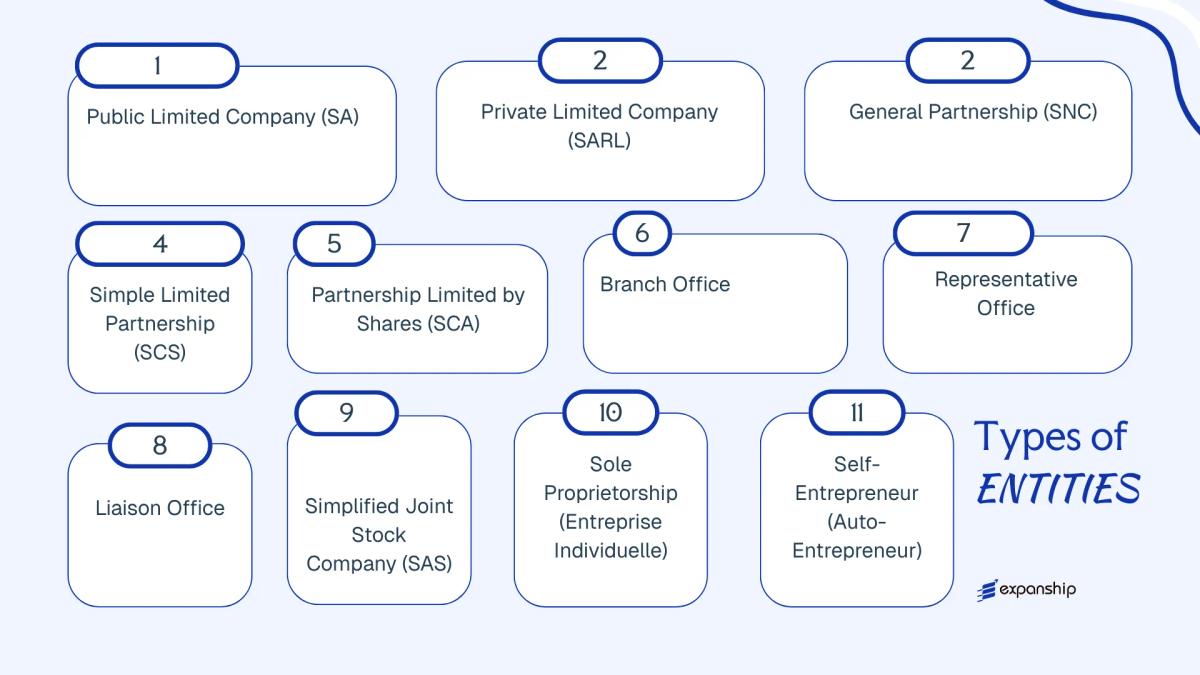
Businesses registering in the country may choose from several legal structures under OHADA law: Société Anonyme (SA), Société à Responsabilité Limitée (SARL), Société par Actions Simplifiée (SAS), Société en Nom Collectif (SNC), Société en Commandite Simple (SCS), Société en Commandite par Actions (SCA), Branch Office, Representative Office, and Sole Proprietorship (Entreprise Individuelle or Auto-Entrepreneur).
Each Ivory Coast company type carries distinct requirements around capital, liability, governance, and compliance — all of which are examined in the sections that follow.
An Overview of Business Structures in Côte d'Ivoire
Côte d'Ivoire recognises several distinct business structures under the OHADA Uniform Act on Commercial Companies and Economic Interest Groups (Acte Uniforme relatif au droit des sociétés commerciales et du groupement d'intérêt économique), which was revised in 2014 and applies across all OHADA member states. As part of that framework, Ivory Coast company formation options span incorporated companies, partnerships, simplified structures, and foreign business presence vehicles. Each form carries different rules on liability, governance, and permitted activities.
Business Structures at a Glance
| Entity Type | Legal Form | Liability | Tax Status | Local Trading | Minimum Members | Regulatory Authority | Governing Act |
|---|---|---|---|---|---|---|---|
| SA | Share company | Limited to shares | Taxable | Yes | 1 shareholder | CEPICI / RCCM | OHADA Uniform Act 2014 |
| SARL | Private limited company | Limited to contributions | Taxable | Yes | 1 shareholder | CEPICI / RCCM | OHADA Uniform Act 2014 |
| SAS | Simplified joint stock | Limited to shares | Taxable | Yes | 1 shareholder | CEPICI / RCCM | OHADA Uniform Act 2014 |
| SNC | General partnership | Unlimited, joint | Taxable | Yes | 2 partners | RCCM | OHADA Uniform Act 2014 |
| SCS | Limited partnership | Mixed liability | Taxable | Yes | 2 partners | RCCM | OHADA Uniform Act 2014 |
| SCA | Partnership limited by shares | Mixed liability | Taxable | Yes | 4 members | RCCM | OHADA Uniform Act 2014 |
| Branch Office | Foreign entity extension | Parent liable | Taxable | Yes | Parent company | CEPICI / RCCM | OHADA + national law |
| Representative Office | Non-trading presence | Parent liable | Generally exempt | No | Parent company | CEPICI | National regulations |
| Liaison Office | Administrative presence | Parent liable | Generally exempt | No | Parent company | CEPICI | National regulations |
| Entreprise Individuelle | Sole proprietorship | Unlimited | Taxable | Yes | 1 individual | RCCM | OHADA + national law |
| Auto-Entrepreneur | Simplified sole trader | Unlimited | Flat-rate regime | Yes | 1 individual | RCCM | National decree |
Each of these structures is examined in full in the sections below.
Société Anonyme (SA) — Public Limited Company
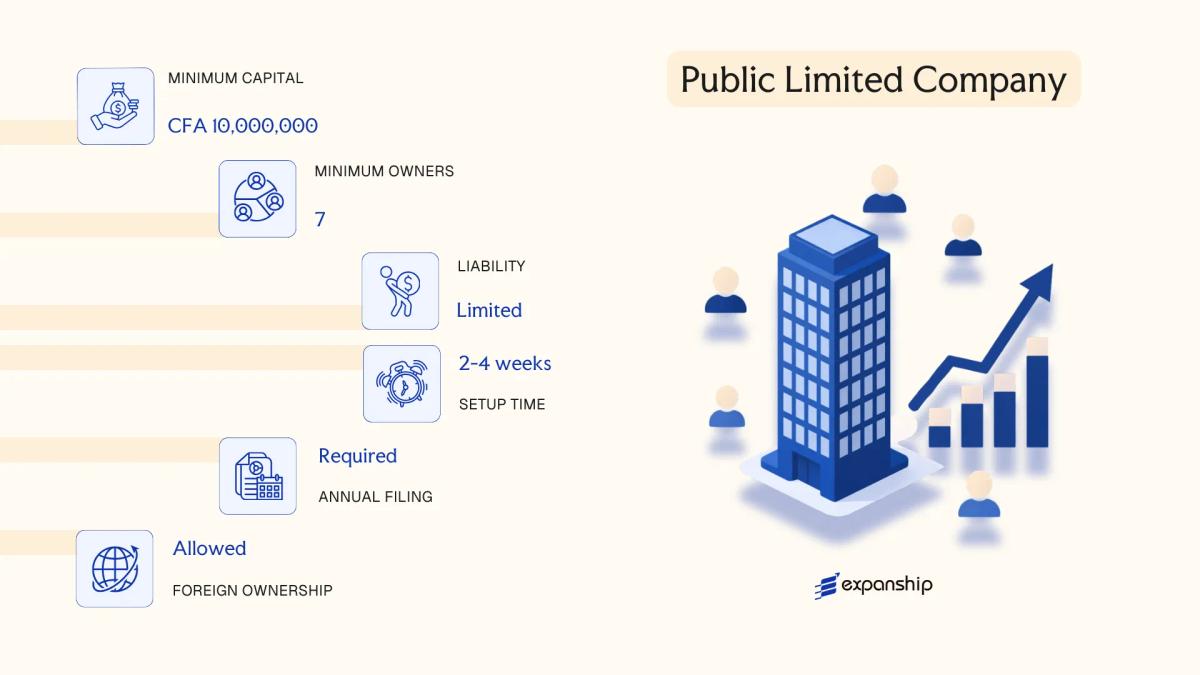
The Société Anonyme SA Côte d'Ivoire is governed by the OHADA Uniform Act on Commercial Companies and Economic Interest Groups, most recently revised in 2014. As a distinct legal entity, the SA carries its own rights and obligations separate from those of its shareholders, with liability confined to each shareholder's capital contribution.
Structurally, the SA accommodates both privately held and publicly listed configurations. It is the required form for companies seeking to list on the Bourse Régionale des Valeurs Mobilières (BRVM), the regional stock exchange serving UEMOA member states.
Key Characteristics
| Requirement | Detail | Notes |
|---|---|---|
| Legal Form | Société Anonyme (SA) | Separate legal personality; limited liability |
| Members | Shareholders: minimum 1 (single-shareholder SA permitted under revised OHADA Act) | No statutory maximum on shareholders |
| Governance | Board of Directors (minimum 3, maximum 12) or single Administrator if sole shareholder | CEO (Directeur Général) manages day-to-day operations |
| Registered Office | Physical address required in Côte d'Ivoire | Must be registered with the CEPICI one-stop shop |
| Share Capital | XOF 10,000,000 minimum (non-listed); XOF 100,000,000 for publicly listed SA | At least 50% of cash contributions must be paid up at incorporation |
| Privacy | Shareholder register not publicly filed; directors disclosed in RCCM | Beneficial ownership disclosure obligations apply |
Focus Points
- Taxation: Corporate income tax applies at 30% on net profits; VAT at 18% on taxable supplies; withholding tax rates vary by payment type and recipient residency; business licence tax (patente) also applies annually.
- Annual Compliance: Mandatory filing of audited financial statements with the RCCM; statutory auditor (commissaire aux comptes) required regardless of size.
- Economic Substance: No formal substance test beyond maintaining a registered office, but operational SAs are expected to conduct genuine activity locally.
- Treaty Access: Côte d'Ivoire has concluded a limited number of double tax treaties; SA entities are generally eligible where treaties exist.
- Conversion: An SA may be converted to a SARL or SAS by shareholder resolution, subject to OHADA procedural requirements.
Closing
The SA suits large-scale commercial operations, joint ventures with institutional partners, and businesses targeting public capital markets through the BRVM. Its principal advantage is the capacity to issue transferable shares freely, though the mandatory statutory auditor and higher minimum capital make it a heavier structure to maintain than most other OHADA forms.
The SA is most appropriate for large enterprises, companies with multiple institutional investors, or businesses planning a future public listing on the BRVM.

Company Incorporation in Côte d'Ivoire
Expanship assists with SA registration, document preparation, and CEPICI filing across Côte d'Ivoire.
Société à Responsabilité Limitée (SARL) — Private Limited Company
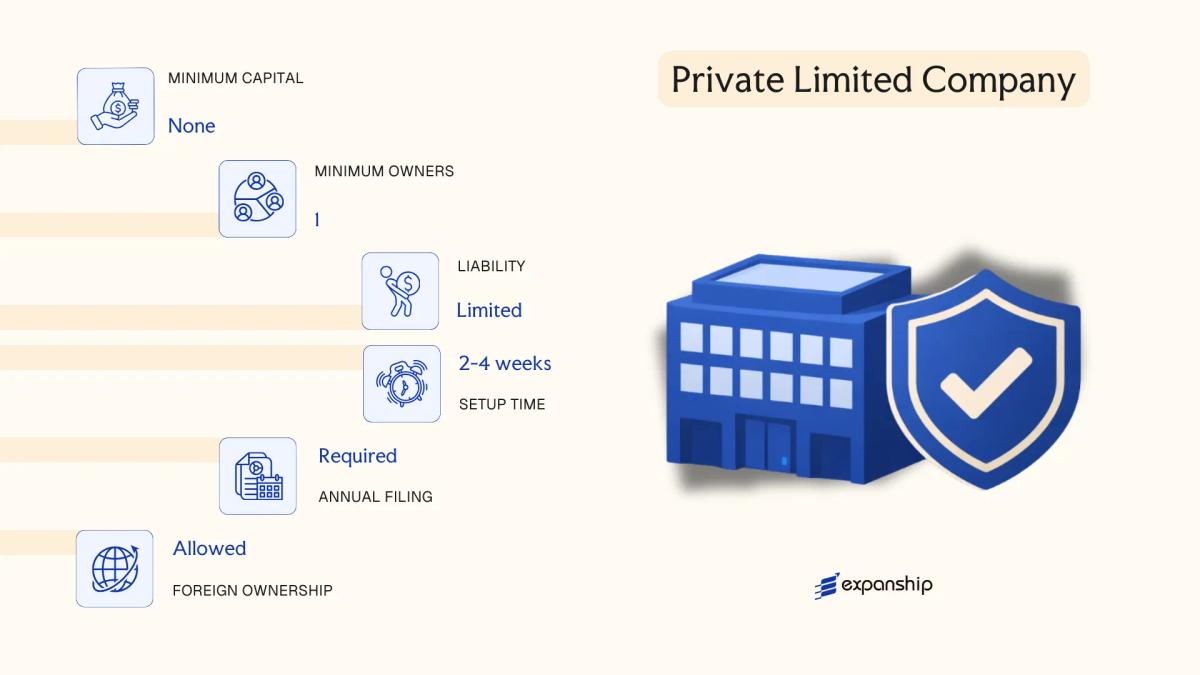
The Société à Responsabilité Limitée SARL Côte d'Ivoire is governed by the OHADA Uniform Act on Commercial Companies and Economic Interest Groups, most recently revised in 2014. As a hybrid structure, it combines the operational simplicity of a partnership with the liability protection of a share-based company.
The SARL holds separate legal personality from its shareholders, meaning it can own assets, enter contracts, and incur obligations in its own name. Shareholders' liability is capped at the amount of their capital contributions, shielding personal assets from business debts.
Key Characteristics
| Requirement | Detail | Notes |
|---|---|---|
| Legal Form | Société à Responsabilité Limitée | Governed by OHADA Uniform Act (revised 2014) |
| Members | 1 to 50 shareholders; managed by one or more gérants (managers) | A single-shareholder SARL is permitted (SARL unipersonnelle) |
| Local Presence | Registered office required within Côte d'Ivoire | No statutory requirement for a resident gérant, but a local address is mandatory |
| Share Capital | Minimum XOF 100,000; no maximum | Divided into parts sociales (non-negotiable shares); not freely transferable to third parties without shareholder approval |
| Privacy | Shareholder identities filed with the RCCM | Beneficial ownership disclosures required under OHADA and national AML frameworks |
Focus Points
- Taxation: Subject to corporate income tax at 25%; VAT applies at the standard rate of 18%; withholding tax applies to dividends, interest, and royalties paid to non-residents at rates that vary by treaty status.
- Annual Compliance: Must file audited accounts with the Registre du Commerce et du Crédit Mobilier (RCCM) annually; a statutory auditor (commissaire aux comptes) is required once certain thresholds are met.
- Transfer Restrictions: Parts sociales cannot be freely sold to outside parties; transfers to non-shareholders require approval by shareholders holding at least three-quarters of the share capital.
- Conversion: A SARL may be converted into a Société Anonyme (SA) or Société par Actions Simplifiée (SAS) subject to compliance with applicable OHADA thresholds and procedural requirements.
- Treaty Access: Côte d'Ivoire maintains a limited tax treaty network; treaty benefits depend on residency status and the specific agreement in force with the counterpart jurisdiction.
A SARL suits trading operations, professional service firms, and domestic holding structures where close ownership control is a priority. Its principal advantage is the low capital threshold combined with limited liability, though the 50-shareholder cap and restrictions on transferring shares make it unsuitable for businesses anticipating broad investor participation or public fundraising.
Small to mid-sized businesses, joint ventures with a defined partner group, or sole operators seeking limited liability without the compliance burden of a full SA.
Partnerships in Côte d'Ivoire [Société en Nom Collectif (SNC), Société en Commandite Simple (SCS), Société en Commandite par Actions (SCA)]
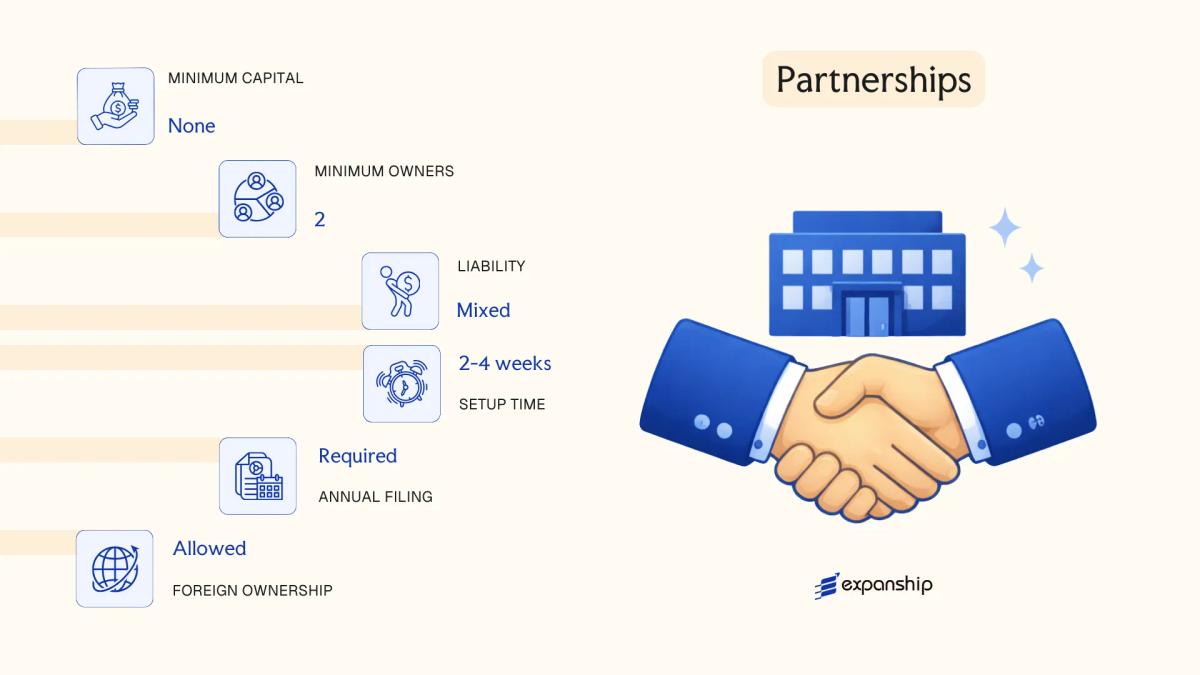
Côte d'Ivoire recognises three distinct partnership structures under the OHADA Uniform Act on Commercial Companies and Economic Interest Groups (AUDSCGIE), most recently revised in 2014. The partnership structures Côte d'Ivoire SNC SCS SCA each represent a separate legal form with distinct liability profiles, making the choice between them consequential rather than cosmetic.
All three forms acquire legal personality upon registration with the Centre de Formalités des Entreprises (CFE) and entry in the Registre du Commerce et du Crédit Mobilier (RCCM). Unlike capital companies, these structures are largely built on personal relationships between partners, and in most cases that relationship carries direct exposure to business obligations.
Key Characteristics
| Requirement | SNC | SCS | SCA |
|---|---|---|---|
| Legal Form | General partnership | Limited partnership | Partnership limited by shares |
| Partners / Members | General partners (associés) | General partners + limited partners (commanditaires) | General partners + shareholder-partners |
| Minimum Members | 2 general partners | 1 general + 1 limited partner | 1 general partner + 3 shareholder-partners |
| Liability | Unlimited, joint and several for all | Unlimited for general; limited to contribution for limited partners | Unlimited for general partners; limited to shares for shareholder-partners |
| Minimum Capital | None specified under OHADA | None specified under OHADA | Set by the statutes; shares must be defined |
| Local Presence | Registered office in Côte d'Ivoire required | Registered office required | Registered office required |
| Privacy | Partner names appear in public RCCM filings | Same as SNC | Shareholder register maintained; general partners publicly listed |
Focus Points
- Taxation: All three forms are subject to the standard Ivorian corporate tax rate (currently 25%) on profits; VAT at the standard rate of 18% applies to taxable supplies; withholding taxes apply to dividends, interest, and royalties in line with the Code Général des Impôts and applicable double tax treaties.
- Annual Compliance: Entities must file annual financial statements with the RCCM and submit tax returns to the Direction Générale des Impôts (DGI); accounting must conform to the OHADA Uniform Act on Accounting.
- Treaty Access: As a resident entity, each form may access Côte d'Ivoire's double tax treaty network, subject to beneficial ownership and substance requirements.
- Restrictions: SNC partners cannot freely transfer their interests without unanimous consent; the SCS imposes similar restrictions on general partner transfers.
Sub-Types
Société en Nom Collectif (SNC)
The SNC is the foundational general partnership under OHADA law. Every partner holds trader status and bears unlimited, joint and several liability for the firm's debts, meaning personal assets are exposed beyond the contributed capital.
Société en Commandite Simple (SCS)
Governed by the same AUDSCGIE, the SCS Côte d'Ivoire limited partnership separates active management (general partners) from passive investors (limited partners). A limited partner who participates in management loses their liability protection and is treated as a general partner.
Société en Commandite par Actions (SCA)
The SCA introduces share capital into the commandite structure, allowing shareholder-partners to hold transferable shares while general partners retain control. This form is rarely used in practice but suits structures requiring equity participation alongside entrenched management control.
Closing
Partnership structures suit closely held commercial ventures, professional firms, and family-owned trading operations where participants accept personal engagement in the business. The principal advantage is structural flexibility under OHADA rules; the significant drawback is that general partners in both the SNC and SCS bear unlimited personal liability with no cap on exposure.
These forms are best suited to small, trust-based ventures between known parties who are prepared to accept personal liability as part of the business arrangement.
Foreign Business Presence in Côte d'Ivoire [Branch Office, Representative Office, Liaison Office]
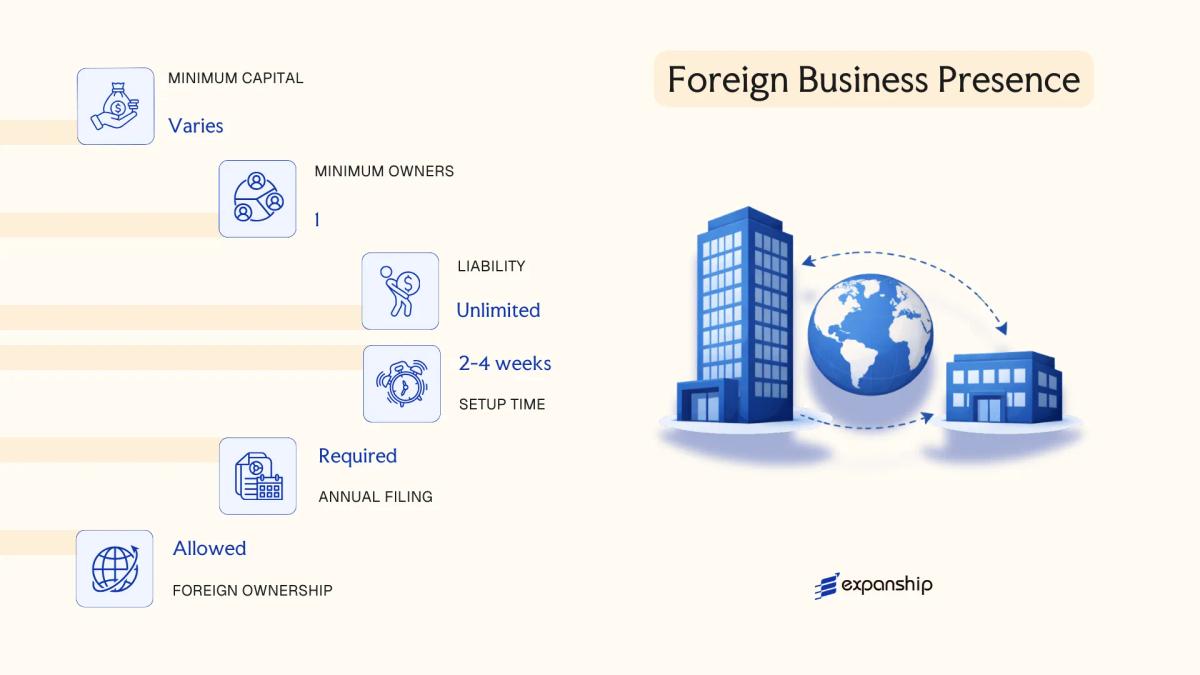
Foreign companies seeking to operate in Ivory Coast without incorporating a separate local entity have three principal options: a branch office, a representative office, or a liaison office. The primary governing framework is the OHADA Uniform Act on Commercial Companies and Economic Interest Groups, supplemented by local CEPICI registration requirements and, where applicable, sector-specific licensing rules.
A foreign company branch office in Côte d'Ivoire has no separate legal personality — the parent company remains fully liable for all obligations incurred by the branch. Registration is handled through the Centre de Promotion des Investissements en Côte d'Ivoire (CEPICI), and the branch must appoint a permanent resident representative.
Key Characteristics
| Requirement | Detail | Notes |
|---|---|---|
| Legal Form | Branch / Representative / Liaison Office | No separate legal personality; parent bears full liability |
| Head of Office | Resident Representative (Mandataire) | Must be permanently based locally; appointed by parent board resolution |
| Local Presence | Registered address + CEPICI registration | Physical office required for branch; lighter requirement for liaison |
| Capital | No minimum imposed | Parent's capital governs; branch operates on allocated funds |
| Tax Registration | Mandatory for branch; generally not for liaison | Branch obtains taxpayer ID (NIF) with DGI |
| Privacy | Parent company details disclosed on registration | Documents filed with RCCM (Trade and Personal Property Credit Register) |
Focus Points
- Taxation: Branch profits subject to 25% corporate income tax; VAT at 18% applies to taxable supplies; withholding taxes apply on remittances to the parent under domestic rules, reducible under applicable tax treaties.
- Treaty Access: Côte d'Ivoire maintains a limited treaty network; treaty benefits for the branch depend on the parent's residence jurisdiction and treaty provisions.
- Annual Compliance: Branches must file audited accounts and annual tax returns with the Direction Générale des Impôts (DGI); the parent's financial statements may also be required.
- Restrictions: Representative and liaison offices cannot engage in revenue-generating commercial activities; trading operations require a full branch registration or local incorporation.
- Conversion: A branch may be converted into a locally incorporated entity (SARL or SA), though the process requires a new incorporation and does not constitute an automatic legal transformation.
Sub-Types
Branch Office
A branch conducts the same commercial activities as its parent and generates taxable revenue locally. It is the appropriate structure when a foreign firm intends to execute contracts, invoice clients, or employ staff directly in-country.
Representative Office
A representative office is permitted to conduct market research, promote the parent company, and liaise with local counterparties, but may not conclude commercial contracts or collect revenue. Registration office Ivory Coast requirements are lighter than for a branch, though CEPICI filing is still required.
Liaison Office
The liaison office serves a purely administrative or coordinating function, typically used to manage supplier relationships or monitor projects. Its scope is more restricted than even a representative office, and any activity beyond internal coordination risks reclassification by tax authorities.
Foreign presence structures suit multinationals testing the market or managing project-based operations without committing to a permanent local entity; the principal advantage is operational speed, while the core drawback is unlimited parent liability for branch obligations.
Branch offices are best suited for established foreign companies with defined project pipelines or client contracts in Ivory Coast who prefer to defer full local incorporation.
Société par Actions Simplifiée (SAS) — Simplified Joint Stock Company
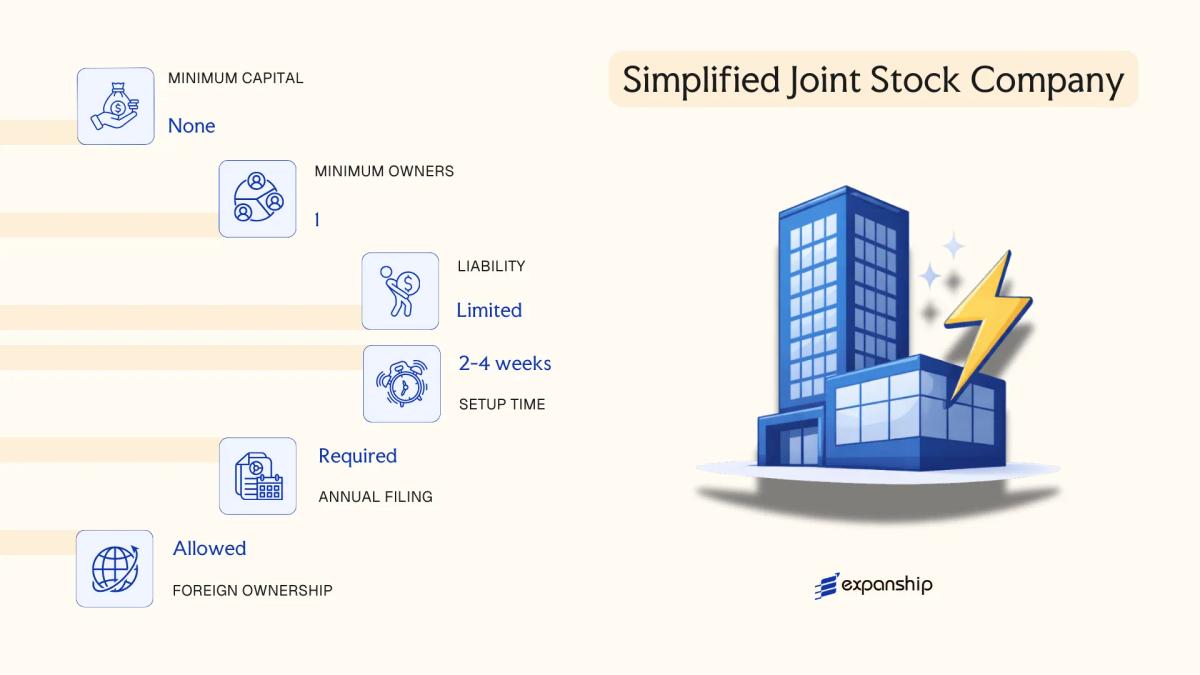
The Société par Actions Simplifiée SAS Côte d'Ivoire is governed by the OHADA Uniform Act on Commercial Companies and Economic Interest Groups, as revised in 2014. Like the SA, it carries separate legal personality and confers limited liability on its shareholders, but its defining characteristic is the degree of contractual freedom accorded to founders in structuring governance through the articles of association.
Because the SAS relies heavily on its bylaws rather than statutory defaults, it functions as a hybrid between a capital company and a contractually governed entity. This makes SAS incorporation in Ivory Coast particularly suited to joint ventures, holding structures, and investor-backed ventures where bespoke governance arrangements are necessary.
Key Characteristics
| Requirement | Detail | Notes |
|---|---|---|
| Legal Form | Simplified Joint Stock Company | Separate legal personality; governed primarily by the articles of association |
| Members | Shareholders; minimum 1, no maximum | Can be natural or legal persons; a single-shareholder SAS is permitted |
| Management | President (mandatory); other officers optional | President represents the company; governance structure is largely defined by the bylaws |
| Local Presence | Registered office required in Côte d'Ivoire | No statutory requirement for a resident director, but a local registered address is mandatory |
| Share Capital | No statutory minimum under the 2014 OHADA Act | Capital is divided into shares; contributions in cash or in kind are permitted |
| Privacy | Shareholder identity disclosed at registration | Beneficial ownership disclosure requirements apply under OHADA and national AML rules |
Focus Points
- Taxation: Subject to corporate income tax at the standard rate of 25%; VAT applies at 18% on taxable supplies; dividends distributed to non-residents attract withholding tax, generally at 15% absent a applicable tax treaty.
- Annual Compliance: Financial statements must be filed annually; statutory audit requirements depend on the thresholds defined in the bylaws or applicable OHADA provisions.
- Treaty Access: As a resident entity, the SAS can access Côte d'Ivoire's double tax treaties, subject to beneficial ownership and substance conditions.
- Conversion: The SAS may be converted into an SA or SARL, subject to compliance with the capital and governance requirements of the target form under OHADA rules.
- Restrictions: The SAS cannot make public offerings of securities, limiting its capital-raising to private placements only.
Closing
The simplified joint stock company suits holding companies, investment vehicles, and multi-party joint ventures where shareholders require tailored governance beyond what standard statutory frameworks provide. Its principal limitation is the restriction on public capital markets access, which constrains growth financing for businesses that may eventually require broad investor participation.
The SAS is best suited for private equity structures, joint ventures between corporate entities, and founder-led businesses seeking flexible shareholder arrangements under a recognised OHADA legal form.
Sole Proprietorship in Côte d'Ivoire [Entreprise Individuelle, Auto-Entrepreneur]
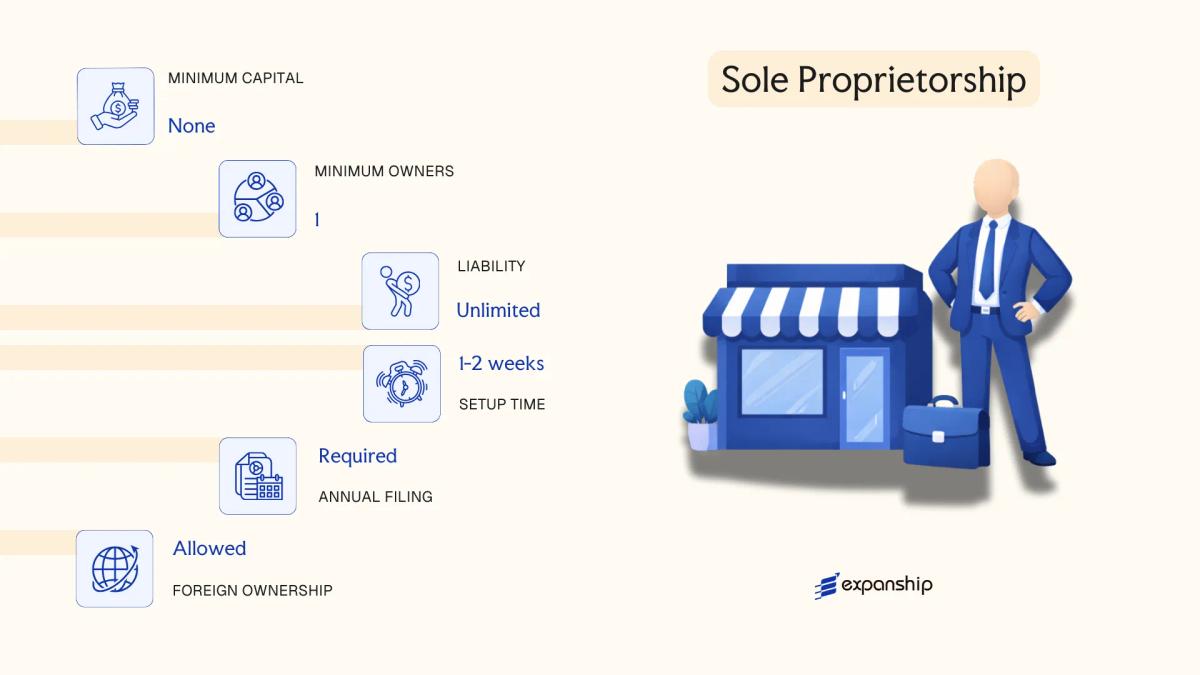
The sole proprietorship in Côte d'Ivoire — known as the Entreprise Individuelle — is governed by the OHADA Uniform Act on General Commercial Law (Acte Uniforme relatif au Droit Commercial Général), most recently revised in 2010. Unlike capital-based entities, it carries no separate legal personality; the business and its owner are treated as one legal unit.
This structure suits individual traders and service providers operating under their own name. The owner bears unlimited personal liability for all business debts, with no legal separation between personal and business assets.
Key Characteristics
| Requirement | Detail | Notes |
|---|---|---|
| Legal Form | Sole Proprietorship (Entreprise Individuelle) | No separate legal personality |
| Owner Title | Proprietor (Exploitant individuel) | Single natural person only |
| Membership | 1 owner; no maximum or minimum beyond that | Cannot have partners or co-owners |
| Local Presence | Registered business address in Côte d'Ivoire required | Must register with the CEPICI (Centre de Promotion des Investissements en Côte d'Ivoire) |
| Capital | No minimum capital requirement | No share capital structure exists |
| Privacy | Owner's identity disclosed in the RCCM (Registre du Commerce et du Crédit Mobilier) | Limited privacy protection |
Focus Points
- Taxation: Subject to the Impôt sur les Bénéfices Industriels et Commerciaux (BIC) or Impôt Synthétique for small operators; VAT applies if annual turnover exceeds the registration threshold; no corporate income tax applies since profits are taxed at the owner level.
- Annual Compliance: Must maintain accounting records and file annual declarations with the Direction Générale des Impôts (DGI); simplified accounting permitted under the système minimal de trésorerie for micro-enterprises.
- Treaty Access: As a non-corporate entity, the proprietor may have limited access to double tax treaty benefits that are structured for companies.
- Conversion: Can be converted into a corporate entity such as an SARL, but requires a formal re-registration process and does not carry over legal continuity automatically.
- Restrictions: Foreign nationals face restrictions on operating as sole traders; specific regulated activities require prior sector-specific authorisation.
Sub-Types
Auto-Entrepreneur
The auto-entrepreneur regime is a simplified registration category introduced to formalise micro-level self-employment. It offers a streamlined enrolment process and a flat-rate tax regime calculated on turnover rather than profit, making administrative compliance lighter than the standard Entreprise Individuelle. This sub-type targets freelancers, artisans, and small service providers whose activity remains below defined turnover thresholds.
Closing Paragraph and Recommendations
The Entreprise Individuelle suits individual traders, artisans, and service providers who operate informally or at small scale and want a low-cost entry into formal commerce. Its primary advantage is the absence of minimum capital and minimal formation costs; its core limitation is unlimited personal liability, which exposes the owner's personal estate to all business obligations.
Best suited for Ivorian nationals or qualifying residents operating a micro or small-scale business who prioritise low administrative cost over liability protection.
How to Choose the Right Entity Type in Côte d'Ivoire
Selecting how to choose the right company type in Côte d'Ivoire requires more than weighing administrative convenience — the wrong structure produces concrete legal and financial consequences that can be difficult to reverse.
Why Your Entity Choice Matters
The OHADA Uniform Act on Commercial Companies (AUSCGIE) governs the available structures, and misalignment between your chosen entity and your actual operations carries real costs:
- Selecting a structure without the capacity to satisfy OHADA's minimum share capital requirements for your sector can result in administrative dissolution.
- Choosing an entity that mandates a statutory auditor (commissaire aux comptes) when your turnover falls below the threshold adds recurring audit costs that are not legally required for smaller firms.
- Forming a SARL when your ownership structure requires publicly tradeable shares locks you into transfer restrictions incompatible with future capital-raising.
- Operating through a representative office while conducting revenue-generating transactions triggers reclassification risk and potential tax exposure under the Direction Générale des Impôts.
Key Factors to Consider
- Business Activity: Active trading, regulated sectors such as banking or insurance, and passive asset-holding each point toward different structures under OHADA rules.
- Ownership and Management: Single-member arrangements may suit a SARL unipersonnelle, while multi-investor setups with governance requirements point toward an SA or SAS.
- Tax Objectives: Your eligibility for specific regimes under the Code Général des Impôts, including the synthetic tax regime for small enterprises, depends on the entity form.
- Liability Exposure: Personal liability in an SNC extends to all partners, whereas capital companies limit exposure to the amount contributed.
- Exit and Restructuring: Not all entity types permit redomiciliation or conversion without dissolution; verify this before formation.
Corporate Compliance Services in Côte d'Ivoire
Maintain good standing under OHADA regulations with structured compliance support for your registered entity.
Conclusion
Choosing the right structure is one of the first substantive decisions you'll make when incorporating a company in Côte d'Ivoire guide searches consistently bring founders back to the OHADA Uniform Act, which governs all commercial entities registered here. The SARL remains the most widely registered form, favoured by small and mid-sized businesses for its simplified governance and capped liability. The SA suits firms requiring broader capital structures or public investor access. An SAS offers the greatest contractual flexibility for joint ventures and holding arrangements. Partnerships — the SNC, SCS, and SCA — serve specific structuring needs rather than general commercial purposes. Branch and representative offices address foreign operators who are not yet ready to establish a locally incorporated entity.
Côte d'Ivoire continues to expand its bilateral investment treaty network and has maintained its position as one of West Africa's more active jurisdictions for foreign direct investment registration. Expanship's formation and compliance services are structured around the procedural requirements of the CEPICI and the OHADA framework.
How Expanship Can Assist You
Expanship's company formation services in Côte d'Ivoire cover every stage of the process, from selecting the right entity — an SA, SARL, SAS, or branch structure — to completing registration with the Centre de Formalités des Entreprises (CFE) at the Tribunal de Commerce d'Abidjan. Our corporate services in Ivory Coast are built around the specific requirements of OHADA-governed entities, not a generic offshore checklist.
From day one, your business has access to structured support across the full incorporation process:
- Document preparation and notarization
- Registered office and legal representative provision
- Government filings and CFE liaison
- Post-incorporation compliance management, including annual obligations
- Corporate account opening introductions with local banks
[Contact Expanship Côte d'Ivoire](ci/contact-us) to discuss your incorporation requirements with a specialist who knows the local regulatory environment firsthand.
Frequently Asked Questions (FAQ)
The SARL (Société à Responsabilité Limitée) is the most frequently registered structure for business setup in Côte d'Ivoire. Its lower minimum capital threshold and simplified governance requirements make it accessible to small and medium-sized enterprises as well as sole operators.
Both are governed under the OHADA AUDSCGIE, but the SA is designed for larger enterprises, requires a minimum share capital of XOF 10,000,000, and may offer shares to the public. A SARL restricts share transferability and carries lower capital requirements, making its compliance burden more manageable for closely held firms.
The SAS (Société par Actions Simplifiée) and SARL do not require full shareholder disclosure in publicly searchable registries in the same manner as an SA. Nominee arrangements are legally possible but must comply with OHADA beneficial ownership disclosure requirements, which limit the extent of confidentiality achievable in practice.
No. An SNC (Société en Nom Collectif) requires at least two partners, and an SCS (Société en Commandite Simple) requires at least one general and one limited partner. A SARL and SAS, by contrast, can each be formed by a single associate or shareholder under OHADA rules.
Foreign nationals may register an SA, SARL, or SAS without restriction on nationality. Branch offices require a parent company established abroad and registration with the RCCM (Registre du Commerce et du Crédit Mobilier). Representative and liaison offices do not permit direct revenue-generating activity, which limits their utility for investors seeking operational presence.
Conversion is permitted under the OHADA AUDSCGIE. A SARL may be converted into an SA once it meets the applicable capital and shareholder thresholds. The process requires a formal decision by the associates, updated articles of association, and re-registration with the RCCM.
The SA, SARL, SAS, SCS, and SNC all acquire separate legal personality upon registration with the RCCM. A sole proprietorship (Entreprise Individuelle) does not create a distinct legal entity, meaning the owner bears unlimited personal liability for business obligations.
Legal Disclaimer
The information provided in this article is for general informational purposes only and does not constitute legal, tax, or professional advice. While we strive to ensure the accuracy and timeliness of the content, laws and regulations are subject to change, and the application of laws can vary widely based on specific facts and circumstances.
Readers should not act upon this information without seeking professional counsel tailored to their individual situation. Expanship and its authors disclaim any liability for actions taken or not taken based on the content of this article.
For specific advice regarding your business setup, compliance requirements, or any legal matters, please consult with qualified legal and tax professionals in the relevant jurisdiction.