
Key Takeaways
- Foreign investors incorporating in Côte d'Ivoire must comply with the OHADA Uniform Act on Commercial Companies, a supranational framework that imposes standardized obligations applicable across all 17 OHADA member states, leaving limited room for jurisdiction-specific flexibility.
- CEPICI registration delays mean that even straightforward incorporation procedures can extend beyond statutory timeframes, creating operational uncertainty for businesses with time-sensitive market entry requirements.
- Corporate and business tax exposure in Côte d'Ivoire adds a significant cost layer for foreign entities, particularly when combined with sector-specific levies and withholding obligations that apply to cross-border transactions.
- Restricted foreign ownership thresholds in certain regulated industries force international investors to structure equity arrangements around local partnership requirements, which can complicate governance and profit repatriation planning.
Côte d'Ivoire operates under the OHADA treaty framework, a supranational commercial law system that imposes standardized yet detailed compliance obligations across its member states. The country's regulatory environment is best described as evolving — formal in structure but uneven in administrative execution, particularly at the agency level.
The disadvantages of incorporating in Côte d'Ivoire span several distinct categories, from registration procedures and capital requirements to tax exposure and enforcement gaps.
Not every foreign investor will encounter all of these drawbacks equally. The specific challenges your business faces depend heavily on its legal structure, sector of operation, and whether foreign nationals hold ownership stakes. A sole-activity trading firm faces a different compliance profile than a joint-venture operating in a regulated industry.
The primary legal reference for commercial entities is the OHADA Uniform Act on commercial companies. This article is most relevant to foreign investors, international SMEs, and multinational subsidiaries considering market entry or formal registration through a local entity.
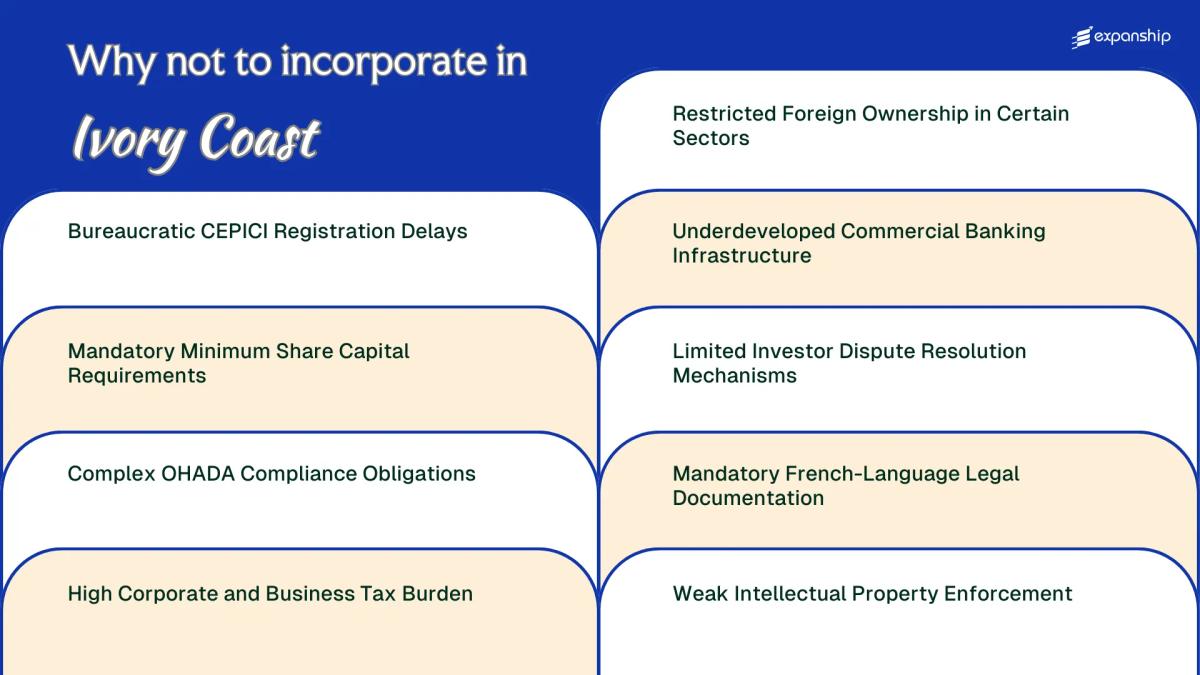
Bureaucratic CEPICI Registration Delays
CEPICI registration delays Côte d'Ivoire represent one of the more persistent friction points for foreign investors, despite the Centre de Promotion des Investissements en Côte d'Ivoire's formal mandate to process new company registrations within 24 to 72 hours.
Gap Between Official Timelines and Operational Reality
The published processing window rarely reflects actual experience. Inter-agency coordination between CEPICI, the tax directorate (DGI), the social security body (CNPS), and the commercial court registry frequently breaks down, extending timelines by days or weeks and leaving your business unable to operate, open bank accounts, or sign contracts in the interim.
Document rejection cycles compound the delay. A single missing apostille, an improperly translated charter, or a formatting discrepancy in the statuts can trigger a full resubmission, restarting the queue rather than resuming from the point of rejection.
Structural Bottlenecks That Affect Foreign Entities Specifically
Foreign-owned entities face additional verification layers not applied uniformly to domestic registrants. Proof of foreign director identity, notarised power of attorney documents, and source-of-capital declarations each require separate authentication steps that are processed sequentially rather than in parallel.
These steps consume time that has direct cost implications, particularly if you have employees, lease agreements, or supplier contracts contingent on a valid registration number being issued.
Until CEPICI issues the Registre du Commerce et du Crédit Mobilier (RCCM) number, your entity has no legal standing to transact, employ staff, or access the formal banking system in Côte d'Ivoire.
Mandatory Minimum Share Capital Requirements
Côte d'Ivoire minimum share capital requirements present a tangible financial barrier before your business generates a single franc of revenue. Under the OHADA Uniform Act on Commercial Companies, a Société Anonyme (SA) requires a minimum share capital of XOF 10,000,000, while a Société à Responsabilité Limitée (SARL) requires XOF 100,000 at formation.
The SA threshold is the sharper obstacle. For early-stage foreign investors or small firms testing a new market, committing XOF 10,000,000 upfront ties up capital that could otherwise fund operations, staffing, or logistics.
Ivory Coast SARL share capital restrictions are comparatively lower, but the SARL structure carries its own limitations on the number of shareholders and share transferability, reducing flexibility for businesses that anticipate growth or external investment.
These requirements create specific operational friction:
- Capital must be deposited before registration completes, delaying your ability to open accounts or sign contracts
- Funds can remain inaccessible during the incorporation review period, creating a liquidity gap
- Foreign-owned SAs face additional scrutiny over capital sourcing, extending timelines further
Côte d'Ivoire SA minimum capital drawbacks affect firms differently depending on structure, and single-member SARLs face their own transfer restrictions under OHADA rules.

Company Incorporation in Côte d'Ivoire
Set up your legal entity in Côte d'Ivoire with guidance on capital requirements, OHADA compliance, and CEPICI registration.
Complex OHADA Compliance Obligations
OHADA compliance challenges in Côte d'Ivoire extend well beyond a simple registration exercise. The OHADA framework, governed by the Organisation pour l'Harmonisation en Afrique du Affaires, imposes a set of Uniform Acts that apply directly without requiring domestic transposition, meaning any breach triggers liability under supranational law rather than local legislation alone.
The Uniform Act on Commercial Companies (AUSCGIE) sets out mandatory governance requirements covering shareholder meetings, auditor appointments, and financial reporting cycles. Foreign-owned entities must appoint a statutory auditor once they cross defined thresholds, an obligation that adds recurring professional costs that many lean-structured foreign subsidiaries are not designed to absorb.
| Requirement | Threshold / Frequency | Practical Burden |
|---|---|---|
| Statutory Auditor Appointment | Mandatory above prescribed capital or turnover thresholds | Recurring annual professional fees, mandatory even for dormant entities above threshold |
| General Assembly (AGO) | Annually within 6 months of fiscal year-end | Director physical or notarized proxy presence required |
| SYSCOHADA Accounting Standards | Mandatory for all commercial entities | Requires certified accountant familiar with OHADA chart of accounts |
| Corporate records filing | Annual financial statements to RCCM | Non-filing risks striking off and personal director liability |
SYSCOHADA, the OHADA-mandated accounting system, differs substantially from IFRS and US GAAP. Your finance team will require either retraining or local outsourcing, both of which generate direct cost exposure.
Director liability under OHADA corporate law risks are not theoretical. The AUSCGIE imposes personal liability on directors for procedural failures, including late filing or failure to convene mandatory shareholder assemblies.
High Corporate and Business Tax Burden
The high corporate tax burden in Côte d'Ivoire sits at a standard rate of 25% on net profits, which already places your firm above several competing West African jurisdictions. Under the Code Général des Impôts, companies are also subject to the Business Licence Tax (patente), the minimum flat tax (impôt minimum forfaitaire), and employer-side payroll contributions that compound the effective cost of operations.
These layered obligations mean the headline 25% rate understates your actual tax exposure. A foreign entity must account for the Employer Contribution to Social Security (CNPS), VAT obligations at 18%, and withholding taxes on dividend remittances to non-resident shareholders.
Profit repatriation carries a withholding tax that directly reduces returns to foreign investors. That cost is structural, not incidental.
- Corporate income tax is assessed at 25% on net profits under the Code Général des Impôts
- An 18% VAT rate applies to most goods and services supplied by registered entities
- The impôt minimum forfaitaire applies even when the company reports a loss
- Dividends remitted to non-resident shareholders are subject to withholding tax
- CNPS employer contributions add to labour costs beyond income tax obligations
Even if your company records zero profit in a fiscal year, the minimum flat tax still generates a payable tax liability under Ivorian law.
Restricted Foreign Ownership in Certain Sectors
Foreign ownership restrictions in Côte d'Ivoire apply selectively but carry real consequences for foreign investors across several industries. Certain sectors are either partially closed or subject to local partnership requirements that reduce operational control.
Sectors Where Foreign Participation Is Capped or Conditioned
Under Ivorian law, sectors such as artisanal mining, coastal fishing, and some media activities impose restrictions on foreign equity participation or require majority Ivorian ownership. Your business may need to structure around a local partner whose stake is not purely nominal, which dilutes decision-making authority and complicates profit distribution arrangements.
Land ownership represents a separate but related constraint. Under the 1998 Rural Land Law and subsequent legislation, foreigners cannot hold freehold title to rural land, which limits direct agricultural investment structures without intermediate arrangements.
Practical Consequences for Foreign-Owned Entities
Mandatory local equity thresholds mean your corporate structure must satisfy both the Investment Code administered by CEPICI and any sector-specific licensing authority, creating a dual compliance burden. Aligning ownership proportions with a local partner while preserving operational control often requires contractual arrangements that add cost and legal complexity.
These restrictions are not uniformly enforced across all industries, so the severity of this disadvantage depends heavily on your target sector. Nonetheless, foreign firms operating in affected industries face a structurally constrained entry position from the outset.
Navigating Foreign Ownership Constraints When Expanding to Côte d'Ivoire
Understand which sectors impose local equity requirements and how your corporate structure may be affected before incorporation.
Underdeveloped Commercial Banking Infrastructure
Côte d'Ivoire banking infrastructure limitations create tangible friction for foreign firms trying to establish operational accounts and move capital efficiently. The commercial banking sector, while growing, remains concentrated in Abidjan and skewed toward larger domestic enterprises.
- Foreign-owned entities frequently face lengthy account-opening procedures at BCEAO-regulated banks, delaying payroll, supplier payments, and capital deployment by weeks or months.
- Correspondent banking relationships between Ivorian banks and international financial institutions are limited, making cross-border wire transfers slower and more expensive than in more integrated markets.
- Trade finance products such as letters of credit and invoice discounting are not uniformly available across the sector, forcing businesses that rely on import-export cycles to accept unfavorable payment terms.
- Digital banking infrastructure lags behind what most foreign executives expect, with many institutions still requiring in-person authorization for routine transactions.
- Credit access for foreign-incorporated entities is constrained, as local lenders typically require collateral structures that non-resident companies cannot easily satisfy under Ivorian law.
Limited Investor Dispute Resolution Mechanisms
Investor dispute resolution risks in Côte d'Ivoire stem from a legal system that, while formally structured, presents practical barriers that disproportionately affect foreign businesses. The national court system operates under civil law principles, but chronic case backlogs and limited judicial specialisation in complex commercial matters mean disputes can remain unresolved for years.
Côte d'Ivoire is a signatory to the OHADA Treaty, which provides access to arbitration under the Common Court of Justice and Arbitration (CCJA) in Abidjan. However, CCJA proceedings still require filings in French, impose procedural timelines that are not always observed in practice, and enforcement of resulting awards against local counterparties can be inconsistent.
Bilateral Investment Treaties (BITs) with certain countries provide access to ICSID arbitration, but this route is only available for investor-state disputes, not commercial disagreements between private parties. For business-to-business conflicts, your options narrow considerably.
- Local courts remain the default forum for most commercial disputes
- Domestic arbitration infrastructure outside the CCJA is underdeveloped
- Enforcement of foreign arbitral awards depends on local court cooperation, which introduces uncertainty
A foreign-owned firm engaged in a contractual dispute with a local supplier could face 18 to 36 months of proceedings in a first-instance commercial court before obtaining a judgment, with no guarantee of enforcement against a locally connected counterparty. The direct cost in legal fees and operational disruption during that period can easily exceed the value of the original contract.
Mandatory French-Language Legal Documentation
French language legal requirements in Côte d'Ivoire are not administrative preference — they are a legal obligation. All corporate documents, contracts, filings, and correspondence with public authorities must be produced in French under national law, with no provision for bilingual submissions to agencies such as the CEPICI or the Tribunal de Commerce.
For a foreign business owner operating in English, German, Chinese, or any other language, every document your firm produces internally must be professionally translated before it carries legal weight. That translation cost accumulates across articles of association, board resolutions, shareholder agreements, and regulatory filings.
Errors in translated legal terminology can invalidate filings or trigger compliance disputes. French legal vocabulary follows civil law tradition, and direct translations from common law jurisdictions frequently produce terminological mismatches that require a locally qualified jurist to correct.
- Contracts signed in any language other than French are not enforceable before Ivoirian courts without a certified French translation.
- Notarial acts, which are required for company formation, must be drafted and executed entirely in French by a locally licensed notaire.
- Tax declarations submitted to the Direction Générale des Impôts must be completed in French using prescribed domestic forms.
Even if your headquarters operate entirely in another language, every statutory document submitted to any Ivoirian authority must be in French, and the cost and legal responsibility for accurate translation rests entirely with your entity.
Weak Intellectual Property Enforcement
Weak IP enforcement in Côte d'Ivoire presents a concrete operational risk for foreign businesses that rely on proprietary trademarks, software, or branded goods. Trademark and patent registrations are processed through OAPI (the African Intellectual Property Organization), which provides regional protection across 17 member states. However, registration through OAPI does not translate into consistent local enforcement on the ground.
Ivorian courts lack specialized IP chambers, meaning disputes are handled by general commercial courts with limited technical expertise in IP matters. Proceedings are slow, and obtaining injunctive relief against infringers is not reliably available within a commercially useful timeframe.
Counterfeit goods circulate openly in major markets including Abidjan's Adjamé district. Your firm may hold a valid OAPI registration and still face sustained brand dilution without a practical legal remedy. The cost of monitoring and pursuing infringement locally often exceeds the value of the enforcement action itself.
Overcoming Incorporation Barriers in Côte d'Ivoire
Overcoming incorporation barriers in Côte d'Ivoire requires structural preparation before entity formation begins, not reactive adjustments after problems emerge. The disadvantages covered in this blog span registration delays, capital requirements, tax obligations, ownership restrictions, and enforcement gaps — each demanding a discrete response.
- Pre-register your business through the CEPICI portal to reduce in-person processing delays at the Guichet Unique.
- Structure your entity's share capital in XOF at the outset to satisfy OHADA Uniform Act minimums without requiring post-incorporation amendments.
- Appoint a locally qualified comptable agréé before filing to address DGI tax registration and annual declaration obligations.
- Review the sectoral foreign ownership schedules under Ivorian investment law before selecting your corporate structure or shareholding arrangement.
- Register trademarks and IP assets with the Organisation Africaine de la Propriété Intellectuelle (OAPI) prior to market entry to establish enforceable rights.
Mitigating Côte d'Ivoire incorporation drawbacks does not eliminate the structural constraints embedded in the OHADA framework or domestic tax code. Navigating Ivory Coast corporate compliance risks remains an ongoing obligation that extends well beyond the registration phase.
Côte d'Ivoire Still a Viable Market
Côte d'Ivoire carries real incorporation barriers — CEPICI delays, tax pressure, sector-level ownership caps, and underdeveloped banking access are not minor frictions. Yet the country remains a credible destination for foreign firms seeking a foothold in Francophone West Africa, underpinned by OHADA's regional legal framework and an economy that has sustained consistent GDP growth.
| Pros | Cons |
|---|---|
| OHADA provides a codified, regionally consistent commercial law framework that courts across member states apply. | CEPICI registration timelines frequently extend beyond published targets due to interagency bottlenecks. |
| Abidjan functions as a regional financial and logistics hub, offering access to broader West African markets. | Minimum share capital requirements under OHADA's SARL and SA structures lock up capital at the point of formation. |
| The government has enacted investment promotion measures through the Investment Code to attract foreign capital. | Foreign ownership is prohibited or capped in sectors including mining and certain media activities. |
| CFA franc convertibility reduces currency exchange risk for firms operating across the UEMOA zone. | Intellectual property rights, though formally registered via OAPI, face weak domestic enforcement in practice. |
Corporate Compliance Services in Côte d'Ivoire
Ongoing compliance obligations for companies registered in Côte d'Ivoire span OHADA reporting requirements, tax filings with the Direction Générale des Impôts, and annual statutory maintenance. This service covers the full scope of post-incorporation compliance for foreign-owned entities.
Conclusion
The Côte d'Ivoire company formation drawbacks summary points to a jurisdiction with genuine commercial potential, offset by structural friction that demands careful planning. OHADA compliance obligations impose ongoing administrative costs that extend well beyond the incorporation stage. Foreign ownership restrictions in strategic sectors can materially limit how your business is structured from the outset. Weak intellectual property enforcement adds long-term commercial exposure that contractual protections alone cannot fully address. Professional legal and compliance support specific to the Ivorian regulatory environment remains the most direct way to manage these risks before they affect operations.
Expanship's Côte d'Ivoire Expansion Services
Côte d'Ivoire's incorporation environment carries real operational weight: CEPICI registration delays, OHADA compliance obligations, sector-specific foreign ownership restrictions, and French-language documentation requirements all demand local knowledge and consistent follow-through. Expanship's Côte d'Ivoire expansion services are structured to reduce the administrative burden these requirements place on your business, particularly during the formation stage and into ongoing compliance.
Expanship supports foreign businesses entering Côte d'Ivoire across the full setup and maintenance cycle.
- Your company registration and all associated document preparation are handled end to end.
- A registered agent and local office address are provided to satisfy statutory presence requirements.
- Expanship liaises directly with government agencies and regulatory bodies on your behalf.
- Post-incorporation compliance obligations are monitored and managed on an ongoing basis.
- Banking introductions are facilitated to help your entity establish a functional local account.
- Tax registration and liaison with local fiscal authorities are coordinated from the outset.
To discuss your setup in Côte d'Ivoire, contact Expanship Côte d'Ivoire.
Frequently Asked Questions (FAQ)
The requirement varies by legal structure under OHADA's Uniform Act on Commercial Companies. A Société Anonyme (SA) requires a minimum share capital of XOF 10,000,000, while a Société à Responsabilité Limitée (SARL) requires XOF 100,000. Both amounts must be deposited before registration is finalized, which creates a liquidity barrier even for the lower-threshold structure.
Non-compliance with OHADA's Uniform Acts can result in civil liability for directors, contract nullification, and in serious cases, forced dissolution of the entity. The OHADA framework is supranational, meaning Côte d'Ivoire's national courts apply these rules uniformly and cannot override them. Directors personally bear responsibility for certain filing and governance failures under the Uniform Act on Commercial Companies.
Côte d'Ivoire's standard corporate income tax rate sits at 25%, which is not the highest in the ECOWAS region but becomes significantly heavier when combined with the business tax (patente), the employer payroll contributions, and the 18% VAT rate. Firms operating across multiple West African markets often find the combined effective tax burden in Côte d'Ivoire higher than in jurisdictions such as Senegal or Ghana once all levies are aggregated. The tax structure creates a compounding cost effect that catches underprepared foreign firms off guard.
Restrictions apply most directly in sectors including mining, media, and land ownership, where Ivorian law either caps foreign equity participation or requires local partnership arrangements. The Mining Code, for instance, includes provisions that reserve certain operational rights and participation thresholds for Ivorian nationals or the state entity. Enforcement seriousness varies by sector, but non-compliance with ownership rules can void licensing agreements and expose directors to regulatory penalties.
No. All legally binding corporate documentation, regulatory filings, and court submissions must be in French, as Côte d'Ivoire's official language is French and the OHADA framework operates exclusively in French within the country's jurisdiction. Foreign firms that rely on English-language internal documents must have them formally translated and, in some cases, notarized before submission to authorities. Operating without compliant French-language documentation can result in filings being rejected or contracts being unenforceable in local courts.
Registration with the African Intellectual Property Organization (OAPI), to which Côte d'Ivoire is a member state, provides formal legal protection across all 17 OAPI member countries, but enforcement on the ground remains inconsistent. Counterfeiting and trademark infringement cases move slowly through Ivorian courts, and rights holders often face difficulties obtaining injunctions or damages in a commercially useful timeframe. For businesses where brand integrity or proprietary technology is central to operations, this enforcement gap represents a material business risk.
Foreign investors can reference the OHADA Uniform Act on Arbitration and pursue arbitration through bodies such as the Arbitration Centre of the Common Court of Justice and Arbitration (CCJA), but domestic court proceedings remain slow and outcomes less predictable for foreign parties. Bilateral Investment Treaties to which Côte d'Ivoire is a signatory may provide ICSID arbitration access for qualifying disputes, though the process is lengthy and costly. In practice, many foreign firms absorb smaller commercial losses rather than pursue formal resolution, which reflects the practical weakness of the dispute resolution infrastructure.
Legal Disclaimer
The information provided in this article is for general informational purposes only and does not constitute legal, tax, or professional advice. While we strive to ensure the accuracy and timeliness of the content, laws and regulations are subject to change, and the application of laws can vary widely based on specific facts and circumstances.
Readers should not act upon this information without seeking professional counsel tailored to their individual situation. Expanship and its authors disclaim any liability for actions taken or not taken based on the content of this article.
For specific advice regarding your business setup, compliance requirements, or any legal matters, please consult with qualified legal and tax professionals in the relevant jurisdiction.