
Key Takeaways
- Côte d'Ivoire's Investment Code can substantially reduce corporate tax liability during a company's early operating years, making it a structurally meaningful incentive for long-term investors rather than an incidental concession.
- Businesses registered in Abidjan gain enforceable legal standing across all 17 OHADA member states through the framework's Uniform Acts, reducing the cost and duplication typically associated with multi-jurisdiction West African operations.
- CEPICI's one-stop registration process consolidates what would otherwise be separate administrative procedures into a single point of contact, directly shortening the timeline for a foreign investor to establish a recognised legal entity.
- The Code Général des Impôts governs a defined corporate tax regime that, when combined with applicable double taxation treaties, provides foreign investors with a measurable degree of fiscal predictability on cross-border structures.
Côte d'Ivoire is a sovereign West African nation and the region's largest economy by GDP, sharing borders with six countries and anchored by Abidjan, its commercial capital. Businesses seeking the benefits of incorporating in Côte d'Ivoire typically register through the Centre de Promotion des Investissements en Côte d'Ivoire, the official one-stop investment and registration authority. The most common vehicle used by foreign investors to establish a local presence is the Société à Responsabilité Limitée.
On taxation, the country operates a standard corporate tax regime governed by the Code Général des Impôts, with treaty-based arrangements providing additional relief for qualifying cross-border structures. Foreign ownership is generally permitted across most sectors, and the government has maintained a policy posture oriented toward attracting foreign direct investment, particularly since the adoption of the revised Investment Code.
This article examines the principal advantages that the jurisdiction's legal, regulatory, and fiscal environment offers to businesses considering Côte d'Ivoire company formation.
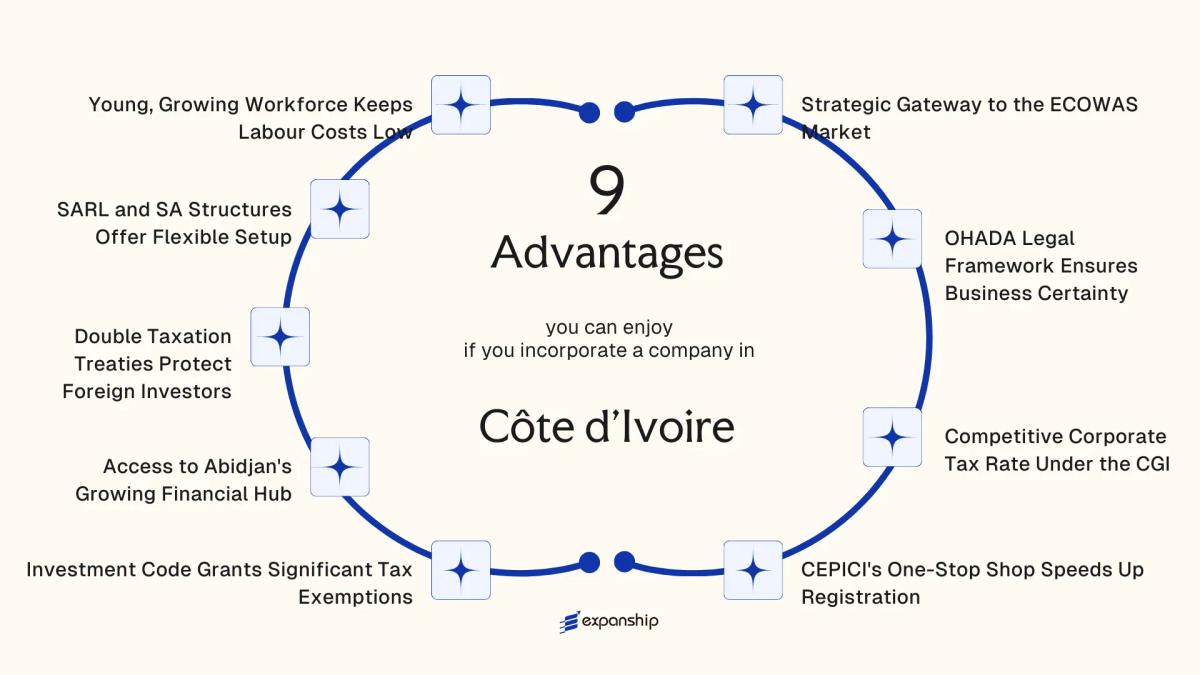
Strategic Gateway to the ECOWAS Market
Côte d'Ivoire ECOWAS market access benefits are grounded in geography and treaty architecture. As a founding member of the Economic Community of West African States, a company incorporated here gains preferential trading rights across a bloc of 15 countries with a combined population exceeding 400 million people.
Free Movement of Goods Within the Bloc
Under the ECOWAS Trade Liberalisation Scheme (ETLS), goods originating from registered community enterprises move across member states free of customs duties and quantitative restrictions. Your firm must obtain ETLS approval, which certifies the product as originating within the community, but once granted, that status opens duty-free distribution from Dakar to Lagos without renegotiating access country by country.
Abidjan as a Regional Distribution Point
The Port of Abidjan is the largest container port in West Africa by throughput, making it a practical entry point for goods destined beyond national borders. Businesses that establish their regional operations here can distribute into landlocked member states — Mali, Burkina Faso, and Niger among them — through well-developed road and rail corridors that connect directly to the port.
ETLS-certified status from a Côte d'Ivoire entity gives your products duty-free access across 15 ECOWAS markets without requiring separate trade agreements in each country.
OHADA Legal Framework Ensures Business Certainty
Côte d'Ivoire is a member of OHADA, the Organisation pour l'Harmonisation en Afrique du Droit des Affaires, a treaty-based legal system that standardises commercial law across 17 member states. For foreign investors, the OHADA legal framework benefits Côte d'Ivoire by replacing fragmented national rules with a single, codified body of business law. That uniformity means your legal team does not need to re-learn an entirely distinct system when operating across multiple OHADA jurisdictions.
The Uniform Acts — binding texts that govern company formation, contracts, securities, insolvency, and arbitration — apply directly in all member states without requiring separate national transposition. This direct applicability reduces the risk of local legislative gaps or inconsistent judicial interpretation.
Disputes are subject to final appellate review by the Common Court of Justice and Arbitration (CCJA), seated in Abidjan. Having a supranational court of last resort gives foreign firms a degree of procedural predictability that purely domestic court systems often cannot offer.
Several features make the legal environment particularly accessible for foreign-owned entities:
- Uniform Acts are publicly available in French, the working language of OHADA, removing ambiguity about applicable rules
- The CCJA arbitration mechanism provides a neutral forum without relying solely on local courts
- Standardised company statutes under the OHADA Uniform Act on Commercial Companies reduce drafting complexity for incorporation documents
Eligibility for CCJA arbitration is generally established through a contractual clause referencing OHADA arbitration rules.

Company Incorporation in Côte d'Ivoire
Incorporate your business in Côte d'Ivoire under the OHADA legal framework with full compliance support from Expanship.
Competitive Corporate Tax Rate Under the CGI
Côte d'Ivoire's corporate tax rate under the Code Général des Impôts (CGI) is set at 25% on net taxable profits. This positions the country's standard rate below several comparable economies in the region, and meaningfully below the OECD average of around 23.6% when weighted by GDP -- though the more relevant comparison for West Africa is that a number of peer economies apply rates between 25% and 35%. For a foreign investor establishing a subsidiary or locally incorporated entity, a 25% headline rate provides a defined, predictable baseline from which tax planning can begin.
| Parameter | Detail |
|---|---|
| Standard Corporate Tax Rate | 25% on net taxable profits |
| Governing Legislation | Code Général des Impôts (CGI) |
| Minimum Tax (IMF) | Applies where standard tax liability falls below a set threshold |
| Tax Year | Calendar year (1 January to 31 December) |
| Filing Currency | West African CFA franc (XOF) |
The CGI also provides for a minimum flat tax, known as the Impôt Minimum Forfaitaire (IMF), which applies when a company's calculated corporate tax liability falls below the statutory minimum. Understanding this threshold matters for early-stage businesses that may initially operate at a loss or low profit.
For your business, the 25% rate means that retained profits are taxed at a level that does not erode reinvestment capacity as sharply as higher-rate jurisdictions might. Combined with the CGI's defined treatment of deductible expenses, foreign firms can structure their Ivorian operations with reasonable confidence in their effective tax burden from the outset.
CEPICI's One-Stop Shop Speeds Up Registration
Established by Decree No. 2012-867, the Centre de Promotion des Investissements en Côte d'Ivoire (CEPICI) operates a one-stop shop that consolidates company registration tasks under a single administrative roof. The CEPICI one-stop shop benefits Côte d'Ivoire-bound investors by eliminating the need to visit multiple ministries or agencies independently. Registration that once required weeks of sequential filings can now be completed within 24 to 48 hours in standard cases.
For a foreign business owner, this compression of timelines has a direct financial consequence: your entity can begin operating, opening bank accounts, and contracting locally far sooner than regional norms typically allow. CEPICI coordinates with the Registre du Commerce et du Crédit Mobilier (RCCM), tax authorities, and the social security body (CNPS) within one submission process.
- Confirm your chosen legal structure before submission, as documents vary between an SARL and an SA
- Ensure notarised statutes are prepared in French prior to filing
- Obtain your Numéro de Compte Contribuable (NCC) through the same process; it is required before any fiscal declaration
Fast company registration benefits extend beyond speed. Reduced administrative contact points mean fewer opportunities for procedural delays tied to incomplete filings across separate agencies.
CEPICI's one-stop shop also handles investment declarations for projects above certain thresholds, meaning registration and preliminary investment approval can overlap in the same process.
Investment Code Grants Significant Tax Exemptions
Côte d'Ivoire's Investment Code, formally structured under Law No. 2018-646, grants qualifying companies significant relief from standard tax obligations during the establishment and operational phases of a project. For foreign investors assessing cost structures before entry, these exemptions directly reduce the fiscal burden during the years when capital outlay is highest.
Phased Tax Relief During Setup and Operations
Under the Investment Code, approved projects benefit from exemptions on duties and taxes applicable to equipment imports, as well as relief from certain indirect taxes during the installation phase. Once operational, eligible businesses can access multi-year exemptions on corporate income tax, reducing the effective tax rate well below the standard rate applied under the Code Général des Impôts. The length of the exemption period varies depending on investment size, sector, and geographic location within the country, with projects sited outside Abidjan typically qualifying for extended benefit periods to encourage regional development.
Conditions That Define Eligibility
Approval from the Centre de Promotion des Investissements en Côte d'Ivoire (CEPICI) is required to access these incentives, meaning the benefits are not automatic upon incorporation. Your business must submit an investment application that meets minimum thresholds and satisfies sector-specific criteria outlined in the Code. Priority sectors, including agro-industry, manufacturing, and digital services, are explicitly listed in the legislation, which means your firm's classification directly determines the scope of tax holiday advantages available to it.
Maximize Your Tax Position in Côte d'Ivoire
Speak with our team about qualifying for investment code exemptions and structuring your entity to access the full range of available fiscal benefits.
Access to Abidjan's Growing Financial Hub
Abidjan financial hub advantages for businesses are closely tied to the city's position as the most active financial centre in Francophone West Africa. The BRVM (Bourse Régionale des Valeurs Mobilières), the regional stock exchange serving all eight UEMOA member states, is headquartered in Abidjan. A company incorporated locally gains direct proximity to this exchange and to the regional capital markets it connects.
- Banking access is a practical consideration for any foreign entity. Abidjan hosts the regional headquarters of major international banks alongside established West African banking groups, giving your business a genuine choice of institutional partners rather than a limited local market.
- The CFA franc (XOF), managed by the BCEAO under the UEMOA monetary union, maintains a fixed parity with the euro. This removes currency conversion risk for European counterparties and provides exchange rate predictability that benefits financial planning.
- Abidjan's status as the BCEAO's operational base means monetary policy decisions and regulatory communications are issued locally, reducing administrative friction for firms that need direct engagement with the central bank.
- For companies in financial services, insurance, or asset management, proximity to both the BRVM and the regional insurance regulator CIMA means compliance interactions and licensing processes are conducted within a single city rather than across multiple jurisdictions.
Double Taxation Treaties Protect Foreign Investors
Côte d'Ivoire has concluded double taxation treaties with several countries, including France, Belgium, Norway, and Canada, along with multilateral arrangements through the WAEMU fiscal framework. For a foreign company repatriating dividends, interest, or royalties, these agreements define the maximum withholding tax rates that can be applied at source — removing the risk of the same income being taxed twice in both the host country and your home jurisdiction.
Under a typical DTT, withholding rates on dividends paid to foreign shareholders may be reduced below the standard domestic rate set in the Code Général des Impôts. That reduction directly lowers the tax cost of extracting profits from your Ivorian entity, which affects the actual after-tax return on your investment rather than just the headline corporate rate.
Treaty protection also extends to permanent establishment definitions. A clear contractual or service arrangement that does not constitute a permanent establishment under the applicable DTT means your foreign parent company avoids an additional corporate tax exposure in-country.
A foreign shareholder in a treaty-eligible structure receiving CFA 10,000,000 in dividends annually could see withholding tax reduced from the standard 15% domestic rate to a lower treaty rate — retaining an additional CFA 500,000 or more per year depending on the applicable treaty terms.
SARL and SA Structures Offer Flexible Setup
Under the OHADA Uniform Act on Commercial Companies, Côte d'Ivoire recognises two primary corporate vehicles for foreign investors: the Société à Responsabilité Limitée (SARL) and the Société Anonyme (SA). Each structure carries distinct capital and governance requirements, giving you a genuine choice based on the scale and nature of your operations.
The SARL requires a minimum share capital of XOF 100,000, making it accessible for smaller ventures or single-purpose entities. Liability is capped at each shareholder's contribution, which protects your personal and external assets from business obligations.
The SA suits larger operations with multiple shareholders or those planning to raise capital from the public. It requires a minimum share capital of XOF 10,000,000 and allows the issuance of transferable shares, which supports institutional investment and future equity transactions.
- The SARL can be formed by a single shareholder, giving sole founders a compliant, limited-liability structure without requiring a local partner.
- SA governance follows a board structure, which can satisfy the compliance expectations of foreign parent companies or institutional stakeholders.
- Both entity types are governed by the same OHADA framework across member states, reducing structural unfamiliarity for investors already operating elsewhere in the zone.
The SA requires at least two shareholders at incorporation under OHADA rules, so a sole foreign founder cannot use this structure without a second party involved.
Young, Growing Workforce Keeps Labour Costs Low
Côte d'Ivoire's young workforce advantages for businesses begin with a fundamental demographic reality: the country's median age sits below 20 years, producing a large and expanding pool of working-age candidates entering the labour market each year. For a foreign-owned firm, this translates directly into hiring flexibility and wage structures that remain competitive against comparable Francophone African markets.
Minimum wage obligations are set under the Salaire Minimum Interprofessionnel Garanti (SMIG), which applies across employment sectors and establishes the statutory floor for remuneration. Because the SMIG rate is significantly below minimum wage thresholds in OECD economies, labour-intensive operations carry a lower fixed cost base than they would in many other regions. This difference is material when projecting staffing budgets across mid-sized or scaled operations.
Employment relationships are governed by the Code du Travail, which defines contract types, termination procedures, and employer contribution obligations. Understanding these obligations in advance allows your business to structure headcount accurately before entering the market.
Key labour cost considerations under Ivorian law include:
- Social security contributions are split between employer and employee, with the employer share managed through the Caisse Nationale de Prévoyance Sociale (CNPS)
- Fixed-term and open-ended contracts are both recognised, giving firms staffing flexibility suited to project-based or permanent operations
- Sectoral collective agreements (conventions collectives) may set wages above the SMIG floor in specific industries, which affects cost planning in sectors such as construction or agro-industry
Why Côte d'Ivoire Stands Out Among West African Business Destinations
Côte d'Ivoire stands out as a top West Africa business destination when measured against the jurisdictions foreign investors most commonly evaluate in parallel. Ghana, Senegal, and Nigeria are the realistic alternatives for a company targeting the West African market, each offering some overlapping features but diverging sharply on legal framework uniformity, registration infrastructure, and treaty coverage. The comparison is useful precisely because those differences are structural, not marginal.
Across the region, legal fragmentation is a persistent operational risk. Côte d'Ivoire's position within the OHADA system places it under a unified commercial law framework shared by 17 member states, which reduces the legal due diligence burden when operating across borders. Ghana and Nigeria, as common law jurisdictions outside OHADA, require a separate legal readjustment for any investor already established in francophone Africa. Senegal shares the OHADA framework but lacks Abidjan's depth as a financial centre and has a smaller domestic consumer base.
| Parameter | Côte d'Ivoire | Ghana | Senegal | Nigeria |
|---|---|---|---|---|
| Legal framework | OHADA (unified civil law) | Common law (national) | OHADA (unified civil law) | Common law (national) |
| One-stop registration body | CEPICI | Ghana Registrar-General | APIX | CAC |
| Standard corporate tax rate | 25% | 25% | 30% | 30% |
| Investment code tax exemptions | Yes, under the 2012 Investment Code | Yes, under GIPC Act | Yes, under Investment Code | Yes, sector-specific |
| Double taxation treaties | Yes, multiple bilateral treaties | Yes, limited coverage | Yes, limited coverage | Yes, wider network |
| Regional trade bloc access | ECOWAS + UEMOA | ECOWAS | ECOWAS + UEMOA | ECOWAS |
| Primary financial hub | Abidjan (regional HQ for multinationals) | Accra | Dakar | Lagos |
Compliance Services for Companies in Côte d'Ivoire
Maintain your company's good standing with ongoing compliance support, from annual filings to regulatory reporting under Ivorian law.
Conclusion
Côte d'Ivoire presents a coherent case for foreign incorporation: a harmonised legal framework under OHADA, a one-stop registration process through CEPICI, and an Investment Code that can substantially reduce your tax liability during the early years of operation. These are not incidental features but structural conditions that directly affect the cost, speed, and legal security of establishing a business entity here.
The benefits of incorporating in Côte d'Ivoire are most pronounced for businesses that intend to operate across the ECOWAS region. OHADA's Uniform Acts, enforceable in 17 member states, mean that the legal work done to establish your company in Abidjan carries predictable weight beyond the country's borders. For investors prioritising regional reach, that consistency reduces legal duplication and operational friction across multiple markets.
The advantages of doing business in Côte d'Ivoire depend on your specific industry, intended structure, and investment horizon. A firm seeking short-term trading arrangements will experience this environment differently from one planning a long-term manufacturing or financial services operation eligible for priority regime status under the Investment Code. The legal and fiscal conditions are well-defined; the question is how precisely they align with your business model. Engaging qualified local counsel alongside a corporate services provider familiar with CEPICI procedures and CGI provisions is a practical starting point for assessing that fit.
Start Your Côte d'Ivoire Company Formation With Expanship Today
Expanship assists foreign investors with company formation in Côte d'Ivoire across the entity types discussed throughout this blog, including the SARL and SA structures governed under the OHADA Uniform Act on Commercial Companies. The firm handles filings with CEPICI, the Centre de Promotion des Investissements en Côte d'Ivoire, and supports compliance with the Code Général des Impôts and the Investment Code incentive regimes.
Services cover the full incorporation and maintenance cycle:
- Document preparation, notarisation, and legalization for foreign-sourced records
- Registered agent and registered office provision within Abidjan
- Government filing and direct liaison with CEPICI and the Tribunal de Commerce
- Post-incorporation compliance management, including annual returns and accounting obligations under OHADA's SYSCOHADA reporting standards
- Banking introduction assistance to support corporate account opening with local financial institutions
Expanship Côte d'Ivoire is available to discuss your incorporation requirements directly.
Frequently Asked Questions (FAQ)
The standard corporate income tax rate under the Code Général des Impôts is 25%. This rate applies to net taxable profits, and businesses operating in qualifying sectors or holding approved investment status under the Investment Code may benefit from reduced rates or temporary exemptions during defined periods of activity.
Through CEPICI's one-stop shop, company registration can be completed within 24 to 48 hours under standard conditions. This timeline covers the core incorporation formalities; ancillary requirements such as sector-specific licences or tax registration follow-up may extend the overall setup period depending on the nature of the business.
The Investment Code provides exemptions that can include relief from customs duties on capital equipment and partial or full corporate tax holidays, typically tied to investment thresholds and job creation commitments. Eligibility depends on the declared investment amount, the sector of activity, and the regime under which the application is approved by the relevant authority.
Côte d'Ivoire has concluded double taxation treaties with several countries, primarily within the UEMOA and broader francophone African grouping, as well as with France. These agreements allocate taxing rights between contracting states, which reduces the risk of the same income being taxed twice and provides greater predictability on withholding tax rates applied to dividends, interest, and royalties paid to non-resident shareholders.
Under the OHADA Uniform Act on Commercial Companies, the minimum share capital for a SARL was removed as a fixed statutory floor, meaning founders can in principle set a nominal amount. However, banks and public procurement bodies may apply their own capital thresholds when assessing creditworthiness or eligibility, so the practical consideration goes beyond the statutory minimum.
Failure to meet ongoing compliance obligations, such as filing annual financial statements with the RCCM or holding statutory general meetings as required under the OHADA framework, can result in administrative penalties and, in serious cases, court-ordered dissolution. Directors bear personal liability for certain compliance failures under OHADA rules, which makes maintaining accurate corporate records a material legal obligation rather than a procedural formality.
Legal Disclaimer
The information provided in this article is for general informational purposes only and does not constitute legal, tax, or professional advice. While we strive to ensure the accuracy and timeliness of the content, laws and regulations are subject to change, and the application of laws can vary widely based on specific facts and circumstances.
Readers should not act upon this information without seeking professional counsel tailored to their individual situation. Expanship and its authors disclaim any liability for actions taken or not taken based on the content of this article.
For specific advice regarding your business setup, compliance requirements, or any legal matters, please consult with qualified legal and tax professionals in the relevant jurisdiction.