
Key Takeaways
- Companies incorporating in the DRC under the OHADA Uniform Act on Commercial Companies and Economic Interest Groups must meet share capital thresholds that differ depending on whether the entity is structured as a Société par Actions Simplifiée or a Société à Responsabilité Limitée.
- A physical registered office address within the DRC is a mandatory registration requirement, and documentation evidencing that address must be submitted to the Guichet Unique de Création d'Entreprise (GUCE) as part of the incorporation process.
- Beneficial ownership disclosure obligations are enforced through the CENAREF framework, requiring entities to identify and report their ultimate beneficial owners as a condition of compliant registration and ongoing operation.
- Foreign investors entering through equity participation or subsidiary structures must appoint directors who satisfy the conditions prescribed under the OHADA Uniform Act, and must also register with the DGRAD alongside the relevant trade registry before the entity acquires legal standing to operate.
Company formation in the Democratic Republic of the Congo is governed primarily by the OHADA Uniform Act on Commercial Companies and Economic Interest Groups, which the DRC adopted upon joining the Organisation for the Harmonisation of Business Law in Africa in 2012. The Guichet Unique de Création d'Entreprise (GUCE) serves as the single-window authority overseeing entity registration.
This article addresses the principal incorporation requirements across structural, documentary, and compliance categories that apply to businesses registering in the country.
Failure to satisfy these conditions results in rejection of the registration application or, if deficiencies emerge post-registration, potential sanctions and loss of legal standing to operate.
Requirements differ depending on the legal form chosen, whether a Société par Actions Simplifiée or a Société à Responsabilité Limitée, and may also vary by sector due to additional regulatory oversight from line ministries.
Foreign investors establishing a commercial presence, particularly those entering through equity participation or subsidiary structures, will find this article most directly applicable to their situation.
Minimum Share Capital Requirements in the Democratic Republic of the Congo
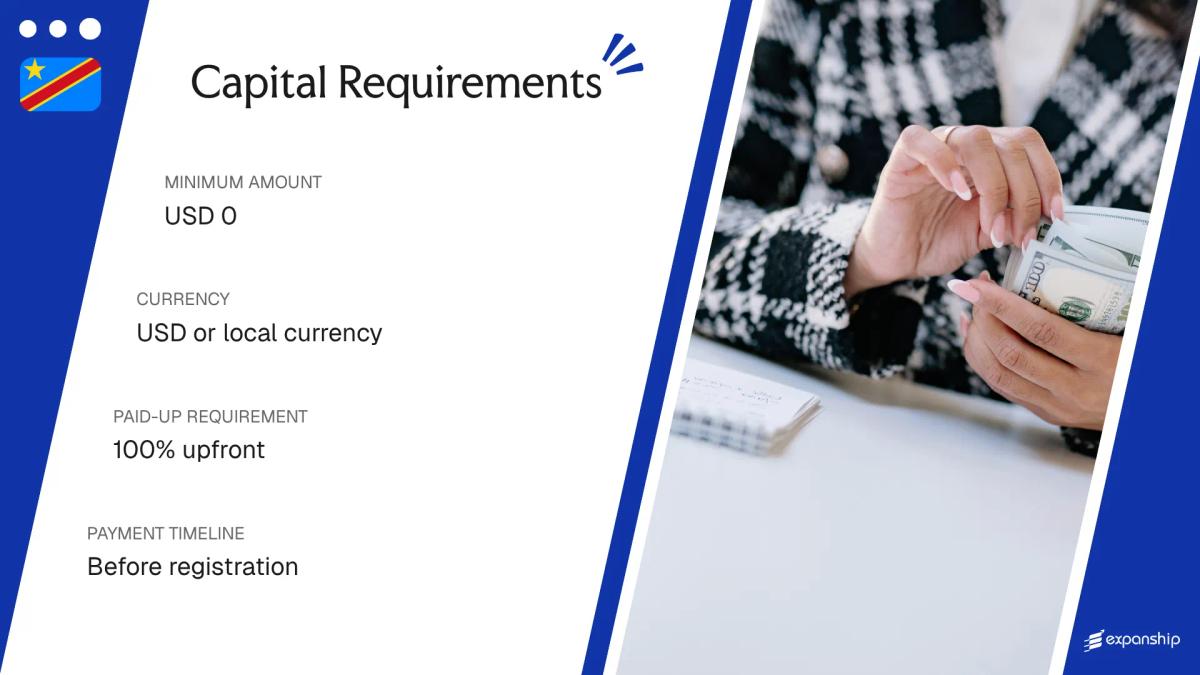
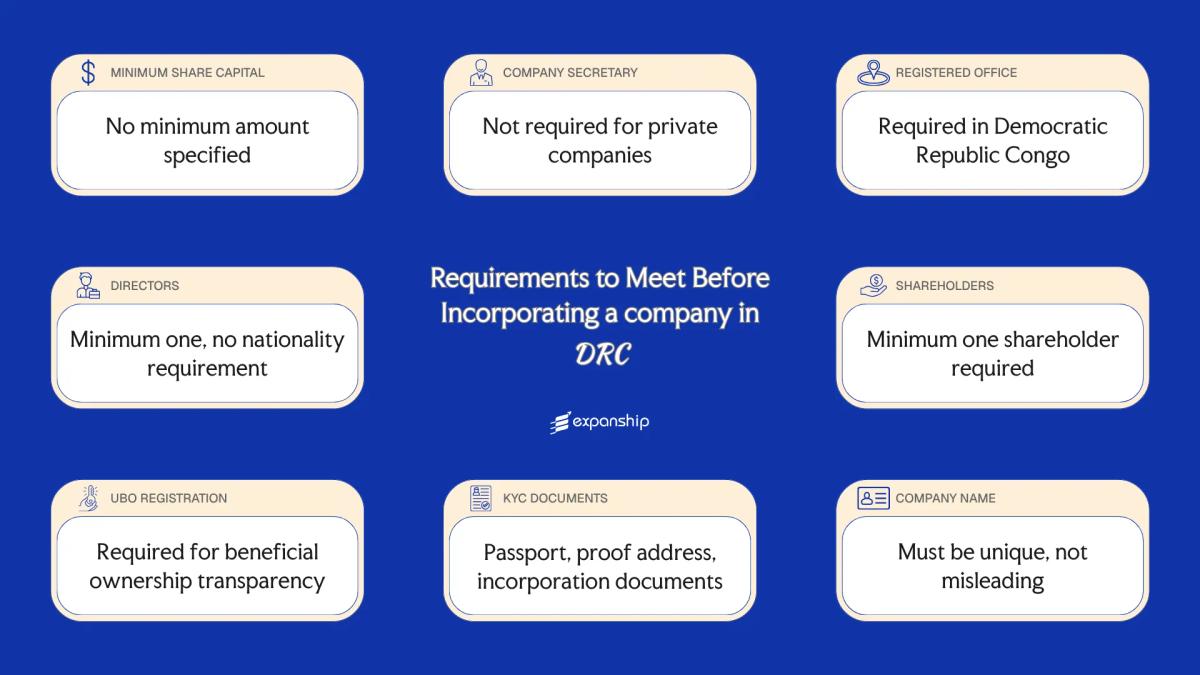
Under the OHADA Uniform Act on Commercial Companies, which governs corporate law across member states including the Democratic Republic of the Congo, minimum share capital requirements DRC businesses must meet depend on the legal form chosen. The Société à Responsabilité Limitée (SARL) and the Société Anonyme (SA) each carry distinct capital thresholds set by OHADA legislation rather than domestic Congolese statute.
Capital contributions are verified at the point of incorporation through the Guichet Unique de Création d'Entreprise (GUCE), the single-window registration authority. Paid-up capital must be deposited with an approved financial institution before registration is finalized, and the deposit certificate forms part of the incorporation file.
| Parameter | Detail |
|---|---|
| Minimum Authorized Share Capital | SARL: XAF 1,000,000; SA: XAF 10,000,000 (OHADA Uniform Act) |
| Maximum Authorized Share Capital | No statutory maximum |
| Minimum Paid-Up Capital | SARL: 50% at incorporation; SA: 50% at incorporation |
| Paid-Up Requirement at Incorporation | 50% of subscribed capital; balance payable within two years |
| Accepted Currency | Congolese Franc (CDF); foreign currency permissible in practice |
| Accepted Forms of Contribution | Cash and in-kind contributions; in-kind assets require auditor valuation |
| Timeframe to Deposit Capital | Prior to filing incorporation documents with GUCE |
The bank deposit certificate confirming paid-up capital must be obtained before submitting your incorporation dossier to GUCE. Registration will not proceed without it.
Company Secretary Requirements in the Democratic Republic of the Congo
Under the OHADA Uniform Act on Commercial Companies, which applies in the Democratic Republic of the Congo, the company secretary requirements DRC businesses must observe depend on the chosen legal structure. Not all entity types carry a mandatory company secretary obligation, but certain formalities around corporate administration remain enforceable under OHADA-governed governance rules.
For a Société par Actions Simplifiée (SAS) or a Société Anonyme (SA), a designated officer responsible for maintaining statutory records and coordinating with the RCCM (Registre du Commerce et du Crédit Mobilier) is standard practice. DRC corporate secretary obligations typically include preparing board minutes, maintaining the company's statutory registers, and ensuring timely filing of resolutions with the competent court-affiliated commercial registry.
Qualification criteria for who may serve in this capacity include:
- No statutory requirement under OHADA mandates that the officer be a Congolese national or resident.
- A corporate entity may be appointed to fulfill this administrative function where the company's statutes permit.
- The individual or entity must have legal capacity to act on behalf of the company.
- No specific professional license is prescribed under OHADA for this role, though legal or administrative qualifications are common in practice.

Incorporate a Company in the Democratic Republic of the Congo
Set up your legal entity in the DRC with guidance on OHADA compliance, registry procedures, and ongoing corporate administration.
Registered Office Requirements in the Democratic Republic of the Congo
Under the OHADA Uniform Act on Commercial Companies and Economic Interest Groups, which applies directly in the Democratic Republic of the Congo, every company must maintain a siège social — a registered legal seat — at a fixed, physical address located within the territory where it is formally constituted.
- A physical address is required; a P.O. box alone does not satisfy the siège social requirement.
- The address must be situated within the DRC; a foreign address cannot serve as the legal seat.
- Either ownership of the premises or a valid lease agreement must support the declared address.
- Virtual offices are not formally recognised as compliant registered office addresses under OHADA rules applicable in the country.
- The siège social is recorded in the Registre du Commerce et du Crédit Mobilier (RCCM) and is publicly accessible.
- Any change to the registered address requires a formal amendment to the company's statuts and updated filing with the RCCM.
- Failure to maintain a compliant address can expose the entity to administrative sanctions and may affect the legal validity of official correspondence and court notifications served at that address.
Director Requirements in the Democratic Republic of the Congo
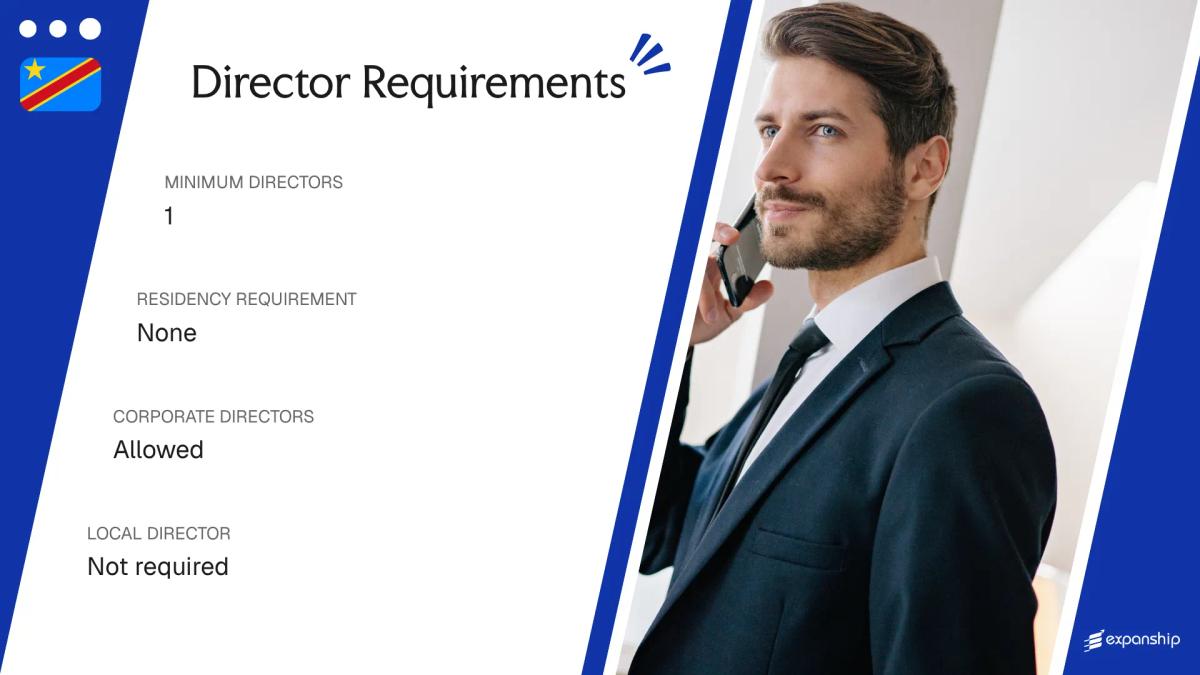
Under the OHADA Uniform Act on Commercial Companies (AUDSC), director requirements in the Democratic Republic of Congo follow a structured framework that assigns personal liability to appointed officers for acts performed in breach of company statutes or applicable law. Upon appointment, a gérant or administrator assumes statutory duties including faithful execution of corporate decisions, preservation of company assets, and accountability to shareholders through annual reporting.
| Parameter | Detail |
|---|---|
| Minimum Number of Directors | One director (gérant) is required for a SARL; a SA requires a board of at least three directors. |
| Maximum Number of Directors | No statutory maximum is prescribed for a SARL; SA boards are subject to limits set in the company statutes. |
| Local/Resident Director Required | No statutory requirement for a locally resident director under OHADA rules as adopted in DRC. |
| Nationality Restrictions | No nationality restrictions apply; foreign nationals may serve as directors. |
| Minimum Age Requirement | Directors must be of legal majority age, which is 18 years under Congolese civil law. |
| Corporate Directors Permitted | Corporate directors are not permitted under OHADA's AUDSC framework. |
| Director Must Be a Shareholder | No statutory requirement; a gérant in a SARL need not hold shares in the company. |
| Publicly Listed on Registry | Director information is filed with the RCCM (Registre du Commerce et du Crédit Mobilier) and is accessible as public record. |
| Disqualification Conditions | Persons subject to criminal conviction for fraud, bankruptcy, or misappropriation may be barred from directorship under OHADA provisions. |
Despite having no nationality restriction on directors, the DRC requires all director appointments to be registered with the RCCM before the individual can legally act on behalf of the company, meaning authority does not vest at the moment of appointment alone.
Shareholder Requirements in the Democratic Republic of the Congo
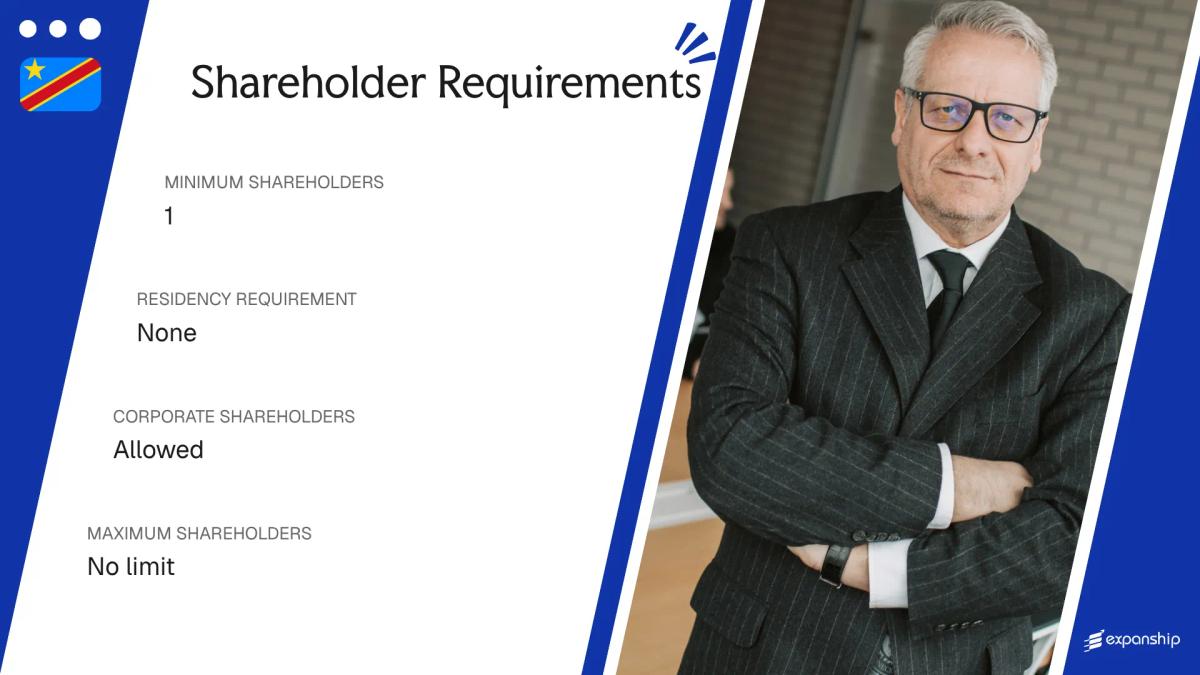
Under the OHADA Uniform Act on Commercial Companies, a Société à Responsabilité Limitée (SARL) requires at least one shareholder, permitting a sole-associate structure. No statutory maximum applies to a SARL, while a Société Anonyme (SA) requires a minimum of one shareholder.
Nationality and Residency Restrictions
Meeting the shareholder requirements for a DRC company does not obligate shareholders to hold Congolese nationality or maintain local residency. Foreign nationals may hold shares without a mandatory local ownership threshold, though sector-specific regimes, such as mining under the Mining Code, may impose separate conditions.
Corporate Shareholders
Corporate entities are permitted to act as shareholders in both SARLs and SAs. The appointing entity must be duly incorporated and may need to provide evidence of legal existence and authorisation.
Shareholder Liability
In a SARL or SA, Congo shareholder compliance rules confine each associé's liability to their capital contribution. Personal assets remain protected absent fraud, piercing of the corporate veil, or personal guarantees voluntarily given.
Register of Shareholders
Each company must maintain an internal register of shareholders reflecting current ownership. This register is submitted to the Registre du Commerce et du Crédit Mobilier (RCCM) and must be updated following any transfer of shares.
Shareholder Compliance Support for Your DRC Entity
Get structured guidance on meeting associé obligations and ownership requirements when establishing or maintaining a company in the Democratic Republic of the Congo.
UBO / Beneficial Ownership Disclosure Requirements in the Democratic Republic of the Congo
Under the OHADA framework, which governs commercial law in the Democratic Republic of the Congo, beneficial ownership disclosure requirements apply to companies registered within the jurisdiction. Beneficial ownership disclosure requirements DRC entities must satisfy are grounded in anti-money laundering obligations, with a UBO generally defined as any individual exercising effective control or holding a qualifying ownership interest in a legal entity.
- Identify all natural persons who directly or indirectly hold a defined ownership threshold in the company.
- Disclose UBO information to the Guichet Unique, the DRC's one-stop business registration authority, at the point of incorporation.
- Submit updated UBO declarations whenever a change in beneficial ownership occurs.
- Retain internal UBO records accessible to competent authorities upon request.
| Parameter | Detail |
|---|---|
| Ownership Threshold for UBO Status | No statutory threshold precisely defined; general principle follows FATF guidance of 25% |
| Filing Authority | Guichet Unique |
| Disclosure Deadline at Incorporation | At the time of company registration |
| Publicly Accessible Register | No publicly accessible register established |
| Penalties for Non-Disclosure | No statutory requirement |
| Ongoing Update Obligation | Required upon any change in beneficial ownership |
KYC / Document Requirements in the Democratic Republic of the Congo
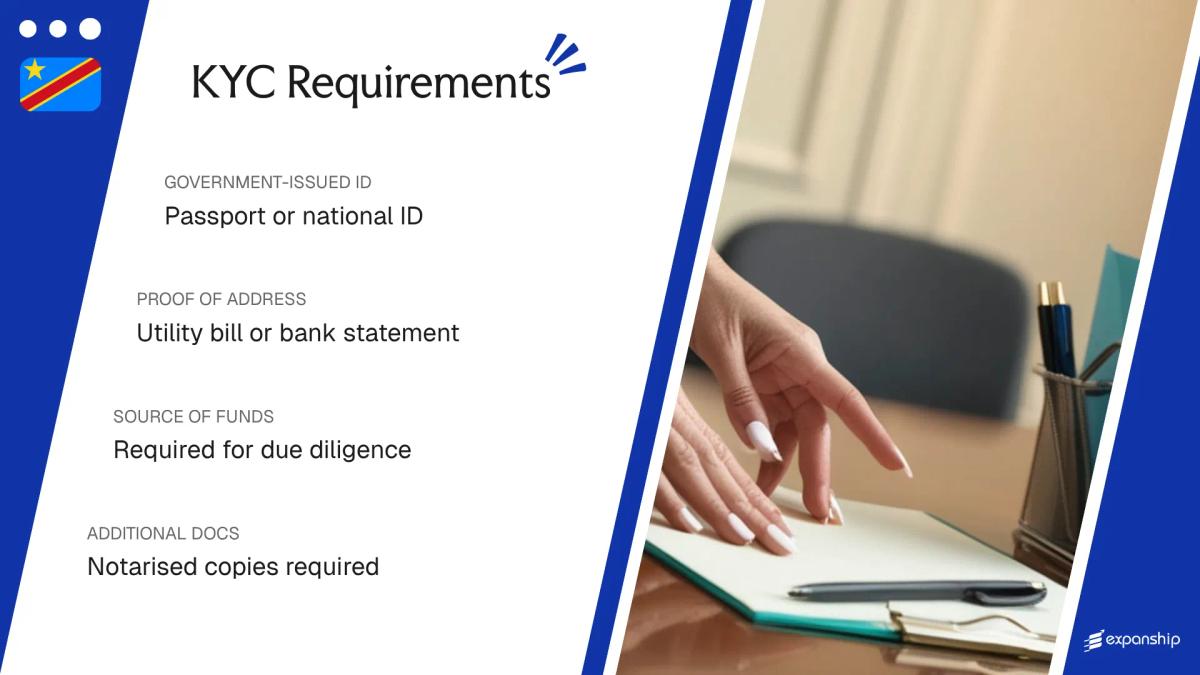
KYC document requirements DRC incorporation are governed primarily by Law No. 04/016 of 19 July 2004 on combating money laundering and the financing of terrorism, administered by the CENAREF, the DRC's Cellule Nationale des Renseignements Financiers. All founders, directors, and shareholders must submit identity documentation before the notarial deed of incorporation can be executed.
Individual / Personal Documents
- Valid national identity card or passport for each individual director, shareholder, or beneficial owner
- Recent proof of residential address, such as a utility bill or official correspondence dated within three months
- Certified copy of birth certificate where required by the notary handling the deed
- Specimen signature provided directly to the notary at the time of deed execution
Corporate Documents
- Certified copy of the corporate shareholder's or director's certificate of incorporation
- Constitutional documents, including articles of association or equivalent, attested by the competent authority in the entity's home jurisdiction
- Current register of directors or equivalent corporate officer documentation
- Proof of the corporate entity's registered address, generally an official letter or utility document
Source of Funds Documentation
- Recent bank statements covering a minimum of three months prior to incorporation
- Audited financial accounts where the subscribing entity is an established business
- A written declaration of the origin of funds if bank statements alone are insufficient
Notarisation and Apostille Requirements
- Foreign-language documents must be translated into French by a sworn translator recognised in the DRC
- Documents originating from countries party to the Hague Convention must carry an apostille before submission
- Documents from non-Hague Convention countries require legalisation through the DRC embassy or consulate in the issuing jurisdiction
Unsigned or undated source of funds declarations are among the most frequently cited reasons for notarial rejection during the DRC incorporation process.
Company Name Requirements in the Democratic Republic of the Congo
Proposed company name requirements DRC follow a structured review process conducted at the point of registration, where the competent authority assesses whether the chosen name conflicts with an existing entity or violates applicable standards.
French is the required language for the official business name, referred to as the dénomination sociale. The legal form suffix, such as SARL or SA, must appear as part of the registered name.
Congo company naming regulations prohibit words that imply a government connection, national or international institutions, or regulated professions unless the relevant authority grants prior approval. Certain terms are outright banned if they are misleading or contrary to public order.
Name reservation is generally available prior to formal incorporation, allowing you to secure a proposed name while documentation is prepared. The reservation period and application process are administered through the registration authority, with validity typically limited to a defined window before lapsing.
Compliance Services for Companies in the Democratic Republic of the Congo
Maintain your company's good standing in the DRC with ongoing compliance support, including annual filings, regulatory reporting, and corporate record maintenance.
Conclusion
Meeting the incorporation requirements in the Democratic Republic of the Congo involves navigating a defined set of obligations under the OHADA Uniform Act on Commercial Companies. Minimum share capital thresholds vary by entity type, and registered office documentation must reflect a genuine physical presence in Kinshasa or another Congolese city. Beneficial ownership disclosure has become an increasingly enforced requirement under the CENAREF framework.
Once these obligations are understood, a foreign investor's attention typically turns to execution: appointing compliant directors, gathering notarised documentation, and registering with the DGRAD and relevant trade registry.
Expanship's Corporate Services for the Democratic Republic of the Congo
Expanship's DRC corporate services company formation support is built around the actual demands that OHADA law and DRC-specific regulations place on foreign investors, from minimum capital structuring to registered office provision and UBO disclosure under Congolese commercial law. These requirements create a significant administrative load, particularly for businesses without existing presence in Kinshasa. Expanship reduces that burden by coordinating the procedural steps on your behalf, without replacing your own legal obligations.
Beyond initial formation, the firm supports your business across the full lifecycle of its Congolese entity.
- Preparing and filing your company registration documents with the GUICHET UNIQUE.
- Providing a registered agent and compliant local office address in the DRC.
- Liaising with the relevant government bodies and regulatory authorities on your behalf.
- Managing ongoing compliance obligations after your entity is incorporated.
- Facilitating introductions to banking institutions to support account opening.
- Handling tax registration and coordination with the Direction Générale des Impôts and other local authorities.
To discuss your requirements directly, contact Expanship DRC.
Frequently Asked Questions (FAQ)
A SARL in the DRC requires a minimum share capital of CDF 100,000 under OHADA rules as applied locally, though this figure is subject to regulatory updates and sector-specific requirements may impose higher thresholds. The capital does not need to be fully paid up at the point of registration, but at least half must be deposited before the company is formally constituted. The remaining balance must be paid within two years of incorporation.
A foreign national can serve as the sole director of a DRC company, but they must hold a valid residence permit and work authorization issued by the Congolese authorities. The DRC does not impose a local director requirement under OHADA, though sector-specific licensing in industries such as mining or telecommunications may include additional conditions. Non-compliance with immigration requirements can expose both the director and the company to administrative sanctions.
Failure to disclose accurate beneficial ownership information to the competent Congolese authority can result in fines, suspension of the company's legal status, or criminal liability for the responsible officers. The DRC has strengthened its anti-money laundering framework in line with FATF recommendations, and the Banque Centrale du Congo oversees compliance for regulated entities. Directors who knowingly provide false UBO information face personal liability separate from any corporate-level penalties.
A company can register its office in any province where it conducts business, not exclusively in Kinshasa. The registered address must be a genuine physical location within DRC territory, capable of receiving official correspondence and legal notices. Virtual offices are not formally recognized as a compliant registered address under DRC company law, and using a non-operational address can lead to service-of-process failures with legal consequences.
Foreign shareholders must provide a certified copy of their passport, proof of residential address dated within three months, and a bank reference or source-of-funds declaration. Corporate shareholders must additionally supply certified constitutional documents, a certificate of good standing from their home jurisdiction, and details of their own beneficial owners. All foreign-language documents must be translated into French by a sworn translator before submission to the RCCM (Registre du Commerce et du Crédit Mobilier).
Yes, the proposed company name must be verified for availability at the RCCM before the incorporation deed is executed before a notary. The name must not conflict with an existing registered entity or a protected trademark, and it must include the correct legal suffix corresponding to the chosen entity type, such as SARL or SAS. Submitting incorporation documents with an unapproved or conflicting name will result in rejection and delay the entire registration process.
Legal Disclaimer
The information provided in this article is for general informational purposes only and does not constitute legal, tax, or professional advice. While we strive to ensure the accuracy and timeliness of the content, laws and regulations are subject to change, and the application of laws can vary widely based on specific facts and circumstances.
Readers should not act upon this information without seeking professional counsel tailored to their individual situation. Expanship and its authors disclaim any liability for actions taken or not taken based on the content of this article.
For specific advice regarding your business setup, compliance requirements, or any legal matters, please consult with qualified legal and tax professionals in the relevant jurisdiction.