
Key Takeaways
- Membership in the OHADA treaty framework gives foreign investors access to a standardized, codified commercial law system that reduces legal uncertainty across the DRC and other member states simultaneously.
- The DRC's Investment Code provides sector-specific tax reductions and exemptions that directly lower the operating cost burden for qualifying businesses in mining, agriculture, and infrastructure.
- Establishing a Société à Responsabilité Limitée through the Guichet Unique de Création d'Entreprise offers a flexible ownership structure with streamlined registration that keeps initial setup costs competitive relative to other Central African jurisdictions.
- Bilateral investment treaties extend formal protections to foreign capital, giving investors a recognized legal basis to safeguard assets against expropriation and discriminatory treatment under international law.
Situated in central sub-Saharan Africa, the Democratic Republic of the Congo is a sovereign nation and one of the continent's largest countries by both territory and population. Company registration falls under the oversight of the DGRAD (Direction Générale des Recettes Administratives, Judiciaires, Domaniales et de Participations) in coordination with the Guichet Unique de Création d'Entreprise, the single-window agency that processes new business registrations. Foreign investors most commonly establish a Société à Responsabilité Limitée when entering this market.
The country operates a general taxation framework that applies standard corporate rates to resident entities, with specific incentive provisions available under the Investment Code for qualifying activities and sectors. Foreign direct investment is formally permitted across most sectors, and national law generally grants foreign-owned firms the same legal standing as locally owned businesses. This article examines the key benefits of incorporating in Democratic Republic of the Congo, drawing on the regulatory, structural, and commercial factors relevant to businesses considering entry into this jurisdiction.
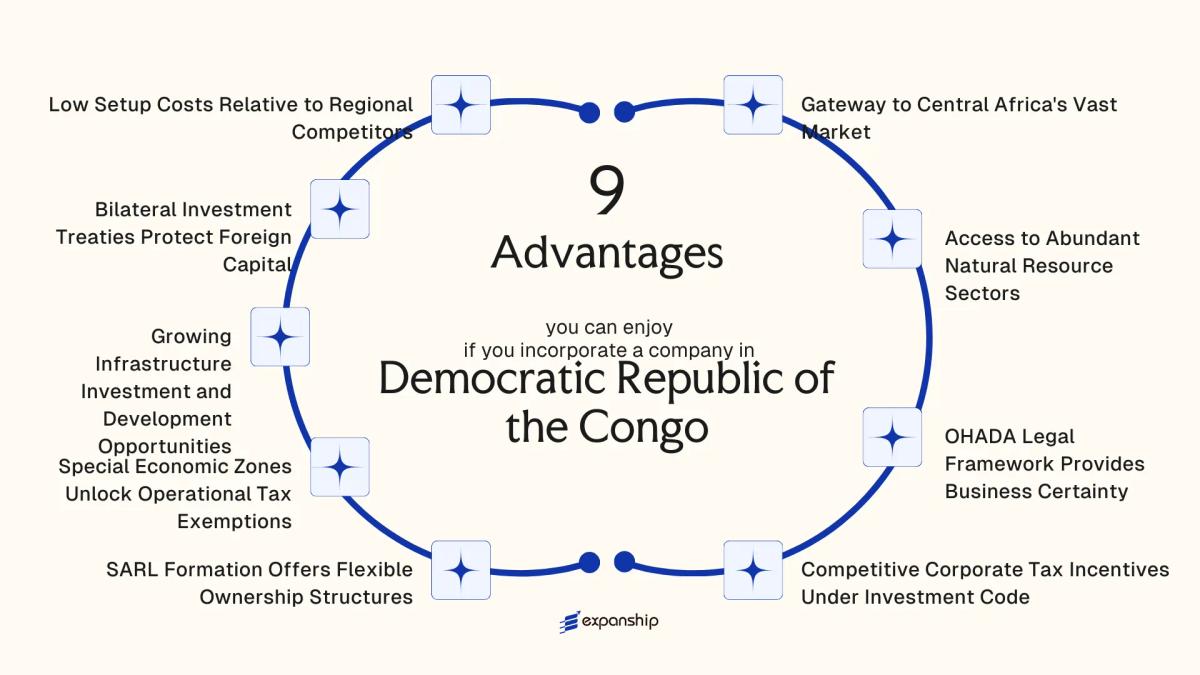
Gateway to Central Africa's Vast Market
Incorporating in the DRC positions your business at the geographic center of sub-Saharan Africa, bordering nine countries including Angola, Zambia, Tanzania, and the Republic of Congo. That adjacency translates into direct commercial reach across a multi-country region with a combined population exceeding 500 million people.
Regional Trade Access Through ECCAS Membership
The DRC holds membership in the Economic Community of Central African States (ECCAS), a regional bloc that provides a framework for preferential trade arrangements among member states. For a foreign-owned entity registered in Kinshasa, this membership opens channels to regional supply chains that would otherwise require separate legal establishments in multiple countries.
COMESA Integration Expands Your Eastern Corridor
Membership in the Common Market for Eastern and Southern Africa (COMESA) extends your firm's reach further east and south. COMESA's trade protocols allow qualifying businesses to access reduced tariff schedules across member states, meaning a single DRC-registered company can serve markets from Ethiopia to Zimbabwe under one operational base.
A single DRC-registered entity can access preferential trade arrangements across both ECCAS and COMESA member states simultaneously.
Access to Abundant Natural Resource Sectors
The DRC holds an estimated $24 trillion in untapped mineral deposits, including some of the world's largest confirmed reserves of cobalt, coltan, copper, and lithium. For foreign businesses, this concentration of strategically critical minerals in a single jurisdiction creates a direct commercial argument for establishing a local entity rather than operating through intermediaries.
Gaining legal presence through a registered company gives your business the standing to enter into mining conventions directly with the state, apply for exploitation permits under the 2018 Mining Code (Loi n° 18/001), and hold assets in your entity's name. Without local incorporation, access to these permit structures is effectively closed.
The 2018 Mining Code governs the full lifecycle of mineral rights and sets out the fiscal regime applicable to extraction activities. Foreign firms operating under this code benefit from several structural features that reduce entry friction:
- Exploitation permits are asset-transferable, meaning your entity can assign or pledge them as collateral
- The code distinguishes between artisanal, small-scale, and industrial mining, so your firm can match its permit class to its actual operational scale
- Fiscal stability clauses within mining conventions protect agreed tax terms for the duration of the permit
The Centre d'Expertise, d'Évaluation et de Certification des Substances Minérales Précieuses et Semi-Précieuses (CEEC) regulates the export certification of precious and semi-precious minerals, giving certified exporters a defined legal pathway to international markets.

Company Incorporation in the Democratic Republic of the Congo
Establish a legally registered entity in the DRC to access mining permits, mineral rights frameworks, and state-level resource contracts under the 2018 Mining Code.
OHADA Legal Framework Provides Business Certainty
The DRC acceded to OHADA (Organisation pour l'Harmonisation en Afrique des Affaires) in 2012, bringing its commercial legal environment under a unified supranational framework shared by 17 member states. For foreign investors, this alignment with OHADA business law advantages in the Democratic Republic of Congo means that core commercial rules — governing companies, contracts, arbitration, and insolvency — are governed by standardized Uniform Acts rather than unpredictable national legislation alone.
The Uniform Act on Commercial Companies (AUSCGIE) defines how entities are formed, managed, and dissolved. Because this Act applies identically across all OHADA member states, a foreign operator already familiar with the framework from operating elsewhere in francophone Africa faces no structural learning curve when establishing a presence here.
| Uniform Act | Subject Matter | Relevance to Foreign Investors |
|---|---|---|
| AUSCGIE | Company formation and governance | Standardized incorporation rules |
| AUA | Arbitration proceedings | Neutral dispute resolution mechanism |
| AUPC | Insolvency and debt recovery | Predictable creditor protections |
| AUVE | Enforcement of judgments | Consistent execution of commercial decisions |
OHADA's arbitration framework, administered through the Common Court of Justice and Arbitration (CCJA), gives your business access to supranational dispute resolution. Judgments issued by the CCJA carry direct enforceability across all member states, which reduces dependence on local court proceedings and strengthens contractual certainty for cross-border commercial arrangements.
Competitive Corporate Tax Incentives Under Investment Code
The DRC Investment Code (Law No. 004/2002, updated and consolidated through subsequent revisions) grants qualifying foreign investors a structured package of fiscal advantages that directly reduce the tax burden during the most capital-intensive phase of operations.
Approved companies can benefit from temporary exemptions on corporate income tax, which in the DRC stands at a general rate of 30%. Depending on the investment zone and sector, the exemption period can extend across several years following the start of commercial activity. For capital-heavy industries, this deferred tax obligation allows your firm to reinvest early revenues rather than immediately remitting them to the state.
Customs duties on imported capital equipment and raw materials may also be suspended during the investment phase. For a foreign-owned entity importing machinery or specialized inputs, this reduces initial setup expenditure in a market where import logistics carry significant costs.
Eligibility for these incentives is administered through the Agence pour la Promotion des Investissements (API-Congo), which evaluates applications against minimum investment thresholds and sector classifications defined in the Investment Code.
- Confirm your investment zone classification before applying, as incentive durations vary by geographic area
- Submit your application to API-Congo before commencing operations; retroactive approval is not guaranteed
- Retain documentation of all capital expenditures, as audits under the Direction Générale des Impôts may require proof of qualifying spend
The DRC Investment Code extends fiscal incentives to Congolese-majority-owned firms and foreign-owned entities equally, meaning there is no differential treatment based on nationality of ownership.
SARL Formation Offers Flexible Ownership Structures
Under the OHADA Uniform Act on Commercial Companies (AUSC), the SARL (société à responsabilité limitée) is the most widely used vehicle for foreign investment in the DRC. The DRC SARL flexible ownership structure benefits foreign principals directly: liability is capped at each shareholder's capital contribution, which means your personal assets remain insulated from the company's obligations regardless of operational outcomes.
Shareholder Composition and Capital Requirements
A SARL can be formed by a single associate or up to 50, giving sole founders and joint venture partners equal access to the same legal structure. The minimum share capital under OHADA rules is set at 1,000,000 CFA francs (roughly USD 1,600), though the DRC applies this within its own commercial registration framework administered by the Guichet Unique de Création d'Entreprise (GUCE). That threshold is low enough that foreign principals can establish a fully operative legal entity without committing significant capital before business activity begins.
Transferability and Foreign Ownership Rights
Shares in a SARL are transferable to third parties, subject to the approval of shareholders holding at least three-quarters of the capital, as prescribed by AUSC. This consent requirement gives existing associates meaningful control over who enters the ownership structure, which protects your position if you are a minority investor. Full foreign ownership is permitted, meaning a non-resident can hold 100% of the shares without requiring a local partner, removing a structural barrier present in many other African jurisdictions.
Structure Your DRC SARL Ownership Correctly
Get guidance on shareholder composition, capital requirements, and foreign ownership rules for your SARL formation in the Democratic Republic of the Congo.
Special Economic Zones Unlock Operational Tax Exemptions
Established under the Loi n° 14/022 du 07 août 2014, the DRC Special Economic Zones tax exemption benefits are structured to reduce the operating cost burden on qualifying companies from the moment they begin production. The primary zone currently operational is the Zone Économique Spéciale de Maluku, located near Kinshasa, administered by the Agence de Promotion des Zones Économiques Spéciales (AZES).
- Companies established within a designated SEZ are exempt from corporate income tax for an initial period, with reduced rates applying thereafter, which directly lowers your effective tax burden during the most capital-intensive phase of operations.
- Customs duties and VAT on imported equipment and raw materials used in production are suspended within the zone, meaning your firm avoids upfront import costs that would otherwise affect cash flow.
- Dividend repatriation within the SEZ framework benefits from reduced withholding tax provisions, giving foreign shareholders clearer returns on invested capital.
- SEZ-based entities may also access simplified administrative procedures through AZES rather than navigating multiple ministries, which reduces the time your business spends on regulatory compliance.
Eligibility is generally tied to operating within a designated zone perimeter and meeting minimum investment thresholds as defined under the applicable zone framework, so entities operating outside these boundaries do not qualify for these specific concessions.
Growing Infrastructure Investment and Development Opportunities
The DRC infrastructure investment opportunities for businesses stem directly from the country's multi-sector development deficit. Roads, energy generation, river transport, and telecommunications all require capital at scale, which means companies entering these sectors face limited incumbent competition and direct access to government procurement channels under the national development program administered by the Agence Congolaise des Grands Travaux (ACGT).
Under the Investment Code (Law No. 004/2002, revised and supplemented by subsequent amendments), foreign firms operating in priority infrastructure sectors can qualify for accelerated depreciation on fixed assets. This reduces taxable income during the capital-intensive early years of a project, which improves return timelines meaningfully for infrastructure-heavy operations.
River infrastructure along the Congo Basin also creates logistics entry points. The Congo River system covers approximately 14,000 kilometers of navigable waterways, giving businesses in transport and freight forwarding access to interior markets without road dependency.
A foreign firm investing USD 5 million in a qualifying energy infrastructure project under the Investment Code's priority sector classification could depreciate USD 500,000 annually under an accelerated schedule, reducing taxable income by that amount each year during the exemption period, compared to a standard straight-line depreciation schedule spread over 20 years.
Bilateral Investment Treaties Protect Foreign Capital
DRC bilateral investment treaties foreign capital protection forms a concrete legal layer that stands apart from domestic policy, which can shift with changes in government or regulation. When a bilateral investment treaty (BIT) is in force between the Congo and your home country, dispute resolution rights and protections against expropriation become enforceable under international law, not just local statute.
The DRC has signed BITs with several countries, including Belgium, Luxembourg, France, Germany, and Switzerland, among others. These treaties typically guarantee fair and equitable treatment, protection against unlawful nationalization, and access to international arbitration through mechanisms such as ICSID (International Centre for Settlement of Investment Disputes). For your business, this means capital repatriation rights and asset protections that exist independently of domestic courts.
Where a BIT applies, foreign investors gain access to neutral arbitration forums rather than being confined to local judicial proceedings. That procedural right carries real weight when protecting significant capital commitments in extractive or infrastructure sectors.
- Treaty coverage varies by nationality of the investing entity
- Protection typically extends to equity, reinvested earnings, and contractual rights
- ICSID arbitration requires separate agreement or direct treaty provision
Confirm whether your specific country of incorporation, not just your nationality, qualifies your entity for BIT protections under the relevant treaty's definitions of "investor" and "investment."
Low Setup Costs Relative to Regional Competitors
Registering a company in the DRC carries lower direct formation costs than several neighboring jurisdictions, giving the DRC low company setup costs a concrete regional advantage for foreign investors calculating entry expenses. The OHADA Uniform Act on Commercial Companies governs entity registration, and the SARL structure requires a minimum share capital of one Congolese franc in principle, removing a common capital barrier that exists elsewhere in the region.
Registration Fees and Government Charges
Formal registration runs through the Guichet Unique de Création d'Entreprise (GUCE), the one-stop window designed to consolidate filings that would otherwise require multiple agency visits. Processing fees at GUCE are generally lower in absolute terms than equivalent charges in countries such as Cameroon or Gabon, where notarial and administrative fees can accumulate significantly. For a foreign investor, lower upfront government charges reduce the initial capital commitment before operations begin.
Professional and Notarial Fee Structure
OHADA member states share a common legal framework, but local implementation costs vary. Notarial fees for articles of association and statutory filings in the Congo tend to fall at the lower end of the Central African range, partly reflecting local fee schedules rather than those calibrated to higher-income economies. Your formation budget can therefore remain tighter without sacrificing legal validity across OHADA-compliant documentation.
Registered Capital Flexibility
- No minimum paid-up capital threshold applies to SARLs at formation under current OHADA rules
- This frees working capital for operational use rather than locking it in a statutory deposit account
- Comparable markets in the region impose minimum capital requirements that can reach several million local currency units for equivalent entity types
Why the DRC Stands Out Among Central African Business Destinations
Among Central African business destinations, the DRC's competitive profile is shaped by a specific combination of factors that neighbouring incorporation hubs do not replicate: OHADA membership, a codified investment regime under the 2002 Investment Code as amended, and direct access to a domestic consumer base exceeding 100 million people. The jurisdictions most relevant for comparison are Republic of Congo (Brazzaville), Cameroon, and Angola, each of which competes for similar foreign direct investment profiles across extractive industries, trade, and services.
What the comparison reveals is structural rather than superficial. Cameroon also operates under OHADA, but its market size and mineral endowment are considerably smaller. Angola offers a larger hydrocarbon sector, yet operates outside OHADA, creating a distinct legal environment for commercial entities that foreign investors must account for separately. Republic of Congo shares both OHADA membership and geographic proximity, but its economy and internal market are a fraction of the scale available through a Congolese incorporation. For investors weighing regional expansion, these distinctions carry direct implications for scalability, legal predictability, and sector access.
| Parameter | DRC | Cameroon | Angola | Republic of Congo |
|---|---|---|---|---|
| Legal Framework | OHADA (SARL/SA) | OHADA (SARL/SA) | Portuguese civil law | OHADA (SARL/SA) |
| Domestic Market Population | 100M+ | ~28M | ~36M | ~6M |
| Investment Code Protections | Yes (2002 Code, amended) | Yes | Yes (2018 Private Investment Law) | Yes |
| Special Economic Zones | Yes (ZES regime) | Yes | Yes | Limited |
| Natural Resource Sector Diversity | Mining, hydrocarbons, forestry, agriculture | Oil, agriculture, timber | Hydrocarbons dominant | Oil, timber |
| Bilateral Investment Treaties | 10+ in force | 10+ in force | 30+ in force | Fewer than 10 |
Compliance Services for Companies in the DRC
Stay aligned with DRC regulatory requirements, from annual filings to OHADA corporate governance obligations.
Conclusion
The benefits of incorporating in the Democratic Republic of the Congo rest on a combination of structural factors that are difficult to replicate elsewhere in Central Africa. Membership in the OHADA treaty system provides a codified commercial law framework that foreign investors can rely on, while the Investment Code offers sector-specific tax reductions and exemptions that directly reduce the cost of operating at scale. For resource-oriented and infrastructure-focused businesses, few jurisdictions on the continent present a comparable concentration of opportunity within a single legal entity registration.
Those advantages are not equally relevant to every business model. A firm entering through a Société à Responsabilité Limitée structure to hold mining or agricultural interests will experience different operational conditions than one using a Special Economic Zone to manage manufacturing or logistics. The applicability of bilateral investment treaty protections, the relevance of specific Investment Code incentives, and the suitability of the SARL versus other legal forms all depend on your industry, ownership structure, and intended activities.
Executing a market entry strategy in this jurisdiction requires accurate interpretation of current regulatory requirements, including those set by the Agence Nationale pour la Promotion des Investissements and the relevant ministry depending on your sector. The foundation for a compliant and well-structured presence begins with precise entity formation and an understanding of how local law interacts with your corporate objectives.
Start Your DRC Company Formation With Expanship Today
Expanship assists foreign investors with DRC company formation from initial structure selection through post-incorporation compliance, covering entity types including the SARL, SA, and branch office. The firm coordinates directly with the Agence pour la Promotion des Investissements (API) and the Guichet Unique de Création d'Entreprises (GUCE), the one-stop registration window administered under DRC commercial law. Each engagement is structured around the specific obligations of the Acte Uniforme OHADA on commercial companies.
Expanship's service scope for DRC business formation includes the following:
- Preparation and legalization of incorporation documents, including statutes and notarial deeds
- Provision of registered agent and registered office address in Kinshasa
- Filing and liaison with GUCE and the relevant ministerial authorities
- Ongoing compliance management covering annual obligations under OHADA and domestic tax law
- Support with Investment Code application procedures before API for incentive eligibility
- Banking introduction assistance with locally licensed commercial banks
For direct assistance with your formation, contact [Expanship DRC](../cd/contact-us).
Frequently Asked Questions (FAQ)
The Investment Code (Law No. 004/2002, as amended) provides eligible businesses with exemptions from customs duties on imported equipment, reduced corporate income tax rates, and exemptions from certain indirect taxes during an establishment phase. The duration and scope of these benefits vary depending on the investment zone and sector declared at the time of application to the Agence Nationale pour la Promotion des Investissements (ANAPI). Projects located in designated Special Economic Zones may qualify for additional fiscal exemptions beyond those offered under the standard Investment Code regime.
OHADA (Organisation pour l'Harmonisation en Afrique du Droit des Affaires) provides a supranational legal framework that standardizes commercial law across its 17 member states, including the DRC. Disputes between commercial parties can be referred to the OHADA Common Court of Justice and Arbitration (CCJA), which operates independently of national court systems. This reduces exposure to unpredictable local judicial outcomes in commercial matters.
Yes, bilateral investment treaties (BITs) to which the DRC is a signatory provide foreign investors with protections including guarantees against expropriation without compensation and access to international arbitration. The enforceability of these protections depends on the specific treaty in force between the DRC and the investor's home country. Where a BIT includes ICSID arbitration clauses, disputes can be submitted to the International Centre for Settlement of Investment Disputes under the Washington Convention.
Company registration is processed through the Guichet Unique de Création d'Entreprise (GUCE), a single-window mechanism designed to consolidate the administrative steps required for incorporation. Processing times vary, but registration can generally be completed within a few business days when documentation is in order. Delays most commonly arise from incomplete filings or sector-specific licensing requirements that fall outside the GUCE's standard procedures.
Under the OHADA Uniform Act on Commercial Companies, the minimum share capital for a SARL is set at one million Central African CFA francs (XAF 1,000,000), though the DRC uses the Congolese franc (CDF) and equivalent thresholds apply. Capital does not need to be fully paid up at the time of incorporation; a portion may be deferred according to the conditions specified in the company's articles of association. Investors should confirm current requirements with ANAPI or a locally registered legal practitioner, as implementing regulations can adjust these thresholds.
Where expropriation occurs, foreign investors may seek recourse through any applicable bilateral investment treaty, provided one exists between the DRC and their country of nationality. The Investment Code also contains provisions addressing compensation obligations, though the practical enforcement of these provisions has historically been inconsistent. For investors seeking stronger procedural guarantees, structuring investment through a jurisdiction with an active BIT that includes binding international arbitration is the more reliable approach.
Legal Disclaimer
The information provided in this article is for general informational purposes only and does not constitute legal, tax, or professional advice. While we strive to ensure the accuracy and timeliness of the content, laws and regulations are subject to change, and the application of laws can vary widely based on specific facts and circumstances.
Readers should not act upon this information without seeking professional counsel tailored to their individual situation. Expanship and its authors disclaim any liability for actions taken or not taken based on the content of this article.
For specific advice regarding your business setup, compliance requirements, or any legal matters, please consult with qualified legal and tax professionals in the relevant jurisdiction.