
Key Takeaways
- Foreign investors incorporating under the OHADA Uniform Act on Commercial Companies face a layered compliance structure that combines regional treaty obligations with domestic Congolese legislation, compounding both registration timelines and ongoing legal costs.
- The mandatory minimum capital requirements for forming a Société à Responsabilité Limitée add an upfront financial threshold that disproportionately burdens smaller foreign entrants with limited in-country liquidity.
- Severe foreign exchange controls and chronic instability of the Congolese franc expose incorporated entities to material currency risk that complicates profit repatriation and cross-border financial planning.
- Weak judicial enforcement mechanisms mean that contractual protections available on paper offer limited practical recourse in disputes, increasing the risk premium for capital-intensive or long-term commercial commitments in the DRC.
Incorporating a business in the Democratic Republic of Congo places your firm within one of Africa's most heavily regulated and institutionally complex environments. The country's commercial framework draws from both the OHADA Uniform Acts — a regional treaty-based legal system — and domestic legislation, creating a layered compliance structure that affects every stage of company formation and ongoing operation. The disadvantages of incorporating in DRC span registration, taxation, currency management, infrastructure, and sector-specific restrictions.
Not all of these disadvantages will affect every business equally. A small services firm faces a different risk profile than a mining or telecoms operator subject to sector-specific licensing under Congolese law.
This article is most relevant to foreign investors and internationally incorporated entities planning to establish a formal commercial presence through a Société à Responsabilité Limitée or Société Anonyme under the OHADA Uniform Act. The risks of company formation in Democratic Republic of Congo are most acute for those operating in capital-intensive or regulated industries.
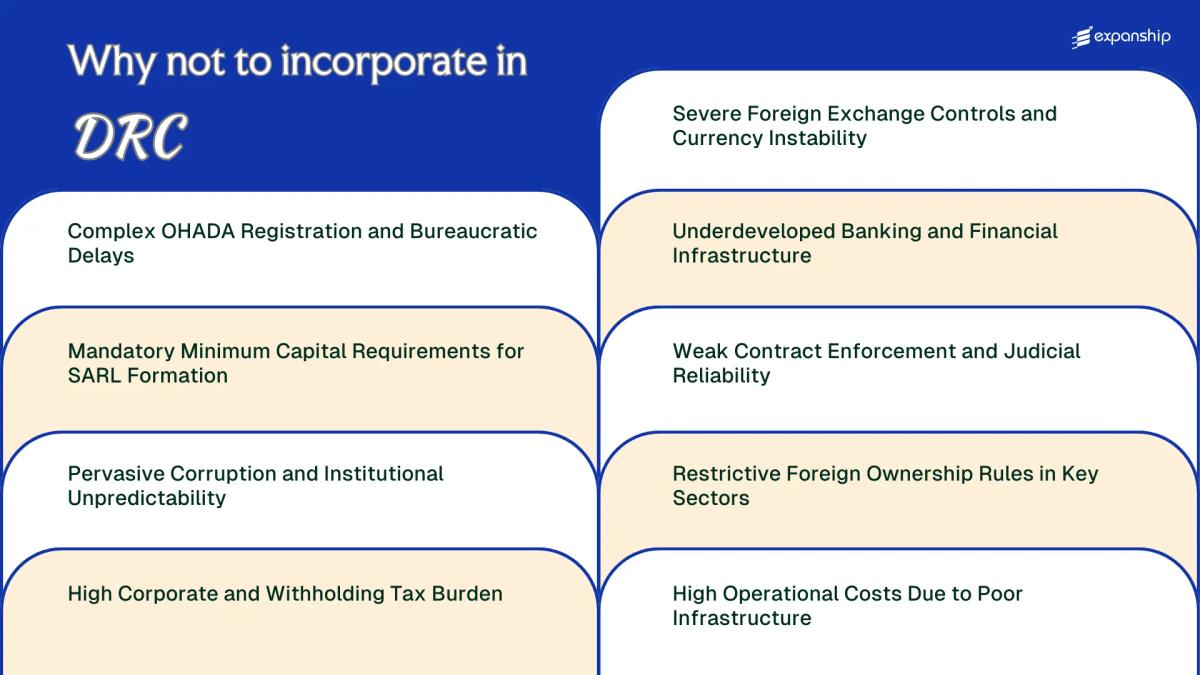
Complex OHADA Registration and Bureaucratic Delays
OHADA registration challenges in DRC are among the most time-consuming barriers a foreign investor will face before a single transaction can legally occur. The process involves multiple agencies, redundant documentation, and approval bottlenecks that have no fixed resolution timeline.
The Multi-Agency Registration Burden
Incorporating a company requires sequential filings across the Guichet Unique de Création d'Entreprise (GUCE), the Registre du Commerce et du Crédit Mobilier (RCCM), and the tax authority Direction Générale des Impôts (DGI), each with distinct requirements. Even when GUCE was introduced to centralize this process under OHADA's Acte Uniforme on Commercial Companies, inter-agency coordination failures in practice extend incorporation timelines well beyond the statutory targets.
Delays That Compound Operational Risk
A registration process that takes weeks or months rather than days means your business cannot open bank accounts, sign enforceable contracts, or hire formal staff during that window. Bureaucratic delays in company registration in Congo are not exceptional cases; they reflect a systemic pattern documented by the World Bank's Doing Business indicators, which historically ranked DRC among the lowest globally for ease of starting a business.
Until RCCM registration is finalized and a tax identification number issued by DGI is obtained, your entity has no legal standing to conduct business or enforce any commercial agreement in the DRC.
Mandatory Minimum Capital Requirements for SARL Formation
DRC SARL minimum capital requirements create an immediate financial barrier before your business generates a single franc of revenue. Under the OHADA Uniform Act on Commercial Companies, a Société à Responsabilité Limitée must meet a statutory minimum share capital threshold, and that capital must be fully subscribed at the time of formation.
The practical friction this creates extends beyond the upfront sum itself:
- Funds deposited as share capital are committed during the registration process, tying up working capital at a stage when your operational costs are already accumulating.
- Foreign investors without an established banking relationship in the DRC face difficulties depositing capital through compliant local channels, since correspondent banking access is limited.
- If your initial capital assessment proves insufficient after incorporation, increasing share capital requires a formal notarial process and re-filing with the RCCM, generating additional legal and administrative costs.
- The capital threshold applies uniformly regardless of business scale, meaning a small-scope market-entry entity carries the same floor obligation as a larger commercial operation.
No tiered or reduced capital regime exists for startups or micro-enterprises under the current OHADA framework applicable in the country.

Company Incorporation in the Democratic Republic of the Congo
Understand the capital requirements and registration obligations before forming a SARL in the DRC.
Pervasive Corruption and Institutional Unpredictability
Corruption risks doing business in DRC are not theoretical. Transparency International's Corruption Perceptions Index consistently ranks the country among the lowest globally, and foreign firms encounter demands for unofficial payments at multiple points of business contact, including customs clearance, permit issuance, and tax audits.
The Agence Nationale pour la Promotion des Investissements (ANAPI) is the designated entry point for investors, yet its involvement does not insulate your company from informal pressures at the agency and ministerial levels. Regulatory decisions that should follow published criteria often depend on undocumented relationships, which makes compliance planning unreliable.
| Contact Point | Reported Informal Demand | Business Impact |
|---|---|---|
| Customs clearance | Unofficial facilitation fees | Unpredictable import timelines and added costs |
| Business permit renewal | Unofficial payments to officials | Delays that can suspend lawful operations |
| Tax audits (DGI oversight) | Demands outside assessed liability | Effective tax burden exceeds statutory rates |
| Mining and sector licensing | Politically mediated approvals | Uncertainty over whether licenses will hold |
Under the OHADA Uniform Act framework, contract terms and regulatory approvals carry formal legal weight, yet enforcement in practice is subject to institutional discretion. A permit granted today can be challenged or revoked by a different official with limited procedural recourse. Your firm cannot price that risk into a standard financial model.
High Corporate and Withholding Tax Burden
The DRC corporate tax burden disadvantages foreign investors from the outset. The standard corporate income tax rate sits at 30%, applied under the General Tax Code (Code Général des Impôts), administered by the Direction Générale des Impôts (DGI). For companies operating in extractive sectors, additional profit-based levies under the Mining Code can push the effective rate higher.
Withholding tax risks in the Democratic Republic of Congo compound the base rate problem. Dividends remitted to foreign parent companies attract a withholding tax of 20%, and interest payments to non-resident lenders face similar exposure. This directly raises the cost of repatriating returns.
The DRC's tax treaty network remains limited, offering little relief for most foreign investors. Without a bilateral tax treaty between the DRC and your home jurisdiction, no mechanism reduces these withholding obligations.
- Withholding tax of 20% applies to dividend distributions to non-resident shareholders
- The 30% CIT rate applies on net taxable profit as defined under the General Tax Code
- DGI requires advance tax payments, creating cash flow obligations before final profit is confirmed
- Minimum forfeit tax (impôt forfaitaire minimum) applies even when the entity records a loss
Companies incorporated in the DRC may owe minimum tax even in years when they report zero or negative profit, meaning a loss-making entity can still face a tax liability.
Severe Foreign Exchange Controls and Currency Instability
DRC foreign exchange controls and restrictions compound the difficulty of operating a foreign-registered entity in one of Africa's most resource-rich yet financially constrained economies. The Congolese franc has lost significant value against hard currencies over the past decade, exposing foreign investors to persistent exchange rate risk.
The Regulatory Framework Governing Currency Movement
The Banque Centrale du Congo administers foreign exchange policy under the 2018 Foreign Exchange Regulation, which imposes strict controls on cross-border capital transfers. Your firm must obtain prior authorization for most outward remittances, including profit repatriation, which adds both cost and delay to routine treasury operations.
Congolese franc depreciation problems are structural rather than cyclical, meaning exposure accumulates steadily rather than through isolated shocks.
Practical Consequences for Foreign-Owned Businesses
DRC capital repatriation restrictions mean that earnings held in local currency lose real value before approval for transfer is even granted. For sectors where USD invoicing is restricted or inconsistent, the gap between contractual value and repatriated value can be material.
Currency instability risks in Congo business operations are not limited to exchange losses; they also complicate financial forecasting and intercompany loan repayment structures across holding arrangements.
Managing Currency and Regulatory Risk in the DRC
Understand how foreign exchange controls and capital repatriation restrictions affect your corporate structure in the Democratic Republic of the Congo.
Underdeveloped Banking and Financial Infrastructure
DRC banking infrastructure limitations create direct operational friction for foreign businesses: most formal financial services are concentrated in Kinshasa, leaving companies operating in mining or agricultural zones with few viable banking options.
- Fewer than 20% of Congolese adults hold a formal bank account, which means your business will struggle to pay suppliers, employees, or contractors through standard wire transfers.
- The Banque Centrale du Congo supervises a sector dominated by a handful of foreign-owned commercial banks, and even those institutions impose high transaction fees and slow processing times that inflate your operating costs.
- Trade finance instruments such as letters of credit are difficult to obtain domestically, forcing foreign firms to route financing through correspondent banks abroad at added cost and delay.
- Mobile money platforms partially fill the gap, but they are not equipped to handle the transaction volumes or compliance requirements that a registered commercial entity generates.
- Dollar-denominated accounts are common due to chronic Congolese franc instability, yet this creates dual-currency reconciliation obligations that complicate your accounting and audit processes.
Weak Contract Enforcement and Judicial Reliability
Weak contract enforcement risks in DRC present a concrete operational threat for any foreign business. Courts operate under the OHADA Uniform Acts, which provide a codified legal framework, but the practical application of those rules is inconsistent and slow.
Judicial independence is structurally compromised. Judges are appointed through processes subject to political influence, and case outcomes in commercial disputes frequently reflect this reality.
Even when a foreign firm obtains a favorable judgment, enforcement is another obstacle entirely. Asset seizure procedures exist under OHADA's Uniform Act on Simplified Recovery Procedures, but execution against a local counterparty can take years.
Arbitration clauses in contracts offer partial relief, but only if your counterparty honors them. Local parties sometimes challenge arbitral awards before Congolese courts, reintroducing the same reliability problems.
A foreign supplier owed $200,000 by a Congolese distributor initiates arbitration under an ICC clause. The award is granted after 18 months. The distributor files a nullity challenge in a Kinshasa commercial court, delaying enforcement by a further two years and adding an estimated $40,000 in legal costs to the creditor.
Restrictive Foreign Ownership Rules in Key Sectors
Foreign ownership restrictions in the DRC are among the most consequential structural barriers for international investors, particularly in sectors where the country's economic value is concentrated.
Under the 2018 Mining Code (Law No. 18/001), the Congolese state holds a compulsory 10% free-carried interest in every mining project, with additional provisions requiring that Congolese nationals or entities hold equity stakes in certain operational structures. This limits the share of economic returns your business can retain, regardless of the capital it contributes.
The hydrocarbons sector carries similar constraints. Foreign firms operating under production-sharing contracts with Gécamines or the state oil company Cohydro must accept state participation terms that are non-negotiable, creating asymmetric risk exposure where private investors bear costs but share upside.
Beyond extractive industries, activities classified as "reserved" or "regulated" under the OHADA-aligned investment framework may require local partnership arrangements. Finding a compliant local partner who can meet both regulatory and operational expectations adds time, cost, and governance risk to your structure.
- Compulsory state equity applies at the project level, not just the corporate level
- Foreign equity caps can apply even when the local partner holds a nominal stake
- Regulatory enforcement is handled by the Ministry of Mines, whose interpretations are not always consistent
The 10% free-carried state interest under the 2018 Mining Code is non-negotiable and cannot be contracted away, meaning any foreign-controlled mining entity automatically absorbs a material equity cost before operations begin.
High Operational Costs Due to Poor Infrastructure
DRC infrastructure problems business costs begin before a single transaction is processed. Electricity supply is unreliable across most of the country, and businesses outside Kinshasa frequently operate on generator power, which adds significant fuel and maintenance costs to baseline operating budgets.
Road networks connecting major commercial centers like Lubumbashi, Mbuji-Mayi, and Kisangani are largely unpaved or deteriorated. Your firm faces extended transit times and elevated freight costs that would not exist in a comparable sub-Saharan market with developed road or rail connectivity.
Port congestion at Matadi, the country's primary Atlantic port, compounds logistics challenges for import-dependent businesses. Customs clearance delays translate directly into demurrage charges and supply chain disruptions.
Telecommunication infrastructure outside urban centers remains thin, limiting remote operations and digital service delivery for any entity with activity beyond the capital region.
Strategies to Overcome These Barriers
Overcoming DRC business incorporation barriers requires structural preparation rather than reactive problem-solving. Foreign entities operating in this jurisdiction face compounding regulatory, financial, and institutional challenges that demand deliberate planning before market entry.
- Register your SARL through the Guichet Unique (one-stop shop) under the OHADA Uniform Act on Commercial Companies to consolidate filing steps and reduce processing time.
- Verify sector-specific foreign ownership thresholds with the ANAPI before committing to a shareholding structure, particularly in mining, forestry, and telecommunications.
- Open a blocked capital account at a licensed Congolese bank to satisfy the SARL minimum share capital deposit requirement prior to notarial deed execution.
- Obtain a tax identification number (NIF) from the Direction Générale des Impôts early in the incorporation process to avoid delays in meeting corporate and withholding tax obligations.
- Structure intercompany agreements and payment terms to account for Banque Centrale du Congo foreign exchange approval requirements before repatriating profits.
- Include arbitration clauses referencing OHADA's Uniform Act on Arbitration in all commercial contracts to reduce dependence on domestic courts for dispute resolution.
These steps address the principal structural barriers but do not eliminate the underlying institutional constraints that characterise this regulatory environment. Ongoing compliance with both OHADA-level obligations and DRC-specific tax and exchange control rules remains a continuous operational requirement.
The DRC's Viability as a Business Destination
Despite the significant structural and regulatory disadvantages covered throughout this blog, DRC viability despite business risks remains a genuine consideration for companies with direct exposure to the country's resource base or consumer market. The Congo is not a jurisdiction for passive or low-touch corporate structures — but for the right operational profile, the underlying economic rationale is real.
| Pros | Cons |
|---|---|
| Vast mineral wealth creates direct commercial opportunity for resource-linked businesses | Foreign ownership is restricted in mining and other strategic sectors under the Mining Code and related legislation |
| A population exceeding 100 million represents one of Africa's largest consumer markets | Poor infrastructure across energy, transport, and logistics raises operating costs significantly |
| OHADA membership provides a regionally recognised legal framework for commercial entities | Registration processes under OHADA remain slow and bureaucratically intensive in practice |
| The SARL structure is accessible to foreign investors with defined liability | Mandatory minimum capital requirements add upfront financial constraints to company formation |
| Natural resource revenues support ongoing foreign investor presence | Pervasive corruption and weak judicial institutions reduce contract enforceability and institutional predictability |
Currency risk compounds the difficulty of repatriating returns, given the Banque Centrale du Congo's foreign exchange controls and the franc's historical instability. These are not theoretical risks — they affect day-to-day treasury operations.
Compliance Services for Companies in the DRC
Maintain good standing with Congolese regulatory requirements, including OHADA obligations, tax filings, and ongoing corporate governance under DRC law.
Conclusion
The cons of company registration in DRC reflect a formation environment shaped by structural barriers that extend well beyond the incorporation stage itself. Foreign exchange restrictions tied to the Banque Centrale du Congo, combined with the burden of double taxation under the Direction Générale des Impôts, create ongoing financial pressure for incorporated entities. Weak judicial enforcement of commercial contracts compounds these risks materially. Structural solutions exist for firms that approach entry with accurate, jurisdiction-specific information and qualified local counsel.
Expanship's DRC Expansion Support Services
Incorporating in the DRC involves a specific set of compliance obligations — from OHADA-governed RCCM registration to sector-specific ownership restrictions and mandatory capital thresholds — that can stall or derail an otherwise straightforward setup process. Expanship's DRC company formation support services are structured to reduce the operational burden these requirements place on your business, particularly where institutional unpredictability and banking access create the most friction.
Our team supports the full incorporation and post-setup cycle across the DRC. Here is what that covers:
- Preparing and filing all company registration documentation with the relevant OHADA-compliant authorities on your behalf.
- Providing a registered agent and local office address to satisfy DRC residency requirements.
- Handling government filings and direct liaison with regulatory bodies, including the DGRAD and tax authorities.
- Managing ongoing compliance obligations after your entity is incorporated.
- Facilitating introductions to local banking institutions to support account opening.
- Completing tax registration and coordinating with the Direction Générale des Impôts (DGI) on your behalf.
To discuss your specific situation, contact Expanship DRC.
Frequently Asked Questions (FAQ)
Yes, the OHADA Uniform Act on Commercial Companies sets the minimum share capital for a SARL at XAF 1,000,000 (approximately USD 1,600), and this threshold applies regardless of the nationality of the shareholders. However, foreign investors in restricted sectors may face additional capitalization conditions imposed by sector-specific regulators beyond the baseline OHADA requirement.
Violations of the DRC's foreign exchange regulations, governed by the Banque Centrale du Congo (BCC), can result in financial penalties, freezing of accounts, and forced repatriation of funds. The BCC has broad authority to sanction firms that fail to report foreign currency transactions or that move capital outside approved channels. Penalties can be substantial enough to materially affect a company's operating capital.
Contract enforcement in the DRC is weaker than in most other OHADA member states, despite the shared legal framework. While OHADA harmonizes commercial law across 17 member countries, enforcement depends on domestic courts, and the DRC judiciary suffers from underfunding, procedural backlogs, and documented interference. Countries like Côte d'Ivoire and Senegal, operating under the same OHADA system, consistently outperform the DRC in the World Bank's contract enforcement metrics.
Full foreign ownership is permitted in many sectors, but the DRC's Mining Code and Hydrocarbons Law impose mandatory local participation requirements in extractive industries. Outside these sectors, foreign nationals can hold 100% of shares in a SARL or SA, but practical barriers — including sector licensing conditions and procurement preferences for locally owned firms — can make full foreign ownership commercially disadvantageous even where it is legally permissible.
The cost premium is significant and difficult to quantify precisely because it varies by location and sector, but businesses outside Kinshasa routinely absorb costs for private generator fuel, satellite connectivity, and private security that can represent 20–40% of operational overhead. The DRC has one of the lowest electrification rates in sub-Saharan Africa, and road infrastructure outside major urban corridors is largely unpaved. These are recurring costs, not one-time setup expenses.
A company that operates without completing registration in the Registre du Commerce et du Crédit Mobilier (RCCM) has no legal personality under OHADA law, meaning it cannot enter enforceable contracts, open a corporate bank account, or invoice clients in the company's name. The founding members can be held personally liable for obligations incurred during that unregistered period. Delays in the GUCE process are common and do not exempt a business from these consequences.
The DRC's withholding tax on dividends paid to non-resident shareholders is 20%, which is materially higher than the rates applied in several other OHADA jurisdictions. Royalty payments to foreign entities are also subject to withholding at rates that, combined with the standard corporate income tax rate of 35%, create one of the heavier combined tax burdens in the region. Treaty relief is limited, as the DRC has a narrow network of double taxation agreements in force.
Legal Disclaimer
The information provided in this article is for general informational purposes only and does not constitute legal, tax, or professional advice. While we strive to ensure the accuracy and timeliness of the content, laws and regulations are subject to change, and the application of laws can vary widely based on specific facts and circumstances.
Readers should not act upon this information without seeking professional counsel tailored to their individual situation. Expanship and its authors disclaim any liability for actions taken or not taken based on the content of this article.
For specific advice regarding your business setup, compliance requirements, or any legal matters, please consult with qualified legal and tax professionals in the relevant jurisdiction.