
Key Takeaways
- Eswatini's corporate tax rate of 27.5% places a measurable cost burden on foreign-owned entities that could structure profits more efficiently through lower-tax jurisdictions.
- The Companies Act of 2009, administered by CIPA, imposes registration processes that have in practice produced bureaucratic delays, extending the timeline before a foreign entity can legally operate.
- Mandatory local shareholder requirements in certain sectors reduce foreign investors' ability to retain full ownership and control over their Eswatini-registered entities.
- A limited double taxation treaty network means cross-border businesses face a heightened risk of being taxed on the same income in multiple jurisdictions without adequate treaty relief.
Eswatini operates under an evolving regulatory framework, shaped primarily by the Companies Act of 2009 and overseen by the Companies and Intellectual Property Authority (CIPA). The Companies Act governs the formation and conduct of registered entities in the country.
The disadvantages of incorporating in Eswatini span several operational, financial, and structural categories that collectively affect how a foreign-owned business functions once registered.
Not every drawback carries equal weight across all business types. A sole-purpose holding structure faces a different set of constraints than a trading company with local employees or a firm seeking third-party financing.
This article is most relevant to foreign investors and internationally oriented business owners evaluating Eswatini company formation drawbacks before committing capital or resources to a local entity. The cons of registering a company here tend to be more pronounced for businesses that depend on external funding, cross-border tax planning, or sector-specific licensing.
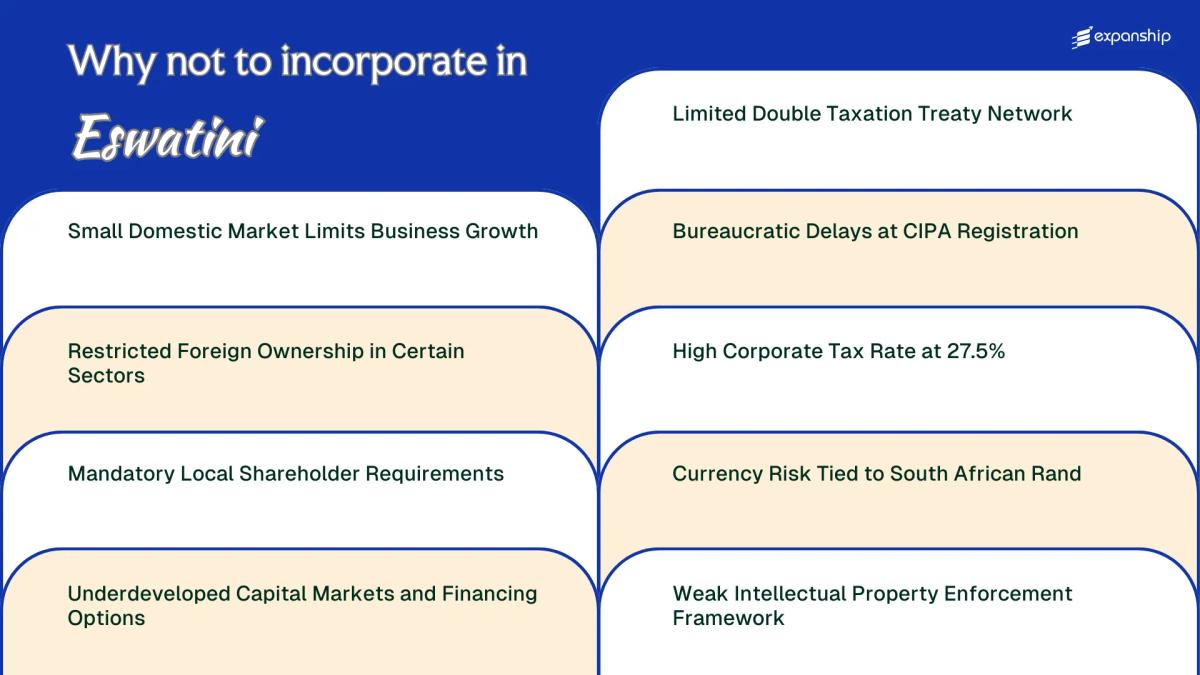
Small Domestic Market Limits Business Growth
Eswatini small market business limitations present a structural ceiling that is difficult to engineer around. With a population of approximately 1.2 million people, the consumer base is simply too narrow to sustain volume-dependent business models.
Population Size Constrains Revenue Potential
Domestic demand across most product and service categories remains low by regional standards. For a foreign business owner, this means that any entity incorporated here and relying on local sales cannot realistically scale without simultaneously building export operations into neighbouring markets, primarily South Africa or Mozambique.
Retail, financial services, and consumer goods sectors face the sharpest constraints. The limited consumer base in Eswatini incorporation contexts forces businesses to factor in cross-border logistics, foreign regulatory compliance, and currency exposure from day one, costs that would not apply in a larger domestic market.
Export Dependency Adds Structural Complexity
Revenue diversification through exports is not optional for most firms; it is operationally necessary. Eswatini market size business risks are therefore front-loaded, requiring your firm to absorb the overhead of regional market entry before achieving baseline profitability domestically.
A foreign business owner incorporating here solely to capture domestic demand will find that the market cannot absorb enough volume to justify the full cost of incorporation, compliance, and ongoing operations.
Restricted Foreign Ownership in Certain Sectors
Eswatini foreign ownership restrictions are codified through sector-specific legislation that bars or limits foreign participation in designated industries. These limitations are not informal policies — they carry legal weight and directly affect how your business can be structured at incorporation.
Under the Immigration Act and various enabling laws, certain sectors are reserved exclusively for Swazi citizens or citizen-majority entities. Foreign firms attempting to enter these areas face outright exclusion or are required to hold minority positions.
Sectors where foreign ownership faces restrictions or full exclusion include:
- Retail trade below defined thresholds forces foreign operators out of the consumer market entirely, removing access to the most accessible revenue streams
- Agriculture and land-based businesses are constrained by land tenure rules tied to citizenship, creating title and operational security problems for foreign-owned firms
- Certain transport and taxi licensing categories are reserved for nationals, adding cost and structural complexity if logistics form part of your business model
- Informal sector activities classified under citizen-only categories cannot be absorbed into a foreign-owned corporate structure
The practical result is that FDI limitations by sector can force a foreign investor to restructure or fragment a business model that would operate as a single entity elsewhere. Even where partial foreign ownership is permitted, minority positioning reduces decision-making authority and profit distribution control.

Company Incorporation in Eswatini
Set up your business entity in Eswatini with guidance on sector eligibility, ownership structuring, and CIPA registration requirements.
Mandatory Local Shareholder Requirements
Eswatini local shareholder requirements apply across a defined set of sectors, and for foreign investors entering those areas, the obligation to bring in a local equity partner is not discretionary. The Companies Act and sector-specific legislation administered by bodies such as the Small Enterprise Development Company (SEDCO) and relevant line ministries establish these ownership thresholds, meaning your corporate structure is constrained before operations begin.
Certain sectors reserve majority ownership for Swazi nationals. A foreign firm cannot simply hold a minority stake on paper — the local partner must exercise genuine equity rights, which introduces governance complexity and potential disputes over profit distribution, decision-making authority, and exit terms.
| Sector Category | Minimum Local Ownership Requirement | Implication for Foreign Investor |
|---|---|---|
| Small-scale retail and trading | Up to 100% reserved for citizens | Foreign participation effectively barred |
| Reserved sectors under indigenisation policy | Majority local shareholding required | Foreign equity capped below controlling threshold |
| Non-reserved sectors | No statutory minimum | Full foreign ownership permissible |
Finding a qualifying local shareholder with the financial capacity and aligned business interests is itself a time-intensive process. Structural dependency on a local partner also means that any future share transfer or exit requires that partner's cooperation, which can complicate divestment significantly.
This restriction does not apply uniformly across all business activities, but the sectors subject to it tend to attract early-stage investment interest from foreign entrants.
Underdeveloped Capital Markets and Financing Options
Eswatini capital market limitations present a structural barrier that many foreign businesses underestimate before committing to incorporation. The Eswatini Stock Exchange (SWX) lists only a small number of securities, restricting your ability to raise equity capital locally through public markets.
Thin trading volumes on the SWX mean that even listed companies face illiquid conditions. For a foreign-owned entity seeking an exit or secondary capital raise, this absence of market depth translates directly into higher transaction costs and fewer viable counterparties.
Domestic bank lending is the primary financing channel available to most businesses, but credit access depends heavily on local relationships and collateral held within the country. Foreign firms without established local assets face narrower borrowing terms than they would in more developed financial markets.
Venture capital and private equity infrastructure remains largely absent, which eliminates early-stage or growth financing options that investors rely on in regional hubs like South Africa or Mauritius.
- Equity capital cannot be raised efficiently through the SWX due to low listing volume and thin secondary market activity
- Debt financing from local banks typically requires Eswatini-based collateral, which foreign entities may not hold at incorporation
- No functioning local venture capital or private equity market exists to support growth-stage funding
- Offshore financing arrangements may require additional regulatory approvals under the Central Bank of Eswatini's exchange control framework
Despite being pegged to the South African Rand, Eswatini maintains its own independent exchange control regulations, meaning cross-border capital movements between the two countries are still subject to Central Bank of Eswatini approval rather than treated as domestic transfers.
Limited Double Taxation Treaty Network
Eswatini double taxation treaty limitations create measurable exposure for foreign-owned entities, particularly those remitting dividends, royalties, or interest across borders.
Narrow Treaty Coverage and Its Structural Gap
The kingdom maintains a small number of bilateral tax treaties, with agreements in place primarily with South Africa, the United Kingdom, and a handful of other partners. If your target investors or parent company are based in jurisdictions outside this narrow network, no treaty protection applies, meaning withholding taxes on outbound payments are levied at domestic statutory rates with no reduction mechanism available.
Consequences for Cross-Border Capital Flows
This absence of treaty coverage directly raises the after-tax cost of repatriating profits for most foreign shareholders. A business with German, American, or Asian ownership structures, for example, cannot access reduced withholding rates that a treaty would otherwise provide, making the firm's effective tax burden on cross-border transactions considerably higher than in treaty-connected jurisdictions.
Eswatini tax treaty network drawbacks are particularly acute for holding structures or regional headquarters, where income flows across multiple jurisdictions. Limited DTAs in Eswatini incorporation contexts can also expose the entity to double taxation in the shareholder's home country, depending on that country's own treaty relief provisions.
Managing Tax Treaty Gaps in Your Eswatini Structure
Understand how limited bilateral treaty coverage affects your cross-border tax position when incorporating in Eswatini.
Bureaucratic Delays at CIPA Registration
CIPA registration delays in Eswatini add measurable time and cost to what should be a straightforward incorporation process. Processing timelines at the Companies and Intellectual Property Authority frequently extend beyond the published standards, leaving your business in legal limbo before it can operate.
- Manual and paper-based procedures at CIPA increase the risk of administrative backlogs, meaning your registration can stall without formal notice or recourse.
- Incomplete digitisation of the company registry forces applicants to attend offices in person, creating an additional logistical burden for foreign incorporators not based in the country.
- Name reservation approvals, which must precede formal registration under the Companies Act of 2009, can consume days or weeks of the overall timeline.
- Delays in receiving your Certificate of Incorporation directly postpone your ability to open a corporate bank account, sign contracts, or apply for sector-specific licences.
- No statutory compensation mechanism exists for processing failures, so time lost to administrative error comes entirely at your expense.
High Corporate Tax Rate at 27.5%
Eswatini's corporate tax rate disadvantages become concrete when you examine the headline figure: resident companies pay a flat 27.5% on taxable income under the Income Tax Order of 1975, as amended. That rate sits above several regional competitors, including Mauritius at 15% and Rwanda at 30% — though Mauritius specifically positions itself as a low-tax holding jurisdiction, making the gap functionally wider for international structures.
For a foreign-owned company, the effective burden often exceeds the statutory rate. Withholding tax on dividends remitted abroad applies on top of corporate tax, compressing post-tax returns for non-resident shareholders.
Manufactured or export-oriented entities may qualify for a reduced rate under specific incentive provisions, but general trading and services companies receive no such relief. Your firm absorbs the full 27.5% from the first taxable shilling.
Hypothetical scenario: A foreign-owned services firm generating SZL 2,000,000 in annual net profit pays SZL 550,000 in corporate income tax at 27.5%. A comparable firm structured in Mauritius under the 15% rate would pay SZL 300,000 — a SZL 250,000 annual difference that compounds materially across a multi-year operating horizon.
Currency Risk Tied to South African Rand
Eswatini currency risk South African Rand exposure is structural, not incidental. The Lilangeni (SZL) is pegged 1:1 to the South African Rand under the Common Monetary Area (CMA) agreement, which means your business absorbs every fluctuation the Rand experiences against major currencies like the USD or EUR.
South Africa's Rand is one of the more volatile emerging market currencies globally, susceptible to domestic political instability, commodity price swings, and shifts in U.S. monetary policy. Because the SZL mirrors the Rand precisely, any depreciation of the Rand directly erodes the value of your Eswatini-held revenues when converted to hard currency.
Your firm has no independent monetary hedge at the country level. The Central Bank of Eswatini cannot adjust the SZL exchange rate independently, so currency risk management falls entirely on the individual business through private hedging instruments, which add cost and operational complexity.
Cross-border transactions within the CMA do not require foreign exchange controls between Eswatini and South Africa, but transfers outside the CMA are subject to exchange control regulations administered by the Central Bank of Eswatini. This restricts capital mobility for businesses with shareholders or obligations outside the region.
If your business holds capital in SZL and repatriates profits outside the CMA, those transfers are subject to Central Bank of Eswatini exchange control approval, meaning Rand volatility compounds with regulatory friction at the point of exit.
Weak Intellectual Property Enforcement Framework
Eswatini intellectual property enforcement problems present a direct operational risk for any foreign business bringing proprietary assets, brand identity, or licensed technology into the country. The Industrial Property Act and the Copyright Act provide the statutory basis for IP protection, but the capacity to enforce these rights in practice remains limited.
The Companies and Intellectual Property Authority (CIPA) administers IP registration, yet registration alone offers limited practical protection when infringement occurs. Enforcement depends heavily on court proceedings that can be slow and resource-intensive for foreign rights holders.
Trademark enforcement limitations are particularly pronounced. Without consistent judicial or administrative action against infringers, your registered mark can be copied with low consequence to the offending party.
For technology-dependent businesses, weak IP protection Eswatini creates a real disincentive to transfer proprietary systems or processes to local operations. The risk of unauthorized replication without meaningful legal recourse affects both licensing structures and day-to-day operational decisions.
Overcoming the Key Incorporation Challenges
Overcoming the Key Incorporation Challenges
Overcoming Eswatini incorporation challenges requires structural decisions made before registration, not adjustments applied after problems surface. The jurisdiction's regulatory framework leaves limited room for retroactive corrections once a company is registered with CIPA.
- Verify your intended sector against the Investment Promotion Authority's restricted foreign ownership list before selecting a business structure.
- Structure equity arrangements in advance to satisfy any mandatory local shareholder thresholds applicable to your activity.
- Assess treaty coverage gaps by reviewing Eswatini's active double taxation agreements before finalising your holding structure.
- Account for SZL/ZAR exposure in financial projections given the lilangeni's fixed peg to the South African rand.
- Register any trademarks or IP assets with the relevant intellectual property office before commencing operations, given the weak enforcement environment.
- Plan working capital independently of local debt markets, as domestic financing options remain underdeveloped.
These steps address structural risks that sit within the Companies Act and the broader regulatory environment. Even with preparation, certain constraints, particularly tax rates and treaty limitations, are fixed by law and cannot be engineered around at the entity level.
Eswatini's Overall Investment Viability
Eswatini investment viability risks are real and measurable, but they do not make the jurisdiction categorically unsuitable for foreign incorporation. For businesses with operations tied to the Southern African Customs Union, regional trade agreements, or manufacturing under the African Growth and Opportunity Act, the country retains a credible structural foundation.
| Pros | Cons |
|---|---|
| SACU membership provides preferential access to South African and regional markets | The domestic market of approximately 1.2 million people offers limited local consumer demand |
| AGOA eligibility supports export-oriented manufacturing to the United States | The corporate income tax rate of 27.5% reduces net returns compared to lower-tax jurisdictions |
| The lilangeni's peg to the South African rand provides exchange rate stability within the region | That same peg exposes your entity to rand volatility against major international currencies |
| Companies Act registration through CIPA is a defined legal process | CIPA processing delays and procedural inconsistencies extend incorporation timelines |
| Certain sectors remain open to 100% foreign ownership | Restricted sectors impose mandatory local shareholder requirements that dilute foreign control |
Eswatini has no broad intellectual property enforcement infrastructure, and its treaty network with major trading partners remains limited. Both factors impose concrete costs on firms that depend on IP assets or cross-border tax planning.
Compliance Services for Companies in Eswatini
Maintain your Eswatini company's good standing with timely annual returns, statutory filings, and regulatory obligations managed accurately.
Conclusion
Eswatini company incorporation drawbacks summary points to a jurisdiction with genuine structural constraints that foreign investors must account for before committing. The 27.5% corporate tax rate, applied without the relief that a wider treaty network would otherwise provide, creates a measurable cost burden for cross-border structures. Restricted foreign ownership rules in designated sectors add a further layer of complexity for firms seeking full operational control. Specialist legal and compliance support becomes a practical necessity rather than an optional consideration when working within these conditions.
Expanship's Eswatini Incorporation Support
Expanship Eswatini company formation support is structured around the specific compliance demands this jurisdiction places on foreign investors — from CIPA registration timelines and the 27.5% corporate tax rate to sector-based ownership restrictions and the limited treaty network that affects cross-border structuring.
From initial registration through to ongoing obligations, Expanship handles the operational weight that these requirements create for your business. Our services across Eswatini include:
- Preparing and filing company registration documents with CIPA on your behalf.
- Providing a registered agent and local office address to satisfy statutory presence requirements.
- Liaising directly with government departments and regulatory bodies throughout the filing process.
- Managing post-incorporation compliance obligations as they fall due.
- Facilitating introductions to local banking institutions to support account opening.
- Handling tax registration and coordination with the Eswatini Revenue Service.
Reach out to Expanship Eswatini to discuss how we can support your incorporation process.
Frequently Asked Questions (FAQ)
Restricted foreign ownership does not apply universally, but certain sectors, including retail and small-scale trading, carry statutory limitations that require local participation. The extent of restriction varies by activity type, so a firm operating in a reserved sector must structure its shareholding accordingly before registration is approved by CIPA.
Failing to maintain the required local shareholding structure after registration can expose your company to regulatory intervention and potential deregistration by CIPA. The requirement is not a one-time formation checkpoint; ongoing compliance is expected, and ownership changes that breach the threshold must be disclosed and rectified promptly.
With a narrow DTT network, withholding taxes on dividends, royalties, and interest paid to foreign shareholders are applied at domestic rates without treaty relief. This directly increases the effective cost of repatriating profits and makes Eswatini structurally less efficient than jurisdictions like Mauritius, which maintains an extensive treaty network across Africa and Asia.
The lilangeni's fixed peg to the South African rand means any depreciation of the rand against major currencies flows directly into your Eswatini entity's foreign currency exposure. Standard hedging instruments available through South African financial markets can provide partial protection, but the peg removes the possibility of independent monetary adjustment, leaving the exposure structurally linked to South Africa's macroeconomic conditions.
For businesses whose value sits in proprietary software, trademarks, or trade secrets, Eswatini's enforcement framework offers limited practical protection against infringement. Registration of IP rights is possible, but the capacity of local courts and regulatory bodies to act swiftly and decisively on infringement claims is constrained, making Eswatini a poor domicile for IP-holding structures that require active enforcement capability.
Bureaucratic delays at CIPA are a documented operational reality, and processing times frequently exceed published guidelines. Compared to South Africa's CIPC, which has invested in digital filing infrastructure, or Mauritius's Registrar of Companies, CIPA's processes remain more manual, making timeline certainty difficult for businesses with pressing operational deadlines.
Legal Disclaimer
The information provided in this article is for general informational purposes only and does not constitute legal, tax, or professional advice. While we strive to ensure the accuracy and timeliness of the content, laws and regulations are subject to change, and the application of laws can vary widely based on specific facts and circumstances.
Readers should not act upon this information without seeking professional counsel tailored to their individual situation. Expanship and its authors disclaim any liability for actions taken or not taken based on the content of this article.
For specific advice regarding your business setup, compliance requirements, or any legal matters, please consult with qualified legal and tax professionals in the relevant jurisdiction.