
Key Takeaways
- Eswatini's corporate income tax rate of 27.5% under the Income Tax Order 1975 sits below many comparable African jurisdictions, reducing the recurring tax burden for resident companies operating across the region.
- Membership in the Southern African Customs Union eliminates intra-regional tariffs across five member states, giving companies incorporated in Eswatini duty-free access to a combined market that includes South Africa.
- Foreign investors face no blanket ownership restrictions across most commercial sectors under the Companies Act 2009, removing a structural barrier that complicates market entry in a number of neighboring jurisdictions.
- Qualifying exporters can route manufactured goods into the United States under AGOA preferences, a trade access advantage that most competing incorporation destinations in the region cannot replicate.
Eswatini is a landlocked, independent monarchy in Southern Africa, bordered by South Africa and Mozambique. Understanding the benefits of incorporating in Eswatini begins with knowing how its regulatory environment is structured. Company registration falls under the oversight of the Eswatini Financial Services Regulatory Authority and is administered through the Registrar of Companies, operating within the framework of the Companies Act of 2009. Foreign businesses most commonly establish a private company limited by shares when entering the market.
The jurisdiction operates a low-tax regime, with corporate income subject to tax under the Income Tax Order of 1975 and its subsequent amendments. Foreign direct investment is generally welcomed, and there are few blanket restrictions on foreign ownership across most commercial sectors.
This article examines the key advantages that company formation in Eswatini offers to international businesses and investors.
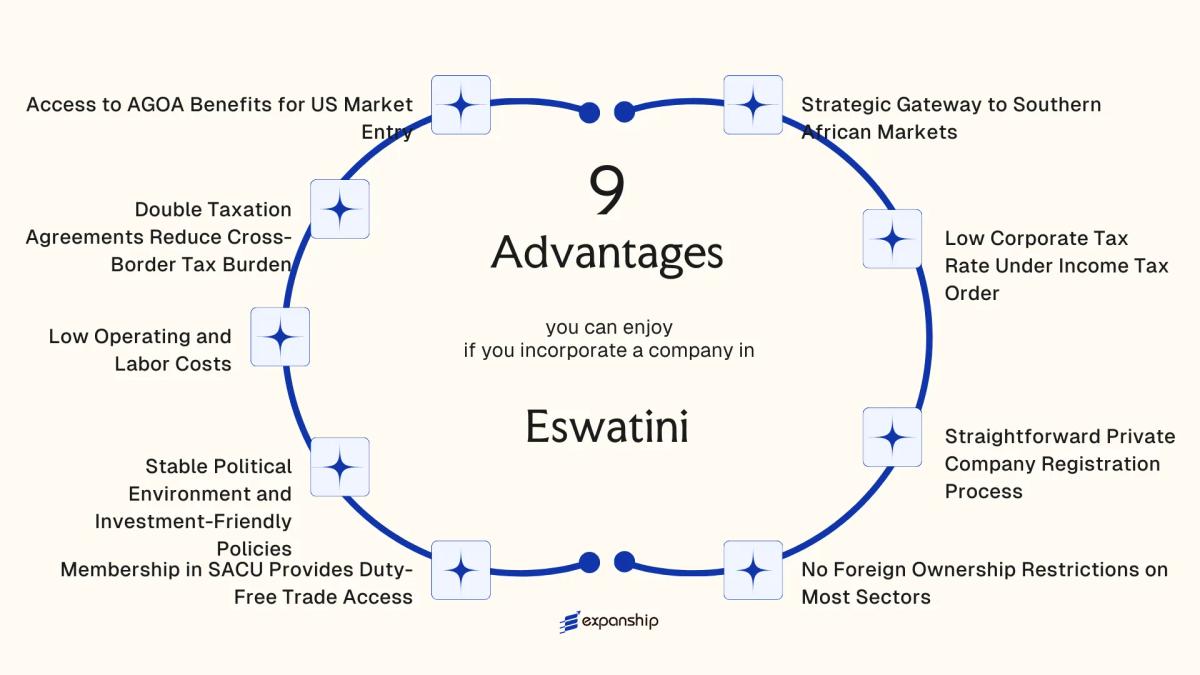
Strategic Gateway to Southern African Markets
Eswatini sits landlocked between South Africa and Mozambique, with direct road and rail connections to both countries. As an Eswatini gateway to Southern African markets, this position gives registered businesses physical proximity to a consumer base exceeding 60 million people within a few hundred kilometers.
Access Through Borders That Actually Move Goods
The Oshoek/Ngwenya border post connects directly to Gauteng, South Africa's commercial and industrial center, roughly 360 kilometers away. For a firm that sources, manufactures, or distributes physical goods, that proximity translates into reduced freight times and lower logistics overhead compared to routing through distant coastal or landlocked alternatives.
A Position That Connects Multiple Trade Corridors
Mozambique's port of Maputo lies approximately 80 kilometers from the eastern border, giving businesses registered in the kingdom access to Indian Ocean shipping lanes without transiting South Africa. The Maputo Corridor, a formally designated transport and development initiative, reinforces this route for regional trade hub benefits. Your business effectively sits at the intersection of two distinct export channels — overland into SACU territory and maritime through Maputo.
A company incorporated here can serve both Southern African domestic markets and international shipping routes from a single operational base.
Low Corporate Tax Rate Under Income Tax Order
Eswatini's standard corporate tax rate sits at 27.5%, governed by the Income Tax Order of 1975. While that figure is not negligible, the Order contains a tiered structure that reduces the effective rate for smaller companies and qualifying entities, which means a newly established foreign-owned firm may carry a meaningfully lower tax burden during its early years of operation.
The Eswatini low corporate tax rate advantages become more tangible when you consider what the Income Tax Order permits in terms of deductions. Allowable business expenses, depreciation of qualifying assets, and sector-specific concessions can reduce taxable income substantially before the headline rate applies.
Manufacturing and export-oriented businesses may qualify for additional tax incentives administered through the Eswatini Investment Promotion Authority, which works alongside the Revenue Authority to facilitate approved projects.
For foreign investors comparing regional options, the combination of rate, deductibility rules, and investment incentives produces an effective burden that competes with neighboring jurisdictions in the SADC region.
The structure also rewards compliance:
- The Income Tax Order creates a clear, codified framework rather than a discretionary system, reducing unpredictability for planning purposes
- Qualifying investment periods can defer portions of tax liability, improving cash flow during setup phases
- Approved status under investment promotion programs unlocks rate concessions that are formal and documented, not informal

Company Incorporation in Eswatini
Register your company in Eswatini with full compliance support across the Income Tax Order, CIPA registration, and ongoing statutory requirements.
Straightforward Private Company Registration Process
Registering a private company in Eswatini involves a relatively contained administrative process, which has direct implications for how quickly a foreign business owner can establish legal presence and begin operations. Under the Companies Act No. 8 of 2009, a private limited company requires a minimum of one shareholder and one director, with no mandatory residency requirement for either. This low threshold removes a structural barrier that exists in many other African jurisdictions.
The Companies and Insolvency Protection Authority (CIPA) serves as the registering body and handles new company filings. Once documentation is submitted, registration can generally be completed within a matter of days under standard processing. For a foreign investor, this translates to reduced dead time between the decision to incorporate and the ability to open a bank account, sign contracts, or apply for sector-specific licenses.
| Requirement | Detail |
|---|---|
| Minimum Shareholders | 1 |
| Minimum Directors | 1 |
| Resident Director Required | No |
| Governing Legislation | Companies Act No. 8 of 2009 |
| Registering Authority | CIPA |
A private company also restricts the public offering of shares, which suits foreign principals who want to maintain control and confidentiality over ownership structure. The Eswatini Companies Act incorporation framework does not impose a minimum paid-up capital requirement for private entities, meaning you are not required to inject capital before the entity is formally recognized. This reduces front-loaded financial exposure during the setup phase.
No Foreign Ownership Restrictions on Most Sectors
One of the more practical Eswatini no foreign ownership restrictions benefits is that foreign nationals can hold 100 percent equity in most business sectors without requiring a local partner. This is grounded in the country's investment framework and supported by the Swaziland Investment Promotion Authority (SIPA), which actively facilitates full foreign-owned entity registration. For your business, this means retained control over profits, decision-making, and capital repatriation.
Under the Companies Act and related commercial legislation, private companies do not impose nationality-based ownership caps across the majority of commercial sectors. Industries including manufacturing, services, retail, and technology remain open to full foreign ownership. Certain strategic sectors such as land ownership retain limitations, but these do not affect standard business incorporation structures.
Full ownership eliminates the cost and complexity of mandatory joint ventures, which remain a condition in several competing African jurisdictions.
Keep the following in mind when structuring your ownership:
- SIPA registration is required for foreign-owned entities before commencing operations
- Some regulated sectors require sector-specific licensing regardless of ownership percentage
- Land cannot be privately owned by foreign nationals; leasehold arrangements are the standard alternative
- Verify current sector classifications with SIPA, as restricted categories can be updated by ministerial notice
Eswatini permits 100 percent foreign ownership in manufacturing enterprises even when they are established inside designated industrial estates, without requiring a local equity stake at any stage.
Membership in SACU Provides Duty-Free Trade Access
Eswatini's SACU membership duty-free trade benefits are among the most operationally significant advantages for foreign-owned companies registered there. As a founding member of the Southern African Customs Union, the country participates in a trade bloc that eliminates customs duties on goods moving between member states: South Africa, Botswana, Namibia, and Lesotho. For a business incorporated there, this means goods manufactured or processed locally can move into a combined market of over 60 million people without attracting import tariffs at the border.
Tariff-Free Access to the SACU Common Market
The SACU Agreement, renegotiated in 2002, established a common external tariff applied uniformly across all member states. Your company does not pay separate customs duties when exporting finished goods into South Africa, which alone represents the largest economy on the continent. That direct, cost-free access to the South African market is a structural pricing advantage that competitors based outside SACU cannot replicate without absorbing tariff costs.
Revenue Pool and Preferential Trade Position
Under the SACU revenue-sharing formula, member states receive allocations from a common customs revenue pool. While this directly benefits the national budget, it also signals that the union functions as an integrated economic zone rather than a loose preferential arrangement. Companies using Eswatini customs union benefits for exporters gain access not only to the SACU internal market but also to preferential trade terms that SACU has negotiated collectively with third parties, including the European Union under the SADC Economic Partnership Agreement.
Maximize Your SACU Trade Advantages in Eswatini
Speak with our corporate services team about structuring your Eswatini entity to fully utilize SACU market access and trade benefits.
Stable Political Environment and Investment-Friendly Policies
Eswatini's stable investment environment advantages stem partly from its constitutional monarchy structure, which has maintained consistent governance since independence in 1968. While the country operates under an absolute monarchy rather than a multiparty system, this structure has produced a predictable regulatory environment where policy shifts tend to be incremental rather than abrupt. For foreign businesses, that consistency reduces the risk of sudden legislative reversals that can disrupt operations in more volatile markets.
- The Investment Promotion Act provides a formal legal framework that recognizes and protects foreign investment, giving your business a defined set of rights upon entry.
- The Eswatini Investment Promotion Authority (EIPA) serves as the primary interface for incoming investors, offering a structured entry point rather than requiring firms to navigate multiple disconnected agencies.
- The country maintains membership in the Southern African Development Community (SADC) and related regional bodies, which subjects it to broader regional standards around trade and investment conduct.
- Dispute resolution for foreign investors can draw on international arbitration conventions that Eswatini has acceded to, providing a mechanism outside of domestic courts when needed.
- Exchange control regulations, administered through the Central Bank of Eswatini, are aligned with the Common Monetary Area framework, giving your treasury function a predictable operational structure for cross-border transactions.
Low Operating and Labor Costs
Eswatini low operating costs for businesses reflect a combination of wage structures, utility pricing, and commercial real estate costs that sit well below what foreign investors typically encounter in South Africa or Botswana. For a manufacturing or distribution entity, this translates directly into lower break-even thresholds and wider margin per unit.
Wages in the country are governed by the Wages Act and sector-specific wage orders issued by the Wages Board. Minimum wage rates are set periodically per industry category, and general labor costs remain modest relative to regional peers. A foreign firm operating in light manufacturing or services can staff operations at a fraction of the cost of comparable roles in Johannesburg or Gaborone.
Commercial lease rates, particularly in industrial zones like Matsapha, are low compared to comparable corridors in the region. Matsapha sits adjacent to key road infrastructure linking to South Africa and Mozambique, so reduced overhead does not come at the expense of logistics access.
A foreign-owned garment manufacturer operating in Matsapha with 50 employees, paying wages near the gazetted minimum for the textile sector, could face a monthly payroll cost substantially below USD 15,000, a figure that would exceed USD 40,000 for equivalent headcount in South Africa's Western Cape manufacturing sector.
Double Taxation Agreements Reduce Cross-Border Tax Burden
Eswatini double taxation agreement benefits apply primarily through a network of bilateral tax treaties the country maintains with several of its key trading and investment partners. These treaties allocate taxing rights between signatory states, which means income earned by your foreign entity through an Eswatini-registered company is not taxed in full by both jurisdictions.
Treaty coverage typically addresses:
- Dividends remitted to foreign parent companies
- Interest payments on cross-border loans
- Royalties for intellectual property licensed across borders
- Capital gains on the disposal of qualifying assets
For a foreign investor, this structure reduces the effective tax cost of repatriating profits. Without treaty protection, withholding taxes on dividends and royalties can erode returns significantly before funds reach a parent company abroad.
Eswatini's Income Tax Order, 1975 governs domestic tax treatment, and treaty provisions take precedence over domestic rates where a valid agreement exists. South Africa is among the treaty partners, which is particularly relevant given how much cross-border business flows between the two economies.
Eligibility for reduced withholding rates generally requires that the recipient entity qualifies as a tax resident of the treaty partner country under that treaty's residency definition.
Treaty benefits only apply if your foreign entity meets the residency and beneficial ownership conditions specified in the applicable bilateral agreement.
Access to AGOA Benefits for US Market Entry
AGOA benefits for Eswatini registered companies give exporters preferential access to the United States market under the African Growth and Opportunity Act, a US trade legislation that eliminates import duties on thousands of product categories originating from eligible sub-Saharan African countries. For a business exporting manufactured goods, textiles, or agricultural products, removing tariffs that would otherwise apply under standard US trade schedules directly reduces the landed cost of your goods in the American market.
Textile and Apparel Exports Under the Third-Country Fabric Provision
Eswatini holds eligibility under AGOA's special textile provision, which permits qualifying apparel manufacturers to use fabric sourced from outside Africa and still export duty-free to the US. This provision is significant for companies that source inputs globally but want to use the kingdom's manufacturing base for final production. The resulting cost advantage over competitors exporting from countries without AGOA eligibility can be material when pricing into US retail or wholesale channels.
Eligibility Requirements That Protect Your Market Access
AGOA beneficiary status is reviewed annually by the US government based on criteria that include governance standards and market reform conditions. Your company must ensure that goods meet the AGOA rules of origin requirements, which stipulate minimum local value addition or transformation thresholds. Maintaining compliance with these origin rules is what preserves duty-free treatment at the US border.
- Products covered span apparel, agricultural goods, manufactured items, and select processed products
- Duty savings apply against the US Most Favored Nation tariff rates that would otherwise apply
- Origin documentation must accompany each shipment to substantiate the preferential claim
Why Eswatini Stands Out Against Regional Competitors
Comparing this jurisdiction against its most relevant regional peers reveals where its structural advantages are most pronounced. South Africa, Botswana, and Mozambique were selected as reference points because they share geographic proximity, target overlapping categories of foreign investors, and are frequently evaluated alongside Eswatini by businesses seeking a Southern African base. The comparison focuses on parameters where the kingdom holds a neutral or favourable position relative to these alternatives.
What the table below illustrates is not simply a list of features, but a pattern: the combination of SACU membership, AGOA eligibility, and a 27.5% corporate tax rate under the Income Tax Order 1975 is a structural cluster that no single neighbouring jurisdiction replicates in full. Botswana offers competitive tax rates but does not share SACU's common external tariff. South Africa carries the weight of higher compliance costs and a more complex regulatory environment for new entrants.
| Parameter | Eswatini | South Africa | Botswana | Mozambique |
|---|---|---|---|---|
| Corporate Tax Rate | 27.5% | 27% | 22% | 32% |
| SACU Membership | Yes | Yes | No | No |
| AGOA Eligibility | Yes | Yes | Yes | Yes |
| Foreign Ownership Restrictions | Minimal across most sectors | Sector-specific restrictions apply | Sector-specific restrictions apply | More extensive restrictions in certain sectors |
| Common External Tariff Access | Yes (via SACU) | Yes (via SACU) | No | No |
Compliance Services for Companies in Eswatini
Maintain your Eswatini company's good standing with ongoing regulatory, filing, and statutory compliance support.
Conclusion
Eswatini offers a specific combination of structural conditions that make it a credible incorporation destination for internationally oriented businesses. SACU membership eliminates intra-regional tariffs across five southern African markets, while preferential AGOA access opens a direct path into the United States without the trade barriers most competing jurisdictions face. The corporate tax rate under the Income Tax Order 1975 sits at 27.5% for resident companies, and the absence of foreign ownership restrictions across most sectors removes a structural barrier that frequently complicates entry into comparable African markets.
The benefits of incorporating in Eswatini are most pronounced for businesses with a clear regional or export orientation. A firm positioned to supply goods into SACU member states or route manufactured exports to US buyers under AGOA operates under a different commercial calculus than one focused solely on the domestic market. Your business structure, the sectors you operate in, and the trade corridors you depend on will determine how much of this framework applies directly.
For businesses that fit that profile, the regulatory environment, trade access, and cost base create conditions that are difficult to replicate through incorporation in neighboring jurisdictions alone. The next step is translating these structural advantages into a correctly formed and compliant legal entity under the Companies Act 2009, with the appropriate registrations in place from the outset.
Start Your Eswatini Company Formation With Expanship Today
Expanship Eswatini company formation services cover the full process of registering a private company (Pty) Ltd under the Companies Act of 2009, from name reservation through the Companies Registry to post-incorporation compliance filings. The benefits outlined throughout this blog, including SACU trade access, AGOA eligibility, and the tax treatment under the Income Tax Order 1975, each carry their own procedural and documentation requirements. Engaging a specialist firm reduces the risk of delays caused by incorrect filings or missing documentation at the Companies Registry of Eswatini.
Expanship handles the specific tasks that tend to slow down foreign-owned incorporations:
- Document preparation and notarization for submission to the Companies Registry
- Registered office and resident agent provision as required under the Companies Act
- Government filing and liaison with the Companies Registry and relevant revenue authorities
- Post-incorporation compliance management, including annual returns and statutory record maintenance
- Banking introduction assistance to support account opening with local financial institutions
Reach out to Expanship Eswatini to discuss your registration requirements.
Frequently Asked Questions (FAQ)
The standard corporate income tax rate under the Income Tax Order, 1975 is 27.5% for companies. This applies to taxable income derived within the country, and certain incentives or reduced rates may apply depending on the nature of business activities or location within designated investment zones.
Membership in the Southern African Customs Union (SACU) means goods moving between Eswatini, South Africa, Botswana, Lesotho, and Namibia are not subject to customs duties. For businesses sourcing inputs or distributing products across the region, this arrangement reduces landed costs considerably compared to operating outside the customs union.
Eswatini has concluded double taxation agreements with several countries, including South Africa and the United Kingdom, which allocate taxing rights and reduce withholding tax rates on dividends, interest, and royalties. A foreign investor whose home country has a treaty in force with Eswatini can rely on those provisions to avoid double taxation on cross-border income flows.
Under the African Growth and Opportunity Act (AGOA), qualifying products manufactured in Eswatini can enter the US market duty-free. Eswatini has maintained AGOA eligibility, which is particularly relevant for textile and apparel manufacturers given the third-country fabric provision that allows inputs sourced outside the US without losing preferential access.
A private company incorporated under the Companies Act of 2009 must maintain a registered office address within the country. While a local resident director is not universally mandated for all private company structures, the entity must have a registered agent or representative capable of receiving official correspondence and complying with filing obligations.
The combination of SACU membership and AGOA eligibility is not available through all neighboring jurisdictions in the same form. South Africa, while larger, does not offer AGOA's third-country fabric rule under the same conditions, and some regional alternatives lack the lower operating cost base that makes Eswatini commercially viable for export-oriented manufacturing.
Legal Disclaimer
The information provided in this article is for general informational purposes only and does not constitute legal, tax, or professional advice. While we strive to ensure the accuracy and timeliness of the content, laws and regulations are subject to change, and the application of laws can vary widely based on specific facts and circumstances.
Readers should not act upon this information without seeking professional counsel tailored to their individual situation. Expanship and its authors disclaim any liability for actions taken or not taken based on the content of this article.
For specific advice regarding your business setup, compliance requirements, or any legal matters, please consult with qualified legal and tax professionals in the relevant jurisdiction.