

Key Takeaways
- Businesses incorporated within Qatar's free zones benefit from a zero percent corporate tax rate, a provision that operates independently of Qatar's standard territorial tax system and applies regardless of profit volume.
- Full foreign ownership is achievable without a local partner requirement under both the Qatar Financial Centre framework, governed by the QFC Authority, and Qatar's designated free zones, removing a structural barrier common across mainland Gulf jurisdictions.
- The Qatar Financial Centre's Financial Services Regulations provide a distinct licensing and compliance architecture that gives financial services firms a credible regulatory standing recognised by international counterparts.
- Shareholders receive distributions free of personal income tax, meaning retained earnings are not subject to a second layer of taxation at the individual level once they exit the corporate structure.
Qatar is an independent sovereign state on the Arabian Peninsula, governed under a constitutional monarchy, and one of the few Gulf nations that has actively restructured its commercial legal environment to attract foreign direct investment at scale. The Ministry of Commerce and Industry oversees company registration for mainland entities, while the Qatar Financial Centre Authority governs firms incorporated within the QFC. For foreign businesses entering this market, the Limited Liability Company remains the most common vehicle used outside of free zone and QFC structures.
From a tax standpoint, Qatar operates a territorial tax system, with significant zero-tax provisions available depending on the jurisdiction of incorporation and activity type. Openness to foreign capital has expanded considerably under frameworks introduced through the QFC and Qatar's free zones, which permit full foreign ownership in defined sectors and structures.
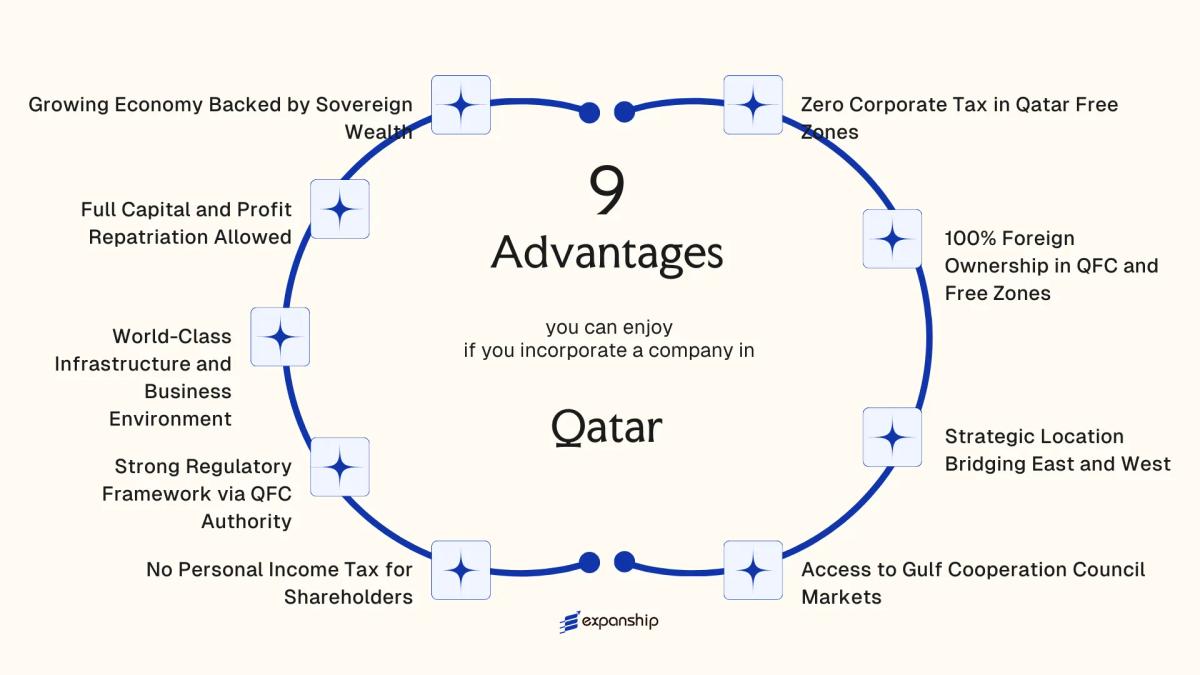
This article examines the principal advantages your business may encounter when establishing a presence here — covering ownership rights, tax treatment, capital mobility, and the broader commercial environment.
Zero Corporate Tax in Qatar Free Zones
Entities licensed within Qatar's designated free zones and the Qatar Financial Centre pay zero corporate income tax on qualifying profits. That single structural feature directly reduces your firm's tax liability to nil on income generated through those vehicles.
What the Tax Exemption Actually Covers
The QFC tax regime, governed by the QFC Tax Regulations, applies a 10% corporate tax rate on locally sourced income — but income from international operations conducted through a QFC-licensed entity is taxed at 0%. Free zone operators such as those licensed under Qatar Free Zones Authority, covering Ras Bushan and Umm Alhoul, receive a blanket exemption on corporate tax, typically granted for a defined period under their operating licence terms.
Why This Matters for Your Business Structure
For a foreign-owned firm routing international trade, financial services, or holding structures through these zones, the absence of corporate tax on qualifying income means retained earnings remain intact for reinvestment or distribution. The tax free business setup Qatar free zone framework means your entity keeps what it earns, without the erosion that standard onshore tax regimes apply.
A QFC or free zone licence can reduce your corporate tax exposure on international income to zero under current regulations.
100% Foreign Ownership in QFC and Free Zones
100% foreign ownership in Qatar free zones removes one of the most significant structural barriers foreign investors face elsewhere in the Gulf. Under mainland Qatar's Commercial Companies Law, non-Qatari investors are generally restricted to a 49% ownership stake, requiring a local partner to hold the remaining majority. Free zones and the Qatar Financial Centre operate under separate legal frameworks that eliminate this requirement entirely.
The QFC, established by Law No. 7 of 2005, permits 100% foreign ownership across a defined range of financial, professional, and business services. Entities registered there are governed by the QFC Authority and QFC Regulatory Authority, not Qatar's onshore company law. Free zones such as Manateq's economic zones offer similar full-ownership structures for qualifying industrial and logistics businesses.
For your business, this distinction carries real consequence. Full ownership means you retain direct control over decisions, profits, and exit strategy without negotiating with a mandatory local partner.
The ownership conditions across these zones are also structured to suit international entrants:
- Minimum capital requirements vary by activity but are generally lower than onshore commercial registration thresholds
- No mandatory local director or sponsor is required within the QFC
- Registered address requirements are satisfied through the respective free zone or QFC-approved facilities
- Licensing categories are activity-specific, which narrows documentation scope rather than broadening it

Company Incorporation in Qatar
Set up a fully foreign-owned entity in the QFC or a Qatar free zone with end-to-end formation support from Expanship.
Strategic Location Bridging East and West
Doha sits at roughly the midpoint between European capitals and major Asian financial centers, placing your business within a four-to-six-hour flight of markets spanning from London to Mumbai. This geographic position is a structural Qatar strategic location advantage for business, not a marketing characterization. The state occupies a peninsula on the northeastern coast of the Arabian Peninsula, with direct access to the Arabian Gulf and shipping lanes connecting the Indian Ocean to the Suez Canal corridor.
| Metric | Detail |
|---|---|
| Distance to Dubai | ~400 km |
| Distance to Mumbai | ~2,400 km |
| Distance to London | ~5,200 km |
| Hamad International Airport annual capacity | ~53 million passengers |
| Qatar Airways destinations | 170+ cities across 6 continents |
Hamad International Airport, operated under the Civil Aviation Authority's regulatory framework, functions as a significant transit hub connecting freight and passengers across three continents. For a firm distributing goods or coordinating regional teams, this translates into shorter logistics chains and lower operational friction compared to locating in markets further from the Gulf's central axis.
Port of Hamad, commissioned in 2016, is the country's primary deep-water commercial port. It connects directly to established East-West shipping routes, which means goods can move between Asia, the Gulf, and European markets without requiring transshipment through third-country ports. For companies managing physical supply chains, this directness reduces transit times and associated costs in a measurable, operational way.
Access to Gulf Cooperation Council Markets
Access to GCC markets via Qatar is one of the more structurally significant advantages available to foreign-incorporated entities in the region. As a full member of the Gulf Cooperation Council, Qatar participates in the GCC Common Market, which allows goods, services, capital, and certain categories of labor to move across Bahrain, Kuwait, Oman, Saudi Arabia, the UAE, and Qatar under unified trade rules.
For a business registered here, this means your entity can supply goods to GCC member states without facing the same tariff barriers that apply to firms incorporated outside the bloc. The GCC Customs Union applies a common external tariff, generally set at 5% on most imported goods, but intra-GCC trade among qualifying businesses is largely exempt from this.
Certain sectors benefit more directly. Companies with a certificate of origin confirming GCC-manufactured goods gain preferential treatment at member-state borders, which matters for firms with production or distribution operations in Qatar.
Keep these points in mind:
- GCC origin certification must meet the rules-of-origin criteria set by GCC Secretariat General guidelines
- Services companies must verify that their licensed activity qualifies under GCC Common Market protocols
- Free zone entities may face different treatment compared to onshore companies when claiming intra-GCC trade benefits
- Not all GCC member states apply Common Market provisions uniformly across every sector
Qatar's 2021 lifting of the Gulf blockade restored full GCC market access for Qatari-registered firms, reopening land, air, and sea routes that had been closed since 2017.
No Personal Income Tax for Shareholders
Qatar imposes no personal income tax on individuals, which means shareholders — including foreign nationals — retain the full value of dividends and distributions received from their companies. This is not a temporary exemption or a special regime requiring separate approval; it is the baseline position under Qatari tax law for natural persons.
What the Law Actually Provides
The Income Tax Law (Law No. 24 of 2018) governs corporate taxation in Qatar but contains no provision for taxing individual income from employment, investment returns, or profit distributions. For you as a foreign investor, this means dividend income received from your Qatari entity is not subject to any withholding or personal-level charge at the point of distribution.
This treatment applies regardless of your nationality or country of residence. There is no minimum ownership threshold or holding period required to qualify — the absence of personal income tax is structural, not conditional.
Why This Matters for Return on Investment
Most OECD jurisdictions apply personal income tax rates between 25% and 55% on dividend income. Shareholders receiving distributions from a Qatar-registered entity face none of that reduction on the Qatari side. The full declared dividend passes to you without local deduction, preserving the effective yield on your equity stake.
Combined with the absence of capital gains tax on individuals, the after-tax return available to shareholders in Qatar reflects a materially different outcome compared to jurisdictions that apply multi-layer taxation on corporate profits and subsequent distributions.
Maximize Your Shareholder Returns in Qatar
Speak with an Expanship advisor to understand how Qatar's personal tax framework applies to your ownership structure and distribution strategy.
Strong Regulatory Framework via QFC Authority
The QFC Authority regulatory framework benefits businesses that require a credible, internationally recognized legal environment rather than a lightly regulated offshore structure. Established under Qatar Financial Centre Law No. 7 of 2005, the QFC operates as a distinct legal and regulatory jurisdiction within Qatar, with its own courts, civil and commercial laws, and independent regulator.
- The QFC Authority licenses and supervises firms operating within the centre, applying standards aligned with international best practices from bodies such as the IOSCO and FATF. For a foreign business, this signals institutional credibility to clients, counterparties, and correspondent banks.
- Disputes within the QFC fall under the jurisdiction of the QFC Regulatory Tribunal and the QFC Court, which apply English common law principles. This gives foreign-owned entities a familiar legal framework that reduces transactional risk.
- The QFC regulatory regime is separate from Qatar's onshore legal system, meaning your firm is not subject to certain restrictions that apply under the Qatar Commercial Companies Law.
- Regulated QFC entities can passport their credentials when engaging with counterparties across the GCC, given the QFC's standing as a recognized financial centre.
- Regulatory clarity under a defined statutory framework reduces legal uncertainty, which directly lowers the due diligence burden for institutional investors and multinational partners evaluating your entity.
World-Class Infrastructure and Business Environment
Qatar's infrastructure investment is a direct product of its National Vision 2030, a state-level development framework that has funded major expansions across transport, energy, digital connectivity, and urban planning. For a foreign business, this translates into operational reliability that is difficult to price but easy to measure in avoided costs and delays.
Hamad International Airport consistently ranks among the top-connected airports in the Middle East, linking Doha to over 170 destinations. Combined with Hamad Port, one of the largest multipurpose ports in the region, your supply chain has access to both air and sea freight corridors with meaningful capacity.
Lusail City, a planned urban district north of Doha, has emerged as a concentrated business address with modern commercial towers, broadband infrastructure, and proximity to financial institutions. Firms registered under the Qatar Financial Centre benefit from offices within a purpose-built regulatory and physical environment, reducing the friction of setting up operational premises.
Mobile and fixed broadband penetration rates in the country are among the highest in the GCC, which directly supports remote teams, cross-border operations, and cloud-dependent business models.
Qatar ranked 1st in the Arab world and 28th globally in the IMF's 2024 GDP per capita figures (PPP basis), reflecting the purchasing power and economic density of the market your business would be operating in.
Source: IMF World Economic Outlook Database, April 2024
Full Capital and Profit Repatriation Allowed
The full profit repatriation benefit Qatar offers is codified rather than discretionary. Under the Qatar Financial Centre's regulatory framework, firms registered within the QFC can transfer 100% of profits and capital abroad without restriction, with no mandatory reinvestment requirements and no prior approval needed from the QFC Authority.
For a foreign investor, this means your returns are not trapped onshore. Funds move on your schedule, not at the discretion of a government body.
Companies operating in Qatar's special economic zones, such as Qatar Free Zones Authority (QFZA)-licensed entities, hold similar repatriation rights under their respective operating frameworks. The key structural advantage across both regimes is the absence of currency controls that would otherwise delay or reduce outward transfers.
- No withholding tax applies to profit distributions sent to foreign parent entities from QFC-registered firms.
- Capital contributed at incorporation can be fully withdrawn upon liquidation without clawback provisions.
- Dividend remittances do not require central bank pre-clearance under standard QFC arrangements.
This directly benefits holding structures and regional headquarters, where cash pooling across subsidiaries depends on the ability to move funds freely and predictably.
Repatriation rights under the QFZA and QFC regimes apply specifically to entities licensed within those frameworks; onshore companies incorporated under the Qatar Commercial Companies Law may face different foreign exchange considerations.
Growing Economy Backed by Sovereign Wealth
Qatar's sovereign wealth economic stability benefits stem directly from the scale and structure of the Qatar Investment Authority (QIA), the state-owned fund established in 2005 to manage the country's hydrocarbon revenues. With assets estimated at over $450 billion, the QIA ranks among the largest sovereign wealth funds globally, and its existence has a direct consequence for businesses incorporated locally: fiscal policy remains insulated from the volatility that affects commodity-dependent economies elsewhere.
For foreign-owned entities, this translates into predictable operating conditions. Government spending programs are not contingent on oil prices in the same way they are in less-diversified Gulf economies, because the QIA provides a structural buffer. Infrastructure contracts, public procurement, and government-linked partnerships continue even during commodity downturns.
Qatar's National Vision 2030, a formal development framework, channels QIA returns into non-hydrocarbon sectors including financial services, logistics, and technology. This diversification effort creates measurable demand for foreign firms operating in those sectors.
- The QIA's investment mandate spans real estate, infrastructure, equities, and private equity across six continents, generating a global returns base that supports domestic fiscal commitments.
- Qatar's GDP per capita consistently ranks among the highest worldwide, sustaining consumer and B2B purchasing power within the domestic market.
- Government debt levels remain low relative to GDP, which limits sovereign credit risk and supports the long-term stability of the Qatari riyal's peg to the US dollar.
That peg, maintained at QAR 3.64 per USD, eliminates currency conversion risk for companies that invoice in US dollars or operate across dollar-denominated supply chains.
Why Qatar Stands Out Among Gulf Business Hubs
Among Gulf incorporation destinations, the most direct comparisons for a foreign investor evaluating Qatar are the UAE and Bahrain. The UAE attracts the largest share of regional foreign direct investment and offers a dense network of free zones, while Bahrain positions itself as a lower-cost entry point with a long-standing financial services sector. Placing these three side by side reveals where Qatar's regulatory architecture and economic structure create genuinely distinct conditions, particularly around sovereign financial backing, free zone tax treatment, and the QFC's common law framework.
What the comparison surfaces is structural rather than incidental. The QFC Authority operates under English common law, which is not replicated in Bahrain's equivalent and differs meaningfully from the UAE's DIFC in terms of sector scope and licensing flexibility. For businesses where legal predictability and dispute resolution under a familiar framework carry operational weight, this distinction has direct consequences for how contracts are drafted, enforced, and litigated.
| Parameter | Qatar (QFC / Free Zones) | UAE (Free Zones) | Bahrain |
|---|---|---|---|
| Corporate Tax in Free Zone | 0% | 0% (most free zones) | 0% (free zones) |
| Legal Framework Option | English Common Law (QFC) | English Common Law (DIFC only) | Civil law based |
| Foreign Ownership | 100% in QFC and designated free zones | 100% in free zones | 100% in most sectors |
| Sovereign Wealth Backing | Qatar Investment Authority (~$500B+ AUM) | Abu Dhabi Investment Authority | No equivalent sovereign fund |
| Personal Income Tax | None | None | None |
| Dispute Resolution (QFC) | QFC Civil and Commercial Court | DIFC Courts (separate jurisdiction) | Bahrain courts |
Compliance Services for Companies in Qatar
Maintain good standing with QFC Authority and free zone regulators through structured compliance support tailored to Qatar-incorporated entities.
Conclusion
Qatar's combination of zero corporate tax within its free zones, unrestricted profit repatriation under the Qatar Financial Centre's regulatory framework, and full foreign ownership structures creates a fiscally coherent environment that few Gulf jurisdictions replicate at the same scale. The absence of personal income tax on shareholder distributions compounds these advantages, allowing retained earnings to remain largely intact at both the entity and individual level.
Not every business will extract equal value from this setup. A firm targeting GCC-wide distribution will benefit differently from the geographic position than a financial services entity seeking QFC authorisation under the Financial Services Regulations. Your structure, sector, and target markets determine which of these features delivers the most meaningful return.
The case for this jurisdiction rests on the alignment between its regulatory architecture and the operational needs of internationally minded businesses. For those whose models are compatible with the QFC or free zone frameworks, the structural advantages are substantive rather than marginal. Confirming how your specific entity type qualifies under current rules is the practical next step before any formation decision is made.
Start Your Qatar Company Formation With Expanship
Qatar company formation with Expanship covers the full incorporation lifecycle across the structures this blog has examined, from QFC-licensed entities and free zone companies to mainland LLCs registered with the Ministry of Commerce and Industry. Expanship works directly within these frameworks, including compliance obligations set by the QFC Authority and the requirements applicable to each jurisdiction type.
For businesses ready to proceed, Expanship's service scope includes:
- Document preparation, attestation, and legalization for submission to relevant authorities
- Registered agent and registered office provision where required by local regulation
- Government filing and liaison with the Ministry of Commerce and Industry or the QFC Authority
- Post-incorporation compliance management, including annual return obligations and license renewals
- Corporate bank account introduction assistance with locally operating institutions
- Ongoing corporate secretarial support to maintain good standing
Reach out to Expanship Qatar to discuss your incorporation requirements.
Frequently Asked Questions (FAQ)
Companies operating within the QFC are subject to a 10% corporate income tax on locally sourced profits, governed by the QFC Tax Regulations. This rate applies to income generated from activities conducted within or from the QFC. Profits derived from activities outside the QFC may be treated differently depending on the entity's structure and the nature of its operations.
The QFC Authority generally processes incorporation applications within a few weeks, though the exact timeline varies based on the complexity of the proposed business activity and the completeness of submitted documentation. Licensed activities requiring additional regulatory approval from the Qatar Financial Centre Regulatory Authority (QFCRA) may extend this period. Firms in financial services, for example, must obtain authorisation from the QFCRA before commencing operations.
QFC-registered entities are permitted to repatriate profits and capital without restriction, and there are no currency controls applied under the QFC framework. This contrasts with certain onshore structures, where repatriation terms may be subject to partnership agreements with local sponsors. The absence of dividend withholding tax under the QFC regime further supports cross-border capital movement.
There is no personal income tax in Qatar, which means shareholders receiving dividends or directors receiving remuneration from a Qatar-registered entity are not subject to personal tax liability in the jurisdiction. This applies regardless of whether the individual is a Qatari national or a foreign resident. Tax obligations in the shareholder's country of residence remain a separate consideration governed by that country's domestic law and any applicable double tax treaties.
The QFC requires entities to have a registered address within the QFC, and firms conducting regulated activities must demonstrate a genuine operational presence. A virtual office arrangement may satisfy basic registration requirements for certain non-regulated entities, but businesses seeking QFCRA authorisation are expected to show substance, including local staffing and physical premises. The specific requirements depend on the licence category applied for.
Qatar's membership in the Gulf Cooperation Council (GCC) means that goods traded under the GCC Customs Union may benefit from reduced or zero tariffs across member states, which include Saudi Arabia, the UAE, Bahrain, Kuwait, and Oman. However, QFC entities are primarily service-oriented structures and do not automatically gain preferential trade treatment for goods under GCC arrangements simply by virtue of their QFC registration. Market access advantages are most relevant to firms using a Qatar presence as a regional hub for professional and financial services.
Legal Disclaimer
The information provided in this article is for general informational purposes only and does not constitute legal, tax, or professional advice. While we strive to ensure the accuracy and timeliness of the content, laws and regulations are subject to change, and the application of laws can vary widely based on specific facts and circumstances.
Readers should not act upon this information without seeking professional counsel tailored to their individual situation. Expanship and its authors disclaim any liability for actions taken or not taken based on the content of this article.
For specific advice regarding your business setup, compliance requirements, or any legal matters, please consult with qualified legal and tax professionals in the relevant jurisdiction.