

Key Takeaways
- Paraguay's flat 10% corporate income tax rate, established under Ley N° 125/1991, is among the lowest statutory rates in South America, directly reducing the tax burden on domestically sourced profits.
- Because Paraguay applies a strict territorial tax regime, foreign-sourced income falls entirely outside the local tax base, allowing internationally focused businesses to hold an operating entity in Paraguay without triggering Paraguayan corporate tax on offshore revenues.
- Minimal capital requirements for both the Sociedad Anónima and the Sociedad de Responsabilidad Limitada lower the financial threshold for market entry, enabling foreign investors to establish a compliant legal presence without committing substantial capital upfront.
- MERCOSUR membership gives a Paraguayan-incorporated entity preferential trade access to Argentina, Brazil, and Uruguay, making the jurisdiction a functional platform for regional commerce rather than a purely administrative holding structure.
Paraguay is a landlocked, independent republic in central South America, bordered by Brazil, Argentina, and Bolivia. Foreign businesses incorporating here most commonly do so through a Sociedad Anónima or Sociedad de Responsabilidad Limitada, depending on ownership structure and operational needs. Company registration falls under the oversight of the Ministerio de Industria y Comercio, which administers the SUACE single-window system for business formation.
The country operates a territorial tax regime, meaning income sourced outside its borders is generally not subject to local taxation. Foreign ownership faces no statutory restrictions across most sectors, and the government has maintained a broadly open posture toward foreign direct investment for several decades.
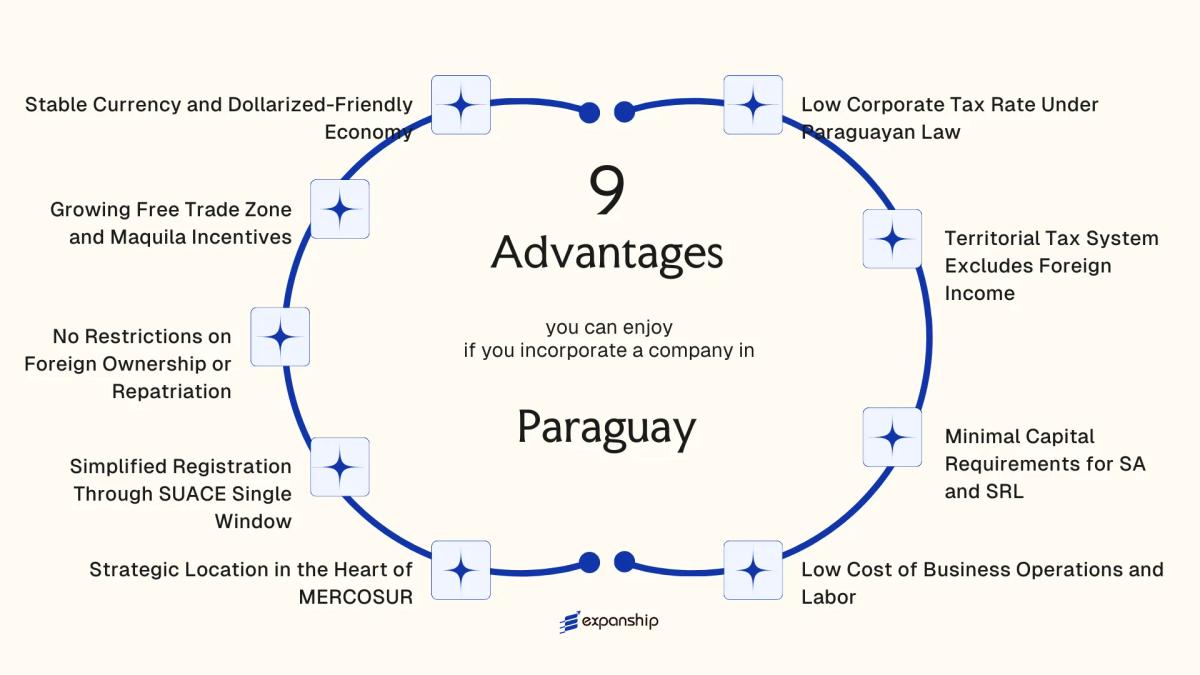
The benefits of incorporating in Paraguay extend across tax structure, operating costs, capital requirements, and access to regional trade frameworks. This article examines those advantages in detail to help you assess whether a Paraguay company formation aligns with your business objectives. Each section addresses a distinct aspect of why incorporate in Paraguay — grounded in current law and regulatory practice.
Low Corporate Tax Rate Under Paraguayan Law
Corporate profit tax in Paraguay is governed by IRACIS (Impuesto a la Renta de Actividades Comerciales, Industriales o de Servicios), which applies a flat 10% rate on net taxable income. For foreign business owners, this rate directly reduces the cost of operating a profitable entity in the country.
How the 10% Flat Rate Works Under IRACIS
IRACIS applies uniformly to commercial, industrial, and service activities conducted within Paraguayan territory. At 10%, the rate is roughly half the Latin American regional average, which sits closer to 20-27% in economies such as Brazil and Argentina, meaning retained earnings are substantially higher for the same level of profit.
What the Rate Structure Means for Dividend Distributions
Dividends distributed to foreign shareholders are subject to an additional withholding of 15% under IRACIS rules, applied only to the distributed portion. Your undistributed profits remain taxed solely at the 10% corporate level, giving you control over when the additional withholding triggers.
Profits retained inside your Paraguayan entity are taxed at just 10%, with the secondary withholding layer applying only when you choose to distribute.
Territorial Tax System Excludes Foreign Income
Paraguay's territorial tax system means that income generated outside the country's borders is not subject to local taxation. Under the Ley de Tributación, income tax obligations apply only to earnings sourced within Paraguayan territory. Foreign-sourced dividends, interest, royalties, and business profits remain outside the scope of the tax authority, the Subsecretaría de Estado de Tributación (SET).
For a foreign business owner, this structural feature has a direct consequence: profits earned from operations in Europe, North America, or elsewhere are not reported to or taxed by SET, regardless of where the company is incorporated. Your overseas earnings stay intact without requiring treaty protections or complex structuring to achieve exemption.
This exemption applies specifically to income with a foreign source of production. Several factors make this particularly practical:
- Income origin determines tax exposure, not the residency of shareholders
- No withholding obligation arises on foreign earnings remitted through a Paraguayan entity
- The territorial principle is embedded in statute, not dependent on bilateral tax treaties
- No controlled foreign corporation rules currently erode the exemption at the entity level
The territorial tax exemption on overseas earnings is available to both SA and SRL structures without special registration or prior approval from SET.

Company Incorporation in Paraguay
Register your Paraguayan company and operate under a territorial tax system that excludes foreign-sourced income from local tax obligations.
Minimal Capital Requirements for SA and SRL
Minimal capital requirements Paraguay SA and SRL represent one of the more tangible structural advantages of incorporating under Paraguayan commercial law. Under the Código Civil (Law 1183/1985) and the Ley de Sociedades Comerciales (Law 117/1991), neither the Sociedad Anónima (SA) nor the Sociedad de Responsabilidad Limitada (SRL) is subject to a statutory minimum paid-in capital requirement at formation. You can incorporate with whatever capital figure the shareholders agree upon.
This matters because many jurisdictions require founders to deposit or certify a minimum capital amount before registration is approved, tying up funds before operations begin. Here, that barrier does not exist.
| Feature | SA | SRL |
|---|---|---|
| Statutory minimum capital | None | None |
| Capital divided into | Shares (acciones) | Quotas (cuotas) |
| Minimum shareholders/partners | 2 | 2 |
| Maximum partners | Unlimited | 25 |
| Capital paid-in requirement at formation | Partial subscription permitted | As agreed by partners |
For the SRL specifically, the absence of a minimum capital threshold means a foreign founder can allocate working capital directly into operations rather than holding it in a statutory reserve. The SA structure offers similar flexibility, with share capital divided into acciones that can be authorized progressively.
One condition applies: the registered capital figure stated in the articles of incorporation becomes part of the public commercial record at the Registro Público de Comercio, and any subsequent capital increase requires a formal amendment process.
Low Cost of Business Operations and Labor
Low business operating costs Paraguay offers are rooted in structural economic conditions, not temporary incentives. Monthly office rents in Asunción remain significantly below those of Buenos Aires or São Paulo, and utility rates for commercial premises are among the lowest in South America, partly due to the country's hydroelectric surplus from the Itaipú and Yacyretá dams.
Labor costs reinforce this advantage. The minimum wage is set and reviewed by the Ministerio de Trabajo, Empleo y Seguridad Social (MTESS), and as of recent adjustments, it sits well below regional averages in Brazil and Argentina. Employer social security contributions under the Instituto de Previsión Social (IPS) are fixed at 16.5% of gross salary, giving your business predictable payroll cost modeling from the outset.
Corporate leasing, staffing, and infrastructure costs collectively reduce overhead in ways that directly improve unit economics for foreign-owned firms, particularly those in services, light manufacturing, or back-office operations.
Keep these points in mind:
- IPS employer contribution rate is 16.5%; factor this into payroll projections
- Utility contracts for commercial entities are governed separately from residential rates
- MTESS publishes minimum wage revisions; monitor these annually
- Labor contracts must comply with the Código Laboral, regardless of the company's foreign ownership structure
Paraguay generates more electricity than it consumes domestically, selling the surplus to Brazil and Argentina, which keeps commercial energy tariffs for local businesses exceptionally low.
Strategic Location in the Heart of MERCOSUR
Paraguay's strategic location MERCOSUR advantages stem from a geographic reality that directly affects how your business accesses one of the world's largest trading blocs. As a landlocked country bordered by Brazil, Argentina, and Bolivia, the country sits at the intersection of MERCOSUR's two largest economies, both of which are full-member states of the bloc alongside Uruguay.
Preferential Market Access Through MERCOSUR Membership
Full MERCOSUR membership gives Paraguayan-registered entities access to a combined market of over 290 million consumers under the bloc's common external tariff framework established by the Treaty of Asunción (1991) and expanded through the Ouro Preto Protocol (1994). Intra-bloc trade under MERCOSUR operates with substantially reduced or eliminated tariffs on qualifying goods, meaning a firm incorporated here can ship to Brazilian or Argentine buyers under preferential conditions that a non-member entity simply cannot access.
This matters because the tariff savings on cross-border transactions within the bloc can materially reduce landed costs compared to sourcing from outside the region. For manufacturers or distributors targeting South American markets, the structural cost difference is built into the trade architecture itself, not dependent on negotiation.
Central South America as a Distribution Anchor
Road and river infrastructure connects the country directly to Atlantic and Pacific trade corridors, with access to the Paraná-Paraguay waterway system enabling bulk cargo movement toward Atlantic ports. Foreign investors treating the region as a distribution hub benefit from the fact that a single incorporated entity can service multiple neighboring jurisdictions without establishing separate legal presences in each.
Structure Your Paraguay Entity to Maximize MERCOSUR Access
Speak with an Expanship specialist about how a Paraguay-registered company can be structured to take full advantage of MERCOSUR trade preferences and regional distribution opportunities.
Simplified Registration Through SUACE Single Window
Paraguay's SUACE single window registration benefits foreign businesses primarily through time compression. Before SUACE (Sistema Unificado de Apertura y Cierre de Empresas) existed, registering a company required sequential visits to multiple government offices, each with separate queues, fees, and documentation requirements. SUACE consolidates those interactions into one coordinated process.
- Under the unified system, your entity can complete registration with the Ministry of Industry and Commerce (MIC), the tax authority (SET), and the municipality through a single submission point, eliminating redundant filings across agencies.
- Processing times under SUACE are significantly shorter than the traditional multi-agency route, meaning your business can become operational and begin receiving income sooner.
- For foreign founders who are managing registration remotely or through a local representative, a single administrative interface reduces coordination complexity and the risk of procedural gaps between agencies.
- The system is specifically designed to accommodate both SA and SRL structures, so your choice of entity does not restrict access to the simplified pathway.
- Because SUACE standardizes document requirements across participating agencies, there is less ambiguity about what must be submitted, reducing the likelihood of rejections that cause delays.
The practical result is that the time between submitting your incorporation documents and receiving authorization to operate is materially shorter than in most comparable Latin American registration systems.
No Restrictions on Foreign Ownership or Repatriation
There are no foreign ownership restrictions on Paraguay companies under current investment law. Foreign nationals may hold 100% of the shares in both an SA (Sociedad Anónima) and an SRL (Sociedad de Responsabilidad Limitada) without requiring a local partner or resident shareholder. This is codified under Law No. 5542/2015, the Investment Guarantees and Promotion Law, which explicitly grants foreign investors the same legal standing as domestic ones.
Profit repatriation is equally unrestricted. Dividends, capital gains, and proceeds from liquidation can be transferred abroad without prior authorization from the Banco Central del Paraguay, and no withholding tax applies to remittances of after-tax profits to foreign shareholders. For an investor operating a holding structure or a regional subsidiary, this eliminates a layer of friction that exists in several neighboring jurisdictions.
- Foreign investors may own 100% equity in any sector, with limited exceptions in areas governed by separate sector-specific legislation
- No minimum local shareholding requirement applies at the corporate level
- Repatriation is not subject to currency controls or mandatory reinvestment quotas
Hypothetical scenario: A German investor holds 100% of an SRL generating USD 200,000 in annual after-tax profit. Under current rules, the full amount can be remitted to Germany without deduction at source, saving an estimated USD 20,000 compared to a 10% dividend withholding regime.
Growing Free Trade Zone and Maquila Incentives
Paraguay free trade zone and maquila incentives operate under two distinct legal frameworks, each designed to attract export-oriented foreign investment.
Free zones are governed by Law No. 523/1995, which grants approved operators full exemption from corporate income tax, VAT, and customs duties on goods processed within the zone. Your business can import raw materials, manufacture or assemble products, and re-export them without triggering domestic tax obligations on those activities.
The maquila regime, established under Law No. 1064/1997, follows a different structure:
- A foreign company contracts a Paraguayan entity to process or assemble goods using imported inputs
- Only 1% of the value added in Paraguay is subject to a single maquila tax, replacing all other national taxes on that activity
- Finished goods must be exported, with up to 10% of production permitted for sale in the local market
For manufacturers targeting global markets, the maquila model significantly reduces the effective tax cost on production. Because inputs enter duty-free and the output tax rate is fixed at 1%, your cost structure remains predictable regardless of production volume.
Maquila status requires formal approval from the National Maquila Council (CNIME), and your firm must operate under a registered maquila contract before any tax benefits apply.
Stable Currency and Dollarized-Friendly Economy
Paraguay's stable currency and dollarized-friendly economy structure offer a practical advantage that directly affects how foreign businesses manage capital, price contracts, and plan across fiscal years.
The Guaraní's Inflation Track Record
Paraguay has maintained one of the lowest inflation rates in Latin America over the past decade, with the Banco Central del Paraguay (BCP) targeting inflation within a band of 4% (+/- 2%). For a foreign investor pricing services, paying local suppliers, or projecting operational costs, this consistency reduces the risk of real value erosion that is common in neighboring economies.
Unrestricted Use of Foreign Currency
Businesses operating in Paraguay face no legal obligation to convert foreign currency into guaraníes. Contracts between private parties can be denominated and settled in U.S. dollars or other foreign currencies under the country's general civil and commercial framework. This matters because it allows your firm to invoice clients, hold receivables, and maintain accounts in the currency that matches your international obligations.
- USD-denominated contracts are legally enforceable between private parties
- No forced conversion requirements imposed on foreign currency receipts
- Local banking infrastructure supports multi-currency accounts
Practical Implication for Capital Management
Because there is no mandatory surrender requirement for foreign exchange, a business can hold dollar-denominated balances onshore without triggering conversion losses. Combined with the BCP's managed exchange rate policy, this gives treasury operations a degree of predictability that is not available in all regional jurisdictions.
Why Paraguay Stands Out Against Regional Competitors
Assessed against its most direct regional peers, the Paraguay vs regional competitors business advantage picture becomes clearest when examining the variables that most affect a foreign investor's actual cost and control: tax treatment of foreign income, corporate tax rates, capital requirements, and ownership restrictions. Uruguay, Argentina, and Brazil are the logical comparators here. All four are MERCOSUR members, all four attract cross-border incorporation inquiries, yet their regulatory and fiscal architectures differ substantially.
What the comparison reveals is structural rather than incidental. Argentina's exchange controls and periodic currency crises impose operational constraints that affect profit repatriation in ways that Paraguayan law, which places no restrictions on foreign capital transfers, does not. Uruguay offers a territorial tax system similar in principle, but its standard corporate rate sits above Paraguay's 10% IRACIS rate. Brazil's incorporation complexity and tax burden are well-documented. For a business generating primarily offshore income, the territorial principle under Paraguayan law combined with a single-digit effective rate on domestic earnings represents a measurably different cost structure than any of these alternatives.
| Parameter | Paraguay | Uruguay | Argentina | Brazil |
|---|---|---|---|---|
| Standard Corporate Tax Rate | 10% (IRACIS) | ~25% | 35% | ~34% |
| Territorial Tax System | Yes | Partial | No | No |
| Foreign Ownership Restrictions | None | None | Limited sectors | Limited sectors |
| Minimum Share Capital (standard entity) | Low / not fixed by law | Moderate | Moderate | Moderate |
| Profit Repatriation Controls | None | None | Exchange controls apply | Regulated |
| MERCOSUR Member | Yes | Yes | Yes | Yes |
Compliance Services for Companies in Paraguay
Maintain your Paraguayan entity in good standing with local regulatory and tax obligations managed by our in-country specialists.
Conclusion
The benefits of incorporating in Paraguay converge around a tax and cost structure that is genuinely distinct within South America. A flat 10% corporate income tax rate, combined with strict territorial application under the Ley N° 125/1991, means foreign-sourced profits remain outside the Paraguayan tax base entirely. For businesses with international revenue streams, that structural feature alone changes the economics of where to hold an operating entity.
Two other factors reinforce that foundation. Capital requirements for both the Sociedad Anónima and the Sociedad de Responsabilidad Limitada remain minimal, reducing the financial barrier to entry for foreign investors. MERCOSUR membership provides preferential access to Argentina, Brazil, and Uruguay, making a Paraguayan entity a functional platform for regional trade, not just a holding structure.
That said, Paraguay company formation advantages apply unevenly depending on your business model. A firm generating purely domestic revenue faces a different calculus than one routing international sales through a local entity, and industries subject to sector-specific licensing carry additional compliance layers. The structural benefits are real, but their value scales with how well the jurisdiction's rules align with your particular operating model. Determining that fit requires analysis of your corporate structure, tax residency position, and the specific income flows involved.
Start Your Paraguayan Company With Expanship Today
Expanship assists foreign founders and investors with company formation in Paraguay, covering both the Sociedad Anónima (SA) and the Sociedad de Responsabilidad Limitada (SRL) structures governed under the Paraguayan Civil and Commercial Code. From initial structuring decisions through to registration with the Dirección General de los Registros Públicos and the Ministerio de Industria y Comercio via the SUACE single-window system, the firm manages each procedural stage on your behalf. Compliance obligations that continue after incorporation, including RUC registration with the Subsecretaría de Estado de Tributación, are handled without requiring your physical presence in the country.
Expanship Paraguay company formation services cover the following:
- Document preparation, notarization, and apostille coordination
- Registered agent and registered office provision for RUC and legal notice purposes
- Filing and liaison with SUACE, the Registros Públicos, and tax authorities
- Post-incorporation compliance management, including annual obligations and corporate maintenance
- Banking introduction assistance to support account opening with local financial institutions
To discuss your structure, timeline, or specific filing requirements, contact Expanship Paraguay directly.
Frequently Asked Questions (FAQ)
The standard corporate income tax rate under Paraguayan law is 10%, applied only to income generated within the country. Income earned from foreign sources falls outside the scope of this tax under the territorial system established in the Ley de Modernización y Simplificación del Sistema Tributario Nacional (Law 6380/2019). A business that generates revenue exclusively from foreign operations would therefore owe no corporate income tax locally.
SUACE (Sistema Unificado de Apertura y Cierre de Empresas) is the single-window registration system that consolidates the steps required to incorporate a business entity. It coordinates filings across multiple government bodies, reducing the administrative back-and-forth that previously extended incorporation timelines. In practice, straightforward incorporations can be completed within a matter of weeks, though timelines vary depending on documentation completeness and entity type.
Foreign-owned companies are eligible to operate under the Maquila regime, governed by Law 1064/1997. The regime allows qualifying firms to import raw materials and machinery temporarily at a 1% special tax rate on value added in-country, in exchange for re-exporting finished goods. Ownership structure does not disqualify a firm from participation, provided it meets the operational requirements set by the Consejo Nacional de las Industrias Maquiladoras de Exportación (CNIME).
Paraguayan law does not impose a high statutory minimum capital threshold for either entity type, making incorporation accessible without significant upfront capital commitments. For an S.R.L., the capital is divided into quotas rather than shares, and the amount is agreed upon by the partners at formation. An S.A. requires a defined share capital structure, but the regulatory floor remains low compared to many other MERCOSUR jurisdictions.
Membership in MERCOSUR gives companies incorporated locally preferential access to trade arrangements involving Argentina, Brazil, and Uruguay, as well as associate and observer states. This is relevant for businesses involved in cross-border goods trade, as intra-bloc tariff reductions can reduce the landed cost of goods moving between member states. The practical benefit depends on the sector and whether the business's supply chain or customer base spans the bloc.
If a company that previously earned only foreign-sourced income begins generating income within the country, that domestic income becomes subject to the 10% corporate income tax under Law 6380/2019. The territorial principle does not exempt all income permanently; it exempts only that which originates outside the country. Businesses that shift or expand their revenue model domestically must register and account for this tax accordingly with the Subsecretaría de Estado de Tributación (SET).
Legal Disclaimer
The information provided in this article is for general informational purposes only and does not constitute legal, tax, or professional advice. While we strive to ensure the accuracy and timeliness of the content, laws and regulations are subject to change, and the application of laws can vary widely based on specific facts and circumstances.
Readers should not act upon this information without seeking professional counsel tailored to their individual situation. Expanship and its authors disclaim any liability for actions taken or not taken based on the content of this article.
For specific advice regarding your business setup, compliance requirements, or any legal matters, please consult with qualified legal and tax professionals in the relevant jurisdiction.