

Key Takeaways
- Palau's territorial tax regime exempts foreign-sourced corporate revenue from local income tax, directly reducing the tax burden for businesses whose clients and operations sit outside Palauan borders.
- Under the Foreign Investment Act, overseas investors can hold full ownership in most commercial sectors, eliminating the need for local partner arrangements that add structural complexity and dilute control.
- The U.S. dollar as Palau's official currency removes foreign exchange risk from financial planning, making cross-border transactions and USD-denominated contracts operationally straightforward.
- Incorporation through the Foreign Investment Board under the Palau National Code provides access to a U.S.-aligned legal framework, giving internationally oriented entities a degree of contractual and regulatory predictability uncommon among Pacific island jurisdictions.
Palau is an independent island nation in the western Pacific Ocean, operating under a Compact of Free Association with the United States that shapes its legal and institutional structure. Foreign businesses incorporating here typically do so through a Foreign Investment Business License framework administered by the Foreign Investment Board, the body responsible for registering and regulating commercial entities. The most common legal vehicle used by international operators is the corporation.
From a tax perspective, the jurisdiction applies a territorial approach, meaning income generated outside its borders is generally not subject to local corporate tax. Foreign direct investment is formally encouraged under the Foreign Investment Act, and the government maintains a general openness to overseas capital across most commercial sectors, with certain industries reserved for Palauan nationals.
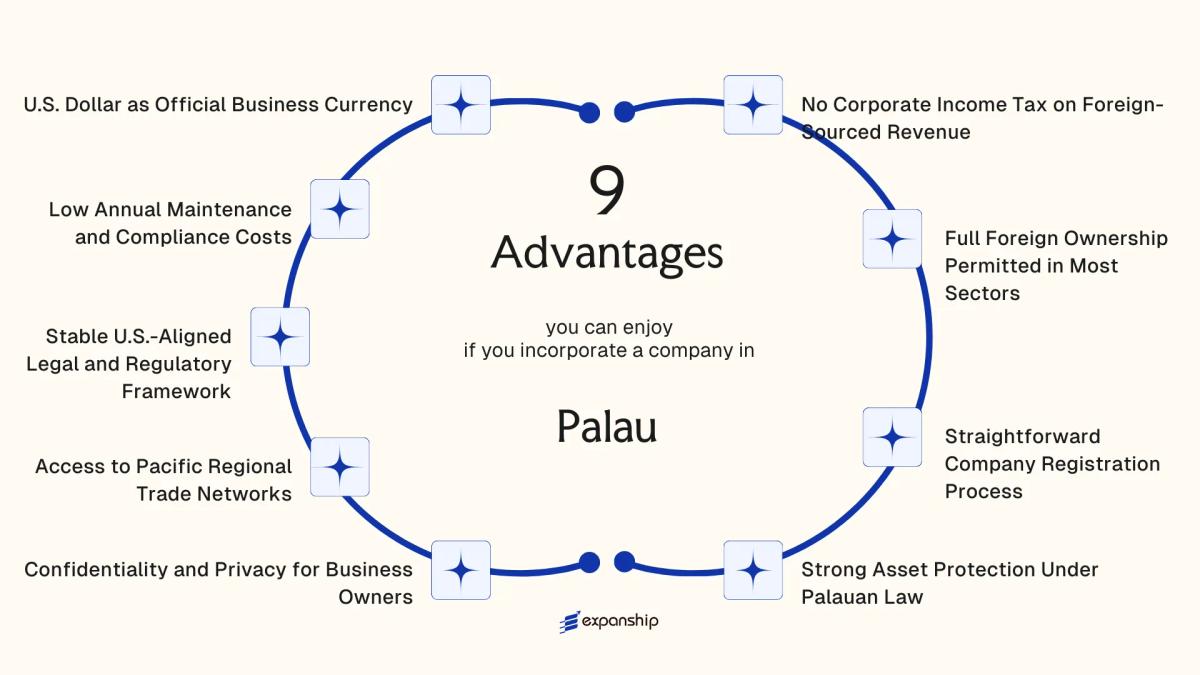
The benefits of incorporating in Palau extend across tax efficiency, legal structure, and access to U.S.-aligned regulatory norms. This article examines the specific advantages that make Palau company formation a practical consideration for internationally oriented businesses.
No Corporate Income Tax on Foreign-Sourced Revenue
Under Palauan tax law, companies incorporated in Palau are not subject to corporate income tax on revenue generated outside the country. This single structural feature has direct, quantifiable consequences for how a foreign-owned entity retains its earnings.
What the Tax Structure Actually Means
Palau imposes a gross revenue tax on locally sourced business income, but foreign-sourced revenue falls outside that charge. For a holding company, international consulting firm, or e-commerce operation with no Palauan customer base, this means profits flow back to the entity without a corporate-level tax deduction.
The Practical Advantage for Foreign Business Owners
Palau no tax on foreign-sourced income is not a deferral mechanism or a treaty-dependent relief — it is a structural exemption embedded in the domestic tax framework. Your business retains the full margin on international contracts, licensing fees, or cross-border service revenue, which directly affects reinvestment capacity and overall return on operations.
To qualify, the revenue must demonstrably originate from sources outside Palau's jurisdiction rather than from domestic transactions.
Foreign-sourced profits are not reduced by a corporate income tax charge at the entity level in Palau.
Full Foreign Ownership Permitted in Most Sectors
Palau full foreign ownership business advantage stems from a legal framework that does not restrict non-citizen investors from holding 100 percent equity in most commercial entities registered under Palauan law.
Under the Foreign Investment Act of Palau, foreign nationals can own and operate businesses without requiring a local partner or co-investor. This removes the structural dilution that investors commonly encounter in jurisdictions across Southeast Asia and parts of the Pacific, where mandatory local ownership thresholds can reach 40 to 60 percent. For a foreign business owner, retaining full equity means full decision-making authority and undivided profit entitlement.
Certain sectors involving land ownership, fishing rights, and natural resource extraction are reserved for Palauan citizens or require specific licensing. Outside those areas, 100 percent foreign ownership Palau company structures are legally permissible across services, trading, consulting, and digital business categories.
The practical advantages of this structure include:
- No obligation to negotiate equity splits with local partners before registration
- Full retention of voting rights and management control from the outset
- Profit repatriation is not conditioned on local shareholding requirements
- Corporate structure reflects the foreign owner's actual investment without legal intermediaries
Foreign investor ownership rights under this framework are recorded through the Republic of Palau's business registration system, providing a documented legal basis for ownership that supports banking relationships and contractual standing internationally.

Company Incorporation in Palau
Register a fully foreign-owned company in Palau with clear legal standing across most commercial sectors.
Straightforward Company Registration Process
One of the Palau company registration advantages that draws foreign entrepreneurs is how quickly and directly an entity can be established through the country's official registration system. The Ministry of Finance, through its Business Registration Division, administers company formation under the Business Entities Act. Foreign applicants are not required to be physically present in Palau to complete registration, which removes a practical barrier that exists in many other jurisdictions.
| Parameter | Detail |
|---|---|
| Governing Legislation | Business Entities Act |
| Administering Body | Business Registration Division, Ministry of Finance |
| Common Entity Type | Limited Liability Company (LLC) |
| Physical Presence Required | No |
| Minimum Directors/Members | 1 |
Registered agents can submit documentation on your behalf, and the process does not require notarised foreign documents to be apostilled through lengthy chains of authentication in most standard formations. This means the time between initiating an application and receiving a certificate of formation is measurably shorter than in jurisdictions with multi-agency clearance requirements.
For a foreign business owner, this matters because operational timelines are real costs. A firm that can open a bank account, sign contracts, and begin trading within weeks rather than months holds a structural advantage. The Palau MIDC company registration framework, which governs entities operating within the Micronesian International Development Centre, adds a further layer of specificity for businesses targeting that designated structure, with defined procedures that reduce ambiguity in the formation process.
Strong Asset Protection Under Palauan Law
One of the recognized Palau asset protection benefits for businesses is the liability separation available through registered corporate structures, particularly the Limited Liability Company (LLC) and corporation. Under the Business Entities Act, your personal assets are legally distinct from those of the company. A creditor pursuing a claim against the business generally cannot reach your personal holdings.
This separation is not merely theoretical. Courts in Palau, operating under a legal tradition drawn from U.S. common law principles, have historically upheld corporate veil doctrines that treat the entity as a separate legal person. For foreign owners, that structural clarity reduces exposure when operating in markets where litigation risk exists.
Palau legal protection for business owners also extends to foreign-held entities. Non-resident shareholders benefit from the same statutory protections as resident members, meaning your ownership stake does not diminish the liability shield.
Keep these points in mind:
- Maintain formal separation between personal and corporate accounts
- Hold annual meetings and keep minutes, even for single-member entities
- Avoid commingling funds, which can invite veil-piercing arguments under common law doctrine
- Courts may pierce the corporate veil if the entity is found to be operating as an alter ego of the owner
Palau's judiciary applies U.S. federal common law principles by default in corporate disputes, which means case precedents from U.S. courts can be persuasive authority in Palauan proceedings.
Confidentiality and Privacy for Business Owners
Palau business owner confidentiality benefits stem from a corporate framework that limits public disclosure requirements for private companies. Under the Business Corporations Act, the public registry does not mandate disclosure of beneficial ownership details, meaning shareholders can hold interests without their names appearing in publicly searchable records.
Shareholder and Director Privacy
Nominee arrangements are permitted under Palauan corporate law, allowing registered nominees to appear on official filings in place of the actual beneficial owners. This separation means your identity as the controlling party is not exposed through standard registry searches, which carries direct value for investors managing sensitive business relationships or cross-border holdings.
Registered agent requirements add a further layer of structural privacy. The agent's details appear on formation documents, and your direct contact information need not be filed with the Registrar of Corporations under the Ministry of Finance.
Practical Value for Foreign Investors
Palau shareholder anonymity benefits extend to foreign nationals who may face political or legal exposure in their home jurisdictions. Corporate confidentiality for foreign investors here operates independently of any public shareholder register, since no such register is accessible to third parties in the ordinary course.
This does not exempt entities from complying with anti-money laundering obligations or information-sharing requests made through formal legal channels. Confidentiality protections apply within the bounds of Palau's AML/CFT framework and any applicable Compact of Free Association obligations with the United States.
Understand Your Privacy Options Before Incorporating in Palau
Speak with an Expanship specialist about how Palau's confidentiality framework applies to your specific ownership structure and residency situation.
Access to Pacific Regional Trade Networks
Palau Pacific trade network access benefits stem directly from the country's membership in the Pacific Islands Forum (PIF) and its status as a signatory to associated regional cooperation frameworks. Positioned in the western Pacific, the country sits at a geographic crossroads between Asia, Australia, and the United States, which has direct commercial implications for businesses registered there.
- As a PIF member state, a company incorporated here gains a recognized standing within a regional bloc that coordinates trade policy, economic development, and investment protocols across Pacific Island nations.
- The Compact of Free Association with the United States grants Palauan-registered entities certain preferential access conditions to U.S. markets, a channel not available to businesses incorporated in most other Pacific jurisdictions.
- Regional proximity to major Asian economies, including Japan, Taiwan, and the Philippines, reduces logistical friction for businesses operating across those trade corridors.
- Membership in Pacific regional bodies gives your firm a credible local anchor, which can matter when establishing commercial relationships with partners in Australia, New Zealand, or other Pacific Islands trade access markets.
- For businesses in maritime, fisheries, or environmental services, Pacific Islands trade access frameworks specifically address those sectors, creating structured pathways that a registered entity can use to enter cooperative agreements.
Stable U.S.-Aligned Legal and Regulatory Framework
Palau's legal system is grounded in U.S. common law principles, a direct legacy of its administrative history under U.S. trusteeship and formalized through the Compact of Free Association with the United States. For foreign business owners, the Palau US-aligned legal framework business advantages are substantive: courts apply familiar doctrines of contract, property, and corporate liability that align closely with U.S. legal standards, reducing the interpretive uncertainty that often accompanies incorporation in jurisdictions with unfamiliar legal traditions.
The Compact of Free Association, first signed in 1986 and renegotiated in 2023, structures the bilateral relationship with the U.S. in ways that extend beyond political ties. It reinforces institutional predictability, which matters directly to how disputes are adjudicated and how regulatory obligations are enforced.
A business incorporated under Palauan law operates within a court system that draws on U.S. federal and state case law as persuasive precedent, meaning that legal outcomes are more predictable for counsel trained in U.S. or common law jurisdictions than in civil law or hybrid systems with limited published jurisprudence.
Foreign-owned entities also benefit from a regulatory environment administered by the Foreign Investment Board, which applies statutory criteria rather than discretionary political review, giving your firm a defined and consistent approval process.
Low Annual Maintenance and Compliance Costs
Palau low annual compliance costs advantage stems from a regulatory structure that places relatively minimal recurring obligations on foreign-owned entities. Annual fees for maintaining a registered company are modest by international standards, and the filing requirements imposed by the Palau Bureau of Revenue and Taxation do not carry the administrative burden typical of higher-regulation jurisdictions.
For businesses with no domestic operations, the practical upkeep is lean. Your firm is not subject to complex local audit mandates if it conducts no trade within the country. This keeps your annual professional and government fees contained, reducing the cost of keeping the entity in good standing.
Key recurring obligations generally include:
- Annual renewal of the business license with the Bureau of Revenue and Taxation
- Maintenance of a registered agent address within the jurisdiction
- Filing any required annual returns with the relevant corporate registry
Each of these carries a defined, predictable fee rather than variable assessments, which allows your finance team to forecast entity maintenance costs accurately from year to year.
If your company's activities extend to earning income within Palau, additional local tax registration and compliance obligations will apply, altering the overall cost picture.
U.S. Dollar as Official Business Currency
The Palau US dollar currency business advantage is structural, not incidental. Under the Compact of Free Association with the United States, the USD functions as the sole legal tender across the country. Your business never operates in a parallel or pegged currency. Transactions, contracts, and financial records are denominated in the same currency used across major global markets.
No Currency Conversion Costs
Foreign companies routinely absorb exchange fees, hedging costs, and conversion losses when operating in jurisdictions with local currencies. Because Palauan entities settle obligations in USD by default, those costs do not exist here. Profit repatriation, supplier payments, and investor distributions all move in the same denomination without conversion friction.
Simplified Financial Reporting
Accounting and audit obligations are straightforward when your functional currency matches the reporting currency. Firms incorporated here produce financial statements in USD without needing to apply foreign currency translation adjustments under frameworks like IFRS or U.S. GAAP. That directly reduces the administrative burden on your finance and compliance teams.
USD-Denominated Banking Access
Banking relationships in this jurisdiction operate natively in USD, which facilitates international wire transfers and cross-border commercial arrangements with U.S. counterparties. Practical advantages for your business include:
- Elimination of bid-ask spreads on routine transactions
- Reduced exposure to currency volatility across invoice cycles
- Direct compatibility with USD-based escrow and trade finance structures
- Simplified treasury management for multi-entity corporate groups
Is Palau the Right Jurisdiction for Your Business?
Determining whether Palau is right jurisdiction for your business depends on how its structural features align with your operational needs. The comparisons most relevant to this assessment are with the Marshall Islands, the Federated States of Micronesia, and Vanuatu. All three target similar investor profiles — offshore holding structures, international trading companies, and asset-holding entities — and are evaluated by the same category of foreign incorporator considering Pacific alternatives.
What the table below reveals is not simply a feature checklist, but a pattern: Palau's position within the Compact of Free Association with the United States creates a legal and currency baseline that neither Micronesia nor Vanuatu replicates in the same way. The Marshall Islands offers strong offshore legislation, but its incorporation volume means higher scrutiny in some banking contexts. Vanuatu provides tax exemptions but operates under a separate legal tradition and currency environment. For businesses that place weight on U.S. dollar denomination, legal system familiarity, and stable regulatory oversight, these distinctions carry practical weight.
| Parameter | Palau | Marshall Islands | Vanuatu | Fed. States of Micronesia |
|---|---|---|---|---|
| Legal System Basis | U.S. common law | U.S. common law | English common law / French civil law | U.S. common law |
| Official Currency | U.S. Dollar | U.S. Dollar | Vanuatu Vatu | U.S. Dollar |
| Foreign Ownership | Permitted in most sectors | Permitted | Permitted | Restricted in certain sectors |
| Corporate Income Tax on Foreign Revenue | Not applied | Not applied | Not applied | Applied in some structures |
| U.S. Compact Affiliation | Yes (Compact of Free Association) | Yes | No | Yes |
| Annual Compliance Complexity | Low | Low to moderate | Low | Moderate |
Compliance Services for Companies in Palau
Maintain your Palauan company's good standing with structured compliance support, covering annual reporting, registered agent obligations, and regulatory filings.
Conclusion
Palau presents a coherent case for foreign incorporation when its structural features are considered together. The exemption of foreign-sourced revenue from corporate income tax, combined with the U.S. dollar as the operating currency, removes two of the most common friction points for internationally focused businesses. Operating under a U.S.-aligned legal framework governed by the Palau National Code provides a degree of legal predictability that many Pacific jurisdictions cannot match.
That said, the benefits of incorporating in Palau are most pronounced for specific business profiles. Firms with operations or clients outside the domestic market are best positioned to utilize the tax treatment. Entities in sectors where full foreign ownership is permitted under Palauan law stand to gain more than those in restricted industries.
Determining whether this jurisdiction fits your structure requires an honest assessment of your revenue model, ownership requirements, and long-term compliance obligations. The foundational advantages are well-documented, but their value is realized only when the entity type, registered agent obligations, and annual maintenance requirements are matched appropriately to your business. Getting that alignment right from the outset is where the formation process either serves or complicates your broader corporate strategy.
Let Expanship Handle Your Palau Company Formation
Expanship's Palau company formation services cover the full incorporation lifecycle for foreign-owned entities, from initial structure selection through to post-registration compliance. The blog sections above detail specific advantages — tax treatment on foreign-sourced income, foreign ownership rights, asset protection provisions, and annual maintenance obligations — all of which involve filings with or approvals from the Division of Corporations and Business Regulations under the Ministry of Finance. Expanship manages each of these touch points directly on your behalf.
The scope of services available to you includes:
- Preparation and legalization of incorporation documents, including Articles of Incorporation and corporate bylaws
- Registered agent and registered office provision in Palau, as required under Palauan corporate law
- Government filing and liaison with the Division of Corporations and Business Regulations
- Post-incorporation compliance management, including annual report filings and license renewals
- Banking introduction assistance for corporate account opening
For your next step, contact Expanship Palau to discuss your incorporation requirements.
Frequently Asked Questions (FAQ)
A company registered in Palau that earns income entirely from outside the country is not subject to Palauan corporate income tax on those earnings. The tax exemption on foreign-sourced revenue is a structural feature of the jurisdiction's tax regime, designed to distinguish between domestic and offshore business activity. Income generated within Palau from local clients or operations is subject to the standard gross revenue tax under the Palau tax code.
Registration with the Palau Office of the Attorney General, which maintains the corporate registry, generally takes between one and three weeks for a straightforward application. Processing time can extend if documentation is incomplete or if the proposed business activity requires a separate foreign investment clearance. There is no expedited filing track formally available in the way that some other jurisdictions offer.
Palau has entered into a limited number of international tax agreements, and its exchange of information commitments are narrower than those of many OECD-member jurisdictions. However, the country is subject to its Compact of Free Association obligations with the United States, which may have implications for U.S.-connected entities or persons. Business owners with U.S. tax residency or citizenship should assess their reporting obligations under U.S. federal law independently of Palauan domestic privacy provisions.
A registered agent with a physical address in Palau is generally required to maintain a valid company registration, though a fully resident board of directors is not mandated for most corporate structures. The registered agent requirement exists to ensure a legal point of contact within the jurisdiction for official correspondence and service of process. Directors themselves may be non-resident foreign nationals in most cases.
The U.S. dollar is the official currency, which removes exchange rate exposure for businesses that invoice, contract, or hold funds in dollars. Palau's banking sector is small, and the number of licensed commercial banks operating locally is limited, which can affect the ease of opening a corporate bank account domestically. Many businesses incorporated in Palau maintain their primary operational banking with institutions outside the jurisdiction.
The Compact of Free Association gives Palau's legal and regulatory environment a structural alignment with U.S. frameworks, which can provide predictability for businesses familiar with American commercial law principles. It does not make a Palau entity a U.S. domestic company, and standard U.S. corporate tax rules do not automatically apply to the entity itself. The Compact's primary relevance to incorporated businesses is the legal stability it provides and the access to certain U.S. federal programs and dispute resolution frameworks.
Annual compliance obligations typically include renewal of the business license, payment of the annual corporate filing fee to the Office of the Attorney General, and maintenance of a registered agent. The aggregate cost of these requirements is generally lower than in many comparable offshore jurisdictions, though specific fee amounts are set by Palauan statute and subject to revision. Companies engaged in regulated activities may face additional licensing renewal costs specific to their sector.
Legal Disclaimer
The information provided in this article is for general informational purposes only and does not constitute legal, tax, or professional advice. While we strive to ensure the accuracy and timeliness of the content, laws and regulations are subject to change, and the application of laws can vary widely based on specific facts and circumstances.
Readers should not act upon this information without seeking professional counsel tailored to their individual situation. Expanship and its authors disclaim any liability for actions taken or not taken based on the content of this article.
For specific advice regarding your business setup, compliance requirements, or any legal matters, please consult with qualified legal and tax professionals in the relevant jurisdiction.