

Key Takeaways
- Portugal's IRC framework imposes a standard corporate tax rate of 21%, which, combined with the SIFIDE II R&D credit scheme, reduces the effective tax burden for qualifying companies operating in innovation-driven sectors.
- Foreign-owned entities incorporated in Portugal gain direct access to EU single market passporting rights and trade agreements without facing statutory restrictions on foreign ownership under domestic law.
- Registration through the Conservatória do Registo Comercial formalises legal standing under both Portuguese and EU regulatory frameworks, giving resident entities a treaty-bound operating environment across 80+ double taxation treaty jurisdictions.
- Principals relocating alongside their business may qualify under the Non-Habitual Resident regime, which applies preferential tax treatment to certain foreign-sourced income streams for up to ten years.
Incorporating a company in Portugal positions your business within a eurozone member state situated on the Iberian Peninsula, with direct Atlantic coastlines bordering Spain to the east and the Atlantic Ocean to the west. As a full European Union member, the country operates under both domestic legislation and EU regulatory frameworks, giving registered entities access to a stable, treaty-bound legal environment. Company registration falls under the supervision of the Conservatória do Registo Comercial, the commercial registry responsible for formalising new business entities. Foreign investors most commonly establish a Lda when entering the market.
Portugal operates a territorial-leaning corporate tax system with treaty-based relief mechanisms that shape how resident entities are taxed on foreign-sourced income. Foreign ownership of Portuguese companies faces no general statutory restrictions, and the country maintains an open posture toward foreign direct investment across most sectors.
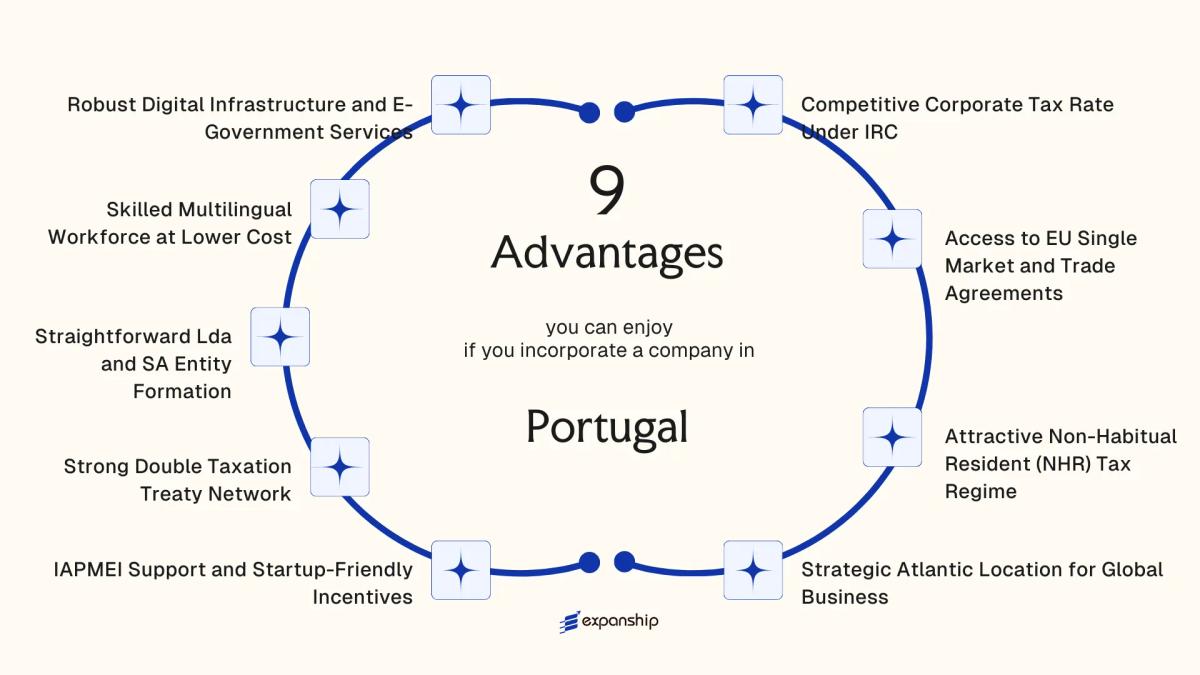
This article examines the key advantages your business can access through company formation here, drawing on the specific legal, fiscal, and regulatory features that define the jurisdiction.
Competitive Corporate Tax Rate Under IRC
Portugal's IRC (Imposto sobre o Rendimento das Pessoas Coletivas) establishes a standard corporate tax rate of 21% on taxable profits, which sits below the OECD average and positions the country as a fiscally competitive base for foreign-owned entities.
Reduced Rates for SMEs and Interior Regions
Companies classified as small or medium-sized enterprises under Portuguese law benefit from a reduced IRC rate of 17% on the first €50,000 of taxable income. For businesses registered in interior regions designated under Portugal's regional development framework, that reduced rate can drop to 12.5% on the same income band, reflecting a deliberate policy to encourage incorporation outside major urban centers.
SIFIDE and RFAI Tax Credit Mechanisms
Beyond the headline rate, the IRC framework supports tax credit regimes including SIFIDE II, which allows qualifying R&D expenditure to offset tax liability directly. The RFAI (Regime Fiscal de Apoio ao Investimento) permits eligible businesses to deduct a percentage of qualifying investment from their IRC due, reducing effective tax burden without requiring changes to corporate structure.
One condition applies: most incentive regimes under IRC require the entity to maintain operations and meet minimum investment or employment thresholds within Portugal.
Your effective IRC rate can fall well below 21% if your firm qualifies for SME treatment, regional incentives, or investment tax credits under RFAI.
Access to EU Single Market and Trade Agreements
Portugal EU single market access benefits apply from the moment your company is registered under Portuguese law. As a full EU member state, a Portuguese entity operates under the same legal and commercial framework as firms based in Germany, France, or any other member state, without additional licensing or market-entry procedures.
Goods exported from a Portuguese firm move freely across all 27 EU member states under the Treaty on the Functioning of the European Union (TFEU), with no customs duties or quantitative restrictions between member states. For service businesses, the EU Services Directive removes most authorization barriers across borders. This means your entity can serve clients throughout Europe from a single registration point.
Beyond internal market access, the EU's external trade agreements extend significant advantages to Portuguese-registered firms:
- The EU-Japan Economic Partnership Agreement eliminates tariffs on a broad range of industrial goods, giving your firm direct access to one of the world's largest import markets
- The EU-Canada Comprehensive Economic and Trade Agreement (CETA) reduces barriers across goods, services, and investment
- The EU-South Korea Free Trade Agreement covers financial services and intellectual property protections that directly affect technology and services firms
- EU-Mercosur negotiations, once finalized, would add preferential access to Brazil, Argentina, and three other major South American economies
A company incorporated as a Lda or SA under the Portuguese Commercial Registry gains full standing to invoke these agreements immediately, with no residency requirement imposed on foreign shareholders.

Incorporate a Company in Portugal
Register your Portuguese Lda or SA and access the EU single market through one of Europe's established Atlantic jurisdictions.
Attractive Non-Habitual Resident (NHR) Tax Regime
The Portugal Non-Habitual Resident tax regime benefits individuals who establish tax residency in the country without having been resident in the preceding five years. Introduced under Article 16 of the Portuguese Personal Income Tax Code (CIRS), the NHR status grants a ten-year window of preferential taxation that can significantly affect the after-tax position of foreign professionals and investors relocating alongside their business.
Under the original NHR framework, qualifying foreign-source income categories, including dividends, interest, and capital gains, were often exempt from Portuguese personal income tax, provided they were subject to tax in the source country under an applicable treaty. Foreign pension income and certain professional income from "high value-added activities" also received favorable treatment. A 2024 legislative reform replaced the original NHR with the IFICI regime (Incentivo Fiscal à Investigação Científica e Inovação), which applies to applications from 2024 onward under modified eligibility criteria.
| Feature | Original NHR (pre-2024) | IFICI Regime (2024 onward) |
|---|---|---|
| Duration | 10 years | 10 years |
| Flat rate on Portuguese-source qualifying income | 20% | 20% |
| Foreign-source income exemption | Broadly available | Restricted to specific categories |
| Eligible applicant profile | Broad | Defined activity categories |
For a business owner relocating to manage a Portuguese entity, securing NHR or IFICI status can substantially reduce personal tax exposure on foreign-source distributions during the qualifying period. Eligibility requires registering as a tax resident and applying through the Tax and Customs Authority (Autoridade Tributária e Aduaneira) within the prescribed deadline following the year of arrival.
Strategic Atlantic Location for Global Business
Portugal's Atlantic location advantages for global business are structural, not incidental. Mainland Portugal sits at the southwestern edge of Europe, with direct maritime and air routes connecting Europe, the Americas, and the African continent. For a company incorporated here, that geography translates into time zone overlap with both the U.S. East Coast and West Africa during standard working hours.
Lisbon and Porto are within a three-hour flight of major Western European financial centers. Transatlantic cargo and logistics operators use Portuguese ports, particularly Sines, as a primary European entry point for container traffic. Your firm gains proximity to these trade corridors without relocating operations to a higher-cost EU hub.
The Autonomous Regions of Madeira and the Azores extend Portugal's geographic footprint further into the Atlantic, each with separate fiscal frameworks under Portuguese law. Madeira's International Business Centre (CINM) operates under a state-aid approved regime through 2027, offering reduced IRC rates for qualifying international companies registered there.
Keep these points in mind:
- CINM registration is subject to job creation and substance requirements
- The Azores and Madeira apply regional tax variations distinct from mainland rates
- Air connectivity through Humberto Delgado Airport links Lisbon to over 100 international destinations
- Sines port handles significant Atlantic container volume, relevant for physical goods trade
Portugal holds observer status in the Community of Portuguese Language Countries (CPLP), giving incorporated entities a cultural and linguistic bridge across nine countries spanning four continents.
IAPMEI Support and Startup-Friendly Incentives
IAPMEI (Agência para a Competitividade e Inovação) is the Portuguese government agency responsible for supporting SMEs and startups through financing, certification, and advisory programs. For foreign founders structuring a business here, IAPMEI startup incentives Portugal benefits extend beyond symbolic recognition — they unlock access to EU-backed funding instruments and preferential treatment under national innovation schemes.
Certified Startup Status and What It Unlocks
IAPMEI administers the official Startup Certificate, a designation under the Portuguese Startup Law (Law No. 21/2023) that grants certified companies access to a specific set of fiscal and operational advantages. Certified entities can qualify for reduced IRC rates on retained earnings and gain eligibility for co-investment programs under frameworks like Portugal 2030, the national operational program channeling EU structural funds.
The certification criteria are defined and not automatic. Your firm must meet thresholds related to age, revenue, and innovation activity, which means early-stage planning around eligibility is operationally significant.
SME Support and Access to Incentivised Financing
IAPMEI also manages the PME Líder and PME Excelência status programs, which give qualifying firms preferential access to credit lines backed by public guarantors like SPGM. This translates to lower collateral requirements and reduced borrowing costs — a material structural advantage for foreign-owned entities without an established credit history in the country.
Access to Portugal government incentives for startups and SMEs through IAPMEI is governed by formal applications reviewed against financial and operational criteria set by the agency.
Understand Which IAPMEI Programs Your Portugal Entity Qualifies For
Our team can assess your eligibility for startup certification, SME status programs, and EU-backed financing instruments available through IAPMEI.
Strong Double Taxation Treaty Network
Portugal's double taxation treaty network advantages extend to over 80 signed agreements, covering major economies across Europe, Asia, North America, and Africa. These conventions are negotiated under the OECD Model Tax Convention framework, which means withholding tax rates on dividends, interest, and royalties paid between treaty partners are typically reduced below domestic statutory rates.
- Reduced withholding taxes on cross-border payments mean that income flowing between your Portuguese entity and a counterpart in a treaty country is taxed at the reduced treaty rate rather than the standard domestic rate, directly lowering the cost of repatriation and intercompany financing.
- Treaties with Angola, Brazil, Mozambique, and Cape Verde reflect the country's historical commercial ties with Lusophone markets, giving businesses incorporated here a documented tax framework for operating across Portuguese-speaking economies that few EU jurisdictions can replicate.
- The applicable treaty provisions take precedence over domestic IRC (Imposto sobre o Rendimento das Pessoas Coletivas) rules where they offer more favorable treatment, providing foreign investors with a legally binding layer of certainty against double taxation.
- Treaty protection applies to permanent establishment definitions, which means your foreign parent company is less exposed to unintended tax presence in Portugal based on the activities of a local subsidiary or representative.
Straightforward Lda and SA Entity Formation
Portugal offers two primary private company structures for foreign investors: the Sociedade por Quotas (Lda) and the Sociedade Anónima (SA). Each is governed by the Código das Sociedades Comerciais (CSC), and both can be registered through the Empresa na Hora ("Company on the Spot") service, which allows same-day incorporation at a designated registry office.
The Lda requires a minimum share capital of €1, making it accessible for early-stage foreign businesses that want a legal presence without committing significant capital upfront. The SA, which requires €50,000 in minimum share capital and at least five shareholders (or one if structured as a sole shareholder SA), suits businesses planning to raise external investment or operate at scale.
Registration is handled through the Registo Comercial, and filings can be submitted electronically via the Portal da Empresa. This reduces the administrative burden on foreign founders who cannot always be present in-country.
A foreign-owned Lda incorporated via Empresa na Hora can be legally registered and operational within 24 hours of submission, compared to multi-week timelines common in several other EU member states, reducing time-to-market for businesses entering the Portuguese or broader European market.
Skilled Multilingual Workforce at Lower Cost
Portugal skilled multilingual workforce advantages are well-documented and measurable. Average gross monthly wages consistently sit below those in Western European counterparts such as Germany, France, or the Netherlands, while the country produces a large volume of university graduates annually through institutions like the University of Lisbon and the University of Porto.
English proficiency rates are high relative to Southern European peers, and a significant share of the working population also speaks French, Spanish, or German. For a foreign business placing client-facing or back-office operations here, this reduces training overhead and hiring timelines.
Labor costs for foreign businesses benefit from a statutory minimum wage set under Portuguese labor law (Código do Trabalho), which remained competitive against Western European benchmarks. Employer social security contributions are fixed at 23.75% of gross salary, a figure that foreign firms can factor precisely into workforce budgeting.
- University graduates across engineering, technology, law, and finance enter the market each year
- Lisbon and Porto have established themselves as European hubs for technology and shared services centers
- Multinational firms such as Mercedes-Benz and Google have located operational teams locally, signaling workforce depth
Employer obligations under the Código do Trabalho, including notice periods and severance rules, apply regardless of where your parent company is incorporated.
Robust Digital Infrastructure and E-Government Services
Portugal digital infrastructure benefits for businesses are grounded in a government-backed digitisation programme that has materially reduced the administrative burden on registered companies. The ePortugal platform (eportugal.gov.pt) centralises hundreds of public services in one portal, allowing foreign-owned entities to handle filings, licensing applications, and official correspondence without requiring physical presence or intermediary visits to public offices.
The Empresa Online service, operated under the auspices of the Instituto dos Registos e do Notariado (IRN), enables company registration and statutory amendments to be submitted digitally. For a foreign founder managing operations across time zones, this removes a class of friction that exists in many EU member states where notarial presence is still mandatory.
Tax compliance follows the same pattern. The Autoridade Tributária e Aduaneira (AT) hosts the Portal das Finanças, through which your company submits IRC returns, VAT declarations, and withholding tax reports electronically. Filings, payment schedules, and correspondence are consolidated in a single authenticated environment.
Portugal has also implemented the iAP (Interoperability Agency for the Public Administration) to connect data across government bodies. The practical result is that your firm avoids duplicating document submissions across multiple agencies.
- The Balcão do Empreendedor portal handles sector-specific business licensing online
- Qualified electronic signatures are legally valid under eIDAS Regulation (EU) 910/2014, which applies directly across the EU
- The AT's e-fatura system automates VAT invoice reporting in near real time
Digital public infrastructure at this level means your compliance calendar runs on documented systems rather than informal processes, which matters significantly for foreign directors managing fiduciary obligations remotely.
Why Portugal Stands Out Among European Jurisdictions
Foreign investors comparing incorporation destinations across Europe tend to weigh Portugal against jurisdictions with similarly accessible structures and Atlantic or Southern European positioning. Spain, the Netherlands, and Ireland are the most common alternatives considered by the same investor profile — those seeking EU residency pathways, holding company efficiency, or a cost-effective base for international operations. What the comparison reveals is that Portugal advantages over other European jurisdictions are less about a single headline rate and more about the combination of tax, talent, and treaty access at a cost structure that Western European peers do not match.
Ireland's 12.5% corporate rate draws attention, yet its operating costs and talent premiums are substantially higher. The Netherlands offers strong holding frameworks, but its substance requirements under ATAD implementation are more demanding. Spain's IRC equivalent sits at 25%, with fewer preferential regimes available to newly established foreign-owned entities. Across these parameters, the Portuguese tax authority framework, combined with NHR access and SIFIDE II R&D credits, presents a structurally different profile rather than a marginal variation.
| Parameter | Portugal | Ireland | Netherlands | Spain |
|---|---|---|---|---|
| Standard Corporate Tax Rate | 21% (IRC) | 12.5% | 25.8% | 25% |
| Participation Exemption | Yes | Yes | Yes | Yes (conditions apply) |
| Individual Preferential Tax Regime | NHR (20% flat / 10% pension) | None equivalent | 30% ruling (conditions) | Beckham Law (24%) |
| Active Tax Treaty Network | 79+ treaties | 73+ treaties | 100+ treaties | 90+ treaties |
| EU Membership | Yes | Yes | Yes | Yes |
| Minimum Share Capital (Private Entity) | €1 (Lda) | €1 (LTD) | €0.01 (BV) | €3,000 (SL) |
| English Proficiency Index | High | Native | High | Moderate |
Compliance Services for Companies in Portugal
Maintain good standing with Portuguese regulatory and tax authorities. Expanship manages your ongoing filing, reporting, and statutory obligations under Portuguese law.
Conclusion
Portugal's position as a gateway to EU markets, combined with a corporate tax framework anchored by the IRC and a treaty network spanning over 80 jurisdictions, gives foreign-owned businesses a structurally sound base for international operations. The benefits of incorporating in Portugal are most tangible when the IRC's 21% standard rate, the SIFIDE II R&D credit scheme, and access to EU passporting rights are considered together as a single operating advantage rather than isolated features.
That said, the degree to which these advantages apply depends on your business model, revenue sources, and whether your principals qualify under applicable regimes such as NHR. A tech firm scaling across the EU will extract different value from Portugal company formation than a holding structure or a professional services business.
The practical case for setting up a company here rests on the combination of regulatory access, fiscal architecture, and a qualified workforce available at a cost base below most Western European markets. For businesses at the evaluation stage, the next step is translating these structural features into a formation and compliance plan that reflects your specific entity type and operational requirements.
Start Your Portugal Company Formation With Expanship
Expanship handles Portugal company formation end-to-end, covering both the Sociedade por Quotas (Lda) and Sociedade Anónima (SA) structures discussed throughout this blog. From coordinating registration through the Empresa na Hora desk to managing ongoing compliance with the Registo Comercial, the firm operates within the actual procedural and regulatory framework that governs incorporation here.
The service scope spans each stage of the formation and maintenance cycle:
- Document preparation, notarization, and legalization for foreign-held entities
- Registered agent and statutory office address provision
- Government filing and liaison with the Conservatória do Registo Comercial
- Post-incorporation compliance management, including annual accounts and IES filing with the Autoridade Tributária e Aduaneira
- Corporate secretarial support for ongoing statutory obligations
- Banking introduction assistance for corporate account opening
Each of these services corresponds to a concrete obligation under Portuguese commercial law rather than a generic offering. Foreign shareholders, in particular, face documentation requirements that differ from domestic founders, including apostilled identity records and, in some cases, Portuguese tax identification numbers (NIF) obtained through the Autoridade Tributária prior to incorporation.
Expanship Portugal is available to answer questions specific to your structure, timeline, and jurisdiction of residence.
Frequently Asked Questions (FAQ)
The standard IRC (Imposto sobre o Rendimento das Pessoas Coletivas) rate is 21% on taxable profits. Small and medium-sized enterprises certified by IAPMEI may qualify for a reduced rate of 17% on the first €50,000 of taxable income. Certain interior regions and the autonomous regions of Azores and Madeira apply lower rates, so the applicable rate depends on where the entity is registered and its size classification.
The NHR regime grants qualifying individuals a flat 20% tax rate on Portuguese-sourced professional income, and certain foreign-sourced income may be exempt from Portuguese tax for a period of ten years. Eligibility requires that the individual has not been a Portuguese tax resident in the five years prior to application. The regime is administered through the Portuguese Tax and Customs Authority (Autoridade Tributária e Aduaneira).
Portugal has an extensive network of double taxation agreements, covering more than 70 countries across multiple continents. Most treaties reduce or eliminate withholding tax on dividends, interest, and royalties paid between treaty partners, with specific rates varying by agreement. The applicable rate for a given payment should be verified against the specific treaty text, as the domestic withholding rate under IRC may differ from the treaty-reduced rate.
Yes, a company incorporated in Portugal holds the legal status of an EU-registered entity, which grants it access to the EU Single Market for the free movement of goods, services, capital, and persons. This status also means the firm benefits from trade agreements negotiated by the European Union at the bloc level, including those with Japan, Canada (CETA), and South Korea. No separate trade licences are required to trade within the EU once the entity is properly registered with the Registo Comercial.
IAPMEI, the Agency for Competitiveness and Innovation, offers certified SME status, access to co-financed funding programmes under Portugal 2030, and participation in schemes such as Startup Portugal. Certification as a PME Líder or PME Excelência can also improve access to financing from Portuguese banks and European Investment Fund instruments. Eligibility is based on defined thresholds for headcount, turnover, and balance sheet size under EU SME criteria.
A Lda (Sociedade por Quotas) can be incorporated with a minimum share capital of €1, though a capital of €5,000 is commonly adopted in practice to meet basic credibility thresholds with banks and suppliers. An SA (Sociedade Anónima) requires a minimum share capital of €50,000, with at least 30% paid up at the time of incorporation. Both entity types are governed by the Código das Sociedades Comerciais (Commercial Companies Code).
Legal Disclaimer
The information provided in this article is for general informational purposes only and does not constitute legal, tax, or professional advice. While we strive to ensure the accuracy and timeliness of the content, laws and regulations are subject to change, and the application of laws can vary widely based on specific facts and circumstances.
Readers should not act upon this information without seeking professional counsel tailored to their individual situation. Expanship and its authors disclaim any liability for actions taken or not taken based on the content of this article.
For specific advice regarding your business setup, compliance requirements, or any legal matters, please consult with qualified legal and tax professionals in the relevant jurisdiction.