
Key Takeaways
- Palestinian corporate tax rates fall below regional norms, giving foreign-owned limited liability companies a structural cost advantage over comparable registrations in neighboring jurisdictions.
- Investment protections and foreign ownership rights codified under the Palestinian Investment Promotion Law No. 1 of 1998 reduce the legal exposure that typically deters foreign direct investment in emerging markets.
- Companies registered under Palestinian Company Law can establish an LLC structure without excessive capital requirements, allowing foreign investors to limit initial liability while maintaining full operational control.
- Formal support from the Palestinian Investment Promotion Agency (PIPA) gives qualifying foreign businesses access to institutional guidance and incentive frameworks that smaller markets rarely provide through a dedicated channel.
The benefits of incorporating in Palestine draw interest from businesses looking to establish a presence in a strategically positioned territory operating under the Palestinian Authority. The West Bank and Gaza Strip constitute the geographic core of the Palestinian territories, where company registration falls under the jurisdiction of the Companies Controller within the Palestinian Ministry of National Economy. Foreign businesses most commonly establish operations through a limited liability company structure under Palestinian commercial law.
Palestinian corporate taxation operates on a relatively low-rate territorial basis, making the framework broadly accessible to foreign-owned entities. The Palestinian Investment Promotion Law, administered by the Palestinian Investment Promotion Agency, signals a formal policy orientation toward attracting foreign direct investment, and foreign nationals are generally permitted to hold ownership stakes in locally registered firms.
This article examines the principal advantages that Palestinian company formation offers to international businesses, covering the regulatory, commercial, and economic factors that shape the decision to register here.
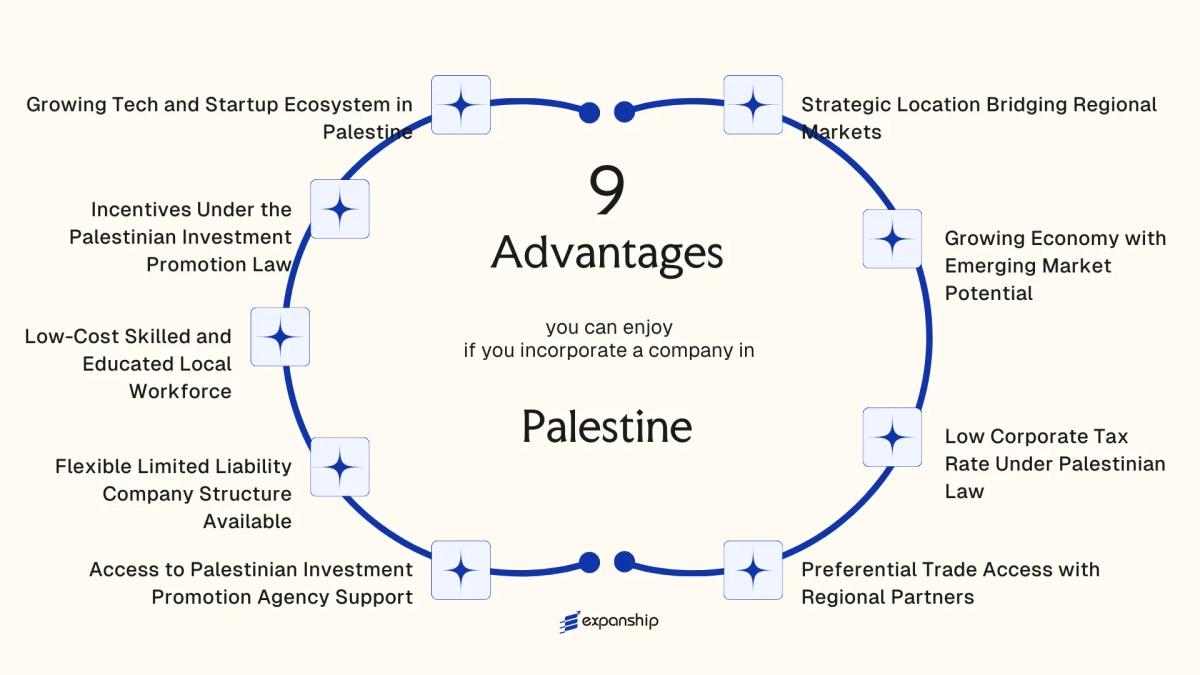
Strategic Location Bridging Regional Markets
Palestine's geographic position — sitting between Jordan to the east and Israel to the west, with proximity to Egypt, Lebanon, and the broader Levant — gives registered businesses a physical foothold at a crossroads that few jurisdictions in the region can replicate. For any firm targeting Palestine strategic location regional market access, that positioning translates directly into reduced logistical distance to multiple economies.
Proximity to Key Regional Economies
The West Bank shares a border with Jordan, which itself connects to Gulf markets through established overland trade corridors. A business incorporated under Palestinian Authority jurisdiction can orient its operations toward multiple national markets without relocating its legal structure.
Gateway Position Within the Levant
Ramallah functions as the commercial center of Palestinian Authority-administered territory, hosting most registered firms and financial institutions operating under the Palestinian regulatory framework. That concentration means your business operates within an established commercial infrastructure while maintaining access to a Palestine business gateway Middle East position that connects to Egypt, Jordan, and the broader Arab world through recognized trade relationships.
A Palestine-registered entity places your operations within one day's transport reach of Amman, Cairo, and Tel Aviv simultaneously.
Growing Economy with Emerging Market Potential
Palestine's economy operates under conditions that create genuine openings for foreign capital. GDP growth in the West Bank has historically been driven by services, construction, and trade, meaning early-entry businesses face less saturation than in more mature regional markets. For investors tracking Palestine emerging market business opportunities, this structural stage of development matters: demand for financial services, logistics infrastructure, and consumer goods remains underserved relative to population growth.
The Palestinian Authority administers economic policy under a framework shaped partly by the Paris Protocol of 1994, which governs trade and fiscal arrangements with Israel. This creates a defined economic environment that, while distinct, is not opaque to foreign operators familiar with similar transitional frameworks.
Sectors drawing measurable interest from foreign firms include:
- Technology and digital services, where low overhead costs translate directly into margin advantages
- Agriculture and agri-processing, where export-oriented production benefits from existing trade relationships
- Construction materials and real estate development, tied to sustained demographic demand
- Healthcare and pharmaceutical distribution, where local supply remains structurally limited
Per capita income figures remain below regional averages, which means your business enters a market where pricing strategy and product localisation can generate durable competitive positioning without the cost pressures of a saturated economy.

Company Incorporation in Palestine
Register your business in Palestine with full compliance support across all stages of the incorporation process.
Low Corporate Tax Rate Under Palestinian Law
Under the Palestinian Income Tax Law No. 17 of 2004, the standard corporate income tax rate is 15% on net taxable profits. For foreign investors accustomed to corporate tax rates in the 20–30% range common across many OECD and regional economies, this rate represents a meaningful reduction in annual tax liability from day one of operations.
| Business Category | Applicable Tax Rate |
|---|---|
| Standard corporate entities | 15% |
| Companies operating in designated development zones | Reduced or exempt (subject to Investment Promotion Law) |
| Nonprofit and charitable organizations | Generally exempt |
The 15% rate applies to resident companies on their Palestine-sourced income, which means a foreign-owned entity incorporated locally is taxed on profits generated within the territory rather than on global income. For businesses structured to serve regional markets through a Palestinian entity, this territorial principle limits tax exposure to locally booked earnings.
Taxable income is calculated after allowable deductions, meaning your firm can reduce the assessable base through qualifying business expenses before the 15% rate is applied. This structure allows for more precise tax planning compared to jurisdictions with flat gross-revenue levies or minimum tax thresholds that apply regardless of profitability.
Administration of corporate tax falls under the Palestinian Ministry of Finance, with filings processed through its Income Tax Department. Compliance obligations are defined, and the legal basis for the rate is codified, giving foreign investors a stable, referenced framework rather than a discretionary or policy-driven arrangement.
Preferential Trade Access with Regional Partners
Palestine preferential trade agreements benefits are grounded in a set of bilateral and multilateral arrangements that give incorporated entities measurable access advantages across neighboring and international markets.
Under the Euro-Mediterranean Association Agreement, Palestinian goods can enter the European Union market under preferential tariff terms. For a company exporting manufactured or agricultural products, this reduces the cost of market entry into one of the world's largest consumer blocs without requiring EU establishment.
A trade protocol with Jordan and arrangements tied to the Arab League's broader trade framework extend this reach across the region. Businesses incorporated under Palestinian Authority jurisdiction and sourcing or producing locally can qualify for reduced duties when trading with member states of the Greater Arab Free Trade Area (GAFTA).
Origin rules govern eligibility. Your goods must meet defined local content or processing thresholds to qualify for preferential rates under each arrangement, so supply chain structuring matters from the outset.
Keep in mind while using these trade benefits:
- Confirm rules of origin requirements under each specific agreement before exporting
- Maintain documentation of local content percentages for customs clearance
- Verify which product categories are covered under GAFTA for your sector
- EU preferential access is tied to compliance with applicable sanitary and technical standards
Palestinian exports to the EU can qualify for zero-duty treatment under conditions that many similarly sized territories have not negotiated, despite the absence of full statehood recognition by all EU member states.
Access to Palestinian Investment Promotion Agency Support
Palestinian Investment Promotion Agency support benefits are available to foreign investors the moment their business is formally registered under Palestinian Authority jurisdiction. PIPA, established under the Palestinian Investment Promotion Law No. 1 of 1998, serves as the primary government body coordinating investment facilitation, licensing assistance, and regulatory guidance for incoming foreign entities.
One-Stop Administrative Facilitation
PIPA operates a one-stop shop mechanism that consolidates approvals from multiple ministries into a single point of contact. For a foreign business owner unfamiliar with the Palestinian Authority's administrative structure, this reduces the time and coordination burden that would otherwise come from approaching each regulatory body independently.
Registered companies can access PIPA advantages for foreign investors including assistance with obtaining required licenses, land allocation inquiries, and introductions to relevant public sector counterparts. This institutional access shortens the setup timeline in a market where independent navigation would require substantial local knowledge.
Investor Support Services and Sectoral Guidance
PIPA provides sector-specific investment information, covering industries such as agri-food, tourism, technology, and manufacturing. For a foreign firm evaluating market entry, this translates into structured data on existing gaps, potential local partners, and applicable regulatory frameworks, without commissioning independent research at additional cost.
PIPA support for incorporated businesses in Palestine also includes post-establishment services. Once your company is operational, the agency can assist with dispute resolution referrals and ongoing compliance queries, giving foreign-owned firms a formal channel to the Palestinian Authority beyond their initial registration.
Unlock PIPA Benefits for Your Business in Palestine
Find out how to access Palestinian Investment Promotion Agency support and other investor advantages available to your registered entity.
Flexible Limited Liability Company Structure Available
The Sharika Mahdudat Masooliya, the Palestinian limited liability company structure, is the most widely used vehicle for foreign investment in the West Bank and Gaza. Governed primarily by the Companies Law No. 12 of 1964 as amended, this entity type imposes no minimum share capital requirement in practice for standard registrations, which reduces the financial barrier to market entry compared to jurisdictions that mandate substantial paid-up capital before operations can begin.
- Liability for shareholders is capped at the value of their subscribed shares, meaning personal assets remain protected from business debts or legal claims against the company.
- A Palestinian LLC can be formed with as few as two shareholders, and foreign nationals are permitted to hold shares without a mandatory local partner requirement in most sectors.
- The structure allows for flexible profit distribution arrangements among shareholders, which gives foreign investors practical control over how returns are extracted from the business.
- Registration is handled through the Companies Controller at the Palestinian Ministry of National Economy, a single administrative body, which consolidates the incorporation process under one authority rather than requiring parallel filings across multiple agencies.
- The LLC form is recognized across Palestinian commercial law, meaning contracts, banking relationships, and regulatory licenses all engage with it as a standard, well-understood legal structure.
Low-Cost Skilled and Educated Local Workforce
Palestine skilled workforce advantages for businesses are grounded in a measurable demographic reality. Roughly half the population is under 20 years old, producing a consistently replenishing pipeline of working-age candidates. Universities including Birzeit University, An-Najah National University, and Al-Quds University graduate thousands of students annually across engineering, IT, business, and the sciences.
Labor costs remain substantially lower than in neighboring Israel and Jordan, without a corresponding drop in technical competency. For a foreign firm hiring locally, this translates directly into a lower payroll burden on operations that require educated, degree-holding staff.
The Palestinian Central Bureau of Statistics has documented tertiary enrollment rates that reflect a population with genuine emphasis on formal education. A significant proportion of graduates hold degrees in STEM-adjacent disciplines, making the talent pool particularly relevant for firms in software development, engineering services, or financial administration.
A software development firm paying a mid-level engineer in Palestine may incur annual salary costs roughly 60–70% lower than equivalent roles in Tel Aviv or Amman, based on regional compensation benchmarks, while drawing from a graduate pool trained in internationally recognized curricula.
Arabic fluency is universal, and English proficiency is widespread among university graduates, reducing onboarding friction for foreign-managed entities.
Incentives Under the Palestinian Investment Promotion Law
The Palestinian Investment Promotion Law (No. 1 of 1998, as amended) established a formal incentive framework administered by the Palestinian Investment Promotion Agency (PIPA). These incentives under the Palestinian Investment Promotion Law are not blanket concessions — they are tied to project classification, sector, and geographic zone, which means qualifying businesses receive targeted relief rather than marginal reductions.
Approved projects may benefit from:
- Exemptions from customs duties on imported capital goods, equipment, and raw materials used directly in production
- Income tax holidays that can extend for defined periods depending on the sector and investment zone classification
- Exemptions on taxes and fees related to land registration for qualifying project assets
For a foreign investor, the practical value lies in timing. Tax relief during a firm's early operational years reduces capital pressure precisely when cash flow demands are highest.
Projects in sectors designated as priority areas by PIPA, including manufacturing, agriculture, and technology, generally access higher tiers of exemption. The agency also provides project facilitation support, which reduces administrative friction when dealing with multiple government bodies.
Incentive eligibility is determined by PIPA on a project-by-project basis; the applicable exemption tier depends on your sector classification and investment zone, not registration status alone.
Growing Tech and Startup Ecosystem in Palestine
Palestine tech startup ecosystem advantages are increasingly visible through a cluster of accelerators, incubators, and early-stage funds operating across the West Bank and Gaza. For a foreign business owner, this means entering a market where local technical talent and entrepreneurial infrastructure already exist, reducing the time and cost of building a team from scratch.
Gaza Sky Geeks, supported by Mercy Corps, functions as one of the most active startup accelerators in the region, providing cohort-based programs that connect foreign-backed ventures to local developers and founders. Ramallah has emerged as a secondary hub, hosting firms in fintech, edtech, and software services that export to regional and diaspora markets.
The Palestinian Information and Communications Technology sector has grown into one of the economy's most consistent export earners. This matters for an incorporated entity because it signals a proven revenue path: Palestinian tech firms have already demonstrated the ability to serve clients in the EU, the Gulf, and North America.
Several programs under the Palestinian Investment Promotion Agency and international donors specifically target digital economy ventures, meaning an incorporated company can access grant funding and co-investment that is not available to firms registered elsewhere.
- Diaspora networks, particularly in the United States and Gulf states, provide active angel investment pipelines to locally registered firms
- English-language technical education at Palestinian universities produces graduates familiar with international software standards
- Operating costs for tech teams remain substantially lower than equivalent talent pools in Jordan or Lebanon
How Palestine Stacks Up Against Neighboring Business Destinations
Comparing Palestine against its most relevant regional competitors reveals where it holds a distinct position for foreign investors evaluating Palestine vs neighboring countries business advantages. Jordan, Israel, and Egypt represent the jurisdictions a business owner would realistically weigh when targeting the West Bank market, given their geographic proximity and overlapping investor profiles. Each operates under its own tax and regulatory framework, making a structured comparison more useful than general claims.
What the table below shows is less about headline rates and more about structural access. Palestine's Investment Promotion Law No. 1 of 1998, administered by the Palestinian Investment Promotion Agency, provides exemptions and guarantees that smaller economies in the region do not always codify at the statutory level. For businesses targeting Palestinian consumers or operating through local entities, the cost base, workforce profile, and treaty access combine in ways that differ meaningfully from what Jordan or Egypt offer at equivalent entry points.
| Parameter | Palestine (PS) | Jordan | Egypt |
|---|---|---|---|
| Standard Corporate Tax Rate | 15% | 20% (standard) | 22.5% |
| Investment Law Guarantees | Investment Promotion Law No. 1 (1998) | Investment Law No. 30 (2014) | Investment Law No. 72 (2017) |
| Tax Exemption Periods Available | Yes, under PIPA-administered incentives | Yes, sector-dependent | Yes, zone-dependent |
| Bilateral Trade Agreements | EU, US, Arab League frameworks | EU, US, Arab League | EU, COMESA, Arab League |
| Regulatory Body for Foreign Investors | PIPA | Jordan Investment Commission | General Authority for Investment |
Compliance Services for Companies in Palestine
Stay aligned with Palestinian regulatory requirements, from annual filings to ongoing corporate obligations under local law.
Conclusion
Palestine presents a coherent case for foreign incorporation when the strategic variables align: a corporate tax structure that sits below regional norms, investment protections codified under the Palestinian Investment Promotion Law No. 1 of 1998, and access to preferential trade arrangements that reduce friction for cross-border commerce.
For firms targeting West Bank markets directly, or using the territory as a base for regional distribution, the combination of a low-cost educated workforce and formal PIPA support creates a foundation that is difficult to replicate at comparable cost. The LLC structure under Palestinian Company Law provides liability separation without excessive capital requirements, which matters for foreign investors assessing initial exposure.
The benefits of incorporating in Palestine are not universally applicable. Your sector, ownership structure, and operational footprint will determine whether the available incentives translate into tangible advantages. A technology firm seeking access to Palestinian Authority procurement will have a different calculus than a manufacturing entity targeting export markets under existing trade frameworks. The right analysis starts with matching your business objectives against what Palestinian company formation concretely offers. Professional guidance on structuring that match is the logical next step.
Start Your Palestinian Company Formation with Expanship
Palestinian company formation with Expanship covers the full registration process under the Companies Law No. 12 of 1964, as amended, working within the framework overseen by the Palestinian Ministry of National Economy and its Companies Controller. From structuring a limited liability company to meeting the ongoing compliance obligations that keep your entity in good standing, the support is built around how Palestinian corporate law actually works in practice.
Expanship's service scope across this jurisdiction includes:
- Document preparation, notarization, and legalization for submission to the Companies Controller
- Registered agent and registered office provision within Palestinian territories
- Government filing and direct liaison with the Ministry of National Economy
- Post-incorporation compliance management, including annual reporting obligations
- Corporate secretarial support for ongoing governance requirements
- Banking introduction assistance to support account opening with local financial institutions
To discuss your specific requirements, contact Expanship Palestine directly.
Frequently Asked Questions (FAQ)
The standard corporate income tax rate under Palestinian tax law is 15%, which applies to most business activities. Companies operating in qualifying sectors under the Palestinian Investment Promotion Law may be eligible for reduced rates or temporary exemptions, depending on the nature and location of the investment. The Palestinian Income Tax Law No. 8 of 2011 governs the general tax framework.
Registration timelines vary depending on the completeness of submitted documents and the workload of the Companies Registrar at the Palestinian Ministry of National Economy. In straightforward cases, the process can be completed within a few weeks, though obtaining sector-specific licenses or approvals from additional authorities may extend that timeline. Delays most commonly arise from document authentication requirements for foreign-sourced materials.
The Palestinian Investment Promotion Law No. 1 of 1998 provides eligible investors with exemptions from customs duties on imported capital equipment and raw materials used in qualifying projects. Tax holidays and income tax reductions are also available for projects that meet defined investment thresholds or operate in priority sectors. The Palestinian Investment Promotion Agency administers these incentives and evaluates applications against the criteria established in the law.
Palestine has trade relationships with several regional partners, and goods produced there benefit from preferential access under certain bilateral and multilateral arrangements. The Palestinian Authority has entered into trade agreements that reduce tariff barriers for qualifying exports, which can lower the cost of reaching markets in the Arab world and parts of Europe. The practical utility of these arrangements depends on your sector, product classification, and the specific agreement applicable to your target markets.
A company that ceases operations must follow the formal dissolution and liquidation process governed by the Palestinian Companies Law. Failure to properly deregister a company can result in continued filing obligations and potential penalties under Palestinian tax and commercial regulations. The Companies Registrar at the Ministry of National Economy oversees the deregistration process, and outstanding liabilities to creditors must be resolved before dissolution is finalised.
Physical presence is not always required, as registration procedures at the Palestinian Ministry of National Economy can in some cases be handled through an authorised legal representative holding a duly authenticated power of attorney. However, certain steps, including notarisation of founding documents, may require in-person attendance or consular authentication depending on the applicant's country of residence. Confirming the specific procedural requirements with a locally qualified agent before initiating the process will reduce the risk of procedural delays.
Legal Disclaimer
The information provided in this article is for general informational purposes only and does not constitute legal, tax, or professional advice. While we strive to ensure the accuracy and timeliness of the content, laws and regulations are subject to change, and the application of laws can vary widely based on specific facts and circumstances.
Readers should not act upon this information without seeking professional counsel tailored to their individual situation. Expanship and its authors disclaim any liability for actions taken or not taken based on the content of this article.
For specific advice regarding your business setup, compliance requirements, or any legal matters, please consult with qualified legal and tax professionals in the relevant jurisdiction.