
Key Takeaways
- Under Act 60 of 2019, qualifying export services businesses pay a fixed 4% corporate tax rate on Puerto Rico-sourced income, a rate unavailable to any mainland U.S. entity operating under the federal tax code.
- Businesses incorporated in Puerto Rico gain access to U.S. federal courts and domestic banking infrastructure while remaining outside the federal income tax regime that applies in all 50 states.
- Capital gains on assets acquired after establishing Puerto Rico residency and bona fide operations can qualify for a 0% tax rate, a combination that has no equivalent in any U.S. state jurisdiction.
- Section 933 of the Internal Revenue Code is the federal provision that makes Puerto Rico's tax advantages legally operational, excluding bona fide residents from U.S. federal income tax on Puerto Rico-sourced earnings.
Puerto Rico sits in the northeastern Caribbean as an unincorporated U.S. territory, giving businesses incorporated there a foothold within the U.S. legal system while operating outside the federal tax regime that applies to the 50 states. The benefits of incorporating in Puerto Rico draw from this distinct political status, which is defined by neither full statehood nor foreign sovereignty.
Company registration falls under the oversight of the Puerto Rico Department of State, which administers corporate filings and maintains the official registry of legal entities. Foreign investors commonly use the limited liability company as their vehicle of choice when establishing a presence on the island.
From a tax standpoint, the territory operates under a formally incentivized, low-tax framework anchored by Act 60 of 2019, which consolidated earlier incentive legislation into a single code. Foreign ownership faces no structural restrictions, and the government has maintained a consistent policy of openness toward foreign direct investment across most sectors. This article examines the principal advantages your business can access through Puerto Rico company formation.
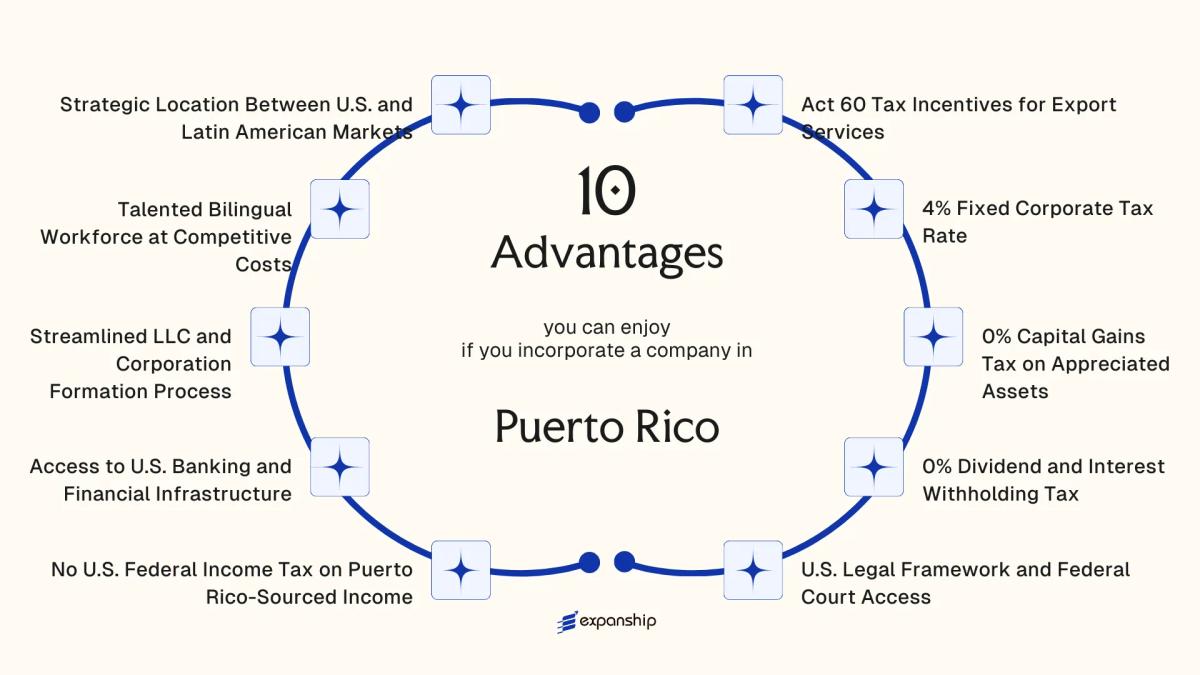
Act 60 Tax Incentives for Export Services
Enacted under Puerto Rico's Act 60-2019 (the Incentives Code), the export services decree offers a combination of tax treatments unavailable under any U.S. state jurisdiction. These Act 60 tax incentives Puerto Rico export services businesses can access are grounded in Puerto Rico's unique status as a U.S. territory, not a U.S. state, which places locally sourced income outside the reach of federal income tax.
A Decree-Based Tax Structure
Qualifying businesses receive a tax decree that locks in specific rates for a defined period, typically 15 years with the possibility of extension. This contractual certainty matters because it insulates your business from future legislative changes that might otherwise erode the tax position you structured your operations around.
What the Decree Covers
Eligible export services companies pay a 4% fixed corporate tax rate on income derived from services rendered to non-Puerto Rico clients. Dividend distributions from decree-covered income carry a 0% withholding rate, meaning profits can be distributed to shareholders without triggering additional tax at the entity level. To qualify, your business must apply to the Puerto Rico Department of Economic Development and Commerce (DDEC) and maintain a genuine operational presence on the island.
A tax decree under Act 60 provides contractually fixed rates, not just statutory ones, giving your firm a legally binding tax baseline for long-term financial planning.
4% Fixed Corporate Tax Rate
Under Act 60 of 2019, eligible export services businesses operating in Puerto Rico pay a fixed 4% corporate income tax rate on qualifying income. That rate does not fluctuate with revenue thresholds or shift under a progressive bracket structure, which means your tax liability remains predictable as the company scales.
The Puerto Rico 4% fixed corporate tax rate benefit becomes most apparent when set against the U.S. federal corporate rate of 21% or the standard Puerto Rico corporate rate of 37.5% that applies to non-incentivized entities. A firm operating under Act 60 and generating $2 million in qualifying export income retains significantly more capital than an equivalent entity taxed under either of those standard regimes.
This rate applies to income derived from services exported outside the island. The qualifying business must maintain a real and continuous presence locally, which in practice means:
- A bona fide office requires actual operational activity, not a nominal registered address
- Local employment conditions are defined and enforced by the Puerto Rico Department of Economic Development and Commerce (DDEC)
- The annual compliance report submitted to DDEC ties continued eligibility to genuine business operations
- The decree issued under Act 60 locks in the negotiated rate for up to 20 years, providing long-term tax certainty
That fixed decree period is what distinguishes this structure from jurisdictions where incentive rates are subject to policy reversals or sunset clauses without contractual protection.

Company Incorporation in Puerto Rico
Set up your Puerto Rico company under Act 60 and access the 4% fixed corporate tax rate on qualifying export services income.
0% Capital Gains Tax on Appreciated Assets
Under Act 60 of 2019, individual investors who become bona fide residents of Puerto Rico pay a 0% tax rate on capital gains accrued after establishing residency. This Puerto Rico zero capital gains tax on appreciated assets applies to gains from stocks, bonds, cryptocurrency, real estate held as investments, and other capital assets. For an investor managing a substantial portfolio, the difference between paying 0% versus the U.S. federal long-term capital gains rate of up to 23.8% (inclusive of the net investment income tax) on the same asset sale is direct, measurable, and significant.
| Parameter | Detail |
|---|---|
| Applicable Law | Act 60 of 2019 (Individual Investors Chapter) |
| Tax Rate on Post-Move Gains | 0% |
| Asset Types Covered | Stocks, bonds, crypto, investment real estate |
| Gain Accrual Timing | Only gains accrued after establishing PR residency qualify |
| Minimum Annual Physical Presence | 183 days per year in Puerto Rico |
The exemption covers gains that accrue from the date you establish bona fide residency, not gains that appreciated before your move. Assets held prior to relocating are subject to a preferential 5% rate on pre-move appreciation when sold, which remains considerably below U.S. federal rates. Qualifying requires meeting the bona fide residency tests under both Act 60 and IRS rules, including physical presence, tax home, and closer connections criteria. Your company's incorporation in the territory can complement this individual-level benefit by anchoring business operations within the same jurisdiction where your investment income is also sheltered.
0% Dividend and Interest Withholding Tax
Puerto Rico's zero dividend withholding tax advantage is one of the more structurally significant features of the Act 60 framework. Under Act 60, qualifying export services businesses can distribute dividends to shareholders without any withholding tax applied at source. For a foreign investor receiving profit distributions, this means the full dividend amount transfers without reduction at the entity level.
The same principle extends to interest income. Qualifying businesses under Act 60 pay 0% withholding on interest, which directly affects cash flow for firms that generate income through intercompany lending or financial structuring arrangements.
Most jurisdictions apply dividend withholding rates ranging from 15% to 35%. Eliminating that layer of taxation changes the effective return on investment in a measurable, calculable way.
Eligibility is not automatic. Your firm must hold a tax exemption decree issued by the Puerto Rico Department of Economic Development and Commerce (DDEC), and the income must qualify as export services revenue under the decree terms.
Keep these points in mind:
- The tax exemption decree must be active and in good standing
- Dividends must be sourced from decree-covered business activity
- The 0% rate applies to distributions from the exempt entity, not personal income from other sources
- Distributions from non-exempt income streams remain subject to standard Puerto Rico tax rules
U.S. citizens who become bona fide Puerto Rico residents under Act 60 may also pay 0% on dividends from Puerto Rico sources at the individual level, a combination unavailable in any U.S. state.
U.S. Legal Framework and Federal Court Access
Puerto Rico's U.S. legal framework business advantage is structural, not incidental. As an unincorporated U.S. territory, the island operates under U.S. federal law while maintaining its own civil and commercial code, giving businesses incorporated there access to two distinct but complementary legal systems.
Federal Court Jurisdiction and Contract Enforcement
Businesses registered in Puerto Rico can bring and defend disputes in the U.S. District Court for the District of Puerto Rico, a federal Article III court. That access matters because federal courts apply established procedural rules under the Federal Rules of Civil Procedure, and their judgments carry the same enforcement weight as any mainland U.S. federal ruling. For foreign counterparties and investors, contracting with a Puerto Rico entity means their agreements are enforceable within a U.S. judicial framework they already recognize.
Common Law Protections Within a Hybrid Legal System
Puerto Rico's civil law heritage, rooted in the Spanish legal tradition, coexists with U.S. federal statutes governing areas like bankruptcy, intellectual property, and securities. Your firm benefits from the Bankruptcy Code's protections under Title 11 of the U.S. Code, the Lanham Act for trademark registration, and federal arbitration enforcement under the Federal Arbitration Act. This hybrid system gives businesses both the contractual flexibility associated with civil law traditions and the federal statutory protections that institutional partners in North America expect to see.
Structure Your Puerto Rico Entity With Legal Clarity
Get guidance on how Puerto Rico's federal court access and U.S. legal protections apply to your specific business structure and jurisdiction of origin.
No U.S. Federal Income Tax on Puerto Rico-Sourced Income
Puerto Rico occupies a unique constitutional position: it is a U.S. territory, yet income generated within its borders from qualifying activities is not subject to no U.S. federal income tax on Puerto Rico-sourced income under the Internal Revenue Code. Specifically, IRC Section 933 excludes bona fide residents from paying U.S. federal income tax on income sourced within Puerto Rico. For a foreign business owner who relocates and establishes residency alongside an Act 60-compliant entity, this means profits earned from qualifying export services or investment activity are taxed only at the local level.
- IRC Section 933 applies to bona fide residents, meaning your physical presence and domicile in Puerto Rico directly determines eligibility, not simply where the entity is registered.
- Income classified as Puerto Rico-sourced under local rules avoids the federal tax layer entirely, leaving only the Act 60 corporate rate of 4% as the applicable burden on qualifying business income.
- For U.S. citizens specifically, this represents a structural exception to the worldwide taxation principle that normally follows American passport holders regardless of where they live or operate.
- The Puerto Rico federal tax exemption for businesses applies per entity and per individual, so the structure of your corporate setup directly affects how much of your income qualifies under this exclusion.
Access to U.S. Banking and Financial Infrastructure
Puerto Rico's U.S. banking infrastructure benefit for businesses is structural, not incidental. Because the territory operates under U.S. federal banking law, companies incorporated there can open accounts with U.S.-chartered banks, access FDIC-insured deposits, and transact entirely in U.S. dollars without the currency conversion exposure that affects offshore jurisdictions in the Caribbean or Latin America.
Banks operating in Puerto Rico, including major institutions with federally regulated branches, fall under the oversight of the Federal Deposit Insurance Corporation and the Federal Reserve System. Your business accounts carry the same $250,000 FDIC deposit insurance protection available to any U.S. mainland entity.
For foreign-owned firms, this has a direct operational implication: U.S. counterparties, suppliers, and institutional clients apply a different level of scrutiny to accounts held outside the U.S. financial system. A Puerto Rico-registered entity eliminates that friction.
A foreign technology firm billing U.S. clients from a Puerto Rico entity receives payment in U.S. dollars, holds funds in an FDIC-insured account, and transfers capital to a U.S. parent or investor without cross-border wire complications that would apply to a Cayman Islands or BVI structure.
Payment processors, merchant account providers, and institutional platforms that restrict access to non-U.S. entities typically treat Puerto Rico-registered companies as domestic U.S. businesses, broadening the financial tools available to your firm.
Streamlined LLC and Corporation Formation Process
Puerto Rico LLC and corporation formation advantages begin, in part, with how quickly a foreign owner can establish a legal presence. Under the Puerto Rico General Corporations Act, corporations are registered with the Puerto Rico Department of State, and the process can be completed without requiring an in-person visit or a local resident director in all cases.
Formation timelines are short relative to many civil law jurisdictions. An LLC or corporation can typically be organized within days of filing the required documentation, which reduces the lag between business planning and operational readiness.
Both entity types offer structural flexibility:
- LLCs are governed by an operating agreement, with no mandatory share structure or minimum capital requirement
- Corporations under the General Corporations Act can issue multiple classes of stock, which supports future equity arrangements or investor onboarding
- Registered agent appointment is required, but a wide network of qualified agents operates on the island
Foreign nationals can serve as sole directors and shareholders without restriction. This removes a common barrier that applies in many other jurisdictions, where local ownership thresholds or nominee arrangements are legally mandated.
Act 60 incentive eligibility requires a separate decree application filed with the Puerto Rico Department of Economic Development and Commerce, distinct from the entity formation process itself.
Talented Bilingual Workforce at Competitive Costs
Puerto Rico's bilingual workforce advantage for businesses stems from a structural feature of the island's education system: English is an official language alongside Spanish, and both are taught from primary school onward. This produces a labor pool that can operate fluidly across U.S. mainland clients, Latin American partners, and international markets without requiring translation infrastructure or language training investment.
Workforce Composition and Skills
The University of Puerto Rico system, along with institutions such as Ana G. Méndez University, graduates thousands of professionals annually across finance, engineering, technology, and legal fields. Many of these graduates hold U.S.-accredited degrees, which means their qualifications are directly transferable to U.S. regulatory and compliance environments. For a firm operating under Act 60 export services categories, this reduces onboarding friction considerably.
Labor costs on the island sit below those of major U.S. metropolitan areas. The federal minimum wage applies, currently set at $7.25 per hour, but average compensation for professional roles remains meaningfully lower than comparable positions in New York, Miami, or San Francisco. That differential allows export services businesses to maintain U.S.-standard output at a lower payroll burden.
Practical Implications for Staffing
For companies that serve both English-speaking and Spanish-speaking markets, a locally hired team can handle:
- Client communications across North American and Latin American accounts
- Bilingual compliance documentation and regulatory correspondence
- Spanish-language customer support without outsourcing
This bilingual talent pool reduces the operational cost of serving dual-language markets from a single office location.
Strategic Location Between U.S. and Latin American Markets
Sitting in the northeastern Caribbean, Puerto Rico occupies a position that places it within a four-hour flight of most major Latin American capitals, while remaining a U.S. territory under federal jurisdiction. This geographic configuration is the core of the Puerto Rico strategic location advantage for businesses that serve clients across both hemispheres.
Operating from the island, your firm can hold U.S.-domiciled contracts and bank accounts while maintaining physical and time-zone proximity to markets from Mexico to Brazil. The Atlantic Standard Time zone (UTC-4) aligns closely with U.S. Eastern business hours and overlaps with working hours across Central and South America, reducing scheduling friction for client-facing operations.
The practical benefit for a foreign business owner is structural:
- Shipments to the continental United States move under domestic trade rules, bypassing the customs procedures that apply to goods entering from foreign countries.
- Air freight and commercial routes connect directly to Miami, New York, and major Latin American hubs, supporting logistics-intensive operations.
- U.S. Customs and Border Protection processes goods transiting through Puerto Rico under federal authority, which simplifies supply chain documentation for firms exporting to the U.S. mainland.
- Spanish and English are both official languages under Puerto Rican law, which reduces translation and localization costs when your business operates across both markets simultaneously.
For export services businesses operating under Act 60 of 2019, physical presence on the island already satisfies the bona fide residency and operational requirements that unlock the associated tax incentives, meaning the geographic positioning and the compliance structure reinforce each other directly.
Why Puerto Rico Stands Out Among Top Business Destinations
Few jurisdictions combine U.S. legal standing with offshore-style tax treatment under a single statutory framework. That combination is what makes Puerto Rico a top business destination advantage for foreign investors who need access to U.S. courts, banking, and dollar-denominated accounts without incurring federal income tax on locally sourced earnings. When evaluating alternatives, the jurisdictions most frequently considered alongside Puerto Rico are the U.S. Virgin Islands, Delaware, and Panama — each targeting similar investor profiles but offering structurally different trade-offs.
The comparison below focuses on parameters where the commonwealth holds a neutral or favourable position. Delaware offers corporate law depth but provides no federal tax exemption for residents. The U.S. Virgin Islands shares some territorial tax characteristics but has a smaller financial services infrastructure. Panama's territorial tax system is well-established, yet it operates outside the U.S. legal framework entirely, which introduces currency, banking, and enforcement considerations absent under Act 60.
| Parameter | Puerto Rico | U.S. Virgin Islands | Delaware (USA) | Panama |
|---|---|---|---|---|
| Corporate Tax Rate (qualifying) | 4% under Act 60 | 90% of U.S. federal rate with EDC benefits | 21% federal + 8.7% state | 25% standard; 0% on foreign-sourced income |
| Federal Income Tax on Local Income | Exempt (territorial) | Partial exemption via EDC program | Full U.S. federal tax applies | Not applicable (outside U.S.) |
| Capital Gains Tax (qualifying) | 0% on post-move appreciation | Partial exemption | Standard U.S. rates apply | 10% on capital gains |
| U.S. Court and Legal System Access | Yes (federal courts) | Yes (federal courts) | Yes | No |
| U.S. Banking Infrastructure | Full access | Full access | Full access | Limited U.S. correspondent access |
| Primary Incentive Legislation | Act 60 (2019) | EDC Tax Benefits Program | No special incentive regime | Law 32 (SEM), Law 41 |
| Currency | U.S. Dollar | U.S. Dollar | U.S. Dollar | U.S. Dollar (official) |
Compliance Services for Companies in Puerto Rico
Stay aligned with Act 60 decree conditions, annual report filings, and regulatory obligations for Puerto Rico-based entities.
Conclusion
Puerto Rico's tax framework under Act 60 creates a structural advantage that few U.S.-affiliated jurisdictions can replicate: a 4% fixed corporate rate on export services income combined with 0% tax on qualifying capital gains and dividends. For businesses deriving income from services delivered outside Puerto Rico, this combination materially reduces the tax burden without requiring the owner to exit the U.S. legal system or operate under foreign regulatory regimes.
That last point carries significant weight. Your entity operates under U.S. federal law, with access to federal courts and U.S. banking infrastructure, while benefiting from income tax treatment that federal law does not extend to businesses based on the mainland. This positioning is not incidental; it is the product of Section 933 of the Internal Revenue Code and the incentive structure codified in Act 60 of 2019.
The benefits of incorporating in Puerto Rico are most pronounced for businesses in export services, fund management, or investment holding, where Act 60 eligibility directly intersects with operational structure. Whether these advantages apply to your specific entity depends on the nature of your income, your residency position, and your ability to satisfy Decree requirements under the Puerto Rico Incentives Code. The next step is mapping those variables against your actual business structure to determine which incentives you qualify for and what your effective tax position would be.
Start Your Puerto Rico Company Formation With Expanship
Expanship supports Puerto Rico company formation with Expanship handling every stage from initial structuring to post-incorporation compliance. The benefits covered in this blog, from Act 60 tax incentives to access to U.S. federal courts, each carry specific filing, registration, and maintenance requirements. Expanship coordinates directly with the Puerto Rico Department of State, the entity responsible for registering LLCs and corporations under the Puerto Rico General Corporations Act.
Expanship's scope of services for your Puerto Rico entity includes:
- Preparation and legalization of formation documents, including articles of incorporation or organization
- Registered agent and registered office provision in Puerto Rico, as required under local law
- Filing and liaison with the Puerto Rico Department of State and relevant regulatory bodies
- Act 60 decree application support and coordination with the Department of Economic Development and Commerce
- Post-incorporation compliance management, including annual report filings and good standing maintenance
- Banking introduction assistance to U.S. and Puerto Rico-based financial institutions
Your business structure, whether a corporation or LLC, determines which compliance obligations apply from day one. Expanship ensures those obligations are identified and addressed before your entity becomes active.
To discuss your incorporation requirements, contact Expanship Puerto Rico directly.
Frequently Asked Questions (FAQ)
The fixed 4% corporate tax rate under Act 60 applies specifically to income derived from eligible export services rendered to clients outside Puerto Rico. Income generated from sources within the island or from non-qualifying activities is subject to standard Puerto Rico corporate tax rates, which differ from the Act 60 preferential rate. The tax decree issued by the DDEC defines the scope of qualifying income, so the boundary between covered and uncovered revenue should be established clearly during the application process.
The 0% capital gains rate under Act 60 applies only to appreciation that accrues after the individual establishes bona fide residency in Puerto Rico and the tax decree takes effect. Gains that accrued prior to relocation remain subject to U.S. federal capital gains tax, as the exemption is prospective. This distinction is material for investors holding appreciated assets at the time of their move, since the tax treatment differs based on when the gain originated.
Processing times for Act 60 decrees through the DDEC can vary based on application completeness and the volume of submissions the agency is reviewing at a given time. The general principle is that a well-prepared application with all required documentation moves through review faster, though no statutory deadline binds the DDEC to a specific issuance timeframe. Applicants should account for several months between submission and decree issuance when planning their operational timeline.
A registered agent with a physical address in Puerto Rico is required for both corporations and LLCs formed under the Puerto Rico General Corporations Act. The requirement for a local director depends on the entity type and its governing documents; corporations are not universally required to appoint a Puerto Rico-resident director, though the registered agent obligation is non-negotiable. Maintaining a valid registered agent ensures that service of process and official government correspondence reaches the entity properly.
If a business fails to maintain compliance with the conditions set out in its Act 60 decree, the DDEC has authority to revoke or suspend the incentive. Revocation can result in the retroactive loss of tax benefits for periods of non-compliance, which may trigger back taxes and interest under Puerto Rico's internal revenue code. Decree holders are subject to annual reporting requirements, and material changes in business activity or structure should be disclosed to the DDEC to avoid unintentional breach.
A corporation incorporated in Puerto Rico that derives income exclusively from Puerto Rico sources is generally not subject to U.S. federal corporate income tax on that income, under the federal tax treatment applicable to possessions. This treatment stems from the island's status as an unincorporated U.S. territory and is reinforced by Act 60 decree protections at the local level. However, income with a U.S. federal nexus, such as revenue from clients located in the fifty states, may be treated differently, and the analysis depends on specific income sourcing rules under the U.S. Internal Revenue Code.
Legal Disclaimer
The information provided in this article is for general informational purposes only and does not constitute legal, tax, or professional advice. While we strive to ensure the accuracy and timeliness of the content, laws and regulations are subject to change, and the application of laws can vary widely based on specific facts and circumstances.
Readers should not act upon this information without seeking professional counsel tailored to their individual situation. Expanship and its authors disclaim any liability for actions taken or not taken based on the content of this article.
For specific advice regarding your business setup, compliance requirements, or any legal matters, please consult with qualified legal and tax professionals in the relevant jurisdiction.