
Key Takeaways
- Poland's standard 19% corporate income tax rate, combined with the Estonian CIT model that defers taxation entirely on reinvested profits, creates a layered tax efficiency structure unavailable in most EU jurisdictions.
- Under the Polish Commercial Companies Code, a Sp. z o.o. can be established with a minimum share capital of PLN 5,000 and registered online via the S24 system, lowering the practical barrier to EU market entry.
- Companies incorporated in Poland gain access to EU financial services passporting rights, allowing a single Polish-registered entity to operate across member states without requiring separate incorporation in each jurisdiction.
- Registration through the National Court Register, operated under the authority of the Polish Ministry of Justice, places a Polish entity within a treaty-backed legal framework that supports cross-border operations through an extensive network of bilateral double tax treaties.
Situated in Central Europe and a full European Union member state since 2004, Poland offers a stable, treaty-based tax environment that attracts foreign direct investment from across the globe. The benefits of incorporating in Poland draw businesses ranging from multinational subsidiaries to early-stage ventures seeking a base within the EU's single market.
Company registration is overseen by the National Court Register, the official registry operated under the authority of the Polish Ministry of Justice. Foreign nationals face no general restrictions on owning a Polish entity outright, and the country maintains an open posture toward inbound investment with no mandatory local shareholder requirements for most business structures. The Sp. z o.o. is the legal vehicle most commonly chosen by foreign businesses establishing a presence here.
Poland operates a residence-based corporate tax system supplemented by an extensive network of bilateral tax treaties. This article examines the principal advantages that make company formation in the country a strategically sound decision for businesses targeting European markets.
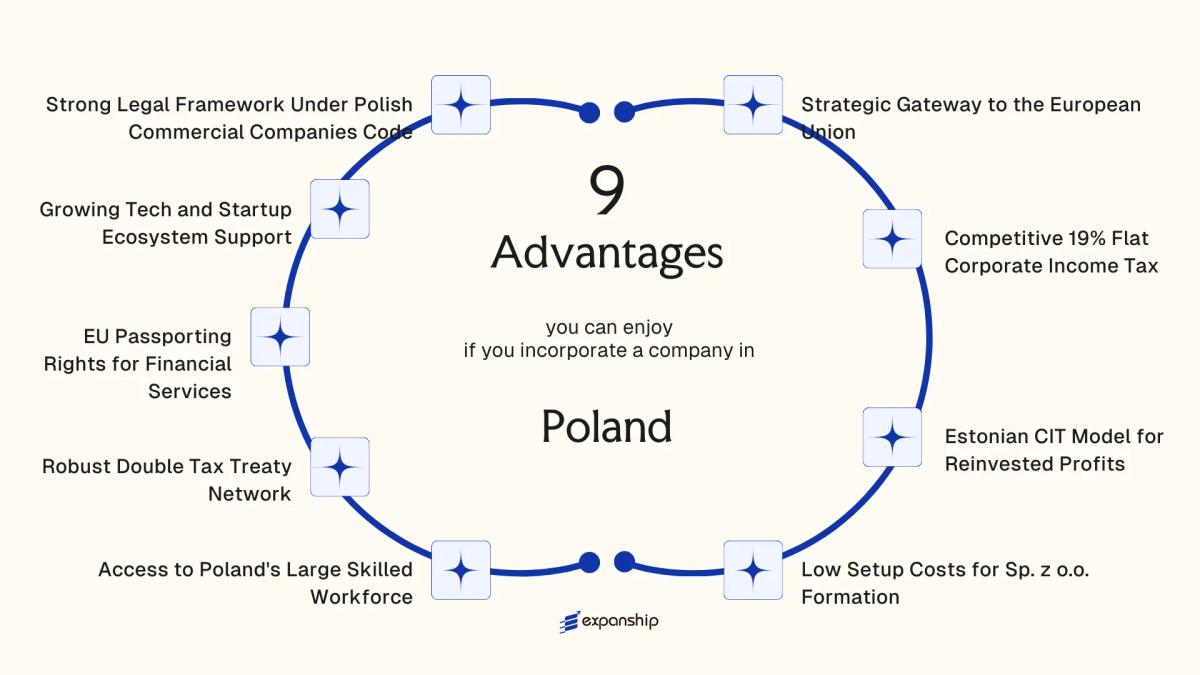
Strategic Gateway to the European Union
Poland EU market access for businesses is underpinned by full EU membership, which grants companies incorporated here direct access to a single market of over 440 million consumers under unified trade rules.
Single Market Membership and What It Unlocks
A company registered in Poland operates under EU law, meaning goods, services, capital, and personnel can move across member states without customs barriers or separate market-entry approvals. For a foreign-owned entity, this eliminates the legal and logistical cost of establishing multiple European subsidiaries simply to serve different national markets.
Geographic Position Within the EU
Situated at the intersection of Western and Eastern Europe, the country shares borders with seven states, including Germany, the EU's largest economy. This geographic position means your supply chain and distribution operations can reach both mature Western European markets and high-growth Central and Eastern European economies from a single registered base, without treaty renegotiation or structural restructuring.
A single Polish entity gives your business legal standing to trade across all 27 EU member states under one regulatory framework.
Competitive 19% Flat Corporate Income Tax
Poland's standard corporate income tax rate is 19%, applied as a flat rate on taxable profits. For foreign investors comparing European jurisdictions, this matters: the EU average corporate tax rate sits above 21%, meaning a Polish entity is taxed below that benchmark from the first year of operation.
The flat structure removes the bracket uncertainty that progressive systems introduce. Your business can model post-tax returns with precision, which simplifies both initial financial planning and ongoing profit repatriation calculations.
Under the Corporate Income Tax Act (ustawa o podatku dochodowym od osób prawnych), small taxpayers — those with annual revenue not exceeding EUR 2 million — qualify for a reduced 9% CIT rate. This threshold gives early-stage foreign subsidiaries or newly incorporated entities a lower tax burden during the critical growth phase.
The 19% rate applies broadly, but the conditions that govern it are worth understanding:
- The 9% reduced rate is unavailable to entities generating passive income such as dividends or interest
- Tax residence is determined by registration or place of management, giving foreign-owned firms clarity on where liability falls
- Transfer pricing documentation requirements apply to related-party transactions above statutory thresholds, keeping intra-group arrangements transparent
For a foreign business structuring regional operations through a Polish spółka z ograniczoną odpowiedzialnością, the flat rate means predictable annual CIT exposure without rate escalation as revenues grow.

Incorporate Your Company in Poland
Set up a Polish spółka z ograniczoną odpowiedzialnością (Sp. z o.o.) with full compliance support across registration, tax, and corporate structuring.
Estonian CIT Model for Reinvested Profits
Introduced by amendments to the Corporate Income Tax Act (ustawa o CIT) effective from 2021, the Estonian CIT model allows qualifying Polish companies to defer taxation entirely until profits are distributed to shareholders. Under the standard regime, corporate tax is triggered at the point of profit recognition. Under the Estonian model, no tax liability arises on undistributed earnings. For a foreign business owner reinvesting profits into operations, equipment, or headcount, this deferral can significantly improve cash flow compared to paying tax annually on retained earnings.
| Taxpayer Type | Standard CIT Rate | Estonian CIT Rate on Distribution |
|---|---|---|
| Small taxpayer (revenue up to €2M) | 9% | 10% |
| Standard taxpayer | 19% | 20% |
| Small taxpayer with investment | 9% | 10% (reduced conditions apply) |
Eligibility requires that the entity be a spółka z ograniczoną odpowiedzialnością (Sp. z o.o.) or similar qualifying form, with shareholders who are exclusively natural persons, annual revenue below PLN 100 million, and a minimum number of full-time employees. The combined effective rate on distributed profits under the Estonian model is structured to remain comparable to the standard regime, but the timing advantage of deferred taxation means retained capital remains fully available for reinvestment during each fiscal year, without any interim tax cost reducing working capital.
Low Setup Costs for Sp. z o.o. Formation
Poland Sp. z o.o. low formation cost advantage is most visible in its statutory minimum share capital requirement: PLN 5,000 (approximately EUR 1,100). For a foreign investor establishing a regulated EU presence, this figure is materially lower than comparable structures in Germany or Austria, where minimum capital thresholds begin at EUR 25,000.
Registration is handled through the National Court Register (Krajowy Rejestr Sądowy, or KRS). Online formation via the S24 portal reduces both notarial fees and processing time. Standard notarial formation is also available where articles of association require customisation, though it carries higher upfront costs than the S24 route.
The practical implication is direct: a foreign-owned entity can achieve a fully operational Polish limited liability company without committing significant capital to satisfy a structural formality. Those resources remain available for operations from day one.
Keep these points in mind:
- PLN 5,000 minimum share capital is the statutory floor under the Code of Commercial Companies (Kodeks spółek handlowych)
- S24 portal formation is available on KRS for standard structures
- Notarial formation applies where bespoke articles are needed
- Capital may be contributed in cash; in-kind contributions are permitted under specific conditions
A Sp. z o.o. formed via the S24 system can be registered within 24 hours of submission, making Poland one of the faster EU jurisdictions for same-week operational readiness.
Access to Poland's Large Skilled Workforce
Poland's skilled workforce advantages for businesses are grounded in measurable output. The country graduates approximately 400,000 university students annually, with a pronounced concentration in engineering, computer science, mathematics, and natural sciences — fields that directly serve technology, finance, and manufacturing operations.
A Deep STEM and Technical Talent Base
Over 100,000 IT specialists are estimated to enter the Polish labor market each year, and the country consistently ranks among Europe's top producers of software developers by volume. For a foreign firm establishing a subsidiary or branch here, this supply translates into a hiring environment where technical roles can be filled at a fraction of the cost typical in Western European markets, without compromising on qualification levels.
Poland's higher education system operates under the Act of 20 July 2018 — Law on Higher Education and Science, which regulates academic standards and degree accreditation. This gives your business a legally anchored framework for assessing credential equivalence when hiring locally.
Multilingual Capacity and EU Labor Mobility
English proficiency across the working-age population is among the higher rates in Central Europe, particularly within urban centers such as Warsaw, Kraków, Wrocław, and Poznań. This reduces operational friction for foreign management teams and remote collaboration structures.
As an EU member state, Poland also benefits from free movement of labor across the bloc. Your entity incorporated here can draw from talent pools across the EU without additional work permit requirements, giving access to the broader European educated labor market from a single legal base.
Make the Most of Your Polish Incorporation
Connect with Expanship to understand how Poland's workforce and regulatory environment align with your business structure.
Robust Double Tax Treaty Network
Poland's double tax treaty network benefits foreign businesses by reducing or eliminating withholding taxes on dividends, interest, and royalties paid across borders. With over 80 bilateral tax treaties in force, the country offers one of the more extensive treaty networks among EU member states, giving your company reliable access to reduced withholding rates in key trading and investment destinations.
- Treaties with major economies including Germany, the United States, the United Kingdom, China, and the Netherlands mean that dividend withholding taxes are frequently reduced to 5% or 10% under treaty provisions, compared to the domestic statutory rate of 19%. For holding structures and multinational groups, this difference directly affects after-tax returns on equity investments.
- Interest and royalty payments routed through a Polish entity to treaty-partner jurisdictions benefit from reduced or zero withholding rates under applicable agreements. This makes the country a functional intermediate holding location for intellectual property or financing arrangements within a group.
- Treaty provisions typically include tie-breaker rules for tax residency, mutual agreement procedures, and exchange of information articles. These clauses give your business a defined legal mechanism to resolve double taxation disputes through competent authority channels, rather than relying on unilateral domestic relief, which is less predictable.
- Treaty eligibility generally requires that the entity has genuine tax residency in Poland, meaning substance requirements and local management criteria must be satisfied.
EU Passporting Rights for Financial Services
Poland EU financial services passporting rights derive from EU single market directives, specifically frameworks such as MiFID II, the AIFMD, and the Payment Services Directive (PSD2). A regulated financial firm authorized by the Polish Financial Supervision Authority (KNF) can passport its services across all 27 EU member states without obtaining separate licenses in each country. For businesses targeting multiple European markets, that single authorization point eliminates duplicative regulatory costs and timelines.
The KNF is the competent authority responsible for granting these authorizations. Once a firm receives its license in Poland, it can operate on a cross-border basis or establish branches in other member states through a standardized notification procedure under EU law. This applies to investment firms, payment institutions, e-money institutions, and alternative investment fund managers, among others.
Because Poland operates within the EU regulatory perimeter, your business accesses the same passporting rights available through higher-cost Western European jurisdictions, but within a lower operational-cost environment.
Hypothetical scenario: A payment institution licensed by the KNF spends approximately EUR 15,000 to 30,000 in total licensing costs in Poland. Pursuing equivalent licenses independently in five EU member states could cost upward of EUR 100,000 in aggregate regulatory and legal fees, excluding ongoing compliance overhead in each jurisdiction.
Growing Tech and Startup Ecosystem Support
Poland's startup ecosystem has attracted sustained institutional attention, making it one of the more structured environments in Central Europe for early-stage and growth-stage companies. The Polish Agency for Enterprise Development (PARP) and the National Centre for Research and Development (NCBR) both administer grant programs and co-financing instruments specifically targeting innovative firms.
Foreign-owned entities registered in Poland can access EU Structural Funds channeled through national programs, including those under the Smart Growth Operational Programme. These instruments fund R&D activity, prototype development, and technology commercialization — reducing capital requirements that would otherwise fall entirely on private investors.
The R&D tax relief under Article 26e of the Personal Income Tax Act and its corporate equivalent allows eligible companies to deduct qualifying research and development costs at 200% for certain expense categories. For a foreign investor establishing a tech entity here, this materially reduces the effective cost of building product in-country.
- PARP operates dedicated acceleration and incubation support programs
- NCBR co-finances applied research with commercial applications
- Special Economic Zones and the Polish Investment Zone offer additional location-based incentives for qualifying tech investments
Access to NCBR and PARP funding programs typically requires the company to demonstrate operational activity and registered presence in Poland, meaning newly formed entities may face eligibility timelines before qualifying.
Strong Legal Framework Under Polish Commercial Companies Code
Poland's Commercial Companies Code, known locally as the Kodeks spółek handlowych (KSH), has governed corporate formation and operation since it came into force in 2001. The Poland Commercial Companies Code legal framework benefits foreign owners directly: it provides a codified, predictable set of rules covering shareholder rights, management structures, liability boundaries, and capital requirements within a single statute.
Defined Shareholder Protections
The KSH sets out explicit provisions for minority shareholder rights, including the right to request extraordinary general meetings and challenge resolutions that conflict with the company's articles of association. For a foreign investor holding a minority stake, these statutory protections exist by default and do not require negotiation into a separate shareholders' agreement to be enforceable.
Structured Governance for the Sp. z o.o.
Under the KSH, a spółka z ograniczoną odpowiedzialnością operates with a clearly defined separation between management board authority and shareholder powers. This statutory clarity reduces governance ambiguity, which is particularly relevant when multiple foreign co-founders are involved and internal disputes could otherwise create operational deadlock.
EU Directive Alignment
Because Poland operates within the EU legal order, the KSH has been progressively aligned with EU company law directives. Key areas include:
- Cross-border mergers and divisions
- Disclosure requirements under the First Company Law Directive
- Shareholder rights under Directive 2007/36/EC
This alignment means legal concepts familiar from other EU jurisdictions carry over, reducing the interpretive learning curve for foreign counsel advising on Polish entities.
Why Poland Stands Out Among European Business Destinations
Positioned against its most frequently compared alternatives, Poland holds a distinct profile for foreign investors evaluating Central and Eastern Europe. The jurisdictions a prospective incorporator typically weighs alongside it are Czechia, Hungary, and Germany, each targeting overlapping investor segments but differing materially on tax structure, labour cost, and treaty depth.
What the comparison reveals is less about any single metric and more about the cumulative configuration. A 19% flat corporate income tax rate applied uniformly, combined with an Estonian-model CIT deferral option for retained profits, produces a tax environment that neither Czechia nor Hungary fully replicates in the same structure. Germany, while offering legal and market depth, operates at a combined corporate tax burden that typically exceeds 30% when trade tax is included. For a foreign-owned Sp. z o.o., the interaction between these features and Poland's treaty network of over 80 bilateral agreements creates measurable planning flexibility without requiring offshore structuring.
| Parameter | Poland | Czechia | Hungary | Germany |
|---|---|---|---|---|
| Standard CIT Rate | 19% | 21% | 9% | ~30% (incl. trade tax) |
| CIT Deferral on Reinvested Profits | Yes (Estonian CIT) | No | No | No |
| Minimum Share Capital (private limited) | PLN 5,000 (~€1,150) | CZK 1 (~€0.04, nominal) | HUF 3,000,000 (~€7,700) | €25,000 |
| EU Member State | Yes | Yes | Yes | Yes |
| Bilateral Tax Treaties | 80+ | 80+ | 80+ | 90+ |
| Skilled Labour Cost (relative) | Low-to-moderate | Moderate | Low-to-moderate | High |
Compliance Services for Companies in Poland
Maintain good standing with Polish regulatory requirements, from annual filings to KRS obligations and ongoing statutory compliance.
Conclusion
Incorporating in Poland offers a structurally grounded case for foreign business owners, not simply because of one favourable rule, but because several features reinforce each other. The standard 19% corporate income tax rate already positions the country competitively within the EU, and the Estonian CIT model extends that advantage further by deferring taxation entirely on profits kept inside the business.
The Sp. z o.o. remains one of the more accessible entry points into EU-based incorporation, with a minimum share capital requirement of PLN 5,000 and online registration available through the S24 system. For businesses that operate across EU member states, the passporting rights available under EU financial services directives add a structural dimension that extends the value of a Polish entity well beyond its domestic market.
That said, the degree to which these advantages apply depends on your business model, ownership structure, and the jurisdictions where your clients or operations are based. A holding company, a tech startup, and a financial services firm each engage with the Polish Commercial Companies Code and the tax framework differently. The next step is assessing which of these structural features align with your specific situation and determining how the formation process maps to your timeline and compliance obligations.
Let Expanship Handle Your Polish Company Formation
Expanship's Poland company formation service covers the full incorporation cycle for foreign nationals and non-resident entities establishing a Spółka z ograniczoną odpowiedzialnością (Sp. z o.o.) or alternative structures under the Kodeks spółek handlowych. This includes managing filings with the Krajowy Rejestr Sądowy (KRS), coordinating notarial deed requirements, and ensuring your entity meets all tax registration obligations with the Urząd Skarbowy from the point of incorporation.
From document preparation through to post-incorporation compliance, Expanship handles each operational requirement so your business can begin trading without administrative delays:
- Preparation and legalization of incorporation documents, including articles of association
- Registered office address and local registered agent provision
- KRS filing and liaison with the National Court Register throughout the registration process
- VAT, CIT, and statistical number (NIP, REGON) registration with relevant Polish authorities
- Ongoing compliance management, including annual reporting obligations
- Banking introduction assistance for corporate account opening in Poland
Each service is delivered by practitioners with direct experience in Polish commercial and tax law, covering the Estonian CIT election, treaty applications, and sector-specific licensing where your structure requires it.
Reach out to Expanship Poland to discuss your incorporation requirements directly.
Frequently Asked Questions (FAQ)
The standard corporate income tax (CIT) rate in Poland is 19%. A reduced rate of 9% applies to taxpayers whose annual revenue does not exceed the EUR equivalent of 2 million złoty in a given tax year, subject to conditions set under the Corporate Income Tax Act (ustawa o podatku dochodowym od osób prawnych). Newly established entities may also qualify for this reduced rate in their first year of operation.
Under Poland's Estonian CIT regime, a qualifying company defers corporate income tax until profits are actually distributed to shareholders rather than paying tax on earned income annually. Eligibility requires that the entity be a Sp. z o.o. or simple joint-stock company (prosta spółka akcyjna), that shareholders are exclusively individuals, and that the company meets specific conditions on passive income thresholds and employment levels. The regime is governed by provisions introduced into the Corporate Income Tax Act effective from 2021.
Registration through the National Court Register (KRS) typically takes between a few business days and several weeks, depending on whether the electronic S24 incorporation procedure is used or a traditional notarial deed is filed. The S24 online path, available for standard Sp. z o.o. formations using a model articles template, generally produces a registration decision faster than the notarial route. Processing times can vary based on the workload of the relevant district court division handling the KRS filing.
Poland maintains double tax treaties with over 80 countries, including major jurisdictions relevant to holding and investment structures such as the Netherlands, Luxembourg, Cyprus, and the United Arab Emirates. Each treaty sets specific withholding tax rates on dividends, interest, and royalties that override domestic rates, so the applicable rate depends on the specific treaty in force. The treaties are administered in accordance with the OECD Model Tax Convention, and Poland has adopted the Multilateral Instrument (MLI) to update a number of them in line with BEPS minimum standards.
A Sp. z o.o. does not require a Polish-resident director under the Commercial Companies Code; foreign nationals may serve as sole or majority members of the management board. However, the company must maintain a registered office address in Poland, which must be a real address capable of receiving official correspondence from the KRS and tax authorities. A virtual office arrangement at a registered address provider is commonly used where the business does not operate physical premises in the country.
Failure to file annual financial statements within the statutory deadline with the National Court Register can result in enforcement proceedings initiated by the registration court, including the imposition of fines on management board members. Under the Accounting Act (ustawa o rachunkowości), financial statements must be approved and submitted within specified timeframes following the end of the financial year. Persistent non-compliance may trigger compulsory dissolution proceedings under the Commercial Companies Code.
Poland can be a tax-efficient holding location for dividend flows within the EU because it implements the EU Parent-Subsidiary Directive, which exempts qualifying intra-EU dividend payments from withholding tax subject to minimum shareholding and holding period conditions. Compared to jurisdictions such as Ireland or the Netherlands, Poland does not have the same depth of unilateral participation exemption rules, so the structure's efficiency depends significantly on the specific treaty or directive provisions applicable to the target subsidiary's jurisdiction. Polish tax law also contains anti-avoidance provisions under the General Anti-Avoidance Rule (GAAR), which apply where arrangements lack genuine economic substance.
Legal Disclaimer
The information provided in this article is for general informational purposes only and does not constitute legal, tax, or professional advice. While we strive to ensure the accuracy and timeliness of the content, laws and regulations are subject to change, and the application of laws can vary widely based on specific facts and circumstances.
Readers should not act upon this information without seeking professional counsel tailored to their individual situation. Expanship and its authors disclaim any liability for actions taken or not taken based on the content of this article.
For specific advice regarding your business setup, compliance requirements, or any legal matters, please consult with qualified legal and tax professionals in the relevant jurisdiction.