

Key Takeaways
- The CREATE Act reduced the standard corporate income tax rate and introduced a tiered structure that gives qualifying enterprises a measurable cost advantage over the rates that applied before 2021.
- Companies registered with PEZA or accredited by the BOI can access income tax holidays and preferential rates that directly lower the effective tax burden beyond the standard CREATE Act baseline.
- Foreign investors entering sectors outside the Foreign Investment Negative List can hold 100% equity in a Philippine domestic corporation without requiring a local joint venture partner, giving full operational control from incorporation.
- With a domestic consumer base exceeding 115 million people and company registration administered by the Securities and Exchange Commission, the Philippines offers both a scalable end market and a defined regulatory pathway within a single jurisdiction.
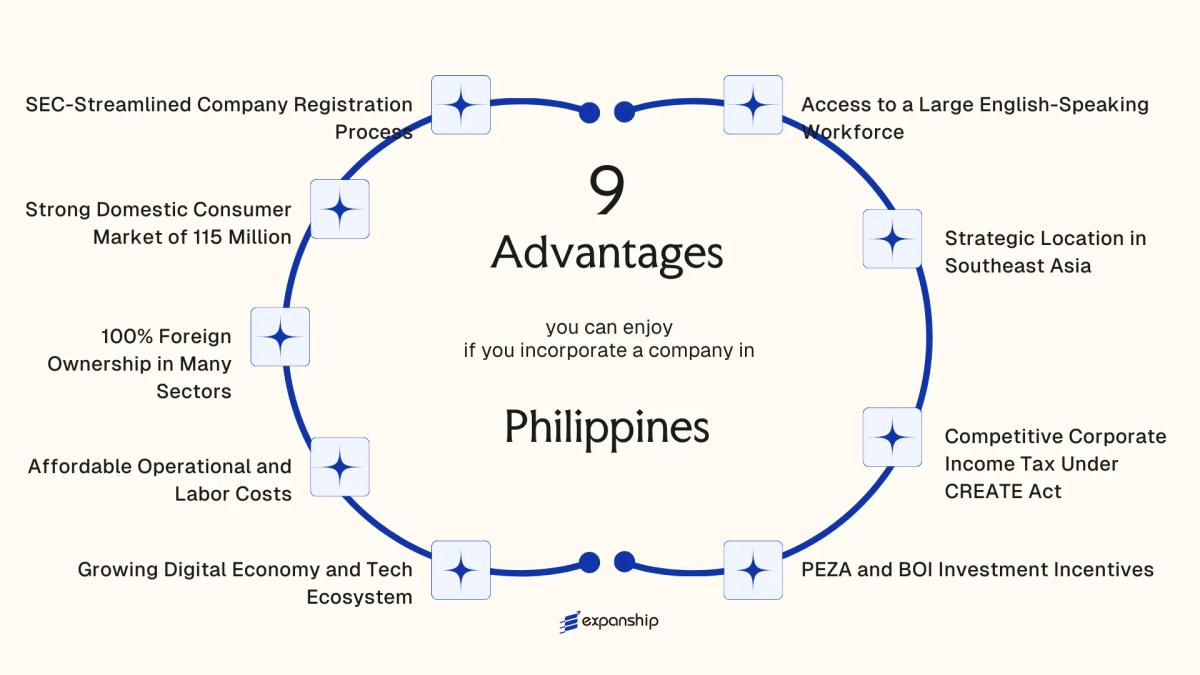
The benefits of incorporating in the Philippines draw interest from foreign investors across manufacturing, services, and technology sectors. Situated in Southeast Asia, the country is an independent republic comprising over 7,600 islands, positioned along major Asia-Pacific trade routes. Company registration falls under the jurisdiction of the SEC, which administers the formation and ongoing compliance of business entities. Foreign firms typically enter the market through a Domestic Corporation.
Tax treatment follows a territorial and treaty-based model, shaped significantly by the Corporate Recovery and Tax Incentives for Enterprises Act, or CREATE Act, enacted in 2021. Foreign direct investment is actively encouraged across a broad range of sectors, with the Foreign Investments Act providing the statutory framework that defines where full foreign ownership is permitted and where restrictions apply.
This article outlines the key advantages your business can expect when forming a company here, drawing on current regulatory structures and economic conditions.
Access to a Large English-Speaking Workforce
The Philippines English-speaking workforce advantage is structural, not incidental. English holds co-official status alongside Filipino under the 1987 Constitution, meaning it is the medium of instruction in higher education and the default language of business, law, and government.
English Proficiency at Scale
With over 110 million people and consistently high placement in global English proficiency indices, the country produces a substantial volume of degree-holders annually across engineering, IT, finance, and healthcare. Your business can recruit locally without investing heavily in language training or translation infrastructure.
Practical Value for Foreign-Owned Entities
For a foreign firm operating a Philippine entity, this means contracts, regulatory filings with the Securities and Exchange Commission, and day-to-day operations all run in English without friction. Bilingual Filipino talent also bridges communication between regional headquarters and local teams across Asia-Pacific markets.
Hiring locally in the Philippines does not require language adaptation costs that are common when entering other non-English-speaking markets in the region.
Strategic Location in Southeast Asia
Positioned at the intersection of the South China Sea, the Pacific Ocean, and the Celebes Sea, the Philippines sits within five hours' flight time of major economies including China, Japan, South Korea, and Australia. For businesses targeting the broader ASEAN region, this geographic placement reduces both transit costs and regional travel time meaningfully.
As a founding member of ASEAN, the country participates in the ASEAN Free Trade Area (AFTA) and the ASEAN Comprehensive Investment Agreement (ACIA), giving registered entities preferential access to a combined regional market of over 670 million people. Your business benefits from reduced tariffs on goods moving across member states, which directly affects supply chain economics.
The practical advantages of this positioning include:
- Proximity to manufacturing centers in Vietnam, Indonesia, and Malaysia shortens supplier lead times
- Direct sea lanes to Northeast Asian export markets reduce freight dependency on single corridors
- ASEAN membership means your entity operates under a recognized regional investment framework, not outside it
- Port infrastructure in Metro Manila and Cebu supports both import and re-export activities
Foreign firms registered under the SEC gain access to these trade arrangements from the point of incorporation.

Company Incorporation in the Philippines
Register your business in the Philippines and position your entity within the ASEAN trade network from day one.
Competitive Corporate Income Tax Under CREATE Act
Enacted in 2021, Republic Act No. 11534, known as the Corporate Recovery and Tax Incentives for Enterprises (CREATE) Act, reduced the regular corporate income tax rate from 30% to 25% for domestic and resident foreign corporations. For smaller firms with net taxable income not exceeding PHP 5 million and total assets below PHP 100 million, the rate drops further to 20%. This tiered structure means your entity's tax exposure scales with its actual size, rather than applying a flat burden regardless of revenue.
The Philippines CREATE Act corporate tax benefits extend beyond the headline rate. The law also introduced a minimum corporate income tax of 2% of gross income, reduced temporarily from the prior 2% applied on a different base, giving qualifying companies breathing room during early operating years.
| Corporation Type | Taxable Income / Asset Threshold | CIT Rate |
|---|---|---|
| Large domestic / resident foreign corp | Above PHP 5M income or PHP 100M assets | 25% |
| Small domestic corporation | Max PHP 5M income and max PHP 100M assets | 20% |
| Minimum corporate income tax (MCIT) | Applies from 4th taxable year onward | 2% of gross income |
Before CREATE, the 30% rate was among the highest in Southeast Asia. The reduction brings the statutory rate closer to regional peers, which directly affects how much post-tax profit your business retains and repatriates. For foreign corporations earning income within the country, the reduced rate applies to Philippine-sourced income, making the structure transparent and predictable from a tax planning standpoint.
PEZA and BOI Investment Incentives
PEZA BOI investment incentives Philippines sit at the center of the country's foreign investment strategy, administered through two distinct but complementary bodies: the Philippine Economic Zone Authority and the Board of Investments.
PEZA governs enterprises operating within designated economic zones. Registered entities can access an Income Tax Holiday of up to six years, followed by a reduced Special Corporate Income Tax rate of 5% on gross income earned, in lieu of all national and local taxes. This substitution eliminates a significant layer of overlapping tax obligations that businesses in non-PEZA areas face. Your firm must operate physically within an accredited zone and meet PEZA's export threshold requirements to qualify under PEZA's rules.
BOI registration, governed by the Omnibus Investments Code (Executive Order No. 226), targets sectors listed in the annual Investment Priorities Plan. Foreign firms in qualifying industries gain access to Income Tax Holidays of four to six years, depending on whether the project is pioneer or non-pioneer status. Customs duty exemptions on capital equipment provide an additional cost advantage during the setup phase. Eligibility conditions and sector coverage are updated annually via the BOI Investment Priorities Plan.
Keep these points in mind:
- PEZA benefits require physical presence within an accredited economic zone
- BOI incentives are tied to sectors listed in the current Investment Priorities Plan
- Income Tax Holiday duration differs between pioneer and non-pioneer classifications
- PEZA's 5% SCIT is in lieu of all national and local taxes, not in addition to reduced rates
A PEZA-registered entity is exempt from paying local government taxes, meaning city or municipal governments cannot impose business taxes on your operations inside an economic zone, regardless of local ordinances.
Growing Digital Economy and Tech Ecosystem
The Philippines digital economy benefits for businesses extend well beyond cost. The government has formally targeted digital economy growth to reach 25% of GDP, creating a policy environment where tech-oriented entities receive structured, legislated support rather than ad hoc incentives.
BPO as Infrastructure, Not Just Industry
The business process outsourcing sector generates over $30 billion in annual revenues and employs more than 1.5 million workers, forming a service infrastructure that foreign firms can enter directly or build adjacent to. This concentration means your business inherits an established operational ecosystem, including trained middle management, tested compliance workflows, and institutional familiarity with foreign client requirements.
Registered IT-BPM companies operating within designated IT parks or special economic zones qualify for incentives under the PEZA law (Republic Act 7916), including income tax holidays and preferential gross income tax treatment.
Startup and Tech Company Formation
The Philippine Startup Act (Republic Act 11337) created a formal legal category for startups, granting qualifying firms access to fiscal incentives, simplified registration through a unified startup portal, and government-facilitated market access programs. This gives early-stage foreign-founded companies a defined legal pathway, rather than forcing them to operate through general commercial structures not designed for high-growth tech models.
Oversight sits with the Department of Trade and Industry and the Department of Science and Technology, both of which administer accreditation and incentive release under the Act.
Incorporate in the Philippines and Access Its Digital Economy Incentives
Find out which incentive programs, legal structures, and registration pathways apply to your tech or BPO business in the Philippines.
Affordable Operational and Labor Costs
Philippines affordable labor costs for foreign businesses represent one of the more concrete financial advantages available at the point of company setup and ongoing operations. Salary benchmarks, statutory contributions, and office costs all sit measurably below comparable markets in the region.
- The minimum wage in the Philippines is set regionally by the Regional Tripartite Wages and Productivity Boards, not by a single national figure. Metro Manila rates generally fall between PHP 610 and PHP 645 per day as of recent orders, which translates to a significantly lower monthly payroll burden per employee than equivalent roles in Singapore or Hong Kong.
- Mandatory employer contributions cover SSS (Social Security System), PhilHealth, and Pag-IBIG Fund. Combined, these statutory contributions add a relatively modest percentage to base compensation compared to European employer social charge obligations, which frequently exceed 30% of gross salary.
- Office space costs in Metro Manila, particularly outside the central Makati CBD, offer meaningful savings versus other regional financial centers. Your firm can establish a fully functional registered office without the capital commitment required in comparable ASEAN hubs.
- For foreign businesses hiring mid-level professional or technical staff, the cost-per-output ratio reflects both the competitive wage structure and the high tertiary education attainment rate in the country, particularly in fields such as IT, finance, and engineering.
100% Foreign Ownership in Many Sectors
Historically, the Foreign Investment Act of 1991 (Republic Act No. 7042) required foreign investors to partner with Filipino nationals in most industries. Amendments under R.A. 11647 (2022) expanded the sectors open to full foreign equity, allowing wholly foreign-owned companies to operate without a local partner in a broader range of activities.
Under the Foreign Investment Negative List (FINL), sectors not expressly restricted are open to 100% foreign ownership. Retail trade was further opened by the Retail Trade Liberalization Act (R.A. 11595, amended in 2021), which lowered the minimum paid-up capital for foreign retailers from USD 2.5 million to USD 500,000. This threshold reduction directly cuts the capital barrier that previously excluded mid-sized foreign retailers from entering the market.
Sectors commonly open to full foreign equity include:
- Export-oriented manufacturing
- Information technology and business process management
- Certain wholesale trade activities
- Tourism and ancillary services (subject to specific conditions)
A foreign retailer with USD 500,000 in paid-up capital can now establish a wholly-owned retail entity under R.A. 11595, where the same business would have required five times that capital prior to the 2021 amendment.
Strong Domestic Consumer Market of 115 Million
Philippines consumer market benefits for businesses extend well beyond export-oriented operations. With a population of approximately 115 million, the country presents a sizeable base of end consumers for firms selling goods or services domestically.
Household consumption has historically accounted for roughly 70% to 75% of GDP, a proportion significantly higher than many other Southeast Asian economies. For a foreign-owned entity incorporated locally, this means revenue can be generated from within the market rather than depending entirely on external trade conditions.
The expanding middle class, driven by remittance inflows and a growing services sector, has increased demand across retail, food and beverage, financial services, and consumer technology. Incorporating locally gives your business direct access to that demand through domestic entity structures rather than distributing through third-party arrangements.
Key consumer demand sectors relevant to foreign-incorporated firms include:
- Fast-moving consumer goods (FMCG) distribution
- Financial products and digital payment services
- Healthcare and wellness
- E-commerce and last-mile logistics
Foreign equity restrictions under the Foreign Investment Negative List (FINL), updated periodically by executive order, limit or prohibit 100% foreign ownership in certain consumer-facing sectors, including retail trade below specific paid-in capital thresholds.
SEC-Streamlined Company Registration Process
One of the practical Philippines SEC company registration advantages is reduced administrative time. The Securities and Exchange Commission (SEC) introduced the eCorp system, an online registration platform that allows foreign investors to reserve a company name, submit incorporation documents, and pay fees without visiting an SEC office in person.
Registration through eCorp typically takes one to three business days for standard applications, compared to weeks under the previous manual filing process. For a foreign investor coordinating across time zones, this reduction in turnaround directly lowers the cost of entry, both in legal fees and delayed market access.
The SEC also maintains a One-Stop Shop (OSS) facility at its Mandaluyong office, where multiple government agencies are co-located. Alongside SEC processing, you can coordinate registration with the Bureau of Internal Revenue, the Social Security System, and local government units in a single visit.
Corporate entity types available to foreign investors include:
- Stock corporation (most common for foreign equity participation)
- One Person Corporation (OPC), which allows a single foreign natural person to incorporate without a board requirement
- Branch office, representative office, and regional headquarters structures for multinational entities
The OPC structure, introduced under the Revised Corporation Code (Republic Act No. 11232) in 2019, removed the previous five-incorporator minimum. A foreign national can now establish a domestic entity without sourcing nominee shareholders, which reduces both formation cost and structural complexity for early-stage market entrants.
Is the Philippines the Right Jurisdiction for You?
Determining whether incorporating in the Philippines suits your business depends less on general appeal and more on structural fit. The jurisdictions most relevant for comparison are Singapore, Indonesia, and Vietnam — each targets a similar class of foreign investor in Southeast Asia, and each presents a different trade-off between tax efficiency, market access, ownership rules, and operating costs. Evaluating where the Philippines stands relative to these three reveals the practical conditions under which it holds a clear advantage.
What the comparison shows is that the Philippines occupies a distinct position: its Foreign Investments Act permits 100% foreign equity in a wider range of sectors than Indonesia, its labour cost base sits below Singapore, and its English-language operating environment reduces administrative friction in ways that Vietnam cannot match at the same scale. For businesses where domestic consumer reach, English-proficient staffing, or BPO-adjacent operations are central to the model, the structural conditions here are specifically relevant.
| Parameter | Philippines | Singapore | Indonesia | Vietnam |
|---|---|---|---|---|
| Corporate Income Tax Rate | 25% standard; 20% for SMEs under CREATE Act | 17% (with startup exemptions) | 22% standard | 20% standard |
| 100% Foreign Ownership | Permitted in most sectors; restricted per Foreign Investment Negative List | Permitted in most sectors | Restricted in many sectors under Negative Investment List | Sector-specific restrictions apply |
| Official Business Language | English | English | Bahasa Indonesia | Vietnamese |
| Minimum Paid-Up Capital (Foreign Company) | USD 200,000 (general); reduced for certain export and tech enterprises | No statutory minimum for most structures | IDR 10 billion (~USD 630,000) for PT PMA | VND 0 statutory minimum; varies by sector |
| Investment Incentive Body | PEZA / BOI | EDB | BKPM (now OSS-RBA) | MPI / provincial authorities |
| Special Economic Zone Framework | Yes — PEZA zones with income tax holiday and 5% GIE option | Yes — various industry clusters | Yes — KEK zones | Yes — Export Processing Zones |
| Domestic Market Size | ~115 million | ~6 million | ~275 million | ~98 million |
| BPO / Services Sector Development | Established, large-scale | Developed, higher cost base | Growing | Growing |
Compliance Services for Companies in the Philippines
Maintain good standing with the SEC, BIR, and other Philippine regulatory bodies through structured compliance support covering annual filings, reportorial requirements, and statutory obligations.
Conclusion
The benefits of incorporating in Philippines rest on a combination of structural tax reform, targeted incentive architecture, and genuine market scale. The CREATE Act's tiered corporate income tax rates, combined with PEZA and BOI incentive regimes, give qualifying businesses a measurable cost advantage from day one. A domestic consumer base exceeding 115 million people means that market entry and revenue generation can occur within the same jurisdiction, reducing the need for costly regional distribution structures.
Foreign ownership rights, now extended to a broader range of sectors, remove a barrier that has historically limited foreign participation in Southeast Asian markets. For capital-light or service-oriented businesses, this structural opening translates directly into operational control without mandatory local partnership arrangements.
Your business model, target sector, and ownership structure will determine how fully these advantages apply. A firm operating in a restricted sector under the Foreign Investment Negative List will face different parameters than one qualifying for full foreign equity. Understanding where your entity sits within the regulatory framework governed by the Securities and Exchange Commission and the Board of Investments is the logical first step before committing to a Philippines company formation decision. Getting that analysis right shapes everything that follows.
Start Your Philippines Incorporation Journey with Expanship
Expanship supports foreign investors pursuing Philippines incorporation services across the entity types covered in this blog, including domestic corporations, one-person corporations, and SEC-registered branch offices. The firm works directly within the regulatory framework administered by the Securities and Exchange Commission, and assists with compliance obligations that continue well after the initial registration is complete. From CREATE Act tax positioning to PEZA registration requirements, each engagement is grounded in the specific rules that apply to your chosen structure.
Expanship's service scope covers the full incorporation and maintenance cycle:
- Preparation and legalization of incorporation documents, including Articles of Incorporation and By-Laws
- Registered agent and registered office provision for entities requiring a local address
- Government filing and SEC liaison throughout the registration process
- BIR registration, local government unit permitting, and post-incorporation compliance management
- Banking introduction assistance to support corporate account opening with local financial institutions
- Ongoing corporate secretarial support to meet annual reporting and GIS filing requirements
Each service is handled with attention to the specific requirements of your entity type and sector, including restrictions that apply under the Foreign Investment Negative List.
To discuss your incorporation plans, contact Expanship Philippines directly.
Frequently Asked Questions (FAQ)
The Corporate Recovery and Tax Incentives for Enterprises (CREATE) Act reduced the regular corporate income tax rate to 25% for large corporations and 20% for domestic corporations with taxable net income not exceeding PHP 5 million and total assets not exceeding PHP 100 million. These rates took effect in 2021. Registered business enterprises under PEZA or BOI may qualify for preferential rates or income tax holidays instead.
Processing times at the Securities and Exchange Commission vary depending on the company type and whether filings are submitted through the SEC's online registration system. Standard domestic corporation registrations processed through the eCorp portal can be completed within a few business days, though name reservation, pre-registration requirements, and post-registration steps with the BIR and local government units add to the total timeline.
The Philippine Economic Zone Authority offers qualified registered enterprises income tax holidays, a special corporate income tax rate of 5% on gross income earned in lieu of national and local taxes, and exemptions on certain import duties. Eligibility depends on the activity type and the economic zone where the business operates. PEZA registration is separate from SEC incorporation and requires meeting specific investment and activity criteria.
Under the Revised Corporation Code (Republic Act No. 11232), a corporation must have at least one director who is a resident of the Philippines. This residency requirement applies to at least one board seat, not the majority. Compliance with this requirement is separate from any foreign equity restrictions and applies regardless of the sector.
Labor costs in the Philippines are generally lower than in Singapore or Malaysia, though comparisons with Vietnam or Indonesia depend on the specific role and region. Minimum wage rates are set regionally by the Regional Tripartite Wages and Productivity Boards, so costs vary across Luzon, Visayas, and Mindanao. The availability of English-proficient professionals at those wage levels is a structural factor that distinguishes the market for service-oriented businesses.
Operating in a restricted sector with foreign equity exceeding the permitted threshold constitutes a violation of RA 7042 and can result in penalties, cancellation of SEC registration, or both. The SEC monitors compliance and has the authority to investigate and sanction non-compliant entities. Foreign investors should verify current FINL classifications before incorporation, as the list is subject to revision by executive order.
Legal Disclaimer
The information provided in this article is for general informational purposes only and does not constitute legal, tax, or professional advice. While we strive to ensure the accuracy and timeliness of the content, laws and regulations are subject to change, and the application of laws can vary widely based on specific facts and circumstances.
Readers should not act upon this information without seeking professional counsel tailored to their individual situation. Expanship and its authors disclaim any liability for actions taken or not taken based on the content of this article.
For specific advice regarding your business setup, compliance requirements, or any legal matters, please consult with qualified legal and tax professionals in the relevant jurisdiction.