
Key Takeaways
- Business entities in Papua New Guinea are registered through the Investment Promotion Authority (IPA), which administers the Companies Act 1997 and oversees foreign equity participation under the Investment Promotion Act.
- The private company limited by shares is the most commonly registered structure for PNG business setup, offering limited liability with comparatively minimal compliance overhead for SMEs and foreign investors.
- General partnerships expose all partners to unlimited personal liability, while limited partnerships provide a partial liability shield, making structure selection a consequential decision for risk exposure.
- Overseas company branches allow foreign firms to operate in Papua New Guinea without incorporating a separate local entity, though they remain subject to IPA oversight and local regulatory requirements.
Introduction to Entity Types in Papua New Guinea
Papua New Guinea occupies the eastern half of the island of New Guinea, in the southwestern Pacific Ocean, sharing a land border with Indonesia to the west and lying north of Australia. It is an independent nation and a member of the Commonwealth, with a legal system that draws on both common law traditions and local statutory frameworks.
Business entity types in Papua New Guinea are governed and registered through the Investment Promotion Authority (IPA), which administers the Companies Act 1997 and maintains the national companies register. Foreign investors are also subject to oversight under the Investment Promotion Act, which sets thresholds for foreign equity participation across various sectors.
Papua New Guinea operates a residence-based tax system, with corporate income tax applicable to locally registered entities on their Papua New Guinea-sourced income.
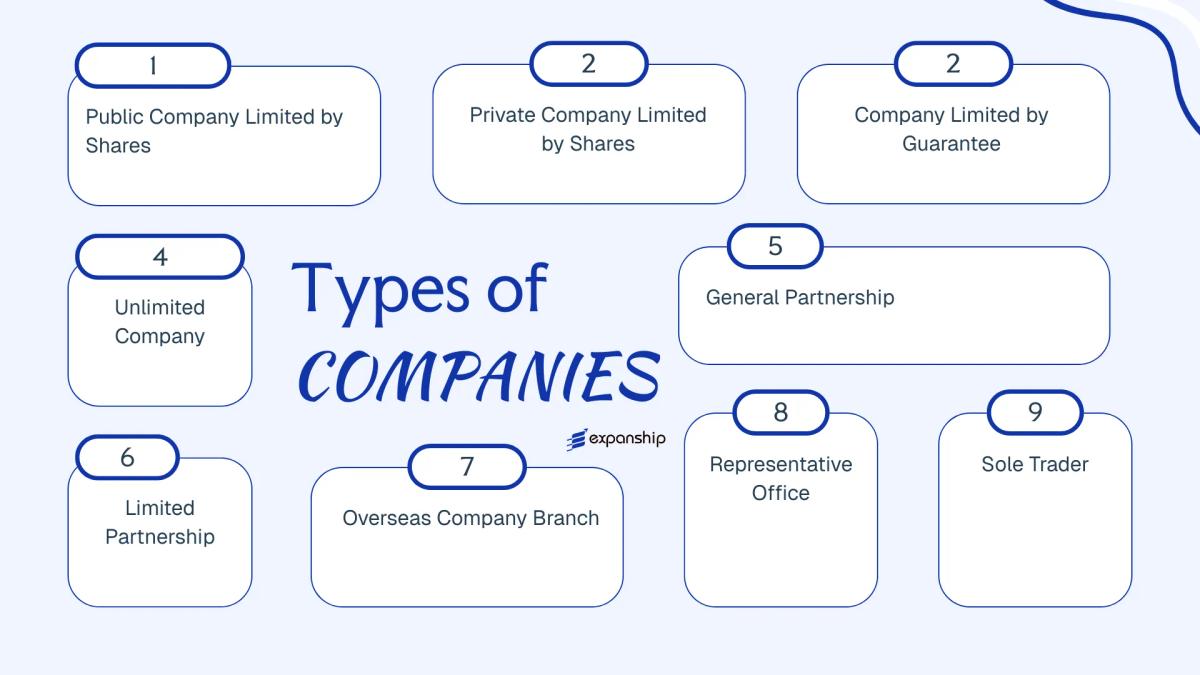
The structures available under local law include: Public Company Limited by Shares, Private Company Limited by Shares, Company Limited by Guarantee, Unlimited Company, General Partnership, Limited Partnership, Overseas Company Branch, Representative Office, and Sole Trader. Each structure carries distinct formation requirements, liability implications, and compliance obligations, all of which are examined in the sections that follow.
An Overview of Business Structures in Papua New Guinea
Several distinct entity types are available to businesses operating under Papua New Guinea's corporate law framework, each governed primarily by the Companies Act 1997 and administered by the Investment Promotion Authority (IPA). Separate provisions under the Associations Incorporations Act and partnership legislation cover non-corporate forms. Each structure carries different implications for liability, ownership, and commercial activity.
Business Structures at a Glance
| Entity Type | Legal Form | Liability | Taxed / Exempt | Local Trading | Minimum Members | Regulatory Authority | Governing Act |
|---|---|---|---|---|---|---|---|
| Public Company (Ltd by Shares) | Incorporated company | Limited to shares | Taxed | Yes | 1 shareholder | IPA | Companies Act 1997 |
| Private Company (Ltd by Shares) | Incorporated company | Limited to shares | Taxed | Yes | 1 shareholder | IPA | Companies Act 1997 |
| Company Limited by Guarantee | Incorporated company | Limited to guarantee | Generally exempt | Yes | 1 member | IPA | Companies Act 1997 |
| Unlimited Company | Incorporated company | Unlimited | Taxed | Yes | 1 shareholder | IPA | Companies Act 1997 |
| General Partnership | Unincorporated | Unlimited, joint | Taxed (partners) | Yes | 2 partners | IPA / IRC | Partnership Act |
| Limited Partnership | Unincorporated | Mixed | Taxed (partners) | Yes | 2 partners | IPA | Partnership Act |
| Overseas Company Branch | Foreign entity extension | Parent liable | Taxed | Yes | N/A | IPA | Companies Act 1997 |
| Representative Office | Non-trading presence | Parent liable | Generally exempt | No | N/A | IPA | IPA Act 1992 |
| Sole Trader | Unincorporated individual | Unlimited | Taxed (personal) | Yes | 1 person | IPA / IRC | Business Names Act |
Each of these structures is examined in full in the sections below.
Public Company Limited by Shares
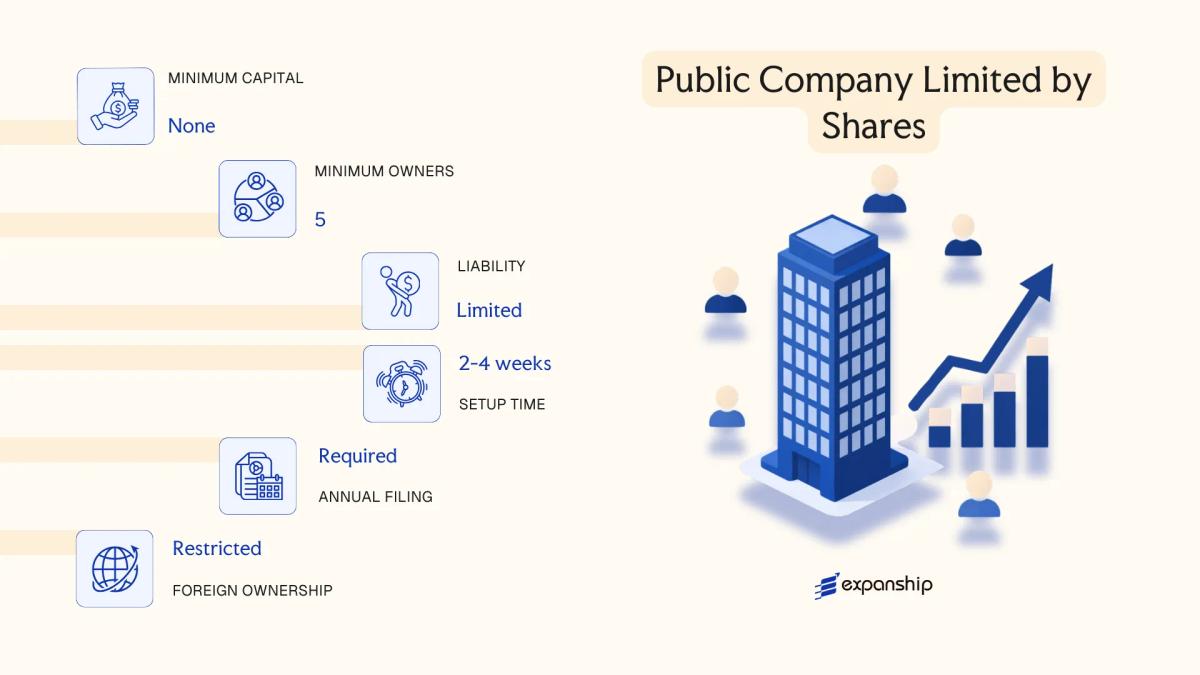
A public company limited by shares PNG is governed by the Companies Act 1997 (PNG), administered by the Investment Promotion Authority (IPA). Shareholders' liability is capped at the unpaid amount on their shares, and the entity holds a distinct legal personality separate from its members.
Unlike a private company, a public entity may offer its securities to the general public. Shares listed company Papua New Guinea structures of this type must comply with the additional disclosure and governance requirements set by the Securities Commission of Papua New Guinea if they seek a stock exchange listing.
Key Characteristics
| Requirement | Detail | Notes |
|---|---|---|
| Legal Form | Public Company Limited by Shares | Incorporated under the Companies Act 1997 |
| Members | Shareholders; minimum 1 shareholder, no maximum | Shares may be offered to the public |
| Directors | Minimum 3 directors required | At least 2 must ordinarily reside in PNG |
| Local Presence | Registered office in PNG; IPA registration required | Physical PNG address mandatory |
| Capital | No statutory minimum share capital; denominated in PGK | Authorised capital must be stated in constitution |
| Privacy | Shareholder and director details are publicly filed with IPA | Low privacy; public inspection available |
Focus Points
- Taxation: Subject to corporate income tax at the standard rate of 30%; GST at 10% applies to taxable supplies; dividend withholding tax and interest withholding tax apply to distributions and payments to non-residents.
- Annual Compliance: Annual returns and audited financial statements must be filed with the IPA; listed entities face additional continuous disclosure obligations.
- Treaty Access: PNG has a limited double tax agreement network; treaty benefits depend on the residence of counterparties.
- Conversion: A public company may convert to a private company under the Companies Act 1997, subject to shareholder approval and IPA filing.
- Listing Requirement: A public company is not required to list on a stock exchange, but listing requires compliance with Securities Commission of Papua New Guinea rules.
Closing
Public company formation Papua New Guinea suits large-scale commercial ventures, entities seeking public capital, or businesses planning a stock exchange listing. The structure offers unrestricted shareholder numbers and access to public equity markets, but the compliance burden is substantially higher than that of a private company, including mandatory audits and public disclosure of corporate records.
Best suited for large enterprises or joint ventures seeking to raise capital from the public or pursue a PNG stock exchange listing.

Company Incorporation in Papua New Guinea
Incorporate a public or private company in PNG with end-to-end support from IPA registration to post-incorporation compliance.
Private Company Limited by Shares
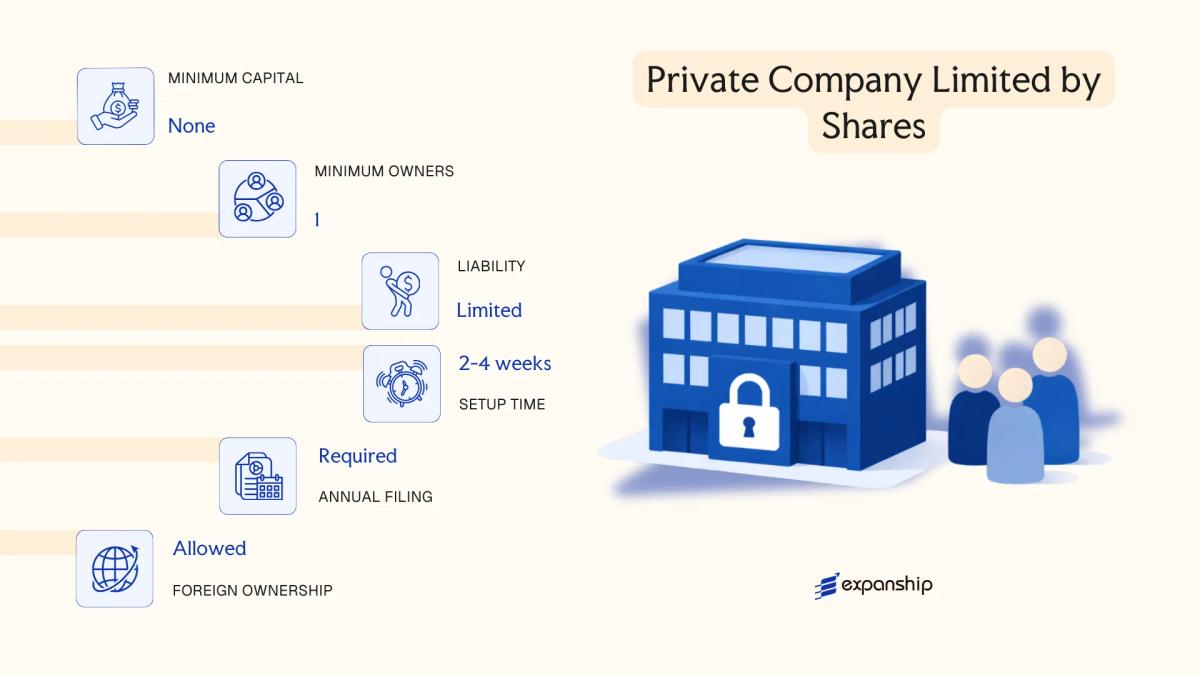
A private company limited by shares is the most commonly used corporate structure for small to medium-sized businesses operating in Papua New Guinea. Governed by the Companies Act 1997, the entity holds separate legal personality, meaning it can own assets, enter contracts, and incur liabilities in its own name. Shareholder liability is capped at the amount unpaid on their shares.
Registration and ongoing compliance fall under the authority of the Investment Promotion Authority (IPA), which maintains the Papua New Guinea companies register. Foreign investors frequently use this structure to establish a locally incorporated vehicle, as it permits full foreign ownership in most sectors, subject to restrictions under the Investment Promotion Act 1992.
Key Characteristics
| Requirement | Detail | Notes |
|---|---|---|
| Legal Form | Private Company Limited by Shares | Incorporated under the Companies Act 1997 |
| Members | Directors: minimum 1; Shareholders: minimum 1, maximum 50 | Shares cannot be offered to the general public |
| Local Presence | Registered office in PNG required | Must be a physical address; PO Box not accepted |
| Capital | Denominated in PGK; no statutory minimum | Shares must be fully or partly paid on issue |
| Privacy | Director and shareholder details filed with IPA | Register is publicly searchable |
| Company Secretary | Not mandatory under current law | Recommended for compliance management |
Focus Points
- Taxation: Subject to corporate income tax at 30% for resident companies (25% for certain listed entities); GST applies at 10%; dividend withholding tax applies to distributions; stamp duty may apply to share transfers.
- Annual Compliance: Annual returns must be filed with the IPA; financial statements are required, with audit obligations depending on company size and activity.
- Foreign Ownership: Foreign-owned entities must register with the IPA and obtain a certification of exemption or foreign enterprise certificate under the Investment Promotion Act.
- Treaty Access: PNG has a limited double tax agreement network; treaty benefits depend on the residency status of shareholders and the nature of income.
- Conversion: A private company may convert to a public company through a special resolution and regulatory filing with the IPA, subject to minimum shareholding requirements.
Closing
This structure suits trading operations, joint ventures, foreign subsidiaries, and holding arrangements where liability protection is required. Its principal limitation is the 50-shareholder ceiling and the prohibition on public share offers, which constrains capital-raising capacity.
Best suited for foreign investors and local entrepreneurs establishing a closely held operating or holding business in Papua New Guinea.
Company Limited by Guarantee
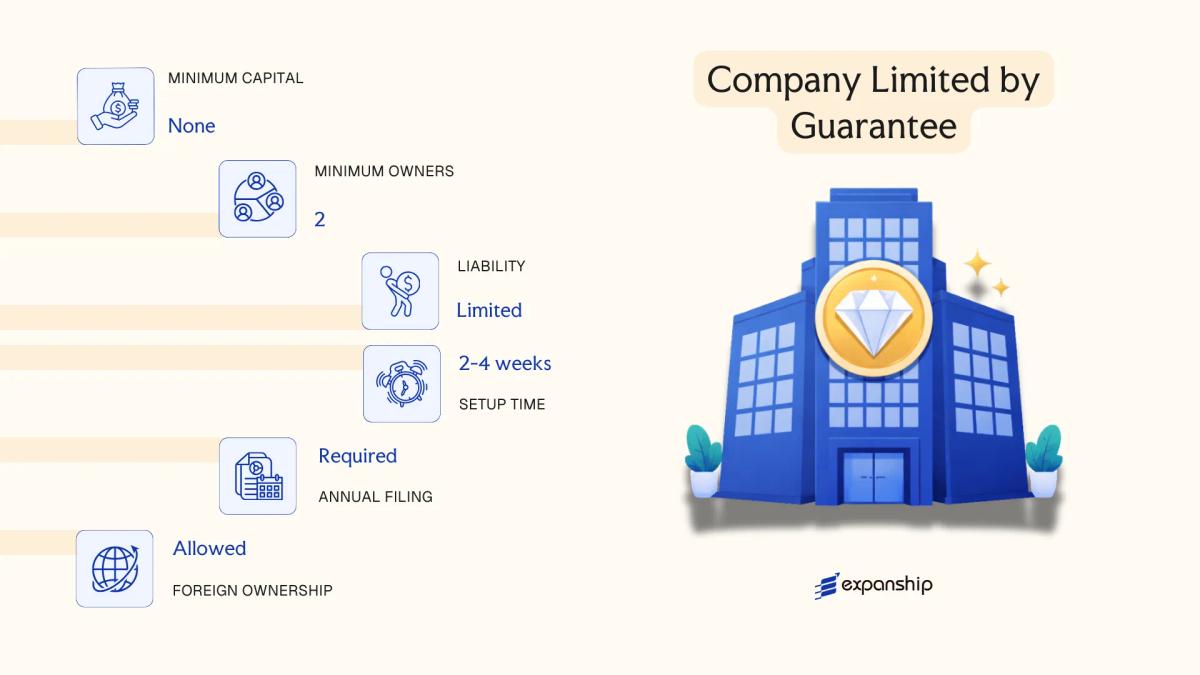
A company limited by guarantee Papua New Guinea is governed by the Companies Act 1997, the principal legislation administered by the Investment Promotion Authority (IPA). Unlike a share-based structure, this entity type has no share capital. Instead, members undertake to contribute a specified amount to the company's assets if it is wound up.
This form carries separate legal personality, meaning it can contract, hold property, and sue in its own name. Liability is capped at each member's guaranteed contribution, which is typically a nominal sum. The structure functions as a hybrid: legally a company, but operationally aligned with non-commercial purposes.
Key Characteristics
| Requirement | Detail | Notes |
|---|---|---|
| Legal Form | Incorporated entity under the Companies Act 1997 | Registered with the IPA; holds separate legal personality |
| Members | Referred to as members; minimum 1, no statutory maximum | No shareholders; members give a guarantee rather than subscribe for shares |
| Local Presence | Registered office in Papua New Guinea required | Must maintain a local registered address; registered agent not mandated by statute but practically necessary |
| Capital | No share capital; guarantee amount per member (typically PGK 1–100) | Guarantee is a contingent liability, not paid-up capital |
| Privacy | Director and member details filed with IPA; public register accessible | No meaningful privacy for officers or members |
Focus Points
- Taxation: Generally exempt from income tax if registered as a non-profit and income is applied solely to the entity's stated purposes; standard 30% corporate tax applies if commercial activity is conducted; GST registration required once turnover exceeds the prescribed threshold; stamp duty applies to certain instruments.
- Annual Compliance: Annual returns must be filed with the IPA; financial statements are required, with audit obligations depending on the entity's size and activities.
- Restrictions: Cannot distribute profits or assets to members during operation or on winding up; any surplus must transfer to another entity with similar objects.
- Conversion: Conversion to a share-based company is not a standard pathway and would require dissolution and re-incorporation.
- Treaty Access: This entity type does not ordinarily access double tax treaty benefits, as such entities are typically non-commercial and outside treaty scope.
Closing
A company limited by guarantee suits associations, industry bodies, and charitable organisations that require a formal legal structure without a profit motive. The primary advantage is the legal protection of separate personality with capped member liability; the limitation is the strict prohibition on profit distribution, which excludes any commercial or investment application.
This structure is best suited for non-profit organisations, professional associations, and NGOs operating in Papua New Guinea that require legal personality but have no intention of distributing financial returns to members.
Unlimited Company
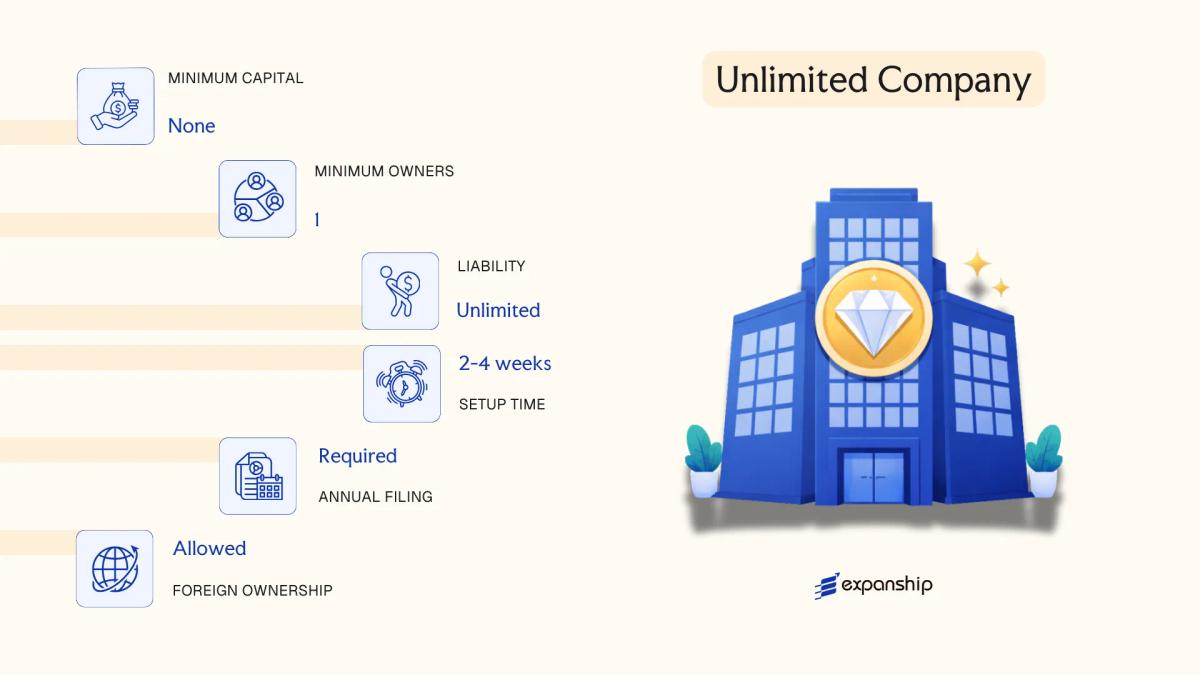
An unlimited company in Papua New Guinea is registered under the Companies Act 1997 and holds a distinct legal personality separate from its members. Unlike other incorporated structures, an unlimited company PNG carries no cap on member liability — shareholders remain personally exposed to the company's debts without restriction. This structure is uncommon in practice but remains a recognized formation option under the Act.
Because liability is uncapped, the unlimited company structure PNG is rarely chosen for general commercial activity. It does, however, offer structural flexibility that some specific arrangements — particularly intra-group or professional structures — may find useful.
Key Characteristics
| Requirement | Detail | Notes |
|---|---|---|
| Legal Form | Unlimited Company | Incorporated entity with separate legal personality; no liability cap on members |
| Members | Shareholders; minimum 1, no statutory maximum | Members bear unlimited personal liability for company debts |
| Local Presence | Registered office in PNG required | Must maintain a registered address accessible to the Investment Promotion Authority (IPA) |
| Share Capital | PGK-denominated; no statutory minimum | Shares may be issued without a minimum paid-up capital requirement |
| Privacy | Shareholder details filed with IPA | Public register maintained; limited privacy for members |
Focus Points
- Taxation: Subject to standard corporate income tax at 30% for resident companies; GST, withholding tax on dividends, interest, and royalties, and stamp duty on dutiable instruments all apply under general PNG tax rules.
- Annual Compliance: Annual returns must be filed with the IPA; financial statements and director obligations follow the same Companies Act 1997 framework applicable to limited companies.
- Treaty Access: Papua New Guinea's double tax agreement network is limited; access to treaty benefits depends on the company's tax residency status, not its liability structure.
- Conversion: The Companies Act 1997 permits conversion between company types, subject to IPA approval and compliance with prescribed procedures.
- Restrictions: Foreign-owned unlimited companies remain subject to the certification requirements under the Investment Promotion Act 1992.
Closing
Unlimited company registration Papua New Guinea is most relevant for holding structures or intra-group arrangements where members accept full liability exposure in exchange for structural simplicity. The absence of a liability cap is the defining drawback and disqualifies this form for most standard trading or investment purposes.
Best suited for closely held intra-group entities where controlling shareholders are prepared to accept personal liability and the uncapped exposure is commercially acceptable within the group structure.
Partnerships in Papua New Guinea [General Partnership, Limited Partnership]
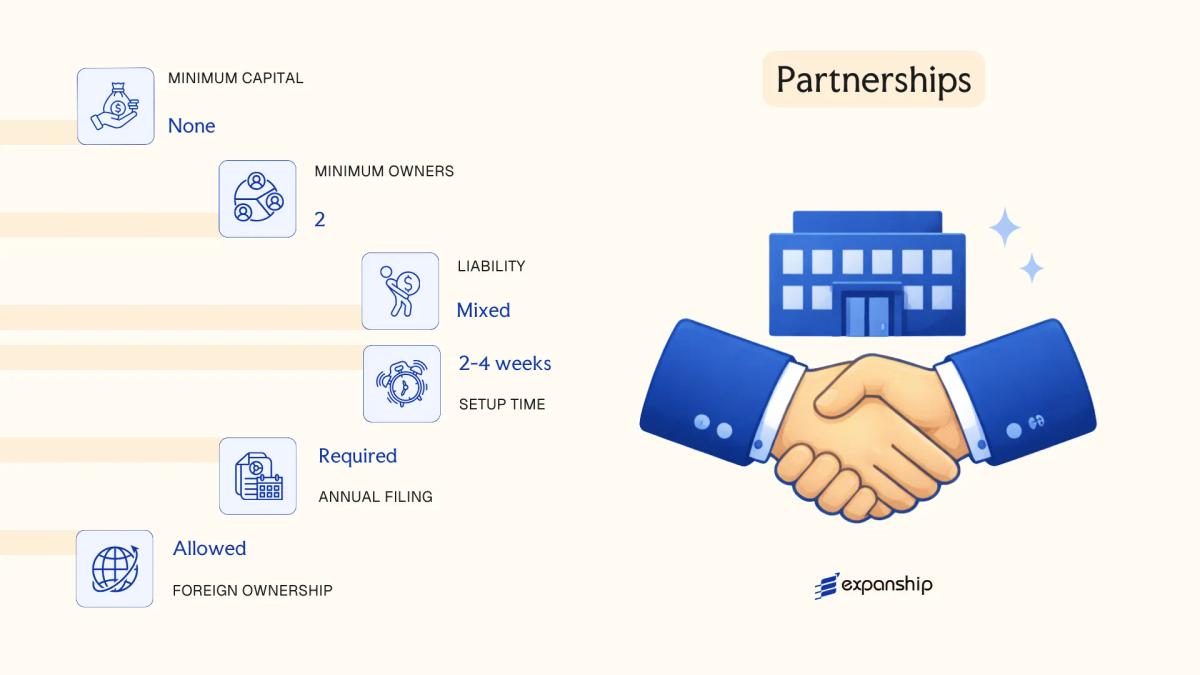
Partnership registration Papua New Guinea is governed primarily by the Partnership Act 1951, which applies across all provinces. Partnerships do not carry separate legal personality under this legislation, meaning partners bear personal liability for the firm's obligations.
Two recognised structures exist: the general partnership and the limited partnership. Each imposes different liability arrangements on its members, and the choice between them affects how the business is structured operationally and financially.
Key Characteristics
| Requirement | Detail | Notes |
|---|---|---|
| Legal Form | Unincorporated association | No separate legal personality from its partners |
| Members | Partners (minimum 2, maximum 20 for general partnerships) | Limited partnerships require at least one general and one limited partner |
| Local Presence | Registered business name required with the Investment Promotion Authority (IPA) | Physical address in PNG required |
| Capital | PGK; no statutory minimum | Contributions defined by partnership agreement |
| Privacy | Partnership agreement is not publicly filed | Partner names disclosed upon registration |
| Liability | Unlimited for general partners; capped at contribution for limited partners | Limited partners cannot participate in management |
Focus Points
- Taxation: Partnerships are tax-transparent; profits flow to partners and are taxed at individual or corporate rates; GST registration required if turnover exceeds the statutory threshold; stamp duty may apply to the partnership deed.
- Annual Compliance: Business name renewal with the IPA is required annually; no separate annual return filing obligation equivalent to companies.
- Restrictions: Foreign nationals may face restrictions on partnership participation under the Fairness of Transactions Act and reserved activity provisions.
- Treaty Access: Partnerships generally do not independently access PNG's double tax agreements; treaty eligibility depends on the residence status of individual partners.
- Conversion: A partnership may convert to an incorporated company under the Companies Act 1997, though the process requires fresh registration.
Sub-Types
General Partnership
All partners hold unlimited joint and several liability for the firm's debts. This structure is common among professional service providers such as legal and accounting practices, where partners actively manage operations.
Limited Partnership
One or more limited partners contribute capital but assume liability only to the extent of that contribution, provided they do not engage in management. The general partner retains full personal liability and day-to-day control.
When to Use
Partnerships suit smaller ventures, professional practices, or joint ventures where two or more parties prefer a flexible, low-cost structure without the compliance burden of incorporation. The tax-transparent treatment is a practical advantage; however, unlimited liability for general partners remains a significant exposure for commercially active businesses.
General partnerships are best suited for professionals or small co-owned businesses; limited partnerships are more appropriate where passive capital contributors want defined liability without formal incorporation.
Foreign Business Structures in Papua New Guinea [Overseas Company Branch, Representative Office]
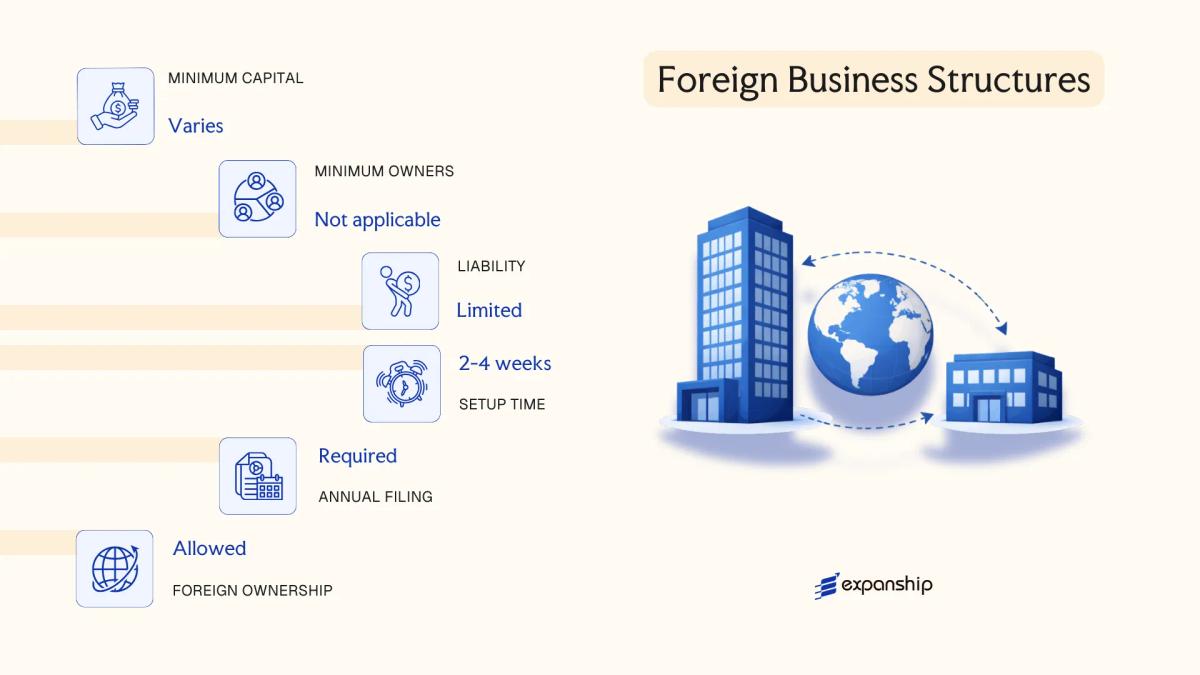
Registering a foreign company branch in Papua New Guinea is governed by the Companies Act 1997, which requires overseas companies to register with the Investment Promotion Authority (IPA) before conducting business in the country. A branch is not a separate legal entity — it remains an extension of the parent company, which retains full liability for the branch's obligations.
A representative office occupies a more restricted position. It may conduct liaison, market research, or promotional activities, but cannot generate revenue or enter into commercial contracts directly. Both structures require appointment of a local agent or representative authorised to accept service of process.
Key Characteristics
| Requirement | Overseas Company Branch | Representative Office |
|---|---|---|
| Legal Form | Extension of parent; no separate legal personality | Non-trading presence; extension of parent |
| Liability | Parent company bears full liability | Parent company bears full liability |
| Local Presence | Registered agent and registered office in PNG required | Local representative required |
| Capital | No minimum capital prescribed; parent's capital applies | Not applicable |
| Permitted Activities | Full trading and commercial operations | Non-commercial activities only (liaison, research) |
| Privacy | Parent company details filed publicly with IPA | Parent details disclosed upon registration |
Focus Points
- Taxation: Branches are subject to corporate income tax at the standard rate of 48% on PNG-sourced income — higher than the rate applied to locally incorporated companies; a branch profits remittance tax may also apply in lieu of dividend withholding tax.
- Annual Compliance: Audited financial statements of the overseas company must be filed annually with the IPA.
- Treaty Access: Access to Papua New Guinea's double tax agreements depends on the parent company's country of residence, not the branch's registration.
- Restrictions: Representative offices are prohibited from invoicing clients or receiving payment for services rendered locally.
- Conversion: A branch can be converted to a locally incorporated subsidiary, though this requires a separate incorporation process under the Companies Act 1997.
Closing
Both structures suit foreign firms testing the market or executing project-specific contracts, though the higher branch tax rate is a meaningful cost consideration for long-term operations.
Overseas company branches are best suited to foreign businesses with defined, short-term project mandates — such as construction or resources contracts — where full local incorporation is not yet warranted.
Sole Trader
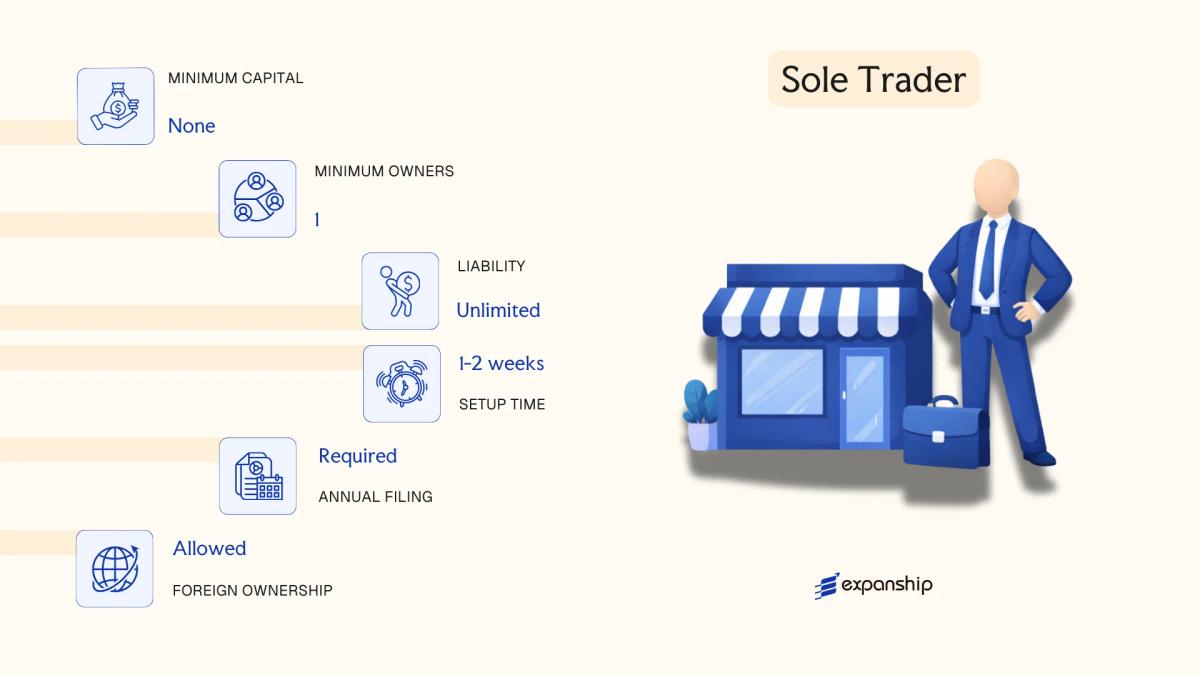
Sole trader registration in Papua New Guinea does not create a separate legal entity. The individual and the business are legally the same person, meaning personal assets are directly exposed to any liabilities the business incurs. Registration is governed by the Business Names Act 2014, administered by the Investment Promotion Authority (IPA), and is required whenever a person trades under a name other than their own legal name.
Unlike incorporated structures, no share capital is issued and there are no members or directors. The proprietor retains full control and receives all profits directly, but also bears unlimited personal liability for all debts and obligations.
Key Characteristics
| Requirement | Detail | Notes |
|---|---|---|
| Legal Form | Unincorporated sole proprietorship | No separate legal personality from the owner |
| Referred To As | Sole Trader / Proprietor | Single individual only; no co-owners permitted |
| Members | 1 proprietor (minimum and maximum) | Cannot have partners or shareholders |
| Local Presence | Registered business address in PNG required | IPA registration mandatory if trading under a business name |
| Capital | No minimum capital requirement | No share structure; personal funds used directly |
| Privacy | Business name and owner details appear on the IPA register | Register is publicly searchable |
Focus Points
- Taxation: Subject to personal income tax under the Income Tax Act 1959 at individual marginal rates; GST registration required if annual turnover exceeds the prescribed threshold; no separate corporate tax applies.
- Annual Compliance: Annual renewal of the business name registration with the IPA is required to maintain active status.
- Treaty Access: As an unincorporated individual, access to PNG's double tax agreements is limited and determined by residency status rather than entity type.
- Conversion: A sole trader can convert to a private company by incorporating under the Companies Act 1997, though assets and contracts must be formally transferred.
- Restrictions: Foreign nationals face restrictions on operating as sole traders; activities are subject to the Investment Promotion Authority Act and the Foreign Investment (Protection) Act.
Closing
A sole trader structure suits PNG-resident individuals running small, low-risk service or trade businesses where administrative simplicity outweighs the need for liability protection. The primary advantage is minimal setup cost and straightforward compliance; the clear limitation is unlimited personal liability, which makes it unsuitable for any business carrying significant financial or legal risk.
PNG-resident individuals operating small-scale, low-risk businesses who prioritise low overhead costs over liability protection.
How to Choose the Right Entity Type in Papua New Guinea
Choosing the right business structure in Papua New Guinea affects your legal exposure, tax position, and operational capacity from the first day of registration.
Why Your Entity Choice Matters
Selecting the wrong structure produces concrete, sometimes costly outcomes:
- Registering an overseas company branch when you intend to conduct ongoing local trade without fulfilling the foreign company registration requirements under the Companies Act 1997 can result in penalties or deregistration.
- Choosing a structure that lacks access to Papua New Guinea's tax treaty network means withholding tax reductions available to treaty-resident entities cannot be claimed.
- Forming a private company when a trust or foundation structure would suit asset protection needs locks your business into annual shareholder obligations, statutory filings, and directorship requirements that are not inherent to those alternatives.
- Selecting an entity that requires audited financial statements when your operation is a sole consultancy introduces recurring compliance costs that serve no regulatory purpose at that scale.
Key Factors to Consider
- Business Activity: Active trading, passive asset-holding, and regulated sectors such as banking or insurance each point toward distinct entity structures under PNG law.
- Local vs. Offshore Operations: If your firm will transact with PNG residents, local incorporation or formal foreign company registration is generally required.
- Ownership and Management: A sole operator has different governance needs than a multi-party venture requiring a formal board structure.
- Tax Objectives: Your need for treaty access, dividend exemptions, or a specific IRC-administered regime will narrow your structural options.
- Substance Capacity: Consider whether your business can realistically maintain staff, a registered office, and decision-making activity within the jurisdiction.
- Exit Strategy: Some structures permit redomiciliation or conversion; others require a full wind-up, which affects long-term planning.
Corporate Compliance Services in Papua New Guinea
Maintain your PNG entity's statutory obligations, annual filings, and regulatory requirements with structured compliance support.
Conclusion
This Papua New Guinea company incorporation guide covers the principal structures available under the Companies Act 1997 and regulated through the Investment Promotion Authority. Each entity serves a distinct purpose. Private companies limited by shares suit most SMEs and foreign investors seeking limited liability with minimal compliance overhead. Public companies accommodate larger capital-raising ambitions. Companies limited by guarantee serve non-profit or member-based organisations. Unlimited companies remain uncommon and niche. General partnerships carry personal liability; limited partnerships offer a partial shield. Overseas company branches allow foreign firms to operate directly without local incorporation.
The private company limited by shares is by far the most commonly registered structure for PNG business setup. Regulatory modernisation, including e-registry improvements, signals a gradual shift toward greater administrative efficiency. Your choice of entity shapes tax obligations, governance requirements, and long-term operational flexibility — all areas where structured professional guidance adds measurable value.
How Expanship Can Assist You
Expanship company registration Papua New Guinea covers the full process, from selecting the correct entity type under the Companies Act 1997 to filing with the Investment Promotion Authority (IPA), which administers the Companies Registry. Each structure discussed in this blog, from a private company limited by shares to an overseas company branch, carries distinct obligations that your business must meet from day one.
Our corporate services Papua New Guinea team handles the practical steps so your formation stays on track:
- Document preparation and notarization
- Registered agent and registered office provision in PNG
- Government filing and IPA liaison
- Post-incorporation compliance management
- Banking introduction assistance
PNG company formation assistance extends beyond registration. Ongoing obligations such as annual returns, director record maintenance, and regulatory filings require consistent attention after incorporation.
Reach out to Expanship Papua New Guinea to discuss your specific requirements.
Frequently Asked Questions (FAQ)
The private company limited by shares is the most frequently registered structure under the Companies Act 1997. Its combination of limited liability, flexible shareholding arrangements, and relatively low compliance thresholds makes it the default choice for small-to-medium operators across most industries.
A branch registered under the Companies Act 1997 is not a separate legal entity — the foreign parent retains full liability for its PNG operations. A locally incorporated private company holds distinct legal personality, is taxed as a resident entity by the Internal Revenue Commission, and generally faces lower reputational barriers when contracting with government agencies or local counterparts.
Among registered structures, the private company limited by shares imposes fewer public disclosure requirements than a public company. Nominee shareholding arrangements are permitted under general corporate law principles, though beneficial ownership details may be required in certain regulatory filings. Director details are recorded with the Investment Promotion Authority (IPA).
A sole trader requires only one individual by definition. A private company limited by shares can be formed by a single shareholder and one director. Partnerships, whether general or limited, require a minimum of two partners, making sole formation legally impossible for those structures.
Foreign individuals and corporations may incorporate a private company limited by shares, register as an overseas company branch, or form a company limited by guarantee, subject to Investment Promotion Authority approval and compliance with the Investment Promotion Act 1992. Certain sectors are reserved for PNG citizens under the Small to Medium Enterprise Policy, so reviewing restricted activities before registration is advisable.
The Companies Act 1997 provides mechanisms for altering a company's constitution and, in certain circumstances, converting between company types registered under that Act. Conversion from a branch to a locally incorporated entity is procedurally possible but treated as a new registration by the IPA. Conversion between a company and a partnership structure is not directly supported and would require dissolution and re-registration.
No. Sole traders and general partnerships do not possess separate legal personality — the individuals behind them remain personally liable for all obligations. Private companies, public companies, companies limited by guarantee, and registered overseas companies each hold distinct legal standing, though for branches, that personality belongs to the foreign parent rather than the PNG registration itself.
The sole trader structure involves no annual returns to the IPA, no audit requirements, and no separate corporate tax filing — income is reported through the individual's personal tax return with the Internal Revenue Commission. All company types registered under the Companies Act 1997 carry ongoing obligations including annual returns, financial reporting, and maintenance of registered office details.
Legal Disclaimer
The information provided in this article is for general informational purposes only and does not constitute legal, tax, or professional advice. While we strive to ensure the accuracy and timeliness of the content, laws and regulations are subject to change, and the application of laws can vary widely based on specific facts and circumstances.
Readers should not act upon this information without seeking professional counsel tailored to their individual situation. Expanship and its authors disclaim any liability for actions taken or not taken based on the content of this article.
For specific advice regarding your business setup, compliance requirements, or any legal matters, please consult with qualified legal and tax professionals in the relevant jurisdiction.