

Key Takeaways
- The Companies Act 1997, administered by the Investment Promotion Authority, provides foreign businesses with a common law-grounded registration structure that supports legal predictability and enforceable shareholder protections.
- Papua New Guinea's bilateral investment treaties give foreign capital a defined layer of treaty-backed security, reducing exposure to unilateral regulatory changes that affect unprotected investments in comparable Pacific markets.
- Businesses operating in extractive industries gain direct access to one of the Pacific region's most resource-rich jurisdictions, where natural resource sectors represent concentrated opportunities unavailable through registration in most neighboring markets.
- Double taxation agreements reduce the cross-border tax burden on qualifying foreign entities, making the jurisdiction structurally more efficient for businesses managing income flows between Papua New Guinea and treaty partner countries.
Situated in the southwestern Pacific Ocean, Papua New Guinea is an independent sovereign nation and a member of the Commonwealth, sharing the island of New Guinea with Indonesia. Company registration falls under the oversight of the Investment Promotion Authority, which administers the Companies Act 1997 and maintains the national business register. Foreign businesses typically establish a presence through a limited liability company.
The country operates under a territorial-based tax system with treaty arrangements that shape how cross-border income is treated. Foreign direct investment is broadly permitted across a range of sectors, with the Investment Promotion Authority serving as the primary gateway for foreign entities seeking to register and operate locally. Understanding the benefits of incorporating in Papua New Guinea requires examining the full regulatory, fiscal, and geographic context that governs how businesses function there. This article covers the key advantages your business can expect when registering a company in this jurisdiction.
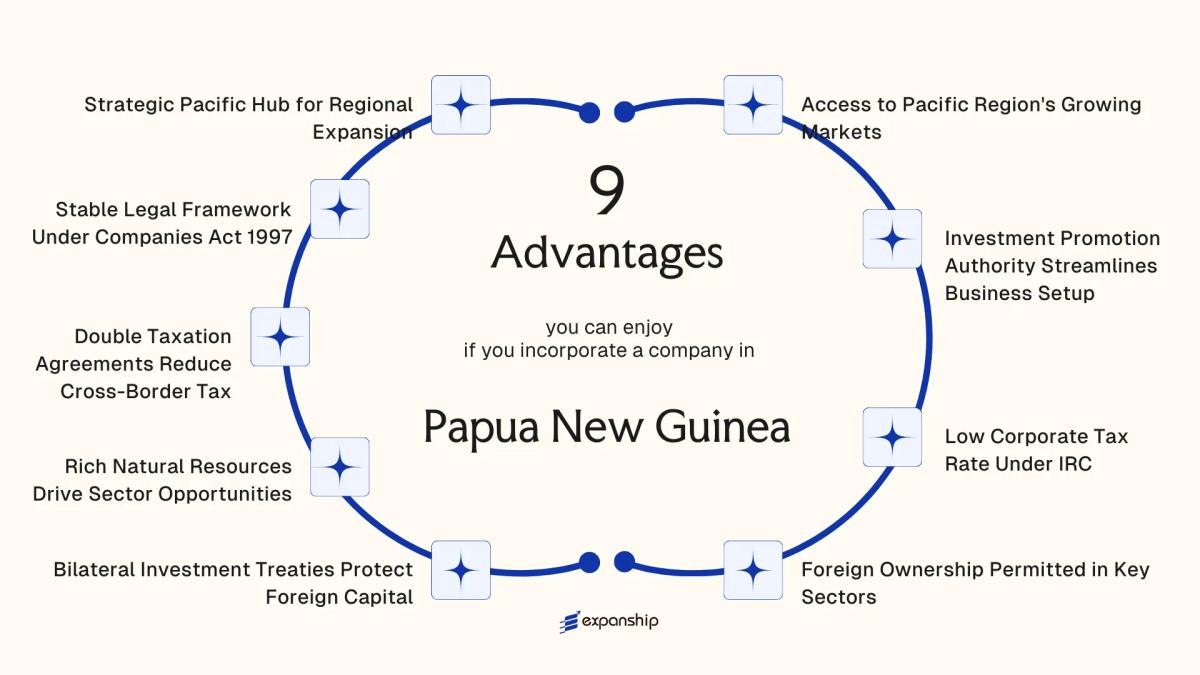
Access to Pacific Region's Growing Markets
Papua New Guinea sits at the junction of Southeast Asia and the Pacific, positioning registered entities to engage with trade flows across both regions. This geographic reality translates into concrete commercial reach for businesses incorporated there.
Pacific Trade Frameworks That Create Market Openings
PNG is a signatory to the Pacific Agreement on Closer Economic Relations Plus (PACER Plus), which governs trade and economic cooperation among Pacific Island Forum member states. That membership gives your business preferential access conditions when trading goods and services across participating Pacific economies, reducing barriers that firms incorporated elsewhere would face.
The country also maintains trade ties through the Melanesian Spearhead Group (MSG) Trade Agreement, covering Fiji, Vanuatu, Solomon Islands, and New Caledonia. For a foreign-owned company registered in PNG, these existing frameworks are ready-made channels into markets that would otherwise require separate negotiations or bilateral arrangements.
Gateway Positioning Into ASEAN-Adjacent Economies
PNG borders Indonesia directly, giving businesses a land and maritime connection to the world's fourth most populous country. That proximity matters when your supply chain or distribution network needs a staging point between Pacific Island markets and the broader Asia-Pacific corridor.
A company incorporated in PNG can access multiple Pacific trade agreements simultaneously from a single registered entity.
Investment Promotion Authority Streamlines Business Setup
The Investment Promotion Authority (IPA) is the single government body responsible for registering foreign and domestic businesses in Papua New Guinea. Foreign investors deal with one agency rather than navigating multiple government offices, which reduces administrative delays and procedural uncertainty before operations begin.
Under the IPA PNG business setup process, a foreign company can register as an overseas company or incorporate a local entity directly through the IPA's online registry system. The registration framework consolidates name reservation, incorporation, and initial licensing coordination within a single institutional point of contact. For a foreign investor, this means your business can achieve legal standing without prolonged multi-agency coordination.
The IPA's requirements are structured to be accessible without requiring extensive local bureaucratic knowledge:
- Registered office and address requirements can be fulfilled through a local registered agent
- Minimum shareholder and director thresholds do not require PNG-resident directors in all entity types
- Incorporation documents follow standardised formats, reducing preparation time for overseas applicants
- The IPA's online portal allows document submission without mandatory in-person attendance
Papua New Guinea IPA foreign investor benefits extend to the IPA's role in issuing Certificates of Incorporation, which carry legal weight for banking, contract execution, and regulatory licensing. Once issued, your entity has full legal capacity to operate, enter agreements, and hold assets under the Companies Act 1997.

Company Incorporation in Papua New Guinea
Register your business in Papua New Guinea through the Investment Promotion Authority with structured guidance from Expanship.
Low Corporate Tax Rate Under IRC
Papua New Guinea corporate tax rate advantages are a concrete factor that many foreign investors weigh when evaluating Pacific incorporation options. Under the Income Tax Act, administered by the Internal Revenue Commission (IRC), the standard corporate income tax rate for resident companies is 30%. Non-resident companies are taxed at 48%, which creates a direct financial incentive to establish a locally incorporated entity rather than operating through a foreign branch.
| Entity Type | Tax Rate | Applicable Basis |
|---|---|---|
| Resident company | 30% | Worldwide income |
| Non-resident company | 48% | PNG-sourced income |
| Endorsed public company (listed) | 25% | Worldwide income |
For companies listed on the Port Moresby Stock Exchange and endorsed as public companies under IRC rules, the rate drops further to 25%. Your business structure, therefore, directly determines the tax exposure your firm carries year to year.
The 30% rate for resident companies sits below the global average corporate tax rate, which the OECD has tracked at approximately 23% for OECD members but considerably higher across many developing economies in the Asia-Pacific region. For a foreign-owned entity incorporated locally under the Companies Act 1997, the resident rate applies, provided the company meets the IRC's residency criteria based on place of incorporation and management control. This structural distinction means the decision to incorporate, rather than branch, carries measurable tax consequence from the outset.
Foreign Ownership Permitted in Key Sectors
Foreign ownership rights Papua New Guinea companies are governed primarily by the Investment Promotion Act 1992, which establishes the categories of business activity open to foreign participation. Under this framework, wholly foreign-owned entities can operate across a broad range of sectors, including mining, petroleum, forestry, manufacturing, and export-oriented services.
This matters because your business is not structurally confined to minority stakes or joint ventures in most commercial activities. Foreign investors can hold 100 percent of equity in companies registered under the Companies Act 1997, retaining full decision-making authority and profit repatriation rights. The Investment Promotion Authority (IPA) maintains the reserved activities list, which identifies the limited categories restricted to citizen ownership, so the boundaries are defined and publicly accessible.
Keep these points in mind:
- Full foreign ownership is permitted outside the IPA's reserved activities list
- The IPA issues Certificates of Exemption for specific restricted activities under defined conditions
- Foreign-owned entities must still meet minimum capital thresholds set by the IPA
- Profit repatriation is permissible but subject to Bank of Papua New Guinea foreign exchange regulations
The reserved list primarily covers small-scale retail, roadside vending, and certain artisanal trades, categories that most foreign commercial operations would not enter. This means the restriction has minimal practical effect on mid-to-large-scale foreign business activity.
Foreign investors can own 100 percent of a PNG-registered company operating in the resources sector without requiring a local partner, which many comparable Pacific island jurisdictions do not permit.
Bilateral Investment Treaties Protect Foreign Capital
Papua New Guinea bilateral investment treaty protection gives foreign investors a legal mechanism that operates above the domestic regulatory level. When a host country breaches treaty obligations, affected investors can pursue international arbitration directly against the state, bypassing local courts entirely. That access to neutral dispute resolution is a structural safeguard that few domestic legal instruments can replicate.
Treaty Network and Its Scope
PNG has signed bilateral investment treaties with several countries, including Australia and China, among others. Each agreement typically guarantees fair and equitable treatment, protection against expropriation without compensation, and free transfer of funds related to the investment. For a foreign business, these protections mean your capital and repatriated profits are shielded by binding international law, not solely by domestic policy that a government can alter unilaterally.
Expropriation clauses within these BITs specifically require that any state acquisition of foreign-held assets must be accompanied by prompt, adequate, and effective compensation. That standard, drawn from customary international law, provides a concrete financial remedy where domestic statutes might otherwise leave investors with limited recourse.
Investor Rights Under Treaty Frameworks
BIT provisions on most-favored-nation treatment allow your entity to claim protections granted to investors from third countries if those terms are more favorable. This creates a floor of rights that adjusts upward with the treaty network over time. The Investment Promotion Authority, which operates under the Investment Promotion Act, is the primary body overseeing foreign investment registrations, and treaty protections apply once your investment is formally registered through that authority.
Understand Your Investment Protections in Papua New Guinea
Get clarity on which bilateral investment treaties apply to your business structure and how to ensure your foreign capital qualifies for treaty-based protections from the outset.
Rich Natural Resources Drive Sector Opportunities
Papua New Guinea natural resources investment opportunities are among the most concentrated in the Asia-Pacific region. The country holds substantial reserves of gold, copper, natural gas, and petroleum, with resource extraction accounting for a significant share of export earnings. This concentration creates direct commercial advantages for foreign businesses structuring operations through a local entity.
- The extractive sector operates under defined legislative frameworks, including the Mining Act 1992 and the Oil and Gas Act 1998, which establish licensing procedures and contractual rights. Having a registered local company positions your business to hold or participate in licenses that are restricted to incorporated entities operating within the jurisdiction.
- The PNG LNG project, operated under production-sharing agreements, demonstrated that large-scale resource joint ventures are structurally viable here. Foreign firms that incorporate locally can enter similar project frameworks as equity participants rather than as service contractors, which typically carries stronger revenue rights.
- Agricultural resources, including palm oil and coffee, are governed through separate regulatory channels and represent export-oriented sectors where a locally registered business can access export licensing and engage with statutory marketing bodies.
- Mining and petroleum projects often require local incorporation as a precondition for regulatory approval, meaning your company structure directly determines your eligibility to participate in resource-sector contracting and equity arrangements.
Double Taxation Agreements Reduce Cross-Border Tax
Papua New Guinea double taxation agreement benefits are grounded in a network of bilateral tax treaties that the country has signed with key trading and investment partners, including Australia, Canada, China, Fiji, Germany, Malaysia, New Zealand, South Korea, Singapore, and the United Kingdom. Each treaty allocates taxing rights between the two contracting states, which directly reduces the risk that the same income is taxed twice — once in PNG and again in your home jurisdiction.
For a foreign business owner, this matters most when repatriating dividends, royalties, or interest payments. Without a DTA, those flows can attract withholding tax in PNG at the standard rate and again under domestic rules at home. A treaty caps or eliminates the PNG withholding rate on qualifying payments, increasing the net return on cross-border income.
A Singapore-based holding company receiving dividends from its PNG subsidiary would, under the PNG-Singapore DTA, potentially benefit from a reduced withholding tax rate on those dividends rather than the standard domestic rate — a direct reduction in the tax cost of structuring a regional holding arrangement through Singapore.
Treaty eligibility typically depends on the beneficial owner of the income being a tax resident of the contracting state, not merely incorporated there.
Stable Legal Framework Under Companies Act 1997
The Papua New Guinea Companies Act 1997 legal framework benefits foreign business owners primarily through statutory predictability. Modeled on New Zealand's companies legislation, the Act establishes clear rules governing incorporation, directorship, shareholder rights, and company administration. That alignment with a well-tested common law model means foreign investors encounter familiar structural principles rather than an opaque or unpredictable regime.
Incorporated entities operate under defined obligations set by the Registrar of Companies, which sits within the Investment Promotion Authority. Compliance timelines, filing requirements, and disclosure standards are codified, so your business operates within a known legal boundary from the outset.
Foreign investor protections under the Act are structurally embedded. Minority shareholder rights, restrictions on improper director conduct, and statutory remedies for corporate disputes give overseas investors enforceable recourse through the National Court of Papua New Guinea.
- Shareholder agreements are recognized and enforceable under contract law
- The Act permits single-director, single-shareholder structures, reducing administrative overhead for smaller foreign-owned entities
- Annual returns and financial disclosures are governed by fixed statutory schedules
Foreign-owned companies operating in sectors covered by the Investment Promotion Act 1992 may face additional licensing or equity conditions that sit outside the Companies Act itself.
Strategic Pacific Hub for Regional Expansion
Papua New Guinea occupies the eastern half of the island of New Guinea, sharing maritime boundaries with Australia, Indonesia, the Solomon Islands, and the Federated States of Micronesia. This geography gives companies incorporated here a documented Papua New Guinea strategic Pacific hub advantage: physical proximity to both the Asia-Pacific trade corridor and the broader Pacific Islands region without requiring a regional subsidiary in each market.
Port Moresby serves as a commercial gateway connecting Melanesian, Polynesian, and Micronesian markets. For firms distributing goods, coordinating extraction operations, or providing professional services across these sub-regions, a PNG-registered entity can function as the operational centre without the overhead of multiple separate registrations.
The country is a member of the Pacific Islands Forum, the Melanesian Spearhead Group, and the Asia-Pacific Economic Cooperation forum. Membership in these bodies creates preferential access frameworks and inter-government commercial arrangements that a locally registered business can engage with directly.
Regional expansion from PNG also benefits from the country's established air and sea freight infrastructure:
- Jacksons International Airport in Port Moresby operates regular cargo routes to Singapore, Hong Kong, Brisbane, and Cairns
- Lae Unitech Port and Port Moresby Harbour handle container and bulk freight into Pacific island chains
- Domestic connectivity across 22 provinces supports in-country distribution before extending regionally
For businesses targeting Pacific regional expansion benefits, the combination of geographic centrality, multi-lateral forum membership, and existing freight infrastructure reduces the logistical complexity of operating across dispersed island markets from a single registered base.
Why Papua New Guinea Stands Out Among Pacific Jurisdictions
Comparing PNG against Pacific peers reveals a pattern that matters for investors evaluating where to base regional operations. Jurisdictions like Fiji, Vanuatu, and the Solomon Islands are frequently considered alongside PNG due to geographic proximity and overlapping investor profiles, but the structural differences are consequential. The IPA Act 1992 creates a consolidated entry point for foreign registration and investment approval that most smaller Pacific jurisdictions lack, and the breadth of bilateral investment treaties in force adds a layer of capital protection that offshore-light jurisdictions in the region cannot match.
What the table below surfaces is not simply cost or speed, but structural depth. PNG carries greater sector diversity, a larger domestic economy, and treaty infrastructure that gives foreign firms recourse mechanisms absent in many Pacific peers. That combination is relevant for businesses planning operational presence rather than nominal registration.
| Parameter | Papua New Guinea | Fiji | Vanuatu |
|---|---|---|---|
| Corporate Tax Rate | 30% (resident companies) | 20% standard rate | 0% (no corporate tax) |
| Foreign Ownership | Permitted in most sectors under IPA framework | Permitted with sector restrictions | Permitted; limited regulatory oversight |
| Bilateral Investment Treaties | Multiple BITs in force | Limited BIT network | Minimal BIT coverage |
| Regulatory Body for Foreign Investment | Investment Promotion Authority (IPA) | Fiji Investment Fiji | No dedicated FDI approval body |
| Governing Companies Legislation | Companies Act 1997 | Companies Act 2015 | Companies Act \[CAP 191\] |
| Double Taxation Agreements | Multiple DTAs in force | Fewer active DTAs | No DTA network |
| Domestic Market Size | Largest Pacific Island economy by GDP | Mid-tier Pacific economy | Small domestic market |
Compliance Services for Companies in Papua New Guinea
Stay aligned with IPA reporting requirements, IRC obligations, and the Companies Act 1997 with structured compliance support tailored to PNG-registered entities.
Conclusion
The benefits of incorporating in Papua New Guinea are grounded in specific structural advantages: a legal framework anchored in the Companies Act 1997, resource-sector access that few Pacific jurisdictions can match, and bilateral investment treaty protections that give foreign capital a defined layer of security. These are not incidental features but deliberate elements of the country's investment architecture.
Your business's suitability for this jurisdiction will depend on your sector, ownership structure, and cross-border tax position. A firm operating in extractive industries faces a different set of considerations than one targeting regional trade or financial services, and the Investment Promotion Authority's certification conditions apply selectively based on activity type.
For businesses with the right profile, this Pacific jurisdiction offers a combination of treaty-backed protections, a common law foundation, and natural resource access that few comparable markets in the region can provide within a single registration structure. The next step is assessing how that structure aligns with your specific operational and tax requirements.
Start Your Papua New Guinea Company With Expanship Today
Incorporating through Expanship means your business engages with the full scope of what this blog has outlined: from registering under the Companies Act 1997 and working within the Investment Promotion Authority's framework, to structuring for the applicable IRC tax rates and bilateral treaty protections. Expanship manages these processes in direct liaison with the IPA's online registry and relevant government offices, so your entity is structured correctly from the point of incorporation.
Expanship's Papua New Guinea company formation services cover each stage of the process, from pre-incorporation through ongoing compliance:
- Document preparation, notarization, and legalization for IPA submission
- Registered agent and registered office provision under the Companies Act 1997
- Government filing and direct liaison with the IPA Registrar of Companies
- Post-incorporation compliance management, including annual return obligations
- Director and shareholder registry maintenance
- Banking introduction assistance for opening a local or international corporate account
To incorporate a Papua New Guinea company with Expanship or to discuss which structure fits your operational requirements, contact Expanship Papua New Guinea directly.
Frequently Asked Questions (FAQ)
The Internal Revenue Commission (IRC) applies a standard corporate income tax rate of 30% to most resident companies. Rates can vary depending on the industry — extractive sectors such as mining and petroleum are subject to different fiscal regimes under sector-specific legislation. Your entity's applicable rate will depend on its industry classification and whether any concessional arrangements apply.
Bilateral investment treaties (BITs) that Papua New Guinea has signed provide foreign investors with protections such as guarantees against expropriation without compensation and access to international arbitration in the event of a dispute with the state. These protections sit outside domestic courts, offering an additional layer of recourse under public international law. The specific protections available depend on the treaty in force between Papua New Guinea and your home country.
The Companies Act 1997 sets out the continuing obligations for companies registered with the IPA's Companies Office, including requirements for annual returns, maintenance of share registers, and director duties. Failure to meet these obligations can result in penalties or deregistration. Directors, whether resident or non-resident, bear personal responsibility for ensuring the company remains compliant with the Act.
Papua New Guinea's double taxation agreements (DTAs) generally address withholding taxes on dividends, interest, and royalties paid to residents of treaty partner countries, often reducing the applicable rate below the domestic withholding rate. The specific reduced rates depend on the individual DTA in force with the relevant country. Where no DTA exists, the standard domestic withholding tax rates under the Income Tax Act apply.
The IPA's Companies Office processes company registration applications, and the timeframe can vary depending on the completeness of documentation submitted and current processing volumes. In general, straightforward incorporations are completed within a few business days once all required documents are lodged correctly. Delays typically arise from incomplete applications, name reservation issues, or the need for additional foreign investment certification.
Under the Companies Act 1997, a company is required to have at least one director, but the Act does not strictly mandate that all directors be Papua New Guinean residents. However, practical and regulatory considerations, including certain sector-specific licensing requirements, may make appointing a local director advisable. You should review both the Companies Act 1997 requirements and any sector-specific regulations relevant to your business activities before finalising your directorship structure.
Legal Disclaimer
The information provided in this article is for general informational purposes only and does not constitute legal, tax, or professional advice. While we strive to ensure the accuracy and timeliness of the content, laws and regulations are subject to change, and the application of laws can vary widely based on specific facts and circumstances.
Readers should not act upon this information without seeking professional counsel tailored to their individual situation. Expanship and its authors disclaim any liability for actions taken or not taken based on the content of this article.
For specific advice regarding your business setup, compliance requirements, or any legal matters, please consult with qualified legal and tax professionals in the relevant jurisdiction.