

Key Takeaways
- Peru's 29.5% corporate income tax rate, administered by SUNAT, provides foreign investors with a defined and stable fiscal baseline that supports cross-border financial planning from the outset.
- Legislative Decree No. 757 formally equates foreign investors with domestic ones in standard commercial activities, offering legal protections that directly reduce capital risk in a jurisdiction where such guarantees are codified rather than discretionary.
- The Sociedad Anónima Cerrada structure imposes no minimum capital threshold, allowing foreign shareholders to establish a legal presence in Peru without the upfront capital commitments that restrict entry in comparable Latin American jurisdictions.
- Access to Peru's double taxation treaty network limits the exposure of cross-border income to duplicate tax burdens, making the country a structurally efficient base for businesses generating revenue across multiple jurisdictions.
Situated on South America's Pacific coast, Peru is an independent republic and one of the region's larger economies by GDP. Company registration falls under the authority of SUNARP, the national public registries agency responsible for formalizing business entities across the country. Foreign businesses entering the market most commonly do so through a Sociedad Anónima Cerrada. The country operates a territorial-leaning tax system administered by SUNAT, with residents and non-residents subject to different treatment depending on the source of income.
Peru maintains a generally open posture toward foreign direct investment, with no blanket restrictions on foreign ownership across most sectors and a legal framework that formally equates foreign investors with domestic ones in standard commercial activities. The benefits of incorporating in Peru extend across areas including capital structure, trade access, and sector-specific incentives. This article examines the key advantages your business can draw on when establishing a legal presence here.
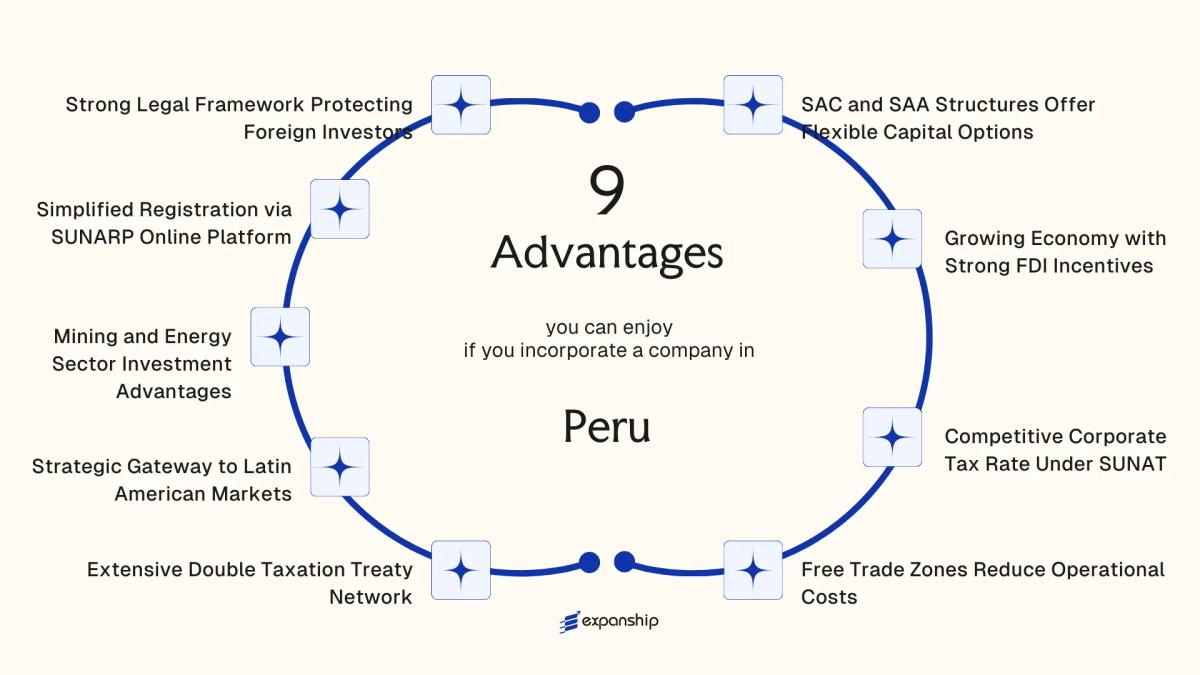
SAC and SAA Structures Offer Flexible Capital Options
Peru's General Corporation Law (Ley General de Sociedades, Law No. 26887) establishes two distinct share-based structures that give foreign investors meaningful control over how capital is organized and transferred: the Sociedad Anónima Cerrada (SAC) and the Sociedad Anónima Abierta (SAA). The Peru SAC and SAA flexible capital structure options exist within the same statutory framework, yet each serves a different ownership model.
SAC: Controlled Ownership with Restricted Transfer
The SAC limits shareholders to a maximum of 20 and allows the company's statutes to include right-of-first-refusal clauses on share transfers. This restriction is not a limitation — it is a governance tool, giving closely held businesses or joint ventures precise control over who may enter the shareholding structure without requiring external regulatory approval.
SAA: Access to Public Capital Markets
An SAA, by contrast, must register with the Superintendencia del Mercado de Valores (SMV) when it meets statutory thresholds, opening access to public capital and institutional investors. This structure suits businesses planning growth financing through equity issuance rather than retained earnings or debt.
Your choice between an SAC and SAA directly determines how capital can be raised, transferred, and governed under Peruvian law.
Growing Economy with Strong FDI Incentives
Peru's legislative framework actively supports foreign capital through a set of binding legal commitments. Under Legislative Decree 757, the Legal Framework for Private Investment Growth, foreign investors receive equal legal standing with domestic investors. No prior government approval is required to invest in most sectors, and profit repatriation faces no restrictions, meaning your returns can be moved abroad without regulatory interference.
ProInversión, the state agency responsible for investment promotion, facilitates legal stability agreements with the government. These agreements lock in the tax and regulatory conditions in force at the time of signing, typically for a period of ten years, which significantly reduces exposure to future legislative changes.
Peru FDI incentives for foreign businesses are embedded in statute rather than left to administrative discretion. This distinction matters because statutory protections are enforceable through the domestic court system and, where relevant, international arbitration under bilateral investment treaties.
Foreign businesses benefit from several structurally favourable conditions under this framework:
- Profit repatriation is unrestricted under Decree 757, removing a common cross-border capital barrier
- Legal stability agreements are available to qualifying investments above defined capital thresholds
- Equal treatment provisions apply across ownership, operation, and asset disposal
- International arbitration access is available without requiring exhaustion of local remedies first

Company Incorporation in Peru
Establish your legal presence in Peru with full compliance across SUNAT, SUNARP, and applicable investment promotion frameworks.
Competitive Corporate Tax Rate Under SUNAT
Peru's standard corporate income tax (CIR) rate is 29.5%, applied to net taxable income and administered by the Superintendencia Nacional de Aduanas y de Administración Tributaria (SUNAT). For foreign business owners, this rate matters because it is defined and predictable, governed under Legislative Decree No. 774 and its successor provisions within the Texto Único Ordenado de la Ley del Impuesto a la Renta. Knowing the exact statutory rate before incorporation allows for accurate financial modelling.
| Tax Parameter | Detail |
|---|---|
| Standard CIT Rate | 29.5% on net taxable income |
| Dividend Withholding Tax | 5% on distributions to non-residents |
| Tax Year | January 1 to December 31 |
| Governing Authority | SUNAT |
| Legal Basis | Texto Único Ordenado de la Ley del Impuesto a la Renta |
Dividend distributions to non-resident shareholders carry a 5% withholding tax under the same framework. Combined with the 29.5% rate, the effective tax burden on distributed profits remains calculable in advance, which reduces uncertainty when structuring cross-border ownership.
Certain sectors, including qualifying companies operating under specific investment promotion regimes, may access reduced rates or tax stability agreements. These agreements, formalized through contracts with the Peruvian state, lock in the applicable tax rate for a defined period, shielding your entity from legislative rate changes during that window.
Free Trade Zones Reduce Operational Costs
Peru free trade zones business advantages are anchored in two primary special economic regimes: CETICOS (Centros de Exportación, Transformación, Industria, Comercialización y Servicios) and ZOFRATACNA, governed by Law No. 27688. Businesses operating within these zones can access exemptions from income tax, IGV (value-added tax), and customs duties on imports of goods and inputs used in production or re-export activities.
ZOFRATACNA, located in Tacna near the Chilean border, is administered under a distinct regulatory framework that makes it particularly relevant for firms moving goods across South American trade corridors. For manufacturing or distribution-oriented businesses, the duty-free import of machinery and raw materials directly reduces cost of goods.
CETICOS zones are established in Ilo, Matarani, and Paita, each positioned near major port facilities. Operating from these locations allows companies to move product through Pacific export channels without the tax friction that applies to domestic commercial zones.
Keep these points in mind:
- Benefits apply only to qualifying activities such as manufacturing, assembly, packaging, and re-export
- Goods transferred from the zone into the domestic market are subject to standard import duties
- Operators must register with the administering authority for the specific zone
- ZOFRATACNA benefits are governed by Law 27688 and subsequent amendments
ZOFRATACNA operators can also access benefits under Peru's general trade agreements, meaning goods produced there may qualify for preferential tariff treatment when exported to FTA partner countries.
Extensive Double Taxation Treaty Network
Peru double taxation treaty benefits are a concrete, structural advantage for foreign investors — not a general feature shared uniformly across the region. The country has signed double taxation agreements (DTAs) with several major economies, including Canada, Chile, Brazil, South Korea, Switzerland, Portugal, and Mexico, among others. These treaties follow the OECD Model Convention in structure, which means your business can predict how cross-border income will be treated before committing capital.
Reduced Withholding Tax Exposure on Cross-Border Payments
Treaty-resident investors can access reduced withholding tax rates on dividends, interest, and royalties paid from a Peruvian entity to a foreign parent or shareholder. Under domestic law administered by SUNAT, the standard withholding rate on dividends is 5%, but treaty provisions can further define or cap rates depending on the counterparty jurisdiction. For businesses structuring intercompany loans or licensing arrangements, this distinction directly affects the net return on invested capital.
Permanent Establishment Protections and Tax Certainty
DTAs also define the conditions under which a foreign firm creates a taxable presence, or permanent establishment, in the country. This matters because it limits SUNAT's authority to assess corporate income tax on foreign entities operating in limited capacities. Qualifying under a treaty reduces the risk of unexpected tax assessments, which is a meaningful operational safeguard when your business is testing the market or providing services remotely before full incorporation.
Maximize Your Tax Treaty Position in Peru
Understand which double taxation agreements apply to your business structure and how to qualify for treaty benefits under Peruvian law.
Strategic Gateway to Latin American Markets
Sitting at the intersection of the Pacific Alliance and Mercosur's sphere of influence, Peru functions as a Peru gateway to Latin American markets in a way that few countries in the region can replicate geographically or commercially. Callao, the country's main port, connects directly to major Pacific Rim trade routes, and Lima's international airport serves as a transit hub for cargo and business travel across South America.
- Pacific Alliance membership gives your business preferential access to Chile, Colombia, and Mexico through a framework that eliminates most tariffs and reduces non-tariff barriers among member states.
- Proximity to Brazil, Bolivia, and Ecuador means supply chains can reach three additional major economies overland, which reduces logistics costs for firms distributing regionally.
- Under the General Customs Law (Legislative Decree No. 1053), goods transiting through Callao benefit from established re-export and temporary admission regimes, making Peru a practical distribution anchor.
- A business incorporated locally can use resident entity status to qualify for treaty benefits and bilateral trade preferences that a foreign branch may not access.
- Lima's role as a regional headquarters location is supported by an established financial services sector and a concentration of multilateral institutions, which reduces the overhead of setting up regional management operations.
Mining and Energy Sector Investment Advantages
Peru mining and energy investment advantages are anchored in a legal architecture that treats foreign and domestic capital equally under Legislative Decree No. 757, the Framework Law for Private Investment Growth. Mining concessions are granted by the Ministry of Energy and Mines (MINEM) and remain valid for indefinite periods, provided the holder meets minimum production requirements. This security of tenure reduces the regulatory uncertainty that typically burdens extractive sector investors in other Latin American markets.
Firms operating in designated mining zones can enter into Legal Stability Agreements with the Peruvian state, locking in the tax regime, exchange rate rules, and administrative procedures at the time of signing for periods of up to 12 years. Your investment is effectively insulated from subsequent legislative changes that could alter cost structures mid-project.
The General Mining Law (Legislative Decree No. 109) also permits full repatriation of profits and capital without restriction, which directly affects how you structure dividend flows back to a parent entity.
A mining company that signs a Legal Stability Agreement at the current 29.5% corporate income tax rate retains that rate for the full agreement term. If the statutory rate rises to 35% five years into the project, the stabilized entity continues paying 29.5%, producing a compounding tax differential across the remaining agreement period.
Simplified Registration via SUNARP Online Platform
SUNARP online registration benefits Peru-based businesses by removing the need for in-person filings at the Public Registry. The Superintendencia Nacional de los Registros Públicos operates a digital portal that accepts company formation documents electronically, meaning your firm can be registered without physical presence at a registry office.
This matters directly to foreign founders who may be managing incorporation remotely or through a local representative. Reduced reliance on in-person procedures shortens the overall formation timeline, which has a direct effect on how quickly your entity can open bank accounts, obtain tax registration with SUNAT, and begin commercial activity.
The platform supports the registration of common Peruvian corporate structures, including the Sociedad Anónima Cerrada, and integrates with notarial workflows that are already digitized under Peru's electronic public deed framework.
- Document submissions are processed through a centralized registry system, reducing manual handling at each stage.
- Notarized documents can be transmitted electronically under the digital notarization rules applicable in Peru, cutting physical courier dependencies.
- Status tracking is available through the platform, giving you visibility over your application without requiring follow-up visits.
The digital process still requires a Peruvian public notary to formalize the company's articles of incorporation, so remote incorporation typically depends on appointing a legally authorized local representative.
Strong Legal Framework Protecting Foreign Investors
Peru's legal framework benefits for foreign investors rests on a constitutional guarantee of non-discrimination. Under Articles 63 and 64 of the Political Constitution of Peru (1993), foreign investors hold the same legal rights as domestic investors. Your firm cannot be subjected to special restrictions, forced divestiture without due process, or differential treatment based on nationality.
Legislative Stability Agreements
One of the more concrete protections available is the Legislative Stability Agreement (Convenio de Estabilidad Jurídica), governed by Legislative Decree No. 757 and administered through ProInversión. Once signed, the agreement freezes the tax regime applicable to your investment for either 10 or 12 years, depending on the investment threshold. This insulates your entity from adverse changes to income tax rates or dividend rules during that period.
Guaranteed Repatriation of Capital and Profits
Foreign investor rights in Peru include the unrestricted right to repatriate profits, dividends, royalties, and capital. This right is enshrined in the Private Investment Framework Law (Legislative Decree No. 757) and requires no prior government approval. For businesses with cross-border treasury operations, the absence of capital transfer restrictions reduces structural complexity considerably.
International Arbitration Access
Disputes between foreign investors and the Peruvian state can be submitted to international arbitration under:
- ICSID (International Centre for Settlement of Investment Disputes)
- UNCITRAL arbitration rules
- Bilateral investment treaty (BIT) mechanisms
Peru has signed over 30 BITs, giving qualifying investors access to neutral forums outside the domestic court system.
Why Peru Stands Out Among Latin American Incorporation Destinations
Comparing Peru against other Latin American incorporation destinations reveals a consistent pattern: the combination of treaty coverage, sector-specific incentives, and SUNAT's territorial treatment of foreign-sourced income positions it differently from neighbours that either impose higher compliance burdens or offer narrower investor protections. The jurisdictions selected for comparison — Chile, Colombia, and Mexico — share similar FDI profiles and attract the same categories of foreign investors, making them the most realistic alternatives a prospective incorporator would evaluate.
What the table below does not capture is the structural coherence between Peru's benefits. SUNARP's online registration system, the Sociedad Anónima Cerrada framework under the General Companies Law (Ley General de Sociedades), and the ZOFRATACNA free trade zone operate as a connected system rather than isolated incentives. That coherence reduces administrative friction across the company lifecycle in ways that a single metric cannot reflect.
| Parameter | Peru | Chile | Colombia | Mexico |
|---|---|---|---|---|
| Standard Corporate Tax Rate | 29.5% | 27% | 35% | 30% |
| Free Trade Zone Regime | Yes (ZOFRATACNA) | Yes (ZOFREE) | Yes (Multiple ZFCs) | Yes (IMMEX/FTZs) |
| Double Taxation Treaties (approx.) | 8+ in force | 30+ in force | 15+ in force | 70+ in force |
| Foreign Ownership Restriction | None for most sectors | None for most sectors | None for most sectors | Restricted in some sectors |
| Online Company Registration | Yes (SUNARP) | Yes (TuEmpresaEnUnDía) | Yes (CCB portal) | Partial (varies by state) |
| Territorial Tax on Foreign Income | Partial | No | No | No |
Compliance Services for Companies in Peru
Maintain your Peruvian entity in good standing with SUNAT, SUNARP, and applicable regulatory bodies through structured compliance support.
Conclusion
Peru's position as a Latin American incorporation destination rests on a convergence of structural and regulatory factors that are relatively rare within the region. The 29.5% corporate income tax rate administered by SUNAT, combined with the legal protections available through Legislative Decree No. 757, gives foreign investors a degree of fiscal and legal certainty that directly reduces risk when committing capital abroad.
Two benefits stand out in practical terms. Access to Peru's network of double taxation treaties limits the exposure of cross-border income to duplicate tax burdens, while the Sociedad Anónima Cerrada structure allows foreign shareholders to organize ownership without meeting minimum capital thresholds that would otherwise constrain early-stage entry. Together, these features make the benefits of incorporating in Peru tangible from both the setup phase and the ongoing operational phase.
That said, the right structure depends on your specific circumstances. A firm operating in the mining sector will weigh the stability guarantees under existing investment frameworks differently than a services business considering a presence in Lima for regional distribution purposes. Peru company formation advantages are real, but their value is proportional to how well the chosen structure, sector classification, and treaty access align with your actual business model. The next step is matching those variables to the correct legal and tax configuration for your entity.
Start Your Peru Company Formation with Expanship Today
Expanship supports foreign investors through every stage of Peru company formation benefits, from selecting the right structure, whether a Sociedad Anónima Cerrada or a Sociedad Anónima Abierta, to meeting ongoing obligations under SUNAT and SUNARP. The services covered in this blog, spanning capital rules, tax treaties, free trade zone access, and sector-specific incentives, each carry their own procedural requirements. Expanship manages those requirements directly with the relevant Peruvian authorities so your business can begin operating without unnecessary delays.
The scope of support includes:
- Preparation and legalization of incorporation documents for filing with SUNARP
- Registered agent and registered office provision within Peru
- Government filing and direct liaison with SUNARP and SUNAT on your behalf
- Post-incorporation compliance management, including annual reporting and tax registration
- Banking introduction assistance to support account opening with local financial institutions
Reach out to Expanship Peru to discuss your incorporation requirements.
Frequently Asked Questions (FAQ)
Registration through SUNARP's online platform typically takes between 24 and 72 hours for the formal registry entry, though the complete incorporation process, including notarization and obtaining a RUC tax identification number from SUNAT, can take one to two weeks in total. Processing times vary depending on the accuracy of submitted documents and the notary's workload. Errors in the founding deed or estatutos are the most common cause of delays.
SUNAT applies a corporate income tax rate of 29.5% on net taxable income, as established under the Impuesto a la Renta regime. This rate applies to both domestic and foreign-owned entities incorporated in Peru. Businesses operating within designated free trade zones, such as CETICOS or ZOFRATACNA, may qualify for exemptions or reduced rates under their respective enabling legislation.
Peru has signed double taxation agreements with a number of significant trade and investment partners, including Canada, Chile, Brazil, Mexico, South Korea, Switzerland, and Portugal, among others. These treaties generally follow OECD or UN model conventions and address withholding taxes on dividends, interest, and royalties. The specific withholding rate reductions depend on the terms negotiated in each individual treaty.
Foreign investors who sign a Legal Stability Agreement (Convenio de Estabilidad Jurídica) with the Peruvian state under Legislative Decree No. 662 and related framework legislation receive a contractual guarantee that the tax rate, foreign exchange rules, and free remittance rights in effect at the time of signing will remain unchanged for the agreement's duration, typically ten years. This protection applies to qualifying investments that meet minimum capital thresholds. Disputes arising under these agreements can be submitted to international arbitration under ICSID or UNCITRAL rules.
Companies operating in the mining sector can negotiate stability agreements under the General Mining Law (Ley General de Minería, Legislative Decree No. 109, as consolidated and amended) that lock in applicable tax conditions for the life of the concession. The hydrocarbons sector offers comparable stability provisions through contracts with Perupetro S.A., the state agency responsible for negotiating and supervising oil and gas agreements. Both frameworks also permit accelerated depreciation on qualifying capital assets.
Peru's membership in the Pacific Alliance, alongside Chile, Colombia, and Mexico, facilitates reduced tariff access across those member markets and creates a framework for regulatory harmonization. Beyond the Pacific Alliance, Peru maintains bilateral free trade agreements with the United States, the European Union, China, Japan, and several other economies. A company incorporated in Peru can use these treaty relationships to structure regional distribution or holding arrangements with preferential access to multiple markets simultaneously.
Legal Disclaimer
The information provided in this article is for general informational purposes only and does not constitute legal, tax, or professional advice. While we strive to ensure the accuracy and timeliness of the content, laws and regulations are subject to change, and the application of laws can vary widely based on specific facts and circumstances.
Readers should not act upon this information without seeking professional counsel tailored to their individual situation. Expanship and its authors disclaim any liability for actions taken or not taken based on the content of this article.
For specific advice regarding your business setup, compliance requirements, or any legal matters, please consult with qualified legal and tax professionals in the relevant jurisdiction.