
Key Takeaways
- Montserrat's Companies Act framework is shaped predominantly by external UK legislative influence, which limits the territory's capacity to adapt corporate law independently in response to local business needs.
- With a resident population of under 5,000 and a domestic economy heavily constrained by the ongoing exclusion zone around the Soufrière Hills volcano, businesses incorporated in Montserrat cannot rely on local market activity to sustain commercial operations.
- The territory maintains a minimal network of double taxation treaties, leaving international businesses exposed to withholding tax liabilities and potential double taxation in counterparty jurisdictions that offer no bilateral relief agreements with Montserrat.
- Recurrent hurricane exposure and the permanent volcanic risk zone covering a significant portion of the island impose material continuity and insurance burdens on any operationally active business established there.
Incorporating a business in Montserrat places your firm within a British Overseas Territory framework, meaning corporate governance operates under a regulated structure shaped largely by external legislative influence rather than a domestically-driven legal evolution. The Companies Act and related statutes form the primary legal basis for company formation and ongoing compliance obligations.
The disadvantages of incorporating in Montserrat span several operational, financial, and structural categories. How significantly each affects your business depends on the industry, the intended corporate structure, and whether the entity is designed for local trading or international holding purposes.
Foreign investors using Montserrat as a base for offshore or international business activities are most likely to encounter the limitations this article addresses. Those running operationally active businesses will face a different — and often more acute — set of constraints than passive holding structures.
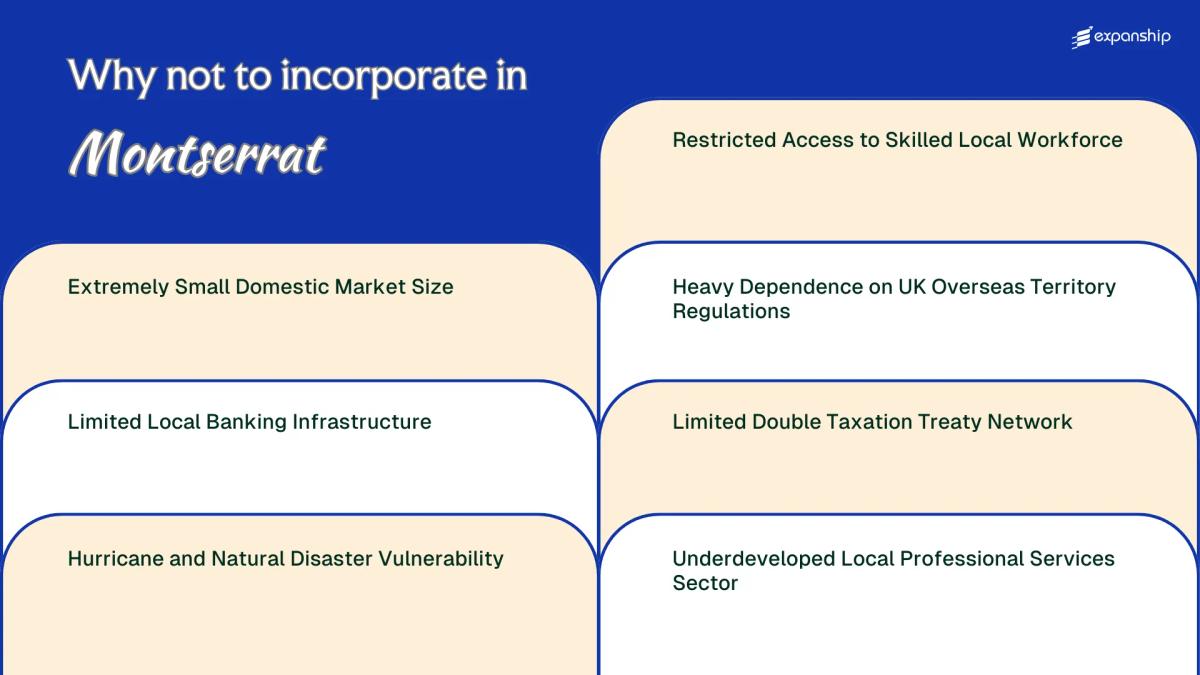
Extremely Small Domestic Market Size
Montserrat small market size limitations represent one of the most immediate structural barriers for any foreign business expecting to generate revenue locally. With a population of approximately 4,500 to 5,000 residents, the domestic consumer base is among the smallest of any incorporated territory globally.
Scale Constraints on Revenue Generation
Generating meaningful local sales volume is effectively impossible across most sectors. A registered company targeting the local population faces spending power and demand levels that cannot support sustainable commercial operations without external revenue sources.
Consumer demand is too thin to justify the fixed costs of incorporation, compliance, and staffing on domestic sales alone. Businesses dependent on local contracts, such as retail, hospitality supply chains, or professional services, will find that market saturation occurs at very low output thresholds.
Structural Dependency on External Markets
Any entity incorporated here that intends to operate primarily within Montserrat faces a structural ceiling that geography and population size impose with no legal workaround. The limited consumer base makes external market access a prerequisite for viability, not a growth option.
Your business cannot rely on domestic revenue to recover incorporation or operational costs, making external market access a financial necessity from the point of formation.
Limited Local Banking Infrastructure
Montserrat banking infrastructure problems are among the most tangible operational obstacles facing foreign business owners. The island has an extremely small number of licensed commercial banks, and international firms frequently find that local institutions are unwilling or structurally unable to service corporate accounts for non-resident-directed entities.
Correspondent banking relationships between Montserrat-based banks and major international financial institutions have narrowed over the past decade due to de-risking policies adopted by large banks in the United States and United Kingdom. This directly limits how your business can send and receive international payments.
Opening a business bank account under these conditions creates friction at multiple levels:
- You may be forced to maintain banking relationships offshore, adding cross-border transfer fees and compliance layers to routine transactions.
- Local banks often apply heightened due diligence to foreign-owned entities, increasing documentation demands and account opening timelines significantly.
- Restricted correspondent networks mean your firm may face payment delays or outright rejections on certain international transfers.
- Without a functional local account, your entity struggles to meet basic operational requirements such as paying local employees or government fees.
Firms incorporated under the Companies Act of Montserrat can legally operate, but banking access does not follow automatically from legal status.

Company Incorporation in Montserrat
Understand what company formation in Montserrat involves, including registration requirements, entity types, and compliance obligations for foreign business owners.
Hurricane and Natural Disaster Vulnerability
Montserrat hurricane risk for businesses is not a theoretical concern. The island sits within the Atlantic hurricane belt, exposing registered entities to Category-level storms during a season that runs from June through November each year. Physical damage to offices, infrastructure, and communications can suspend operations entirely, and insurers often apply Caribbean-specific exclusions or elevated premiums that directly increase your firm's cost base.
| Risk Factor | Practical Burden on Your Business |
|---|---|
| Hurricane season duration | Six months of elevated operational risk annually |
| Volcanic exclusion zones | Southern half of the island remains largely uninhabitable since the 1995 Soufrière Hills eruptions, restricting usable land and infrastructure |
| Property insurance premiums | Caribbean catastrophe risk typically commands significant loading above standard commercial rates |
| Infrastructure recovery time | Post-storm restoration depends on limited local contractor capacity, extending downtime |
The Soufrière Hills volcano, active since 1995, adds a layer of natural disaster vulnerability that few offshore jurisdictions carry. The Plymouth capital was permanently abandoned, and the Montserrat Volcano Observatory continues to monitor ongoing activity. Any escalation in volcanic status can trigger movement restrictions under local emergency protocols, disrupting your business continuity without warning.
Recovery capacity on the island is constrained by its small population and limited public infrastructure budget. That dependency means your firm's return to normal operations after a major event sits outside your control entirely.
Restricted Access to Skilled Local Workforce
Montserrat skilled workforce limitations stem directly from the island's population, which sits below 5,000 residents following the Soufrière Hills volcanic eruptions that began in 1995 and displaced the majority of the population. That demographic reality means the pool of locally available professionals across finance, technology, engineering, and management is structurally thin.
Work permit requirements under the Immigration rules administered by the Department of Immigration impose conditions on hiring foreign nationals, adding time and administrative cost to any staffing plan. For a foreign-owned entity that needs even a small specialist team, those obligations compound quickly.
Restricted local talent in Montserrat also affects operational continuity. If a key hire leaves the island, replacing them locally is often not possible, forcing renewed reliance on overseas recruitment cycles.
- Work permits are required for non-national employees; applications are processed through the Department of Immigration
- No guarantee of approval exists for specialist roles if local candidates are deemed available
- Salary benchmarking for imported talent must account for relocation costs and overseas compensation expectations
- Workforce contracts may be subject to the Labour Code of Montserrat, which governs termination and redundancy obligations
Despite its size, Montserrat maintains a formal work permit regime comparable in procedural complexity to jurisdictions with populations fifty times larger.
Heavy Dependence on UK Overseas Territory Regulations
Montserrat UK overseas territory regulations create a structural dependency that limits how much autonomy your company can actually exercise. The territory operates under a constitutional framework derived from the Montserrat Constitution Order 2010, which reserves certain legislative and governance powers to the Crown.
The Scope of Regulatory Dependency
Under this arrangement, UK Privy Council approval is required for certain categories of local legislation, meaning the Montserrat Companies Act and related commercial regulations can only evolve within boundaries set externally. For a foreign business owner, this means the compliance environment is not fully controlled by the local legislature, creating uncertainty when policy shifts originate in London rather than Plymouth.
British overseas territory compliance restrictions also mean that UK-driven directives on beneficial ownership, anti-money laundering, and financial transparency apply to Montserrat entities, often on accelerated timelines. The Register of Persons with Significant Control requirements, for instance, were extended to British Overseas Territories under external pressure, increasing reporting obligations regardless of local legislative readiness.
Practical Consequences for Foreign Entities
Montserrat regulatory dependence on UK policy means your entity may face compliance changes it had no institutional input in shaping. Adapting to externally mandated rule changes carries real administrative and legal costs, particularly for smaller firms without dedicated compliance staff.
Addressing Regulatory Compliance Challenges in Montserrat
Understand how UK overseas territory obligations affect your Montserrat entity and what compliance requirements apply to your structure.
Limited Double Taxation Treaty Network
Montserrat double taxation treaty limitations represent one of the most consequential structural gaps for foreign investors, as the territory has not independently concluded a broad network of bilateral tax treaties. As a British Overseas Territory, any treaty coverage it receives flows indirectly through the United Kingdom's arrangements, and that coverage is neither guaranteed nor uniformly applicable to corporate structures formed under the Montserrat Companies Act.
- Your business may face withholding taxes on dividends, royalties, and interest payments in counterparty jurisdictions that would otherwise be reduced or eliminated under a direct bilateral treaty.
- The absence of standalone tax agreements Montserrat companies can rely on means transfer pricing disputes and cross-border income flows lack the arbitration mechanisms that formal treaties provide.
- Investors operating across multiple jurisdictions may incur full domestic withholding rates in source countries, materially increasing the effective tax cost of repatriating income.
Underdeveloped Local Professional Services Sector
The Montserrat professional services sector drawbacks are most acutely felt when you try to assemble a local advisory team. The island's population sits below 5,000, which means the total number of resident lawyers, accountants, and licensed corporate service providers is extremely limited.
Finding a qualified local attorney with direct experience in international corporate structuring is difficult. Most legal practitioners on the island focus on conveyancing, estate matters, and general litigation rather than cross-border commercial work.
The accounting profession faces similar constraints. Limited accounting firms in Montserrat means that firms capable of handling IFRS-compliant financial statements or multi-jurisdiction tax reporting are scarce, and those that exist often operate at capacity.
When local capacity is insufficient, you typically redirect mandates to practitioners in Antigua, Barbados, or the UK. That introduces coordination delays, time zone friction, and higher fees from offshore advisors who charge at their home-market rates.
Hypothetical scenario: A foreign-owned IBC requiring annual audited accounts, registered agent services, and local legal counsel could realistically pay 40-60% more in professional fees compared to a similarly structured entity in a larger Caribbean jurisdiction such as the British Virgin Islands, simply due to the absence of competitive local service supply.
Overcoming Incorporation Challenges in Montserrat
Overcoming Montserrat incorporation challenges requires structural planning before registration, not after. The disadvantages covered in this blog are systemic, and addressing them calls for deliberate decisions at the entity setup stage.
- Register your company under the Companies Act and confirm your chosen business structure is appropriate for non-resident ownership from the outset.
- Open offshore or correspondent banking relationships in advance, given the limited local banking infrastructure on the island.
- Obtain adequate catastrophic event insurance coverage that accounts for hurricane exposure and volcanic activity risk.
- Identify treaty-based jurisdictions for holding structures or IP ownership to compensate for the absence of a broad double taxation treaty network.
- Engage qualified professionals based outside Montserrat to supplement gaps in the local professional services sector, particularly for audit and legal functions.
- Confirm ongoing compliance obligations with the Financial Services Commission, which oversees regulated business activity on the island.
These steps operate within a framework governed by both domestic legislation and the UK Overseas Territory regulatory overlay. That dual-layer structure affects how certain compliance obligations are applied and enforced.
Montserrat's Value as a Business Destination
Montserrat's position as a Montserrat business destination is credible but narrow in scope. The jurisdiction suits a specific category of foreign business rather than serving as a general-purpose incorporation hub, and the structural limitations documented throughout this blog are real constraints, not minor inconveniences.
| Pros | Cons |
|---|---|
| Operates under UK Overseas Territory legal frameworks, providing a degree of legal predictability | The domestic market is among the smallest globally, with a population under 5,000 |
| Companies incorporated under the Companies Act benefit from a recognised common law foundation | Local banking infrastructure is thin, requiring most businesses to bank offshore |
| The territory's political stability is underpinned by its constitutional relationship with the United Kingdom | Montserrat's limited double taxation treaty network reduces its utility for international tax planning |
| No corporate income tax on foreign-sourced income for qualifying international business companies | Sourcing skilled professionals locally is constrained by workforce size and ongoing emigration |
| The professional services sector is underdeveloped, making reliance on overseas advisors the norm | |
| Geographic exposure to Atlantic hurricane activity creates recurring operational and continuity risk |
Structural constraints aside, your business can operate from this jurisdiction provided it does not depend on local market access, local talent, or broad treaty coverage.
Compliance Services for Companies in Montserrat
Maintain your Montserrat company's good standing through annual filings, registered agent requirements, and regulatory obligations under the Companies Act.
Conclusion
Forming a business under the Companies Act of Montserrat carries genuine structural constraints that any prospective incorporator should weigh carefully. A Montserrat company formation cons summary points to three persistent obstacles: the absence of a developed local banking network, a treaty framework that offers almost no relief from double taxation in key trading markets, and the territory's documented exposure to hurricane risk. These are not peripheral concerns. Specialist guidance from a firm with direct experience in British Overseas Territory regulatory requirements remains the most practical way to manage the compliance burden that registration here entails.
Expanship's Montserrat Company Formation Support
Incorporating in Montserrat involves managing a set of challenges that are specific to its regulatory environment, from the Financial Services Commission's oversight requirements to compliance with UK Overseas Territory directives and the limited local infrastructure for business operations. Expanship's Montserrat company formation support services help reduce the administrative weight of these obligations, particularly for foreign-owned entities unfamiliar with the FSC's licensing and registration processes. Our role is to manage the procedural complexity, not to change the conditions on the ground.
Beyond registration, Expanship handles the full scope of setup and ongoing compliance:
- Preparing and filing all company registration documents with the relevant authorities
- Providing a registered agent and local office address in Montserrat
- Liaising directly with government departments and the FSC on your behalf
- Managing post-incorporation filings and annual compliance obligations
- Facilitating introductions to banking institutions suited to your business structure
- Handling tax registration and coordination with local revenue authorities
To discuss your requirements, contact Expanship Montserrat.
Frequently Asked Questions (FAQ)
Beyond physical damage, a major hurricane can interrupt a company's ability to meet filing deadlines with the Financial Services Commission, the body responsible for corporate oversight on the island. The 1997 Soufrière Hills volcanic eruption effectively shut down large portions of the island's administrative infrastructure for years, which is a concrete precedent for how severely a natural disaster can disrupt corporate continuity. Your registered agent's ability to maintain filings and correspondence on your behalf becomes critical in those scenarios.
It affects all company types but is most acute for businesses requiring ongoing specialist support such as audit, structured finance, or cross-border tax advisory. The local pool of qualified accountants, lawyers, and corporate administrators is very small relative to established offshore centres like the British Virgin Islands or Cayman Islands. Firms incorporating in Montserrat typically need to source these services externally, which adds cost and coordination complexity.
Montserrat's legislative framework operates within parameters set partly by the United Kingdom, meaning certain regulatory changes can be driven by UK policy rather than local commercial priorities. The UK's commitment to implementing OECD transparency and beneficial ownership standards across its Overseas Territories has directly required Montserrat to introduce public registers and enhanced disclosure requirements. Your business has no direct channel to influence those changes, and non-compliance with resulting local amendments can expose the entity to penalties under Montserrat's Companies Act.
Opening a corporate bank account locally is difficult because Montserrat has very few commercial banking institutions operating on the island, and those that do apply conservative due diligence standards to offshore entities. Most businesses incorporated in Montserrat end up banking in a third country, which introduces additional account setup costs, correspondent banking fees, and compliance documentation requirements in that separate jurisdiction. This arrangement also means your company is subject to the banking regulations of two separate jurisdictions simultaneously.
For pure offshore holding or IP structures that generate no local revenue, the domestic market size is largely irrelevant. However, any business that needs to hire locally, source services on-island, or establish physical operations will find the talent pool and supplier base severely constrained by a population that has hovered below 5,000 since the volcanic eruptions of the late 1990s. That population reality also limits the island's economic resilience, which indirectly affects infrastructure investment and government service capacity.
The Financial Services Commission has authority under the Montserrat Companies Act to strike off non-compliant entities, which results in the company losing its legal standing and its ability to enter contracts or hold assets. Reinstatement is possible but requires settling outstanding fees, filing missing documents, and potentially paying administrative penalties, a process that can take considerable time given the limited administrative capacity on the island. Directors and shareholders of a struck-off company can also face personal liability for transactions conducted after the striking-off date.
Yes, for most business purposes the drawbacks are more pronounced in Montserrat. The British Virgin Islands has a substantially larger financial services sector, a deeper pool of licensed professionals, more developed banking relationships, and a longer track record of handling complex corporate structures. Montserrat's Financial Services Commission oversees a far smaller registry, which means less institutional experience with sophisticated transactions and fewer competitive service providers driving down costs and turnaround times.
Legal Disclaimer
The information provided in this article is for general informational purposes only and does not constitute legal, tax, or professional advice. While we strive to ensure the accuracy and timeliness of the content, laws and regulations are subject to change, and the application of laws can vary widely based on specific facts and circumstances.
Readers should not act upon this information without seeking professional counsel tailored to their individual situation. Expanship and its authors disclaim any liability for actions taken or not taken based on the content of this article.
For specific advice regarding your business setup, compliance requirements, or any legal matters, please consult with qualified legal and tax professionals in the relevant jurisdiction.