

Key Takeaways
- Foreign-sourced income earned by an International Business Company registered in Montserrat is subject to zero corporate tax, giving holding companies and international trading entities a structurally efficient base for offshore earnings.
- The International Business Companies Act provides a defined legislative framework backed by English common law and the Eastern Caribbean Supreme Court, offering foreign-owned entities a level of legal predictability that many comparable Caribbean jurisdictions lack.
- Montserrat's Financial Services Commission oversees company registration and regulatory compliance, meaning incorporations operate within an institutional structure rather than a loosely governed offshore environment.
- The complete absence of exchange controls means foreign currency held or transacted through a Montserrat IBC can be freely repatriated, removing a friction point that affects corporate treasury operations in numerous other low-tax jurisdictions.
Montserrat is a British Overseas Territory located in the Leeward Islands of the Eastern Caribbean, operating under the constitutional authority of the United Kingdom while maintaining its own legislature and legal system. Company registration falls under the oversight of the Financial Services Commission, the statutory body responsible for licensing and regulating financial and corporate activity on the island. Foreign businesses incorporating here most commonly do so through an International Business Company.
The territory's tax posture is broadly zero-tax for qualifying foreign-sourced income, making it a structurally distinct option for international operations. There are no restrictions on full foreign ownership of locally registered entities, and the government has maintained a policy of openness toward foreign direct investment across business categories. The benefits of incorporating in Montserrat — spanning tax treatment, legal infrastructure, privacy provisions, and operational requirements — are covered in detail throughout this article.
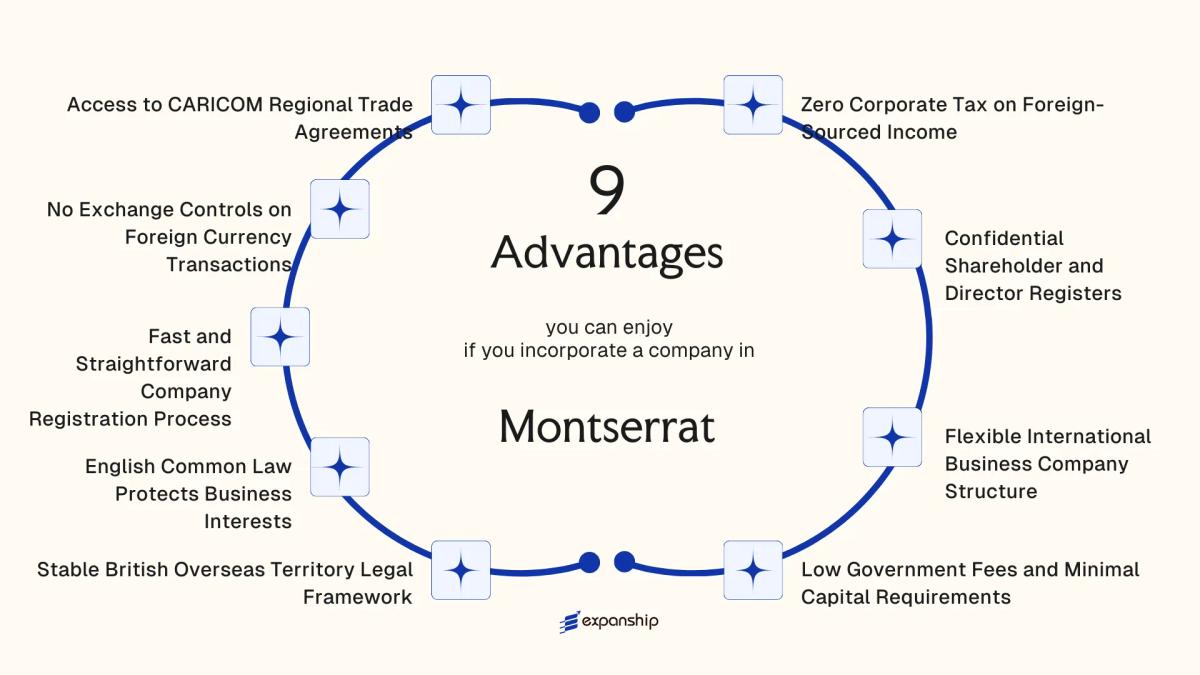
Zero Corporate Tax on Foreign-Sourced Income
Montserrat zero tax on foreign income is the defining fiscal feature of the jurisdiction's International Business Company regime. Under the International Business Companies Act, qualifying entities pay no corporate tax on profits generated outside the territory.
What the Exemption Actually Covers
Income sourced from foreign clients, overseas investments, and cross-border service contracts falls entirely outside the local tax base for a qualifying IBC. This means your firm retains the full margin on international operations rather than surrendering a portion to corporate tax, which in comparable Caribbean jurisdictions can reach 25% to 30%.
Why Structure Matters for Eligibility
The exemption applies specifically to companies incorporated under the IBC framework whose activities and income remain foreign-sourced. A business conducting transactions exclusively with non-resident clients and holding assets abroad will generally satisfy this condition without complex restructuring.
Foreign-sourced profits flow back to your IBC intact, with no corporate tax deducted at the Montserrat level.
Confidential Shareholder and Director Registers
Montserrat's International Business Companies Ordinance establishes that the registers of shareholders and directors for an IBC are not filed with any public registry. The practical consequence of Montserrat confidential shareholder register benefits is direct: ownership information remains outside public access, which limits exposure to unsolicited legal claims, competitor intelligence, or reputational scrutiny in the owner's home country.
Under the IBC framework, the registered agent holds these records locally, but disclosure to third parties is restricted by statute. Your identity as a beneficial owner does not appear in documents available through general public searches. This separation between legal ownership records and public-facing filings is a meaningful structural feature for business owners operating in jurisdictions where transparency requirements are more extensive.
Montserrat director privacy advantages follow the same principle. The names of appointed directors are maintained in the company's internal register rather than exposed through a publicly searchable government database.
Conditions that make this privacy structure practical for foreign owners:
- Disclosure obligations to regulators apply under anti-money laundering law, not to the general public
- Registered agents are bound by confidentiality duties under local statute
- Information sharing with foreign authorities requires a formal legal process, not routine administrative requests
- Beneficial owner records held by the agent are subject to defined access restrictions

Incorporate a Company in Montserrat
Set up a Montserrat International Business Company with confidential registers and full foreign ownership through Expanship.
Flexible International Business Company Structure
Montserrat's International Business Company (IBC) structure, governed by the International Business Companies Act, is deliberately designed with foreign-owned operations in mind. The Act separates IBCs from domestic companies, creating a distinct legal category that gives international operators more operational latitude than a standard local entity would allow.
One area where this flexibility is most visible is corporate governance. An IBC can be incorporated with a single shareholder and a single director, who may be the same person. Directors are not required to be residents of Montserrat, and board meetings can be held outside the territory or conducted electronically. For business owners managing operations across time zones, this removes a practical constraint that exists in more rigid corporate frameworks.
| Feature | Permitted Under the IBC Act |
|---|---|
| Minimum shareholders | 1 |
| Minimum directors | 1 |
| Resident director required | No |
| Corporate director permitted | Yes |
| Location of board meetings | Anywhere |
| Bearer shares permitted | No |
The IBC framework also allows considerable flexibility in share structure. A company can issue shares with or without par value, and different share classes can carry distinct voting rights or economic entitlements. This makes it practical to structure equity arrangements for joint ventures or multi-investor setups without requiring separate legal instruments.
Capital requirements under the Act are minimal by design. There is no mandatory paid-up capital threshold before the entity can begin operations, which means your business can be structured according to its actual financial needs rather than an arbitrary statutory floor.
Low Government Fees and Minimal Capital Requirements
Montserrat low government fees company formation represent one of the more concrete cost advantages available to offshore incorporators. Under the International Business Companies Act, government registration fees for an IBC are fixed at low nominal rates, and annual renewal fees remain comparably modest. For a business owner, this means predictable, low overhead from year one without exposure to the escalating filing costs seen in jurisdictions like the Cayman Islands or the British Virgin Islands.
Capital requirements under the IBC framework are minimal by design. An IBC can be incorporated with an authorized share capital as low as USD 50,000, though this figure represents an authorization ceiling rather than a paid-up requirement. No minimum paid-up capital must be deposited before or after registration. This removes a common barrier that ties up working capital in jurisdictions where statutory minimums carry real deposit obligations.
Annual government fees are payable to the Montserrat Financial Services Commission, which also oversees ongoing compliance for IBCs. Keeping these obligations in one regulatory channel simplifies annual cost forecasting considerably.
Keep these points in mind:
- Authorized share capital of USD 50,000 does not require actual deposit
- Annual government renewal fees are payable to the MFSC
- Fee structures are fixed by statute, not subject to discretionary variation
- Confirm current fee schedules directly with the MFSC, as periodic legislative amendments may apply
Montserrat IBCs can be incorporated with a single share of no-par-value stock, meaning there is no minimum monetary value attached to any issued share at formation.
Stable British Overseas Territory Legal Framework
Montserrat's status as a British Overseas Territory provides a politically stable foundation that many independent small-island jurisdictions cannot replicate. The Montserrat British Overseas Territory legal stability stems from its constitutional relationship with the United Kingdom, which backstops the island's governance, legal system, and institutional integrity.
Constitutional Backing and Sovereign Continuity
Montserrat operates under a Constitution Order made by the UK Privy Council, meaning core governance structures, including the protection of property rights and contractual enforcement, are anchored at a sovereign level. For foreign business owners, this matters because the risk of sudden legislative reversal or arbitrary regulatory change is substantially reduced compared to fully independent offshore centers with less institutional accountability. Your firm's legal standing rests on a framework that cannot be unilaterally dismantled by local political shifts alone.
The Governor, appointed by the Crown, holds reserved powers that provide an additional institutional check. This layer of constitutional oversight gives creditors, counterparties, and investors a degree of confidence in the continuity of the regulatory environment that underpins any contractual relationship you enter through an entity registered here.
UK Privy Council as Final Appellate Authority
Appeals from Montserrat's courts ultimately proceed to the Eastern Caribbean Supreme Court and, in certain cases, to the Judicial Committee of the Privy Council in London. Access to one of the world's most respected appellate bodies means that serious commercial disputes are adjudicated by judges applying consistent common law principles rather than by courts operating in isolation. That access directly reduces legal risk for cross-border transactions and high-value commercial arrangements structured through a Montserrat entity.
Get Guidance on Incorporating Under Montserrat's British Legal Framework
Speak with an Expanship specialist to understand how Montserrat's constitutional structure and UK-backed legal system can work for your business.
English Common Law Protects Business Interests
Montserrat English common law business protections give foreign business owners access to a legal tradition refined over centuries, with a body of case law that governs contracts, corporate disputes, and property rights in predictable, well-documented ways.
- Contract disputes are resolved under principles established through English common law precedent, meaning courts apply consistent interpretive standards rather than untested local statutes. For cross-border commercial agreements, this reduces the risk of unexpected judicial outcomes.
- Corporate governance for International Business Companies registered under the Montserrat International Business Companies Act follows common law fiduciary principles. Directors owe duties of care and loyalty that are well understood by legal counsel in any common law jurisdiction.
- Intellectual property protections, agency relationships, and trust structures all operate within recognized common law frameworks. Foreign investors familiar with UK, Canadian, or Australian legal systems will find the underlying legal logic familiar and transferable.
- Dispute resolution mechanisms, including arbitration and mediation, are enforceable under common law principles applied by the Eastern Caribbean Supreme Court, which has appellate jurisdiction over Montserrat. Final appeals proceed to the Privy Council in London, providing an additional tier of legal oversight outside the territory itself.
That appellate link to the Privy Council is a structural advantage not available in many competing offshore jurisdictions.
Fast and Straightforward Company Registration Process
One of the Montserrat fast company registration advantages for foreign business owners is the speed at which an International Business Company can be incorporated. Under the International Business Companies Act, a new entity can typically be registered within one to two business days once the required documentation is submitted to the Montserrat Financial Services Commission (FSC). That turnaround reduces the lag between deciding to incorporate and being operationally ready.
You are not required to be physically present at any stage of the process. A licensed registered agent, as required by the IBC Act, handles submission on your behalf, which means your firm can be formed remotely from any jurisdiction.
The documentation requirements are also minimal. Generally, you need:
- A completed application form
- Certified copies of identification for directors and beneficial owners
- Proof of address
- A memorandum and articles of association
A foreign business owner incorporating a Montserrat IBC on Monday with a two-day processing window could have a legally registered entity, complete with a certificate of incorporation from the FSC, by Wednesday of the same week, with no travel costs and no in-person appointment required.
No Exchange Controls on Foreign Currency Transactions
Montserrat imposes no exchange controls on foreign currency transactions conducted by International Business Companies. Your firm can receive, hold, convert, and remit funds in any currency without seeking regulatory approval or filing conversion reports with a government authority.
This absence of restriction has direct operational consequences. Cross-border payments, dividend remittances, and intercompany transfers can be executed on your own timeline, without the delays that exchange control regimes typically introduce. For businesses managing multi-currency cash flows across several markets, that freedom reduces both administrative overhead and transactional friction.
Under the International Business Companies Act, an IBC's foreign-sourced income and capital are treated separately from the domestic monetary system. Because the Eastern Caribbean Central Bank governs monetary policy for the territory, the absence of exchange controls specifically for IBCs represents a deliberate carve-out that protects offshore commercial activity from domestic currency management measures.
- Funds can be held in foreign currency accounts without mandatory conversion
- Outbound remittances to shareholders or parent entities face no statutory caps
- No prior approval is required from a local monetary authority for routine transfers
This exchange control exemption applies specifically to IBCs conducting business outside Montserrat; entities with domestic operations may be subject to different ECCB-related monetary requirements.
Access to CARICOM Regional Trade Agreements
Montserrat CARICOM trade agreement advantages stem from the territory's full membership in the Caribbean Community, established under the Treaty of Chaguaramas. As a participating member, companies registered here can access the CARICOM Single Market and Economy (CSME), which governs the free movement of goods, services, capital, and skilled labour across member states.
Free Movement of Goods and Services
Under the CSME framework, qualifying businesses can trade goods with other CARICOM member states without facing intra-regional tariffs. For a firm distributing products across the Caribbean, this eliminates a layer of trade costs that would otherwise apply when operating from outside the bloc. Eligibility typically depends on the company meeting CARICOM rules of origin requirements.
Capital and Labour Mobility
The CSME also provides for the free movement of capital between member states, which means your business can transfer funds regionally without the restrictions that apply to non-member jurisdictions. Certified skilled nationals within CARICOM can move across borders to work, reducing hiring friction for regional operations.
Preferential Market Access Beyond CARICOM
CARICOM as a collective has negotiated trade arrangements with third parties, including the CARIFORUM-EU Economic Partnership Agreement. A company incorporated within the bloc can potentially benefit from preferential access to European markets that would not be available to an entity incorporated outside CARICOM entirely.
- Intra-regional tariff elimination on qualifying goods
- Regional capital transfer rights under the CSME
- Access to CARIFORUM preferential trade terms with external partners
- Rules of origin compliance required to claim tariff preferences
Why Montserrat Stands Out Among Offshore Jurisdictions
Positioned against its most direct competitors, Montserrat's advantages over other offshore jurisdictions become clearer when examined through the lens of what foreign investors consistently prioritise: legal stability, cost, privacy, and structural flexibility. The jurisdictions most relevant to this comparison are the British Virgin Islands, Belize, and Anguilla. All four operate within English common law traditions and target similar incorporation profiles, making them the realistic alternatives a business owner would evaluate alongside a Montserrat IBC.
What the comparison reveals is less about dramatic gaps and more about a consistent pattern. Montserrat holds a neutral-to-favourable position across multiple parameters simultaneously, without the elevated fee structures that accompany more prominent Caribbean centres. Annual government fees in the BVI, for instance, have increased substantially over the past decade, while Montserrat's fee schedule has remained comparatively modest. Anguilla and Belize offer similar zero-tax structures on foreign income, but neither carries the constitutional relationship with the United Kingdom that underpins Montserrat's legislative framework and judicial oversight.
| Parameter | Montserrat | British Virgin Islands | Belize | Anguilla |
|---|---|---|---|---|
| Corporate tax on foreign income | 0% | 0% | 0% | 0% |
| Legal system | English common law | English common law | English common law | English common law |
| Constitutional relationship with UK | Yes (British Overseas Territory) | Yes (British Overseas Territory) | No (independent state) | Yes (British Overseas Territory) |
| Exchange controls | None | None | None | None |
| Annual government fee level | Low | High | Low-moderate | Low-moderate |
| Director register privacy | Confidential (not public) | Partially public (post-2023 reforms) | Confidential | Confidential |
| CARICOM membership | Yes | Yes | Yes | No |
Compliance Services for Companies in Montserrat
Maintain your Montserrat IBC in good standing with ongoing regulatory filings, annual returns, and statutory compliance support.
Conclusion
Montserrat's position as a British Overseas Territory, governed by legislation including the International Business Companies Act, gives foreign-owned entities a legally grounded foundation that many comparable offshore options cannot match. The benefits of incorporating in Montserrat converge around three durable structural advantages: the territorial tax treatment of foreign-sourced income, the absence of exchange controls, and the protections afforded by English common law through the Eastern Caribbean Supreme Court.
Not every business structure will extract equal value from these features. A holding company or international trading entity is far better positioned to benefit from the zero-tax treatment of offshore income than an operation with substantive local activity. The fit between your corporate structure and what this jurisdiction offers determines how much practical advantage you realise.
For businesses that do qualify, the combination of a stable legal order, a defined IBC framework, and freely repatriable foreign currency creates a consistent operating environment. The path from that foundation to active corporate use is one where informed structuring decisions matter considerably.
Start Your Montserrat Company with Expanship Today
Expanship assists foreign business owners in forming International Business Companies under the Montserrat company formation with Expanship process, working directly with the Financial Services Commission, the statutory body responsible for IBC registration and ongoing compliance oversight. From confirming that a proposed corporate name meets the requirements of the International Business Companies Act to managing annual licence renewal obligations, the support covers each stage that this blog has outlined.
Services provided include:
- Preparation and notarization of incorporation documents, including the Memorandum and Articles of Association
- Registered agent and registered office provision as required under the IBC Act
- Filing and liaison with the Financial Services Commission on your behalf
- Post-incorporation compliance management, including annual returns and licence fee coordination
- Document legalization where required for use outside the territory
- Banking introduction assistance for corporate account opening
Reach out to Expanship Montserrat to begin your incorporation.
Frequently Asked Questions (FAQ)
IBCs incorporated under the International Business Companies Act pay zero corporate tax on income sourced from outside the territory. This exemption covers profits, dividends, interest, and capital gains of foreign origin for the duration the entity qualifies as an IBC. Income derived from business conducted within Montserrat is not covered by this exemption and may be subject to local tax obligations.
No minimum paid-up capital is prescribed for IBC formation under Montserrat's International Business Companies Act. The authorized share capital can be set at a nominal amount, and shares may be issued without par value if the company's constitutional documents permit it. This gives founders flexibility in structuring the initial capital without regulatory capital thresholds acting as a barrier.
Shareholder and director registers for IBCs are not available for public inspection under Montserrat's IBC framework. The Financial Services Commission, which regulates corporate entities on the island, maintains oversight access, but third parties cannot search or retrieve beneficial ownership details through a public registry. This confidentiality is a statutory feature of the IBC structure, not simply an administrative practice.
Once the registered agent submits the required incorporation documents to the relevant authority, registration can generally be completed within a few business days, though exact timelines depend on document completeness and current processing volumes. There is no publicly mandated statutory processing window, so your registered agent is the appropriate point of contact for current turnaround estimates. Delays typically arise from incomplete due diligence documentation rather than regulatory backlogs.
CARICOM membership provides access to the CARICOM Double Taxation Agreement, which applies among member states, but IBCs structured to conduct business exclusively outside the territory may have limited practical use of those provisions depending on how their income is classified. The treaty primarily benefits entities with operational ties to CARICOM member states rather than pure offshore holding structures. You should assess whether your business activities and counterparty locations align with the treaty's scope before relying on it for tax planning purposes.
An IBC that conducts business within Montserrat risks losing its exempt status in relation to that locally sourced income, as the zero-tax treatment under the International Business Companies Act applies specifically to foreign-sourced activity. The Financial Services Commission can review an entity's compliance with IBC conditions if its operational conduct appears inconsistent with the IBC designation. Maintaining a clear separation between offshore activities and any local transactions is essential to preserving the exemption.
English common law forms the foundational basis of Montserrat's legal system as a British Overseas Territory, but local statutes, including the International Business Companies Act, take precedence where they specifically address a matter. In areas not covered by local legislation, courts apply common law principles drawn from English jurisprudence, which provides a well-documented body of precedent for commercial disputes. This dual framework means that contractual and fiduciary principles familiar to parties from common law jurisdictions generally apply in the absence of a conflicting local provision.
Legal Disclaimer
The information provided in this article is for general informational purposes only and does not constitute legal, tax, or professional advice. While we strive to ensure the accuracy and timeliness of the content, laws and regulations are subject to change, and the application of laws can vary widely based on specific facts and circumstances.
Readers should not act upon this information without seeking professional counsel tailored to their individual situation. Expanship and its authors disclaim any liability for actions taken or not taken based on the content of this article.
For specific advice regarding your business setup, compliance requirements, or any legal matters, please consult with qualified legal and tax professionals in the relevant jurisdiction.