
Key Takeaways
- Despite Mali's membership in the OHADA framework, the Uniform Acts' standardized corporate law provisions offer limited practical protection when judicial enforcement remains unreliable and court outcomes are inconsistently applied at the national level.
- Businesses incorporating in Mali face a registration process complicated by bureaucratic layering across multiple agencies, adding time and administrative cost that erodes the appeal of an otherwise regionally harmonized entry structure.
- The combination of military governance since the 2021 coup and suspended constitutional processes creates a political risk environment that directly affects contract enforceability, regulatory continuity, and the security of long-term capital commitments.
- Underdeveloped banking infrastructure and restricted correspondent banking relationships in Mali limit a foreign-incorporated entity's ability to move capital efficiently, manage payroll, or service international obligations without significant operational friction.
Mali operates under an evolving regulatory framework, with corporate activity governed primarily by the OHADA (Organisation pour l'Harmonisation en Afrique des Affaires) Uniform Acts, which provide a regional commercial law structure across member states. Despite this supranational foundation, the disadvantages of incorporating in Mali span institutional, infrastructural, and operational categories that extend well beyond what the written law suggests in practice.
The cons of setting up a company in Mali affect different businesses unevenly. A manufacturing firm faces different constraints than a services-based entity, and the severity of each drawback shifts depending on sector, ownership structure, and geographic presence within the country.
This article is most relevant to foreign investors and internationally-operating business owners considering direct incorporation rather than indirect market entry. For the applicable legislative framework, refer to the OHADA Uniform Act.
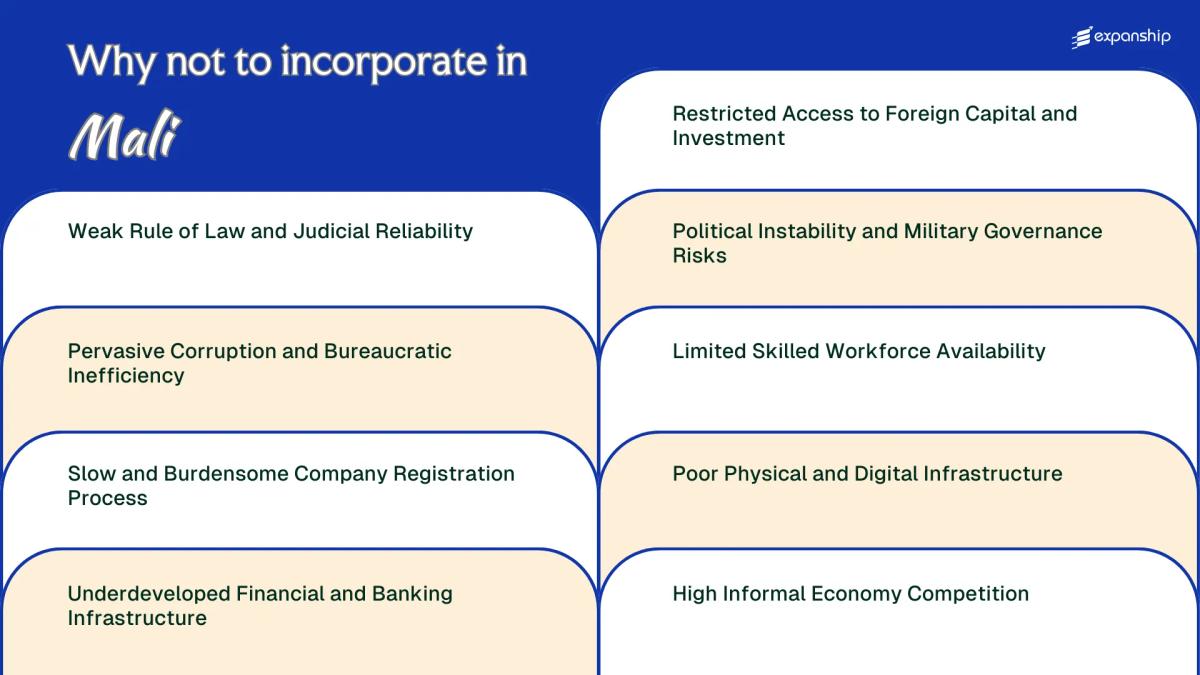
Weak Rule of Law and Judicial Reliability
Mali weak rule of law risks create a direct operational liability for any foreign company that relies on contract enforcement or legal recourse as a core business assumption.
Judicial Independence and Structural Unreliability
Mali's court system operates under the Ministry of Justice, and the judiciary has historically lacked independence from executive influence, particularly since the 2021 military takeover. Contract disputes can remain unresolved for years, and judgments, when issued, are inconsistently enforced. For a foreign business owner, this means that written agreements carry significantly less practical protection than in jurisdictions with independent judicial oversight.
Enforcement Gaps and Arbitration Limitations
OHADA, the regional business law framework Mali is party to, provides standardized commercial rules, but local courts applying OHADA statutes still face capacity and impartiality constraints that undermine procedural reliability. Your ability to recover assets, enforce a judgment against a local counterparty, or exit a dispute efficiently depends heavily on factors outside legal text. Domestic arbitration infrastructure remains underdeveloped, limiting viable alternatives to court proceedings.
If a local partner or counterparty defaults on contractual obligations, your practical ability to enforce that contract through Mali's court system is materially constrained, regardless of what the written agreement states.
Pervasive Corruption and Bureaucratic Inefficiency
Corruption challenges doing business in Mali represent one of the most significant operational risks for any foreign investor. Transparency International's Corruption Perceptions Index consistently ranks Mali among the lower-performing nations globally, reflecting systemic graft embedded across public administration, customs, and licensing authorities.
Bribery risks during Mali business registration are not isolated incidents. Informal payments are frequently expected at multiple touchpoints within the Centre de Formalités des Entreprises (CFE), the body responsible for processing business registration. Your firm may face demands for unofficial fees even when statutory requirements are fully met.
Bureaucratic inefficiency compounds the problem. Departments within the Direction Nationale du Commerce et de la Concurrence (DNCC) can operate with overlapping mandates, creating contradictory directives that delay approvals without legal recourse.
For a foreign business owner, this translates into specific, measurable burdens:
- Unofficial payments inflate your actual setup costs beyond published government fee schedules
- Delays caused by bureaucratic obstruction extend your pre-revenue period without any contractual remedy
- Inconsistent enforcement of the OHADA Uniform Act on Commercial Companies forces you to retain ongoing local legal counsel to interpret ad hoc decisions
- Document requests can be duplicated or contradicted across agencies, consuming management time with no accountability mechanism
Governance problems for investors are further concentrated at the municipal level, where local officials can impose informal requirements on firms operating outside the capital, Bamako.

Company Incorporation in Mali
Understand the full scope of Mali's regulatory environment before committing to incorporation.
Slow and Burdensome Company Registration Process
The Mali company registration process problems begin before your business is legally recognized. Incorporating under the OHADA framework requires registration with the Registre du Commerce et du Crédit Mobilier (RCCM), but in practice, the process involves multiple sequential steps across different government bodies that do not operate in a coordinated manner.
Each step depends on prior approvals, and delays at any single office create a compounding backlog. Your timeline is effectively controlled by administrative capacity rather than any statutory deadline.
| Registration Step | Estimated Time Required | Practical Burden |
|---|---|---|
| Notarization of company statutes | 3 to 7 days | Requires physical presence or local notary mandate |
| RCCM filing and issuance | Up to 10 business days | No electronic filing option widely available |
| Tax identification number (NIF) | 5 to 10 days | Separate administrative queue, not integrated |
| Total estimated registration period | 15 to 30+ days | Significantly longer than OHADA regional average |
Slow business registration in Mali is not merely an inconvenience; it delays your ability to open a corporate bank account, execute contracts, or hire staff legally. Operational launch is stalled until every document clears.
The absence of a functioning one-stop shop means you are dependent on intermediaries to track filings across disconnected offices. That dependency introduces both cost and unpredictability into your incorporation timeline.
Underdeveloped Financial and Banking Infrastructure
Mali banking infrastructure limitations create immediate, tangible obstacles for foreign-incorporated entities attempting to conduct routine financial operations. The banking sector is supervised by the Banque Centrale des États de l'Afrique de l'Ouest (BCEAO), which governs monetary policy across the WAEMU zone, but the density of commercial banking services within the country remains among the lowest in the region.
Correspondent banking relationships are scarce. This limits your company's ability to execute international wire transfers efficiently, often resulting in delays of days or weeks for cross-border transactions that would clear overnight in higher-infrastructure markets.
Account opening for foreign-owned entities requires extensive documentation, and local banks frequently impose conditions that domestic firms do not face. Rejection rates for corporate accounts held by foreign shareholders are disproportionately high relative to comparable West African jurisdictions.
Credit access compounds the problem. Corporate lending is constrained by high interest rates and collateral requirements that most foreign SMEs cannot meet without local asset ownership.
- Corporate bank accounts for foreign-owned firms require BCEAO-compliant documentation, including proof of local registered address
- International transfers are subject to WAEMU foreign exchange regulations, which impose reporting obligations
- Multi-currency account facilities are not widely available through local commercial banks
- Cash transaction volumes remain high, creating reconciliation and audit compliance burdens for formally structured entities
Despite being a WAEMU member with a shared currency (the CFA franc), foreign businesses in Mali cannot assume that BCEAO membership translates into standardised or accessible banking services at the country level — local bank branch penetration remains under 10% of the adult population, according to BCEAO data.
Restricted Access to Foreign Capital and Investment
Mali foreign investment restrictions extend beyond general emerging-market risk. Accessing external capital as a foreign-incorporated entity operating in the country is structurally constrained by the regulatory environment.
Structural Limits on Foreign Capital Access
Mali operates under the West African Economic and Monetary Union (WAEMU) framework, which governs capital flows through the Banque Centrale des États de l'Afrique de l'Ouest (BCEAO). Foreign currency transfers and repatriation of profits are subject to BCEAO exchange control regulations, meaning your firm cannot move capital freely without regulatory clearance. This dependency on a supranational monetary authority adds a layer of procedural friction that slows investment cycles and reduces financial flexibility for foreign-owned entities.
Practical Consequences for Foreign Investors
Limited FDI barriers for companies also stem from Mali's exclusion from most active bilateral investment treaty networks following the 2021 military transition, reducing the legal protections that institutional investors typically require before committing capital. Multilateral financiers such as the IFC and AfDB have scaled back or suspended certain operations in the country, narrowing the range of financing instruments available to businesses registered there. Sectors outside of designated priority zones receive little structured foreign capital access, which isolates your entity from both debt and equity channels that would ordinarily support early-stage growth.
Addressing Foreign Capital Challenges for Your Mali Operations
Understand the structural constraints on foreign investment in Mali and how to plan your corporate structure accordingly.
Political Instability and Military Governance Risks
Mali political instability business risks are among the most acute in West Africa, shaped by three successful military coups since 2012 and the current transitional government's indefinite extension of its mandate beyond the 2024 electoral deadline.
- The ruling junta, the Transition Government led by the National Committee for the Salvation of the People (CNSP), operates outside a constitutionally anchored legal framework, meaning contracts, operating licenses, and regulatory decisions your company depends on carry no institutional guarantee of continuity.
- Suspension of the ECOWAS-backed transition timeline has triggered sustained economic sanctions, which directly restrict cross-border trade flows and correspondent banking relationships that foreign-incorporated entities rely on.
- The withdrawal of UN peacekeeping forces (MINUSMA) in 2023 has expanded insecurity across northern and central regions, making physical operations in those areas uninsurable under standard commercial policies.
- Military governance increases the risk of abrupt regulatory changes issued by decree, with no legislative review process through which your firm can anticipate or contest policy shifts.
Limited Skilled Workforce Availability
Mali skilled workforce limitations directly affect your ability to staff technical, managerial, and specialized roles locally. The country's adult literacy rate sits below 35%, according to UNESCO data, which constrains the pool of candidates qualified for knowledge-based or professionally demanding positions.
Tertiary enrollment rates remain among the lowest in West Africa. Even graduates from institutions such as the Université des Sciences Juridiques et Politiques de Bamako often lack exposure to international business practices, creating a gap between formal credentials and operational requirements.
Sectors requiring technical expertise — engineering, finance, IT, and legal compliance — face the sharpest shortages. Importing expatriate talent triggers additional costs through work permit fees, relocation, and the requirements under the Labour Code (Code du Travail) governing foreign worker ratios within Malian firms.
Talent shortage risks in Mali compound when skilled nationals emigrate for better-paid opportunities in neighboring Francophone countries or Europe, a trend that continuously depletes mid-level and senior talent pipelines.
A foreign firm hiring three expatriate specialists in Bamako could face annual per-employee costs exceeding $40,000–$60,000 USD when factoring in work authorization fees, housing allowances, and legally mandated local hiring ratios, compared to regional hubs like Côte d'Ivoire where deeper local talent pools reduce reliance on costly expatriate packages.
Poor Physical and Digital Infrastructure
Mali infrastructure challenges for business extend beyond inconvenience — they translate directly into higher operating costs and unreliable supply chains. The country's road network outside Bamako is largely unpaved, and seasonal flooding regularly renders key routes impassable, disrupting freight movement for weeks at a time.
Electricity supply is managed by Énergie du Mali (EDM-SA), the state utility, which suffers from chronic generation shortfalls. Frequent outages force businesses to invest in private generators, adding capital and fuel expenditure that competitors in more developed markets do not bear.
Landlocked geography compounds logistics problems for investors significantly. All import and export cargo must transit through neighboring countries — primarily Senegal or Côte d'Ivoire — adding transit fees, clearance delays, and exposure to cross-border disruptions beyond your control.
On the digital side, fixed broadband penetration remains extremely low nationally. Mobile internet coverage is limited outside urban centers, meaning firms dependent on real-time data, cloud systems, or remote operations face structural connectivity gaps that affect day-to-day business functions.
- Internet infrastructure is concentrated in Bamako, leaving secondary cities with inconsistent or absent service
- Power outages affect data center reliability and cloud-dependent operations
- Cold chain and time-sensitive logistics are particularly exposed to road and power failures
Foreign businesses operating outside Bamako should independently verify electricity access, road connectivity, and mobile network coverage for their specific location before assuming that national-level infrastructure data reflects conditions at the operational site.
High Informal Economy Competition
Mali informal economy competition risks are a structural problem, not a marginal one. Estimates from the International Labour Organization place informal employment in Mali above 80% of the total workforce, meaning most economic activity occurs outside the tax and regulatory system.
Formally registered businesses must pay corporate taxes under the General Tax Code, contribute to social security, and comply with OHADA accounting standards. Unregistered operators carry none of these costs, which allows them to undercut your pricing on goods and services in the same market.
This cost asymmetry is most acute in retail, agriculture, and transport sectors where grey market operators dominate on price alone. Your entity cannot compete on cost structure against businesses that face zero compliance overhead.
Enforcement capacity within the Direction Générale des Impôts is limited, meaning unregulated competitors face minimal consequences for operating informally. The disadvantage is therefore persistent rather than transitional.
Overcoming Mali's Business Incorporation Challenges
Overcoming Mali's business incorporation challenges requires a structural approach grounded in the country's actual regulatory framework rather than assumptions borrowed from more stable markets.
- Register your entity through the APIM (Agence pour la Promotion des Investissements au Mali), which serves as the official one-stop shop for company formation under the OHADA Uniform Act on Commercial Companies.
- Open a corporate bank account with a BCEAO-supervised institution before finalising your capital deposit, given constraints in the local banking sector.
- Obtain a Numéro d'Identification Fiscale from the Direction Générale des Impôts to establish your tax compliance standing from incorporation.
- Structure equity and profit repatriation arrangements in advance, accounting for UEMOA's foreign exchange protocols that govern capital flows out of the CFA franc zone.
- Assess workforce requirements against ANPE (Agence Nationale pour l'Emploi) registration obligations before hiring locally.
Mitigation steps exist within a legal environment shaped by OHADA treaty obligations and UEMOA monetary rules, both of which sit above domestic Malian legislation. Structural changes to political governance or judicial enforcement fall outside any compliance framework a foreign investor can control.
Mali's Viability as a Business Destination
Mali's viability as a business destination is constrained by structural weaknesses that run across its legal, financial, and political systems. For a narrow set of business profiles — particularly those operating in extractive industries or regional trade — the country retains a degree of commercial relevance tied to its natural resource base and membership in ECOWAS and the WAEMU monetary union.
| Pros | Cons |
|---|---|
| WAEMU membership provides access to a shared currency and regional trade framework | Judicial reliability is low, with limited enforcement of commercial contracts |
| The extractive sector offers documented resource opportunities | Military governance since 2021 creates unpredictable regulatory and policy conditions |
| OHADA membership provides a regionally harmonized commercial law framework | Company registration under the RCCM involves slow, multi-step bureaucratic processes |
| A large informal economy creates unmet demand in certain product categories | Banks operate with restricted credit access and limited correspondent banking capacity |
| Corruption within administrative bodies raises compliance costs and operational risk |
Assessing Mali as an incorporation destination requires an honest reading of those drawbacks against any sector-specific opportunity your business may identify. The risks covered in this blog are not peripheral — they affect daily operations, capital access, and legal recourse at a fundamental level.
Compliance Services for Companies in Mali
Maintain your Mali entity's good standing with accurate filings, statutory reporting, and regulatory obligations managed in line with OHADA and local RCCM requirements.
Conclusion
The Mali company formation drawbacks summary presented across this blog reflects a jurisdiction carrying substantial structural weight. Political authority held by military-led transitional bodies, compounding delays within the RCCM registration process, and systemic corruption indexed consistently by Transparency International represent the most consequential barriers for foreign operators. Structural constraints of this depth do not resolve quickly. For businesses that still intend to proceed, working with parties who have direct, on-the-ground knowledge of Mali's regulatory and administrative realities is not optional — it is a baseline requirement.
Expanship's Support for Your Mali Expansion
Incorporating in Mali places real operational demands on your business from the outset. Expanship's support is designed to reduce the administrative burden those demands create, particularly around OHADA-aligned filings, RCCM registration at the Tribunal de Commerce de Bamako, and ongoing compliance with the Direction Nationale des Impôts. Your firm still faces the underlying Mali business expansion support risks this blog outlines, but having structured assistance means those risks don't compound through missed deadlines or procedural missteps.
Our Mali incorporation compliance assistance covers the full formation and post-registration cycle.
- We prepare and submit all company registration documents on your behalf.
- A registered agent and local office address are provided to satisfy residency requirements.
- We liaise directly with government bodies and regulatory authorities throughout the process.
- Post-incorporation compliance obligations are tracked and managed on an ongoing basis.
- Banking introduction support is available to help your entity establish a local account.
- Tax registration and coordination with the Direction Nationale des Impôts are handled for you.
Reach out to Expanship Mali to discuss your incorporation requirements.
Frequently Asked Questions (FAQ)
Corruption in Mali is pervasive across sectors, but it is most acute in industries that require frequent interaction with public officials, such as mining, construction, and import-dependent businesses where customs clearance is involved. Mali ranks among the lower tiers of Transparency International's Corruption Perceptions Index, and the Direction Générale des Impôts, along with customs authorities, are frequently cited as points of informal payment pressure. Even routine administrative procedures can involve undocumented costs that are difficult to anticipate or budget for.
Official registration fees under the OHADA framework are relatively modest, but total costs typically exceed published figures once notarial fees, informal facilitation payments, and the cost of delays are factored in. Registration through the Centre de Formalités des Entreprises (CFE) in Bamako can stretch well beyond the statutory timeframe, and each additional week carries indirect costs in professional fees and lost operational time. Businesses that rely solely on official fee schedules frequently find themselves underprepared financially.
Within the OHADA zone, Mali consistently performs worse on business registration indicators than peer members such as Côte d'Ivoire or Senegal, despite all three sharing the same underlying commercial law framework under the OHADA Uniform Acts. The shared legal foundation means the disadvantage is not in the law itself but in local implementation, specifically the reliability of the CFE, court efficiency, and administrative follow-through. That gap in execution makes Mali a comparatively difficult environment even when the statutory rules appear equivalent on paper.
Contract enforcement through Mali's domestic judiciary is unreliable and slow, with cases routinely taking years to resolve. The courts lack both the resources and, in some instances, the independence needed to adjudicate commercial disputes impartially, particularly where one party has political connections. While OHADA arbitration mechanisms are available as an alternative, accessing them requires that your contracts explicitly incorporate arbitration clauses, and even then, enforcing an award against a local party can present practical difficulties.
Opening a corporate bank account in Mali is more cumbersome than in most comparable markets, with banks requiring extensive documentation and, in practice, exercising considerable discretion over which clients they accept. The banking sector is shallow, dominated by a small number of regional institutions, and correspondent banking relationships with major international banks have become more restricted in recent years due to Mali's geopolitical positioning and anti-money laundering compliance pressures. This directly limits your firm's ability to receive international transfers or access trade finance at competitive terms.
Yes. Under the Malian General Tax Code, failure to register with the Direction Générale des Impôts or to file returns within prescribed deadlines attracts financial penalties and can result in tax assessments made on an estimated basis, which are typically unfavorable to the taxpayer. Repeated non-compliance can lead to asset freezes or forced closure proceedings, though enforcement is inconsistent in practice. The inconsistency itself is a risk, since selective enforcement creates unpredictability rather than reducing the legal exposure.
It does, materially. Reliable internet connectivity outside Bamako is limited, and even within the capital, outages and low bandwidth affect cloud-dependent operations, digital payments, and remote team management. The government's e-services infrastructure for business compliance, including online tax filing and regulatory submissions, is not consistently functional, which means in-person visits to administrative offices remain necessary for many routine tasks and add recurring time costs to your operations.
Legal Disclaimer
The information provided in this article is for general informational purposes only and does not constitute legal, tax, or professional advice. While we strive to ensure the accuracy and timeliness of the content, laws and regulations are subject to change, and the application of laws can vary widely based on specific facts and circumstances.
Readers should not act upon this information without seeking professional counsel tailored to their individual situation. Expanship and its authors disclaim any liability for actions taken or not taken based on the content of this article.
For specific advice regarding your business setup, compliance requirements, or any legal matters, please consult with qualified legal and tax professionals in the relevant jurisdiction.