
Key Takeaways
- Mali's membership in both WAEMU and ECOWAS positions a registered entity to access a combined market exceeding 400 million people under preferential trade conditions, without requiring separate incorporation across multiple jurisdictions.
- The OHADA Uniform Acts — binding across all 17 member states — provide foreign investors with a standardised contractual and corporate governance framework that reduces legal uncertainty typically associated with single-country civil law systems.
- Bilateral investment treaties extend enforceable protections against expropriation to foreign shareholders, anchoring capital security in international legal obligations rather than domestic regulatory discretion alone.
- Company registration in Mali is administered through a single authority, the Centre de Formalités des Entreprises, with the Société à Responsabilité Limitée serving as the primary vehicle for foreign market entry under the SYSCOHADA accounting and commercial law regime.
Incorporated as an independent republic in 1960, Mali is a landlocked nation in West Africa governed by a civil law system harmonized under the OHADA treaty framework. The benefits of incorporating in Mali are shaped by this supranational legal architecture, which standardizes commercial law across seventeen member states and provides a predictable statutory basis for business registration and operation. Company formation is administered through the Centre de Formalités des Entreprises, which operates as the principal one-stop registration authority for commercial entities. Foreign businesses entering the market most commonly do so through a Société à Responsabilité Limitée.
Mali operates under a standard corporate tax regime, with territorial and treaty-based elements that affect how income sourced inside the country is treated. Foreign direct investment is formally permitted across most sectors, and the government has maintained a general policy of openness to external capital, particularly in extractive industries and infrastructure. This article examines the key advantages that Mali company formation offers to businesses considering establishing a presence in the region.
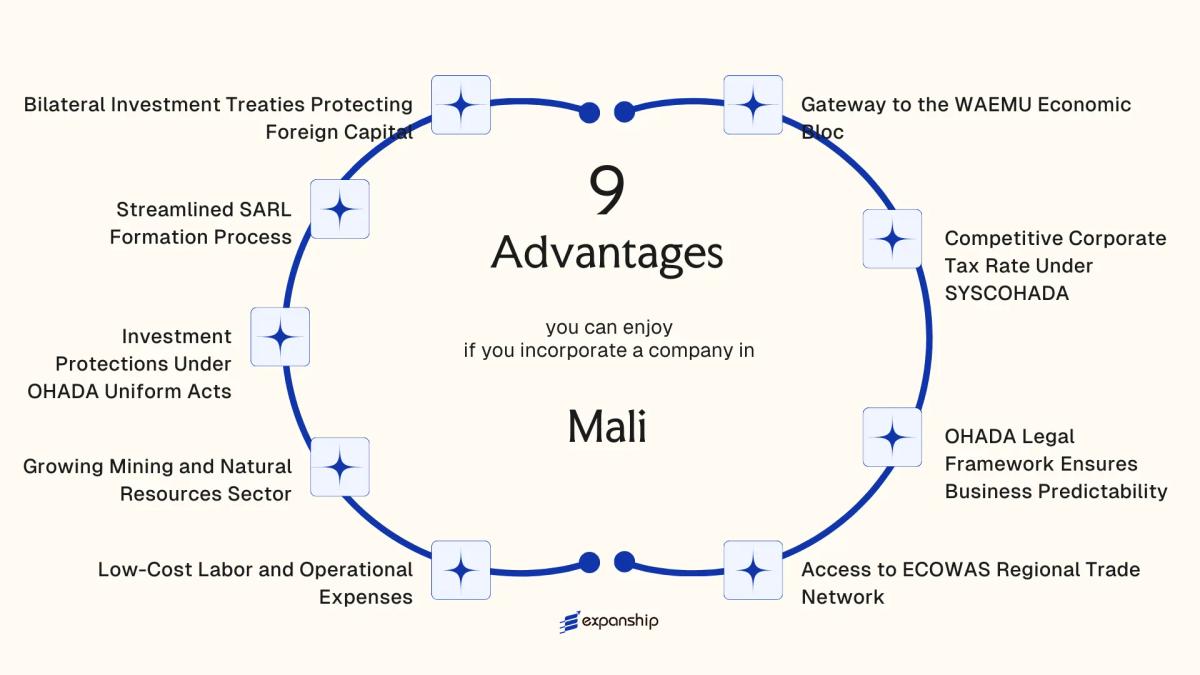
Gateway to the WAEMU Economic Bloc
Mali's membership in the West African Economic and Monetary Union (WAEMU) gives incorporated entities direct access to a market of approximately 130 million people across eight member states, operating under a single currency, the CFA franc (XOF).
A Unified Market With Shared Regulatory Architecture
WAEMU's common external tariff means goods produced by your company within the union circulate freely among member states without facing internal customs duties. This structural feature reduces the cost and complexity of cross-border trade significantly compared to operating through separate bilateral arrangements.
The CFA Franc as a Commercial Tool
Currency stability within the zone is maintained through a fixed parity with the euro, administered under an agreement with the French Treasury. For a foreign investor, this eliminates intra-regional exchange rate exposure on transactions across Senegal, Côte d'Ivoire, Burkina Faso, and the other member states. Your Mali-incorporated entity can invoice and receive payments across the bloc in the same currency it uses domestically.
A Mali-registered company can serve the full WAEMU market under one currency and one customs framework, without restructuring for each country.
Competitive Corporate Tax Rate Under SYSCOHADA
Mali's standard corporate income tax (CIT) rate is 30%, applied to net taxable profits as defined under the General Tax Code (Code Général des Impôts). For foreign investors assessing West African options, the Mali corporate tax rate SYSCOHADA advantages become visible when examining how the SYSCOHADA accounting framework standardizes profit calculation, limiting arbitrary adjustments and creating a predictable tax base.
Under SYSCOHADA, financial statements follow uniform chart-of-accounts rules across all OHADA member states. This consistency means your firm's taxable income is computed on a recognized, auditable basis rather than under opaque local interpretations, reducing exposure to disputed assessments.
Certain qualifying investments benefit from reduced rates or temporary exemptions under the Code des Investissements, administered through the Centre de Promotion des Investissements au Mali (API-Mali). Eligibility typically depends on sector, investment volume, and employment commitments.
Several structural features of the tax environment make compliance manageable for foreign-owned entities:
- Taxable profit follows SYSCOHADA accrual rules, which foreign accountants already recognize across francophone Africa
- Depreciation schedules are codified, giving your entity predictable deductions over asset lifetimes
- Withholding tax obligations on dividends are defined within the WAEMU treaty framework, limiting double-layer taxation for regional holding structures

Company Incorporation in Mali
Register your business entity in Mali with structured support for compliance, documentation, and SYSCOHADA-aligned accounting setup.
OHADA Legal Framework Ensures Business Predictability
The OHADA legal framework business predictability Mali offers to foreign investors stems from a supranational legal architecture that overrides domestic commercial law inconsistencies. Adopted by Mali as a founding member of the Organisation pour l'Harmonisation en Afrique du Droit des Affaires, OHADA unifies commercial legislation across 17 member states through directly applicable Uniform Acts. These acts govern company formation, contracts, securities, debt recovery, insolvency, and arbitration — removing the uncertainty that often accompanies operating under a single country's evolving national statutes.
| Uniform Act | Subject Matter | Year of Current Version |
|---|---|---|
| AUDSC-GIE | Commercial Companies and Economic Interest Groups | 2014 |
| AUS | Secured Transactions | 2010 |
| AUPSRVE | Simplified Recovery Procedures and Measures of Execution | 1996 |
| AUPCIE | Insolvency Proceedings | 2015 |
| AUA | Arbitration | 2017 |
Because the Uniform Acts carry supranational authority, a contract dispute or insolvency proceeding follows the same procedural rules your legal counsel would encounter in Senegal, Côte d'Ivoire, or Cameroon. That consistency reduces legal due diligence costs when structuring cross-border transactions within the OHADA zone. The Common Court of Justice and Arbitration (CCJA), seated in Abidjan, serves as the final appellate body for commercial disputes, giving your firm access to a specialized supranational tribunal rather than relying solely on domestic courts. Arbitration awards issued under CCJA rules are enforceable across all member states without requiring separate recognition proceedings in each jurisdiction.
Access to ECOWAS Regional Trade Network
Mali ECOWAS regional trade network benefits begin with geography. As a landlocked member state, Mali sits at the intersection of West Africa's major trade corridors, and its ECOWAS membership converts that position into measurable commercial access. The bloc covers 15 member states with a combined population exceeding 400 million people, all connected under a framework that reduces intra-regional trade barriers for qualifying goods and services.
Under the ECOWAS Trade Liberalisation Scheme, approved industrial and agricultural products originating from member states may circulate duty-free across the community. A company incorporated in Mali can qualify for this preferential treatment, meaning goods manufactured locally avoid the tariff layers that non-member exporters face when entering regional markets.
Membership also connects your business to the ECOWAS Common External Tariff (CET), which standardizes import duties on goods entering from outside the bloc. This creates predictable cost structures for businesses sourcing inputs from third countries while selling regionally.
Keep the following in mind when structuring operations to capture these benefits:
- Goods must meet ECOWAS rules of origin requirements to qualify for duty-free movement
- Industrial products require prior approval under the Trade Liberalisation Scheme before preferential treatment applies
- West Africa free trade benefits under ECOWAS apply to registered entities, not branches of foreign firms in all cases
- Transit documentation must comply with the ECOWAS Inter-State Road Transit framework for cross-border shipments
Mali's landlocked status, often seen as a logistical constraint, actually positions a Mali-incorporated entity as a natural regional distribution hub, since ECOWAS corridor infrastructure was specifically designed around transit countries like Mali.
Low-Cost Labor and Operational Expenses
Mali low-cost labor advantages for businesses are rooted in structural economic conditions rather than policy incentives alone. The country's working-age population is young and expanding, which keeps wage floors competitive relative to many peer economies in the region. Under the Code du Travail (Labor Code), minimum wage rates are set nationally and remain modest in absolute terms, reducing the fixed cost base for labor-intensive operations from day one.
Wage Levels and What They Mean for Your Cost Structure
Formal employment in Mali is governed by the Direction Nationale du Travail, which oversees compliance with wage standards and collective agreements. Because minimum wage benchmarks are materially lower than those in francophone peers such as Senegal or Côte d'Ivoire, a foreign firm establishing a local subsidiary can allocate a higher proportion of its capital toward operations rather than payroll.
Social contribution obligations under Malian law include employer contributions to the Institut National de Prévoyance Sociale (INPS). These add a defined percentage to gross payroll costs, but the overall burden remains limited when compared to employer contribution rates common across OECD member states.
Office and Infrastructure Costs
Physical operational costs in Bamako, the commercial center, are substantially lower than in comparable West African capitals with more developed real estate markets. This applies to both commercial leasing and utilities. For a foreign entity setting up a SARL or branch office, the gap in overhead between Mali and higher-cost regional hubs can represent a meaningful reduction in monthly fixed expenditure.
Structure Your Mali Operations for Cost Efficiency
Speak with our corporate services team to understand how Mali's labor and overhead cost profile applies to your specific business structure and operational model.
Growing Mining and Natural Resources Sector
Mali mining sector investment advantages are closely tied to the country's position as one of Africa's top gold producers. Gold consistently ranks as the country's principal export commodity, and the sector operates under the Mining Code (Loi N°2019-056), which governs licensing, fiscal terms, and the rights of permit holders.
- Under the 2019 Mining Code, qualifying mining companies benefit from a stabilized fiscal regime during the exploitation phase, meaning tax conditions set at the time of permit issuance cannot be unilaterally altered by subsequent legislation. For a foreign investor committing capital over a multi-decade project timeline, this contractual stability reduces regulatory risk considerably.
- Mali natural resources business opportunities extend beyond gold to include lithium, manganese, phosphate, and iron ore, sectors where exploration activity has increased as global demand for battery minerals grows. Your entity can therefore enter the country at an early stage of non-gold resource development.
- The Direction Nationale de la Géologie et des Mines (DNGM) administers the permit registry. A single administrative body managing both prospecting and exploitation permits reduces the procedural fragmentation that delays project timelines in multi-agency systems.
- Foreign-held mining entities are permitted under the code, with the Malian state retaining a standard carried interest, a defined and disclosed participation structure that allows you to model equity dilution before committing capital.
Investment Protections Under OHADA Uniform Acts
OHADA Uniform Acts investment protections Mali-based businesses receive originate from a supranational legal system, not domestic legislation alone. The OHADA Treaty, ratified by 17 member states, produces Uniform Acts that take direct precedence over national law upon publication in the Official Gazette. For a foreign investor, this means your contractual rights, security interests, and enforcement mechanisms are governed by a standardized body of law that cannot be altered unilaterally by the Malian legislature.
Two Uniform Acts are particularly relevant to investor protection:
- The Uniform Act on Commercial Companies (AUSC) governs shareholder rights, capital contributions, and corporate governance structures.
- The Uniform Act Organizing Securities (AUS) allows creditors and investors to register pledges, charges, and other security interests over assets, creating enforceable priority positions.
Disputes can be escalated to the OHADA Common Court of Justice and Arbitration (CCJA) in Abidjan, bypassing domestic courts entirely. That option removes significant jurisdictional uncertainty for foreign capital holders who may otherwise question local court reliability.
Under Article 10 of the OHADA Treaty: "Uniform Acts are directly applicable and binding in Member States notwithstanding any contrary provisions of domestic law, whether prior or subsequent."
Streamlined SARL Formation Process
Mali SARL formation advantages for investors begin with one of the more accessible entry points for foreign capital in West Africa. Under the OHADA Uniform Act on General Commercial Law, a Société à Responsabilité Limitée requires a minimum share capital of 1,000,000 XOF, which is approximately USD 1,600. That threshold is low enough that most serious foreign business owners can meet it without complex pre-incorporation financing arrangements.
Registration is handled through the Centre de Formalités des Entreprises (CFE), a single-window body that consolidates what would otherwise be separate administrative steps across multiple agencies. This structure reduces the time a foreign founder spends coordinating between institutions before the entity becomes operational.
Liability for shareholders is capped at the level of their contribution. Your personal assets remain separate from obligations incurred by the firm, a structural protection codified directly in the OHADA Uniform Act on Commercial Companies and Economic Interest Groups.
- A minimum of one shareholder is required, with no nationality restriction on foreign founders
- The SARL structure does not require a local resident director by default under OHADA rules
- Share transfers to third parties require member approval, giving founding shareholders meaningful control over the ownership structure
While OHADA rules set the baseline, local Malian administrative practice and sector-specific licensing requirements may add conditions that apply to your specific industry before the entity can lawfully operate.
Bilateral Investment Treaties Protecting Foreign Capital
Mali bilateral investment treaties foreign capital protection gives foreign investors a layer of contractual security that sits above domestic policy changes. These treaties, negotiated bilaterally with partner states, bind both governments to specific standards of treatment, meaning a shift in local administration cannot simply override the protections your investment has secured under international law.
Treaty Network and Covered Protections
Mali has signed BITs with several capital-exporting nations, including France, Germany, the Netherlands, and Switzerland, among others. Each agreement typically includes provisions on fair and equitable treatment, protection against expropriation without compensation, and the right to repatriate profits and capital freely. For a foreign business owner, this means your ability to move returns out of the country is not left to the discretion of domestic foreign exchange regulations alone.
Most treaties also grant access to international arbitration, commonly through ICSID (the International Centre for Settlement of Investment Disputes), rather than routing disputes solely through local courts. That matters because it gives your firm a neutral, internationally recognized forum if a contractual or regulatory dispute arises with the state.
Conditions and Eligibility
BIT protections generally apply to investments made by nationals or legal entities of the treaty partner country. Your company's country of incorporation, not the nationality of its shareholders, typically determines eligibility.
Key protections common across Mali's active BITs include:
- Compensation at market value in expropriation scenarios
- Most-favored-nation treatment in comparable circumstances
- Free transfer of investment-related payments
- Access to ICSID or UNCITRAL arbitration procedures
Mali vs. Other West African Business Destinations
Senegal and Côte d'Ivoire are the jurisdictions foreign investors most commonly evaluate alongside Mali, given their shared OHADA legal framework, WAEMU membership, and overlapping target sectors. That shared baseline makes the distinctions more precise: the differentiating factors are not legal system compatibility but cost structure, sectoral access, and investment incentive architecture.
Where Côte d'Ivoire carries higher operational costs tied to its more developed urban infrastructure, and Senegal attracts premium-tier investment driven by its financial services positioning, Mali's comparative profile centers on lower entry costs, direct access to landlocked Sahelian markets, and a mining investment code that offers structured fiscal incentives not replicated identically elsewhere in the sub-region. For businesses targeting extractive industries or cross-border trade corridors into Burkina Faso, Niger, and Guinea, the geographic and regulatory configuration here differs in ways that sector-specific cost comparisons reflect.
| Parameter | Mali | Senegal | Côte d'Ivoire |
|---|---|---|---|
| Legal Framework | OHADA Uniform Acts | OHADA Uniform Acts | OHADA Uniform Acts |
| Standard Corporate Tax Rate | 30% | 30% | 25% |
| WAEMU Membership | Yes | Yes | Yes |
| ECOWAS Membership | Yes | Yes | Yes |
| Primary Incorporation Vehicle | SARL | SARL | SARL |
| Mining Investment Code | Yes (Code Minier 2019) | Limited | Yes (separate code) |
| Minimum Share Capital (SARL) | FCFA 1,000,000 | FCFA 1,000,000 | FCFA 1,000,000 |
| Bilateral Investment Treaties | Multiple | Multiple | Multiple |
| Labour Cost Index | Lower | Moderate | Moderate-High |
Compliance Services for Companies in Mali
Maintain your Mali entity in good standing with SYSCOHADA reporting obligations, annual filings, and regulatory requirements managed by Expanship specialists.
Conclusion
The benefits of incorporating in Mali are most clearly understood through the intersection of its regional trade positioning and its OHADA-based legal architecture. Membership in both WAEMU and ECOWAS gives a registered entity preferential market access across a combined population exceeding 400 million people, while the OHADA Uniform Acts supply the contractual and structural certainty that cross-border investors require.
Two structural advantages stand out. First, the OHADA framework standardises commercial law across 17 member states, meaning that legal precedents and contractual norms established in one jurisdiction carry interpretive weight across the bloc. Second, bilateral investment treaties provide foreign shareholders with enforceable protections against expropriation, grounding capital security in international law rather than domestic discretion alone.
Your business goals, industry sector, and intended market will determine whether this jurisdiction fits your corporate strategy. A firm targeting Sahelian mineral resources operates in a different regulatory context than one using Mali as a WAEMU distribution hub. The legal and fiscal conditions covered throughout this blog apply differently depending on entity type, shareholder residency, and sector classification. Establishing a company here is a technical and jurisdictional decision that warrants precise structural planning before registration begins.
Start Your Mali Company Formation With Expanship Today
Expanship supports foreign investors through each stage of entity formation in Mali, from initial RCCM registration with the Tribunal de Commerce to post-incorporation compliance under OHADA Uniform Acts. Whether your structure involves an SARL, SA, or branch office, the firm's work covers the full cycle of obligations that each entity type carries under Malian law.
Services provided include:
- Document preparation, notarization, and legalization for submission to Malian authorities
- Registered agent and registered office provision in Bamako
- Government filing and liaison with the Centre de Formalités des Entreprises (CFE) and RCCM
- Post-incorporation compliance management, including annual filings and statutory record-keeping under SYSCOHADA accounting standards
- Banking introduction assistance to support account opening with locally licensed financial institutions
- Ongoing corporate secretarial support aligned with OHADA reporting cycles
Reach out to Expanship Mali to discuss your formation requirements.
Frequently Asked Questions (FAQ)
Mali applies a standard corporate income tax rate of 30% under its national tax code, with accounting obligations governed by the SYSCOHADA framework. Companies operating under approved investment regimes, such as those granted status through the Investment Code, may benefit from temporary tax exemptions or reduced rates during an initial operating period. The specific duration and scope of those exemptions depend on the classification of the investment and the sector involved.
The OHADA Uniform Acts create a standardized legal environment across all 17 member states, including Mali, governing contracts, insolvency, arbitration, and corporate structure. Foreign investors benefit from access to the Common Court of Justice and Arbitration (CCJA), which provides a supranational dispute resolution mechanism independent of domestic courts. This reduces exposure to unpredictable local judicial outcomes in commercial matters.
Mali has signed bilateral investment treaties (BITs) with several countries, including France, Germany, and the United States, which provide protections such as guarantees against expropriation without compensation and access to international arbitration. The specific protections available to your business depend on the nationality of the investing entity and the terms of the applicable treaty. Investors should verify whether their home country has a BIT in force with Mali before structuring cross-border capital flows.
A company registered in Mali gains access to preferential trade terms within both the Economic Community of West African States (ECOWAS) and the West African Economic and Monetary Union (WAEMU). WAEMU member states share a common external tariff and a single currency, the CFA franc (XOF), which eliminates intra-union currency conversion costs. ECOWAS membership extends that market reach to 15 countries with a combined population exceeding 400 million.
Shareholder disputes in a Malian SARL are governed by the OHADA Uniform Act on Commercial Companies, which sets out default rules on voting rights, profit distribution, and shareholder meetings. Parties can also refer commercial disputes to the CCJA for arbitration under OHADA procedural rules, bypassing the domestic court system if an arbitration clause is included in the company's statutes or a separate shareholders' agreement. Absent such a clause, disputes default to Mali's national commercial courts.
Operational costs in Mali, including labor and office expenses, are generally lower than in coastal West African hubs such as Côte d'Ivoire or Senegal, though direct cost comparisons depend on sector and business model. The shared SYSCOHADA accounting framework and CFA franc monetary zone reduce administrative complexity for businesses already operating elsewhere in WAEMU. That said, infrastructure limitations and landlocked geography introduce logistical costs that do not apply equally to coastal jurisdictions.
The OHADA Uniform Act on Commercial Companies does not impose a statutory requirement for a resident director in a standard SARL structure. A SARL requires at least one gérant (manager), who can be a foreign national and need not be resident in Mali. Certain regulated activities may carry additional requirements under sector-specific Malian law, so confirming residency obligations with local counsel is advisable before finalizing your corporate structure.
Legal Disclaimer
The information provided in this article is for general informational purposes only and does not constitute legal, tax, or professional advice. While we strive to ensure the accuracy and timeliness of the content, laws and regulations are subject to change, and the application of laws can vary widely based on specific facts and circumstances.
Readers should not act upon this information without seeking professional counsel tailored to their individual situation. Expanship and its authors disclaim any liability for actions taken or not taken based on the content of this article.
For specific advice regarding your business setup, compliance requirements, or any legal matters, please consult with qualified legal and tax professionals in the relevant jurisdiction.