

Key Takeaways
- Under Lithuania's Law on Companies, UAB founders must meet a mandatory minimum share capital threshold before registration can proceed, creating an upfront financial barrier that may constrain early-stage or bootstrapped ventures.
- Social security contribution rates for employees in Lithuania represent a significant payroll cost burden that can materially reduce the cost competitiveness of hiring local staff compared to some other EU jurisdictions.
- Official documentation, filings, and State Enterprise Register submissions must be conducted in Lithuanian, adding translation and localization costs for non-Lithuanian-speaking founders that extend beyond a one-time setup expense.
- Registration through the State Enterprise Register involves procedural steps that can extend the incorporation timeline, delaying the point at which a foreign investor can legally commence business operations in the country.
Lithuania operates under a structured, EU-aligned regulatory framework that places measurable compliance obligations on incorporated entities. The Law on Companies governs the formation and operation of private limited liability companies, known as UABs, and sets the baseline legal expectations for foreign investors entering the market.
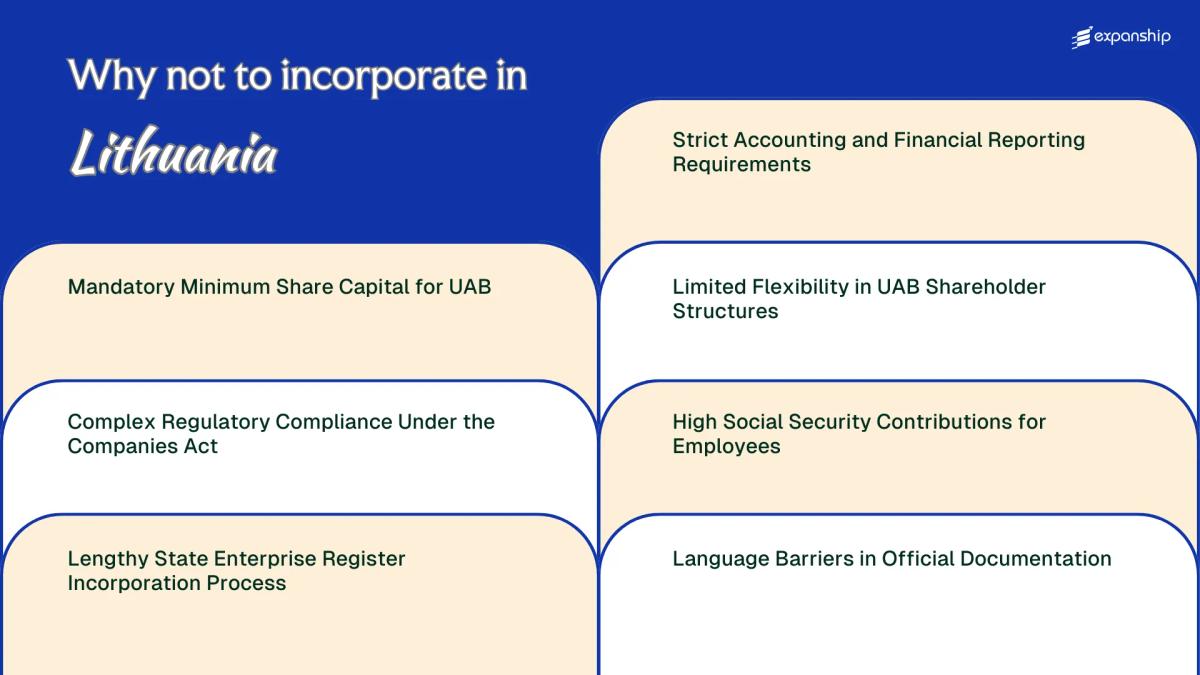
The disadvantages of incorporating in Lithuania span several distinct areas, from capital requirements to administrative processes and employment-related costs. Not all of these will affect every business equally. A solo consultant establishing a small UAB faces a different compliance burden than a manufacturer hiring local staff or a financial services firm subject to sector-specific licensing.
This article is most relevant to non-EU founders, foreign holding structures, and international entrepreneurs who have limited prior exposure to Baltic or EU regulatory environments when evaluating the cons of registering a company in Lithuania.
Mandatory Minimum Share Capital for UAB
Forming a UAB in Lithuania requires a minimum share capital of €2,500, which must be fully paid up before registration. For foreign founders, this upfront capital obligation ties up funds immediately, before the business generates any revenue.
Capital Is Locked at Formation
Under the Law on Companies of the Republic of Lithuania, the €2,500 must be deposited into a bank account and confirmed before the State Enterprise Register (Registrų centras) completes the incorporation. This means your capital is inaccessible during the registration period, creating a liquidity gap at the precise moment a new business typically needs working funds most.
Structural Inflexibility Around Capital Contributions
Contributions can be made in cash or in kind, but non-monetary contributions require an independent valuation, adding cost and time to the process. If your founding capital is asset-based rather than liquid, this requirement introduces a procedural burden that cash-funded entities in comparable EU jurisdictions do not face.
The €2,500 minimum must be fully paid at incorporation, not pledged, meaning foreign founders cannot defer capital commitment until operations begin.
Complex Regulatory Compliance Under the Companies Act
Lithuania Companies Act compliance challenges extend well beyond basic registration formalities. The Law on Companies of the Republic of Lithuania (Akcinių bendrovių įstatymas) imposes a detailed governance framework on UABs, and foreign directors or shareholders unfamiliar with Lithuanian corporate law frequently underestimate the operational weight this creates.
Board resolutions, shareholder meeting protocols, and amendments to constituent documents must conform to specific procedural requirements under the Act. A procedural error does not simply invite correction — it can invalidate a corporate decision, creating legal exposure for the company.
UAB regulatory requirements problems compound when your management sits outside Lithuania. Non-resident directors must still ensure local compliance with:
- Mandatory shareholder meeting timelines that require advance notice in Lithuanian, forcing foreign owners to rely on local legal counsel for every formal resolution
- Strict rules governing profit distribution that restrict dividend payouts unless specific financial conditions are satisfied, delaying access to retained earnings
- Compulsory amendments to the articles of association for material operational changes, each requiring notarisation and re-registration with the Register of Legal Entities
- Document retention obligations under the Act that impose administrative costs on firms without permanent local office infrastructure
Lithuania company law compliance risks are not limited to large structural decisions. Routine corporate actions carry compliance triggers that demand consistent legal oversight.

Company Incorporation in Lithuania
Set up your UAB with full compliance support across the Lithuanian Register of Legal Entities and Companies Act requirements.
Lengthy State Enterprise Register Incorporation Process
Lithuania State Enterprise Register incorporation delays remain one of the more persistent friction points for foreign founders. The Juridinių asmenų registras, or Register of Legal Entities (JAR), operates under the Law on the Register of Legal Entities and processes all UAB registrations. While online submission is available through the self-service portal, the end-to-end timeline from document preparation through final registration confirmation routinely exceeds the stated processing window.
| Stage | Official Timeframe | Practical Risk for Foreign Applicants |
|---|---|---|
| Document notarisation (if required) | 1-3 business days | Notary availability varies; remote founders face delays |
| JAR online submission review | Up to 3 business days | Incomplete filings reset the queue entirely |
| Corrections and resubmission window | 5 business days to respond | Missed deadline requires full restart |
| Final registration certificate issuance | 1-3 business days post-approval | Certificate needed before bank account opening |
Errors or missing information in your submission trigger a formal rejection notice, and your filing re-enters the queue from the beginning. For a foreign founder without a local representative, identifying and correcting the deficiency within the five-business-day response window is genuinely difficult.
The company registration process drawbacks compound when notarisation is involved. Certain structural changes or deed amendments require a Lithuanian notary, and notary appointments are not always immediately available. Each delay at any single stage postpones the entire chain of post-registration steps, including tax registration with the VMI and corporate bank account opening.
Strict Accounting and Financial Reporting Requirements
Lithuania financial reporting requirements drawbacks extend beyond simple bookkeeping. Under the Law on Financial Reporting by Undertakings, UABs are required to prepare annual financial statements in accordance with either Lithuanian Business Accounting Standards (LBAS) or International Financial Reporting Standards (IFRS), depending on entity size and public interest status.
Annual accounts must be submitted to the Register of Legal Entities within four months of the financial year-end. Missing this deadline triggers administrative penalties, and persistent non-compliance can result in forced liquidation proceedings.
For foreign-owned entities, the obligation to maintain books and file reports exclusively in Lithuanian creates a structural cost. Your business will require a locally qualified accountant familiar with LBAS, which is an additional recurring expense that does not exist at this scale in many comparable EU jurisdictions.
- Annual financial statements must be filed within 4 months after the financial year-end
- Accounting records must be maintained in Lithuanian and denominated in euros
- Entities exceeding two of three size thresholds (assets, turnover, headcount) face mandatory audit requirements
- IFRS adoption is compulsory for public-interest entities regardless of owner preference
- Non-compliant entities face fines under the Code of Administrative Offences of the Republic of Lithuania
A UAB that misses its statutory filing deadline can be struck off the register without a creditor petition, meaning the state can initiate dissolution unilaterally.
Limited Flexibility in UAB Shareholder Structures
UAB shareholder structure limitations in Lithuania are more constrained than many foreign investors expect, particularly when compared to holding company structures common in Western Europe.
Structural Restrictions Under the Law on Companies
Lithuania's Law on Companies (Akcinių bendrovių įstatymas) governs the UAB and imposes rules that limit how ownership can be structured. Shareholder agreements have restricted enforceability under Lithuanian law, meaning provisions standard in other jurisdictions, such as drag-along rights or pre-emption waivers, may not hold the same legal weight.
Practical Consequences for Foreign Ownership
For foreign investors accustomed to customising equity arrangements, this creates a gap between contractual intent and enforceable rights. The Civil Code partially supplements gaps in the Companies Act, but relying on two separate legal frameworks to patch ownership mechanics adds cost and uncertainty.
A UAB is capped at 249 shareholders, which, while rarely a binding constraint for small firms, restricts scalability for structures involving employee equity pools or complex multi-tier ownership. This cap makes the UAB unsuitable as a vehicle for broad-based equity participation without restructuring into an AB (public company).
Structuring Your UAB Ownership in Lithuania
Speak with our team about the legal boundaries around UAB shareholder arrangements and how to structure your ownership framework within them.
High Social Security Contributions for Employees
Lithuania social security contributions drawbacks are among the most significant payroll cost factors for any foreign-owned company hiring local staff.
- Employer Sodra contributions are set at 1.77% to 2.49% on top of gross wages, but employee-side deductions run at 19.5%, creating a combined statutory burden that substantially inflates the true cost of each hire.
- Your business must register with Sodra, the State Social Insurance Fund Board, before any employee begins work, making pre-employment lead times non-negotiable.
- Contributions apply from the first employee, with no small-employer threshold or phase-in period that might ease initial hiring costs.
- Health insurance contributions are included within the Sodra framework rather than handled separately, so the full statutory rate applies across every payroll cycle without relief.
- Foreign firms accustomed to lower employer payroll tax obligations in jurisdictions outside the EU may find that Lithuania employment costs erode projected margins faster than pre-entry financial models anticipated.
Language Barriers in Official Documentation
Lithuania official documentation language barriers create a direct operational cost for foreign-owned entities that is easy to underestimate before incorporation. Under Lithuanian law, all official corporate documents, filings submitted to the Register of Legal Entities, and correspondence with state authorities must be in Lithuanian.
This requirement extends to articles of association, board resolutions, contracts filed with public authorities, and financial statements. If your internal team operates in English or another language, every document entering the official record requires certified translation.
Certified legal translation from English into Lithuanian is not a minor administrative expense. For a mid-sized firm filing amended incorporation documents, shareholder agreements, and annual accounts, translation costs can accumulate to several hundred euros per filing cycle, before factoring in translator availability and turnaround time.
There is no general statutory exemption for EU-registered branches or foreign-owned subsidiaries.
A foreign-owned UAB amending its articles of association, filing a notarised shareholder resolution, and submitting audited annual accounts in a single year could realistically incur €600–€1,200 in certified Lithuanian translation fees alone, none of which would apply to the same entity operating in an English-language jurisdiction.
Navigating These Disadvantages Successfully
Overcoming Lithuania incorporation disadvantages requires structural preparation before the entity is registered, not after operational problems surface.
- Pre-fund the UAB with the minimum share capital of EUR 2,500 before submitting registration documents to the Register of Legal Entities.
- Appoint a qualified accountant familiar with the Lithuanian Accounting Standards Board requirements prior to the company's first reporting period.
- Prepare all founding documents in Lithuanian from the outset to avoid rejection delays at the State Enterprise Register of Legal Entities.
- Establish a payroll model that accounts for the State Social Insurance Fund Board (Sodra) contribution rates before hiring the first employee.
- Review the Law on Companies of the Republic of Lithuania to confirm your intended shareholder structure is permissible under UAB rules before incorporation.
Lithuania's regulatory framework is administered through multiple statutory bodies, each with distinct filing requirements and timelines. Compliance gaps at one body frequently create downstream obligations at another.
Lithuania Still a Viable Business Destination
The structural disadvantages covered in this blog are real and measurable. At the same time, Lithuania remains a credible destination for foreign incorporation, particularly given its EU membership, established legal framework under the Law on Companies, and access to the SEPA payment zone.
| Pros | Cons |
|---|---|
| EU member state with access to the single market and SEPA infrastructure | UAB formation requires a minimum share capital of EUR 2,500, which must be deposited before registration |
| Corporate income tax rate of 15% with reduced rates available for small companies | Registration through the State Enterprise Register of Legal Entities involves multiple procedural steps and can extend timelines |
| Recognised legal entity structures with clearly defined shareholder rights under the Law on Companies | Accounting and financial reporting obligations are detailed and subject to strict deadlines under Lithuanian GAAP |
| Membership in the EU single market supports cross-border trade and banking access | High employer social security contribution rates increase the total cost of hiring local staff |
| Lithuanian legal framework aligns with EU directives, providing regulatory predictability | Official documentation is required in Lithuanian, creating friction for foreign directors and shareholders |
Structural costs and procedural requirements do not disappear, but they are known quantities that can be planned for before incorporation.
Compliance Services for Companies in Lithuania
Understand your ongoing compliance obligations under Lithuanian law, including financial reporting deadlines, State Enterprise Register requirements, and social contribution filings.
Conclusion
The cons of Lithuania company incorporation are real and operational, not theoretical. The UAB structure, while widely used across the EU, carries compliance demands that go beyond simple registration. High social security contribution rates affect payroll economics directly. Language requirements in official filings create friction for non-Lithuanian-speaking founders. The State Enterprise Register of Legal Entities process adds timeline uncertainty to entity formation. Structural limitations within UAB shareholder arrangements further constrain certain ownership configurations. For businesses weighing this jurisdiction, understanding these factors in advance determines how smoothly formation and ongoing operation proceed.
Expanship's Support for Your Lithuania Expansion
Expanship's Lithuania company formation support services are structured around the practical realities of incorporating under Lithuanian law, including the Share Capital requirements for a UAB, compliance with the Law on Companies, and registration through the Centre of Registers. The firm's role is to reduce the operational burden these obligations place on your business, particularly around documentation, filings, and ongoing reporting requirements.
Expanship covers the full scope of what your entity needs from day one through ongoing operations.
- Your company is registered with all required documentation prepared in accordance with Lithuanian requirements.
- A registered agent and local office address are provided to satisfy residency obligations.
- Government filings and liaison with the Centre of Registers and State Tax Inspectorate are handled on your behalf.
- Post-incorporation compliance management keeps your firm aligned with annual reporting cycles.
- Banking introduction assistance connects your business with suitable Lithuanian financial institutions.
- Tax registration and coordination with local authorities is managed as part of the setup process.
Reach out to Expanship Lithuania to discuss your incorporation requirements.
Frequently Asked Questions (FAQ)
Yes, the EUR 2,500 minimum applies regardless of whether the UAB has one shareholder or multiple. Lithuania's Law on Companies does not provide a reduced or deferred capital threshold for single-member entities, which distinguishes it from jurisdictions that offer simplified micro-entity structures with nominal capital requirements.
Late or inaccurate submission of annual financial statements to the Register of Legal Entities can result in administrative fines imposed under the Lithuanian Code of Administrative Offences. Directors bear personal liability for reporting failures, and persistent non-compliance can trigger suspension of the company's legal standing. The State Tax Inspectorate may also initiate separate proceedings if reporting deficiencies intersect with tax obligations.
Employer social security contributions in Lithuania are set at 1.77% for health insurance plus an additional Sodra contribution, while the total employer burden including all compulsory payments typically reaches around 1.77% to over 2.49% depending on the employee's contract type, though the combined employee and employer social tax burden is among the higher ones relative to gross salary in the Baltic region. This materially increases the cost per hire beyond the agreed gross salary. Businesses modelling headcount costs based solely on gross wage figures will systematically underestimate their actual payroll expenditure.
Lithuania's incorporation timeline through the Register of Legal Entities generally takes longer than Estonia's e-Residency-enabled digital registration, which can be completed in under a day for eligible applicants. In Lithuania, the process involves notarised documentation, submission to the Register of Legal Entities, and state fee payment, with the standard processing window running several business days even under normal conditions. Estonia's fully digital infrastructure represents a meaningful procedural advantage for founders prioritising speed.
Lithuanian law requires that official corporate documentation submitted to state institutions, including the Register of Legal Entities and courts, must be in the Lithuanian language. Foreign-language documents must be accompanied by certified translations, which adds both cost and processing time to any regulatory interaction. This requirement applies continuously throughout the company's life, not just at incorporation, meaning ongoing compliance filings, amendments, and legal proceedings all carry the same translation burden.
The Law on Companies imposes mandatory rules on shareholder decision-making thresholds and meeting procedures that limit the contractual flexibility available to UAB shareholders. Certain resolutions require qualified majority votes prescribed by statute, and deviations from these thresholds through private shareholder agreements are not enforceable against the company itself. Founders seeking highly bespoke governance arrangements, such as weighted voting classes or drag-along mechanisms with custom triggers, may find the UAB structure less accommodating than corporate forms available in jurisdictions with more permissive company law frameworks.
A foreign director can legally hold the position without Lithuanian residency, but practical management is constrained by the language requirements imposed on official communications and filings. Directors are responsible for ensuring that all submissions to the Register of Legal Entities and tax authorities meet Lithuanian language standards, which in practice requires either fluency or reliance on local legal support. The absence of an English-language administrative interface for most state procedures means remote management carries a structurally higher compliance overhead than in jurisdictions like Estonia or Ireland.
Legal Disclaimer
The information provided in this article is for general informational purposes only and does not constitute legal, tax, or professional advice. While we strive to ensure the accuracy and timeliness of the content, laws and regulations are subject to change, and the application of laws can vary widely based on specific facts and circumstances.
Readers should not act upon this information without seeking professional counsel tailored to their individual situation. Expanship and its authors disclaim any liability for actions taken or not taken based on the content of this article.
For specific advice regarding your business setup, compliance requirements, or any legal matters, please consult with qualified legal and tax professionals in the relevant jurisdiction.