

Key Takeaways
- Lithuania's flat 15% corporate income tax rate, combined with the 0% rate available to qualifying small UABs under the Law on Corporate Income Tax, gives eligible entities a structurally low tax burden within a fully compliant EU framework.
- Companies registered as UABs through Lithuania's Self-Service Portal can achieve legal incorporation within a single business day, reducing the administrative lead time that typically delays market entry in other jurisdictions.
- Foreign nationals can hold 100% ownership of a Lithuanian UAB with no sectoral restrictions on foreign direct investment, removing a structural barrier that exists in several competing jurisdictions.
- Lithuania's double tax treaty network and its status as a Eurozone member state mean that cross-border income flows and EU single market transactions operate under well-defined legal and tax frameworks rather than ad hoc bilateral arrangements.
Situated on the eastern coast of the Baltic Sea, Lithuania is an independent EU member state and part of the Eurozone, giving incorporated entities direct access to European single market frameworks. Company registration falls under the jurisdiction of the Register of Legal Entities, administered by the State Enterprise Centre of Registers. Foreign entrepreneurs typically establish a UAB (uždaroji akcinė bendrovė) as their preferred legal vehicle. The country maintains a low-tax posture anchored by a flat corporate income tax rate, with additional concessions available to qualifying smaller firms.
Foreign nationals face no restrictions on owning 100% of a Lithuanian company, and the government has maintained an open policy toward foreign direct investment across most sectors. Regulatory processes are conducted through digitised systems, reducing administrative friction without eliminating formal compliance requirements.
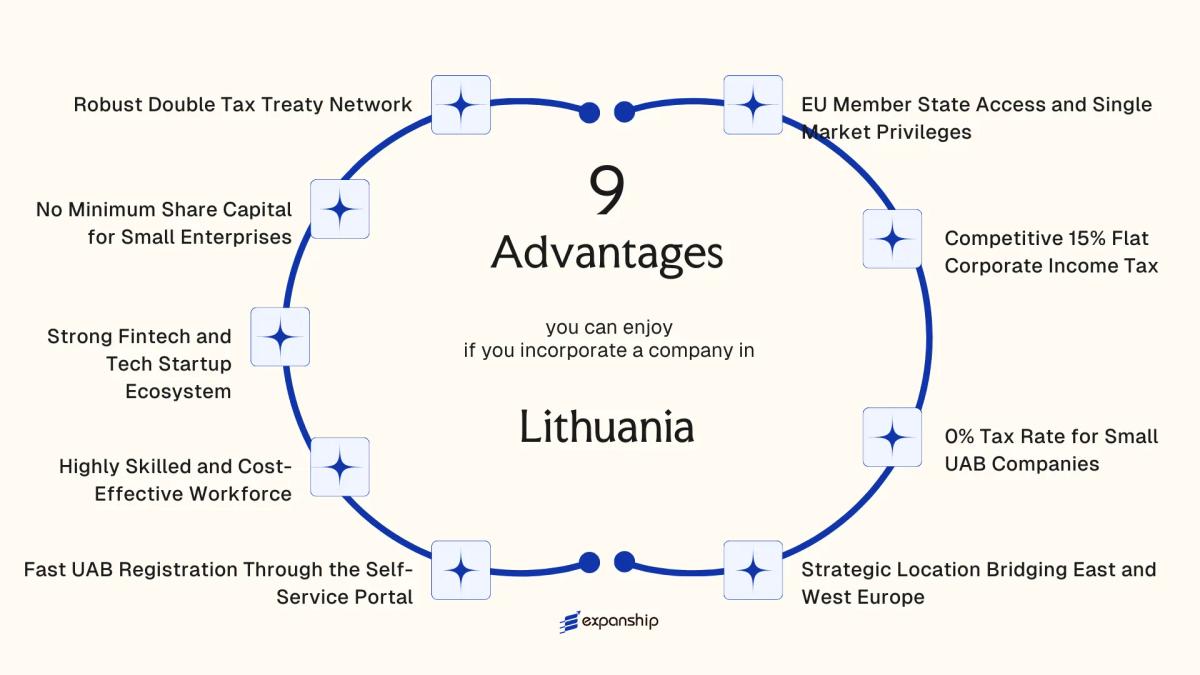
The benefits of incorporating in Lithuania span tax efficiency, EU access, talent availability, and sector-specific advantages — this article examines each in factual detail to support an informed decision about Lithuania company formation.
EU Member State Access and Single Market Privileges
As an EU member since 2004, incorporating in Lithuania gives your business direct access to Lithuania EU single market access benefits, including the freedom to trade goods and services across all 27 member states without customs barriers or re-registration requirements.
Cross-Border Trade Without Friction
A company registered in Lithuania operates under EU law, meaning it can contract with, invoice, and supply clients across the bloc under a single legal framework. This eliminates the cost and delay of establishing separate legal entities in each target market.
Financial Services Passporting
Under EU directives, licensed financial institutions and payment firms incorporated here can passport their authorizations into other member states. This is particularly relevant given that the Bank of Lithuania, which operates under the European Central Bank's supervisory framework, has established a reputation for processing fintech licenses at speed relative to comparable EU regulators.
A Lithuanian entity also benefits from EU-wide VAT mechanisms, including the One Stop Shop (OSS) scheme, which simplifies VAT reporting for cross-border digital and e-commerce sales across all member states.
One Lithuanian entity can serve the entire EU market without requiring separate incorporation in each country you sell to.
Competitive 15% Flat Corporate Income Tax
Lithuania's standard corporate income tax rate sits at 15%, applied as a flat rate on taxable profits under the Law on Corporate Income Tax (Pelno mokestis įstatymas). Compared to the EU average corporate tax rate of approximately 21%, this flat structure means your business retains a meaningfully larger share of earnings without navigating tiered rate bands or complex phase-out thresholds.
The flat-rate design matters for forecasting. Foreign-owned entities can calculate tax liability with straightforward arithmetic rather than consulting bracket schedules, which simplifies financial planning across accounting periods and reduces reliance on local tax advisory for routine projections.
The Lithuania 15% corporate income tax advantage also applies consistently regardless of company size for standard UABs (uždarosios akcinės bendrovės) subject to normal PMI rules, meaning a mid-sized foreign-owned firm does not face a higher marginal rate as it scales.
Several structural features make the rate particularly workable for foreign businesses:
- Taxable profit is calculated on actual net income, not revenue, so operating costs reduce the base before the rate applies
- The flat rate eliminates bracket-driven incentives to artificially cap profits within a reporting period
- Compliance with the State Tax Inspectorate (VMI) follows a codified annual return process, without rate-specific reporting variations

Incorporate a Company in Lithuania
Register your Lithuanian UAB with full compliance support across tax registration, share structure, and State Tax Inspectorate filings.
0% Tax Rate for Small UAB Companies
Under the Lithuanian Law on Corporate Income Tax (Pelno mokesčio įstatymas), small UABs (uždarosios akcinės bendrovės) meeting defined thresholds can apply a 0% corporate income tax rate on the first €20,000 of annual taxable profit. The Lithuania 0% tax rate for small UAB companies effectively eliminates the tax burden during the early revenue-generating years, preserving capital that would otherwise be remitted to the state.
To qualify, a UAB must have fewer than ten employees and gross annual income not exceeding €300,000. Shareholders must be natural persons, not legal entities. This structural requirement is deliberate: the benefit is designed for owner-operated micro-businesses, making it directly accessible to a sole foreign founder who holds shares personally.
| Condition | Requirement |
|---|---|
| Maximum employees | Fewer than 10 |
| Annual gross income ceiling | Up to €300,000 |
| Shareholder type | Natural persons only |
| Tax-free profit threshold | First €20,000 |
| Standard rate above threshold | 15% |
Profits exceeding the €20,000 threshold are taxed at the standard 15% flat rate, so the zero-rate functions as a graduated relief rather than a blanket exemption. For a foreign entrepreneur incorporating a UAB as a first EU operational entity, this structure allows retained earnings to fund growth before the full corporate tax obligation applies. That retained capital can be reinvested into operations, staffing, or market expansion without an immediate statutory deduction reducing the available base.
Strategic Location Bridging East and West Europe
Lithuania's strategic location bridging East and West Europe is a structural advantage that many foreign businesses underestimate until they map out their logistics. Sitting at the crossroads of Northern, Central, and Eastern Europe, the country shares borders with Latvia, Belarus, Poland, and the Kaliningrad Oblast of Russia, while maintaining direct transport corridors to Western European markets.
The Via Baltica and Rail Baltica infrastructure projects connect the Baltic states directly to Poland and, further, to the broader EU rail and road network. For businesses distributing goods across the continent, this translates into measurable reductions in transit time and freight costs.
Klaipeda, the only ice-free port on the eastern Baltic coast, handles cargo year-round without the seasonal restrictions that affect other regional ports. Companies incorporated locally can use it as a distribution hub for both EU and CIS-adjacent markets, without maintaining separate logistics entities in multiple countries.
Keep these factors in mind:
- Klaipeda State Seaport handles over 40 million tonnes of cargo annually
- Rail Baltica will integrate the Baltic states into the EU's TEN-T core network
- The free economic zone at Klaipeda offers additional customs and tax incentives
- Trade routes through Belarus are subject to EU sanctions; verify compliance before planning eastward logistics
Lithuania shares a time zone with Central European countries like Poland and Hungary, not with the other Baltic states, giving Vilnius-based teams a scheduling edge when coordinating across both Eastern and Western European offices simultaneously.
Fast UAB Registration Through the Self-Service Portal
The Lithuania UAB fast registration benefits begin before your company even opens its doors. The Centre of Registers (Registrų centras) operates a self-service portal through which a UAB can be incorporated entirely online, without requiring a physical presence in the country. For a foreign business owner, this eliminates the logistical cost of travel and reduces the dependency on local intermediaries for the formation step itself.
Speed as a Structural Advantage
Registration through the portal can be completed within one business day when documents are in order and the electronic submission is made correctly. That turnaround is not incidental; it reflects a deliberate legal design under the Law on Companies of the Republic of Lithuania, which sets out streamlined formation procedures for private limited liability companies. Faster registration means your entity can open a corporate bank account, sign contracts, and begin operations sooner, all of which has direct commercial value.
What Remote Incorporation Actually Enables
A foreign founder with a qualified electronic signature recognised under the eIDAS regulation can submit the incorporation documents without appointing a local representative solely for formation purposes. This reduces both the cost and the procedural layer that many other EU jurisdictions require at the point of formation. Your company's deed of incorporation, shareholder data, and registered address are filed digitally and become part of the public Register of Legal Entities upon approval.
Plan Your UAB Incorporation in Lithuania
Get guidance on using the self-service portal, meeting formation requirements, and structuring your Lithuanian entity from day one.
Highly Skilled and Cost-Effective Workforce
Lithuania skilled workforce advantages for businesses stem from a combination of high educational attainment and wage levels that remain below the Western European average, making the country a practical base for building technical and operational teams.
- Around 57% of Lithuanians aged 25 to 34 hold a tertiary education qualification, one of the higher rates within the EU. For a foreign-owned UAB, this translates directly into access to degree-educated candidates without the salary expectations typical of markets like Germany or the Netherlands.
- Average gross monthly wages in Lithuania were approximately EUR 1,900 as of recent national statistics. Engineering, IT, and finance roles can be filled at costs considerably below comparable positions in Western EU member states, which reduces your payroll burden during the early stages of operation.
- English proficiency is high among working-age professionals, particularly in urban centers like Vilnius and Kaunas. This reduces onboarding friction for foreign management and removes the need to invest heavily in language training.
- The Labour Code of Lithuania (in force since 2017) governs employment contracts, working hours, and termination procedures within a defined legal framework. Understanding this structure upfront allows your business to set realistic HR expectations before registering the entity.
- The country produces a consistent graduate pipeline in STEM fields through institutions such as Vilnius University and Kaunas University of Technology, sustaining talent availability in sectors where skilled hiring is otherwise competitive across the EU.
Strong Fintech and Tech Startup Ecosystem
Lithuania fintech startup ecosystem advantages are, in large part, a product of deliberate regulatory architecture. The Bank of Lithuania, operating under the Law on the Bank of Lithuania, issues Electronic Money Institution (EMI) and Payment Institution (PI) licenses with a comparatively fast processing timeline. For foreign fintech founders, this means a licensed EU entity without the multi-year authorization queues common in larger Western European markets.
The regulatory sandbox program, administered by the Bank of Lithuania, allows fintech firms to test financial products under a supervised framework before full licensing. This reduces capital exposure during early-stage development and gives foreign operators a structured path to EU regulatory compliance.
Vilnius has become a concentration point for fintech talent, with over 260 licensed fintech companies operating in the country as of recent years. The density of licensed entities creates a ready ecosystem of legal, compliance, and technical professionals familiar with EU financial regulation.
According to the Bank of Lithuania's own reporting, Lithuania ranks among the top EU jurisdictions by number of active EMI and PI licenses issued, with over 100 payment and e-money institutions licensed by 2023, making it one of the most active fintech licensing centers on the continent.
No Minimum Share Capital for Small Enterprises
Under Lithuania's Law on Companies, a private limited liability company (UAB) classified as a small enterprise can be registered with a minimum share capital of just EUR 1. This threshold removes a common financial barrier that, in many jurisdictions, requires founders to lock up thousands of euros before a business generates a single transaction.
For a foreign founder, this has a direct practical consequence: capital that would otherwise sit in a statutory reserve can be deployed into operations, hiring, or product development from day one.
Eligibility for this reduced threshold is tied to small enterprise status under Lithuanian law, which applies criteria related to employee headcount, annual revenue, and total assets. Once a UAB exceeds those thresholds, standard share capital requirements apply.
- The EUR 1 minimum applies specifically to UABs meeting small enterprise criteria
- Share capital must be fully paid up at the time of registration
- The registered capital figure is publicly recorded in the Register of Legal Entities (Juridinių asmenų registras)
The EUR 1 minimum share capital is only available to UABs that qualify as small enterprises under Lithuanian classification criteria; confirm your projected revenue, headcount, and asset figures before assuming this threshold applies to your entity.
Robust Double Tax Treaty Network
Lithuania's double tax treaty network benefits foreign-owned companies by reducing or eliminating withholding taxes on dividends, interest, and royalties paid across borders. The country has concluded over 55 bilateral tax treaties, covering major trading partners across the EU, the US, Canada, China, Japan, and the United Arab Emirates, among others.
These agreements are grounded in the OECD Model Tax Convention framework and administered under Lithuanian domestic law, primarily the Law on Corporate Income Tax (Pelno mokesčio įstatymas). When your business routes payments to or from a treaty partner, the applicable withholding rate is governed by the treaty rather than the domestic statutory rate, which can result in significantly lower tax costs on cross-border transactions.
Reduced Withholding on Dividends and Royalties
For foreign investors receiving dividends from a Lithuanian entity, treaty provisions frequently reduce the standard withholding rate to 0-5%, depending on the specific treaty terms and shareholding thresholds. Royalty payments, which under domestic law may be subject to withholding, are often reduced to zero under treaty provisions with key jurisdictions.
Relevance for Holding and IP Structures
Companies using a Lithuanian entity as part of a regional holding or intellectual property structure benefit directly from this treaty coverage. Profits repatriated to a parent company in a treaty jurisdiction face lower tax friction compared to holding structures based in non-treaty countries.
- Treaty benefits generally require the recipient entity to be the beneficial owner of the income
- Anti-abuse provisions apply under both domestic law and relevant EU Directives
- Treaty eligibility depends on the tax residency status of all parties involved
Lithuania vs Other EU Business Destinations
Comparing Lithuania vs other EU business destinations is most useful when set against jurisdictions targeting the same foreign investor profile. Estonia, Latvia, and Ireland are the natural reference points: the Baltic neighbours share the same geographic context and similar UAB/OÜ-style private company structures, while Ireland attracts many of the same international businesses seeking an English-language, common-law EU base.
Across registration speed, tax structure, and incorporation costs, the comparison reveals meaningful differences that affect operational setup, not just headline rates. Estonia's e-Residency programme is widely cited, yet its 20% corporate income tax on distributed profits contrasts with the flat 15% rate applied to standard Lithuanian entities. Ireland's 12.5% trading rate is lower, but statutory costs and professional fees at incorporation are considerably higher. Latvia's corporate tax similarly applies only on profit distribution, which can defer liability but reduces planning predictability for certain business models.
| Parameter | Lithuania | Estonia | Latvia | Ireland |
|---|---|---|---|---|
| Standard Corporate Tax Rate | 15% flat | 20% on distributed profits | 20% on distributed profits | 12.5% (trading income) |
| Small Company Tax Rate | 0% (qualifying UAB) | No equivalent exemption | No equivalent exemption | 25% (passive/non-trading) |
| Minimum Share Capital (Private Company) | None (small UAB) | €2,500 (OÜ) | €2,800 (SIA) | No minimum (LTD) |
| Online Incorporation Portal | Yes (JAR Self-Service) | Yes (e-Business Register) | Yes (UR portal) | Yes (CRO online) |
| EU Single Market Access | Yes | Yes | Yes | Yes |
| State Registration Fee | Low | Moderate | Low | Moderate |
| Language of Business Registration | Lithuanian / English supported | Estonian / English supported | Latvian / English supported | English |
Compliance Services for Companies in Lithuania
Maintain your Lithuanian UAB in good standing with registered address, annual reporting, and ongoing regulatory obligations managed by local specialists.
Conclusion
Lithuania's position as an EU member state with a flat 15% corporate income tax rate, a genuine 0% rate for qualifying small UABs under the Law on Corporate Income Tax, and a Self-Service Portal that can complete company registration within a single business day creates a coherent structural case for incorporation. These are not isolated incentives but interlocking features that reduce both the cost and the administrative burden of establishing a legal presence in the European single market.
That said, the benefits of incorporating in Lithuania are not uniformly distributed. A small consulting firm targeting EU clients will draw different value from this jurisdiction than a fintech scaling across multiple regulatory frameworks or a logistics operation relying on geographic positioning between Central and Eastern Europe. The tax relief thresholds, workforce cost dynamics, and treaty protections each carry different weight depending on your entity's income profile and sector.
For businesses where the structural fit is present, the combination of tax efficiency, EU market access, and low formation costs makes this jurisdiction a technically sound choice. The question is not whether these advantages exist, but whether they align with how your business generates revenue, where it employs people, and how it manages cross-border obligations. Determining that alignment with confidence requires jurisdiction-specific analysis tailored to your corporate structure.
Start Your Lithuanian Company with Expanship Today
Incorporating in Lithuania with Expanship begins with understanding which entity structure fits your objectives. This blog has covered the UAB (uždaroji akcinė bendrovė) as the primary vehicle for foreign investors, touching on tax rates, share capital rules, workforce advantages, and treaty access. Expanship works directly within that framework, supporting the registration process through the Centre of Registers (Registrų centras) and ensuring your entity meets the ongoing compliance obligations set by Lithuanian law.
Expanship's services across the incorporation and post-incorporation cycle include:
- Preparation and legalization of incorporation documents, including the articles of association
- Registered address and resident agent provision, as required under the Law on Companies of the Republic of Lithuania
- Filing coordination with the Registrų centras and relevant government authorities
- Post-incorporation compliance management, covering annual reporting and corporate governance obligations
- Banking introduction assistance to support your entity's operational setup
- Ongoing registered office maintenance and director services where applicable
Your business can engage Expanship at the formation stage or after incorporation, depending on where you are in the process. The firm does not replace legal counsel but operates as a structured intermediary for corporate administration and regulatory filing, reducing the administrative burden on foreign principals who are not based in the country.
To discuss your incorporation requirements, contact Expanship Lithuania.
Frequently Asked Questions (FAQ)
A qualifying small UAB can apply a 0% corporate income tax rate on the first EUR 300,000 of taxable profit, provided the company has fewer than ten employees and its gross annual income does not exceed EUR 300,000. These thresholds are set under the Lithuanian Law on Corporate Income Tax. If either threshold is exceeded during the tax year, the standard 15% flat rate applies to the full taxable profit.
Lithuania maintains double tax treaties with over 55 countries, including major economies across the EU, Asia, and North America. The specific withholding tax rates on dividends, interest, and royalties vary by treaty. Treaty relief is available only when the beneficial ownership conditions stipulated in the relevant agreement are satisfied.
No local director or resident shareholder is required to form a UAB. Both the sole director and all shareholders may be foreign nationals residing outside Lithuania. However, the company must maintain a registered address in Lithuania and designate a contact point reachable by the Register of Legal Entities.
At 15%, Lithuania's headline corporate income tax rate is below the EU average of approximately 21%. Countries such as Germany and France apply rates exceeding 25%, while Ireland's 12.5% rate remains lower. The effective rate in Lithuania can fall further for companies qualifying under the small enterprise provisions of the Law on Corporate Income Tax.
If a UAB breaches either the ten-employee limit or the EUR 300,000 gross income threshold during a tax period, the 0% preferential rate no longer applies for that year. The standard 15% corporate income tax rate then applies to the company's taxable profit for the full period. Businesses approaching these thresholds should monitor their figures against the criteria defined in the Lithuanian Law on Corporate Income Tax to avoid unplanned tax liability.
Yes, a UAB incorporated in Lithuania is an EU-domiciled entity and can register for VAT under Council Directive 2006/112/EC, enabling it to trade goods and supply services across EU member states under standard intra-community rules. The company can also engage staff across the EU under the Posted Workers Directive and benefit from the freedom of establishment. VAT registration in Lithuania is handled through the State Tax Inspectorate (VMI).
Legal Disclaimer
The information provided in this article is for general informational purposes only and does not constitute legal, tax, or professional advice. While we strive to ensure the accuracy and timeliness of the content, laws and regulations are subject to change, and the application of laws can vary widely based on specific facts and circumstances.
Readers should not act upon this information without seeking professional counsel tailored to their individual situation. Expanship and its authors disclaim any liability for actions taken or not taken based on the content of this article.
For specific advice regarding your business setup, compliance requirements, or any legal matters, please consult with qualified legal and tax professionals in the relevant jurisdiction.