
Key Takeaways
- Comoros's adoption of the OHADA Uniform Act on commercial companies introduces a layer of supranational legal obligation that foreign registrants must navigate alongside domestic regulatory gaps, creating compliance uncertainty that few local advisors are equipped to resolve.
- The jurisdiction's minimal double taxation treaty network leaves foreign-owned entities exposed to potential double taxation on cross-border income, a burden that significantly erodes the financial rationale for structuring through Comoros.
- Persistent deficiencies in banking infrastructure limit foreign companies to a narrow range of financial institutions with restricted correspondent banking relationships, complicating routine transactions such as international wire transfers and trade finance.
- Weak intellectual property protections mean that businesses holding proprietary assets — patents, trademarks, or trade secrets — cannot rely on Comorian legal mechanisms to enforce those rights against domestic infringement.
The disadvantages of incorporating in Comoros span operational, financial, and regulatory dimensions that foreign investors frequently underestimate before committing to a structure there. Comoros operates under an evolving regulatory framework, with company formation governed by provisions under the OHADA Uniform Act on commercial companies, which the Union formally adopted to standardize business law across member states.
The categories addressed in this article range across infrastructure, legal, financial, and reputational concerns specific to operating a registered entity in this jurisdiction.
Disadvantages do not apply uniformly. A holding company structured for asset protection encounters different friction points than an operational firm engaged in trade or services, and industry type further shapes the exposure to specific risks.
This article is most relevant to foreign entrepreneurs, small-to-mid-sized firms, and offshore structuring advisors evaluating Comoros company formation drawbacks before proceeding with registration or considering the risks of registering a business there.
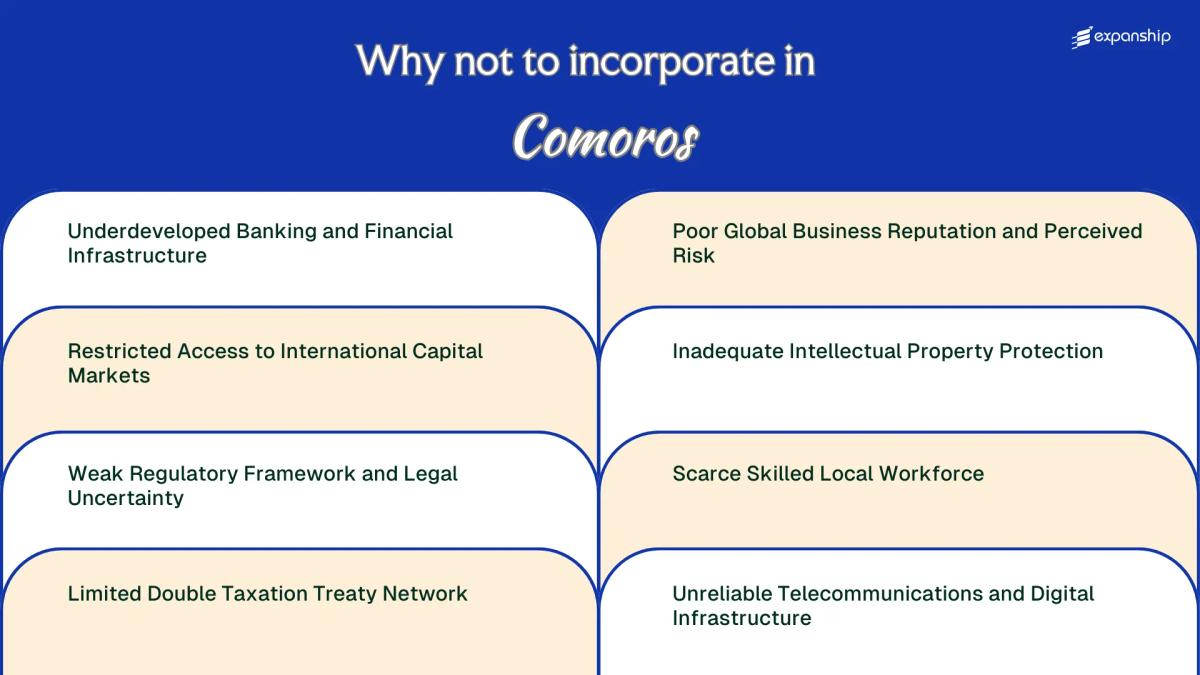
Underdeveloped Banking and Financial Infrastructure
Comoros banking infrastructure problems affect foreign businesses from the moment they attempt to establish operational accounts. The country's financial system remains among the least developed in the Indian Ocean region.
Thin Banking Network and Limited Correspondent Relationships
Comoros has only a small number of commercial banks, with the Banque Centrale des Comores serving as the regulatory authority overseeing a sector that lacks depth in both credit facilities and transaction infrastructure. Foreign-owned entities frequently encounter difficulties obtaining corporate accounts, as local banks apply cautious due diligence standards toward non-resident directors and offshore structures.
Correspondent banking relationships with major international institutions are limited, which means cross-border wire transfers can face delays, rejections, or elevated fees that erode operational efficiency for any business relying on regular international payments.
Restricted Financial Products for Foreign Entities
Trade finance instruments such as letters of credit, business credit lines, and multi-currency accounts are largely unavailable through domestic banks, forcing your business to seek these services abroad. That dependency adds cost, jurisdictional complexity, and counterparty friction to routine financial operations.
Banking access challenges in Comoros are compounded by the franc comorien's peg to the euro, which limits monetary flexibility without resolving the underlying gaps in financial product availability.
Foreign business owners should assume that routine corporate banking functions available in most jurisdictions, including multi-currency accounts and trade finance, cannot be reliably sourced from within the local financial system.
Restricted Access to International Capital Markets
Comoros capital markets access restrictions affect foreign businesses from the moment they seek external financing. The country has no functioning domestic stock exchange, which means equity capital cannot be raised locally through public listings.
Without access to a formal securities market, your firm must rely entirely on private arrangements or foreign financial institutions to raise growth capital. Those institutions routinely apply higher risk premiums to entities incorporated in jurisdictions with limited financial oversight and no credit rating infrastructure.
The practical friction this creates is significant:
- Correspondent banking relationships are difficult to establish, forcing you to route transactions through intermediary banks at added cost and delay.
- Foreign lenders unfamiliar with the Comorian legal system treat local incorporation as a credit risk factor, directly increasing borrowing costs.
- Development finance institutions that require compliance with internationally recognized capital markets standards will disqualify your entity at the screening stage.
- Without a recognized regulatory body equivalent to a securities commission, there is no formal framework for bond issuance or structured finance instruments.
International financing challenges in this jurisdiction extend to trade finance as well. Letters of credit and similar instruments are harder to process when local banking counterparties lack established correspondent networks.

Company Incorporation in Comoros
Understand the full regulatory and structural requirements before registering a business entity in Comoros.
Weak Regulatory Framework and Legal Uncertainty
Comoros weak regulatory framework risks stem largely from the absence of a consolidated, modern commercial code. The legal system draws from a fragmented mix of French civil law, Islamic law, and local customary rules, with no unified body reliably governing corporate conduct.
The body nominally responsible for commercial registration is the Tribunal de Commerce, but enforcement capacity remains thin and inconsistently applied. Your firm may find that registered obligations carry little practical weight when disputes arise.
| Regulatory Factor | Condition / Limitation | Practical Burden for Foreign Business |
|---|---|---|
| Commercial dispute resolution | No dedicated commercial court system | Disputes routed through under-resourced civil courts with unpredictable timelines |
| Corporate law codification | No modern standalone companies act | Reliance on outdated French colonial-era statutes with significant interpretive gaps |
| Regulatory oversight body | No independent corporate regulator | Compliance standards are unenforced or applied inconsistently |
| Contract enforceability | Weak judicial enforcement mechanisms | Foreign-law contracts offer limited practical protection domestically |
Corporate law instability means that statutory requirements can shift without advance notice or structured consultation, leaving your entity exposed to retrospective compliance obligations. There is no equivalent of a formal regulatory gazette process that provides predictable rule-making timelines.
For businesses dependent on legal certainty, such as financial services firms or those holding IP assets, this unpredictability is a structural operating cost. Exceptions exist for entities operating within the autonomous island frameworks of Anjouan or Mohéli, where offshore-specific regulations apply, though those regimes carry their own reputational constraints.
Limited Double Taxation Treaty Network
Comoros double taxation treaty limitations present a concrete structural problem for foreign businesses. The country has not signed a broad network of bilateral tax treaties, leaving your company exposed to potential double taxation on income earned across borders without any formal relief mechanism.
Without a treaty in place between Comoros and your home country, income may be taxed twice — once locally and once in your jurisdiction of residence. This is a direct cost burden, not a theoretical risk.
Most major trading economies have extensive treaty networks. Countries like Mauritius or Cyprus maintain dozens of active DTAs, giving resident entities access to reduced withholding tax rates on dividends, royalties, and interest. The lack of DTAs in Comoros business structures means those rate reductions are simply unavailable.
The OECD tax treaty database confirms Comoros has minimal participation in the global treaty framework. Foreign shareholders receiving distributions from a Comorian entity carry the full withholding burden, with no treaty-based cap to contain it.
- No bilateral tax treaty may apply between Comoros and your home country
- Withholding taxes on dividends, royalties, or interest are not capped by treaty rates
- Foreign tax credit eligibility in your home country depends entirely on domestic law, not treaty provisions
- Repatriation of profits may trigger full taxation at both ends without offset
Despite its offshore reputation, Comoros has not signed a single comprehensive double taxation agreement with any G20 nation.
Poor Global Business Reputation and Perceived Risk
Comoros business reputation risks are well-documented among international compliance professionals and correspondent banks. The jurisdiction has appeared on international watchlists that directly affect how foreign-registered entities are perceived by third parties.
How International Classifications Shape Counterparty Behavior
Comoros has been associated with concerns raised by bodies including the Financial Action Task Force (FATF) and the EU's list of non-cooperative jurisdictions for tax purposes, creating a credibility problem that precedes any due diligence meeting. Banks, institutional partners, and payment processors in regulated markets frequently apply enhanced scrutiny or outright refusal to entities incorporated there, regardless of the underlying business activity.
Comoros offshore company perceived risk is not abstract; it translates into declined account applications, restricted correspondent banking access, and delayed transactions that impose direct operational costs on your business.
The Structural Source of the Credibility Gap
The Comoros jurisdiction credibility problems stem partly from the historically permissive structure of its autonomous island regimes, particularly Anjouan, which previously operated independent offshore licensing frameworks with minimal oversight. That legacy persists in how compliance officers and institutional risk teams assess any entity with a Comorian registration.
Businesses incorporated under the Union's current framework still carry reputational drawbacks that have not been fully reversed by subsequent regulatory reforms.
Assessing Incorporation Risk in Comoros
Understand the full compliance and reputational implications of a Comorian entity before committing to this jurisdiction.
Inadequate Intellectual Property Protection
Comoros intellectual property protection risks are a direct concern for any business holding proprietary assets, as the country lacks a dedicated national IP registry or a standalone intellectual property law. Trademark registration limitations mean your brand assets have no enforceable domestic registration pathway independent of regional frameworks.
- Comoros is a member of the African Intellectual Property Organization (OAPI) framework only through indirect regional arrangements, so IP rights enforcement challenges arise because your registrations may not be directly actionable before local courts without additional procedural steps.
- No specialized IP tribunal exists within the domestic judiciary, forcing disputes into general civil courts that lack the technical expertise to adjudicate patent or trademark claims reliably.
- Customs authorities in the country have limited capacity to intercept counterfeit goods at ports of entry, leaving your registered marks practically undefended against infringing imports.
- Even where rights are formally recognized, the absence of a structured enforcement mechanism means obtaining injunctive relief can take years through the ordinary civil process.
Scarce Skilled Local Workforce
Comoros skilled workforce limitations present a structural hiring challenge that foreign businesses rarely anticipate before incorporation. With a population of roughly 900,000 spread across three main islands, the available talent pool is inherently small. Specialized disciplines — finance, engineering, IT, and legal services — are significantly underrepresented.
Tertiary enrollment rates remain low, and the country has no established university system producing graduates at the scale required to support a formal corporate environment. Many educated Comorians emigrate to France, Mayotte, or Réunion, accelerating the brain drain problem.
For a foreign entity operating locally, this means relying on expatriate hires, which triggers residency and work permit requirements under Comorian labor regulations. That process adds both administrative cost and lead time to staffing any operation.
Talent scarcity challenges in Comoros business affect even basic back-office functions. Sourcing locally qualified accountants or compliance officers is not straightforward, and firms often end up paying above-market rates to retain the few available candidates.
A foreign firm requiring three mid-level finance professionals locally could realistically spend 40–60% more on total employment costs compared to a similar hire in a larger regional hub like Mauritius, once expatriate relocation packages and permit fees are factored in.
Unreliable Telecommunications and Digital Infrastructure
Comoros digital infrastructure challenges rank among the more concrete operational barriers for any foreign-registered entity attempting to run meaningful business activity through this jurisdiction. The country relies heavily on a single undersea fiber-optic cable, the EASSy cable, for international connectivity. A single point of failure at that level means any fault or maintenance window can sever the archipelago's external internet access entirely.
Mobile and fixed-line penetration rates remain low by regional standards, and electricity supply instability compounds the problem. Frequent power outages disrupt connectivity even where network coverage technically exists, making consistent digital operations unreliable rather than merely slow.
For businesses that depend on real-time communications, cloud-based accounting, or digital banking interfaces, this is a direct operational cost. Your team or local service providers cannot guarantee uptime for routine tasks that most jurisdictions treat as basic infrastructure.
- Bandwidth is limited and expensive relative to the service quality delivered.
- VoIP and video conferencing tools that support international client relationships frequently suffer packet loss.
- Local co-location or data hosting options are effectively non-existent.
If your business model requires consistent digital connectivity for compliance filings, financial reporting, or client-facing operations, the absence of redundant internet infrastructure means service interruptions are not exceptional events but an expected operational variable.
Overcoming These Incorporation Challenges
Overcoming Comoros incorporation challenges requires structural planning rather than reactive adjustments. The disadvantages covered in this blog, from banking access gaps to IP enforcement failures, are systemic and cannot be resolved through routine compliance alone.
- Register your entity under the OHADA Uniform Act framework, which governs commercial company formation and provides a more codified legal baseline than domestic statutes alone.
- Open correspondent banking relationships through regional institutions before initiating operations, given the absence of correspondent banking access documented under the local financial system.
- File intellectual property rights with OAPI (Organisation Africaine de la Propriété Intellectuelle), as the Comoros is a member state and OAPI registration carries regional enforceability.
- Structure payroll and senior staffing to draw from offshore talent pools, acknowledging the documented scarcity of qualified local professionals.
- Use bilateral investment treaty provisions where available to establish a defined legal recourse mechanism outside the domestic court system.
These steps address documented structural gaps but do not eliminate them. The OHADA secretariat provides the closest approximation to a standardised regulatory reference point for businesses operating under this jurisdiction's commercial law.
Comoros Business Viability Assessment
Any Comoros business viability risks assessment must account for a clear-eyed view of what the jurisdiction offers alongside its well-documented structural limitations. Comoros holds legal standing as an incorporation destination and maintains recognized offshore legislation, but the operational realities facing foreign businesses are material and cannot be dismissed.
| Pros | Cons |
|---|---|
| Low corporate tax environment reduces the overall tax burden for qualifying entities | No significant double taxation treaty network limits relief from withholding taxes in counterpart jurisdictions |
| Offshore company legislation provides a defined legal framework for foreign-owned structures | Weak regulatory oversight and legal uncertainty increase exposure to compliance and enforcement unpredictability |
| Relatively low incorporation and maintenance costs compared to established offshore centers | Underdeveloped banking infrastructure makes opening and maintaining a functional business account difficult |
| Geographic position offers nominal access to Indian Ocean trade routes | Poor international reputation raises due diligence concerns with foreign banks, partners, and counterparties |
| Minimal local staffing requirements for offshore entities reduce operational overhead | Inadequate digital and telecommunications infrastructure limits remote business management |
Evaluating Comoros incorporation drawbacks against its cost advantages is the central exercise for any prospective registrant. The jurisdiction suits a narrow profile of use cases and performs poorly against most operational benchmarks that international businesses typically require.
Compliance Services for Companies in Comoros
Maintain your Comoros entity in good standing with accurate filings, regulatory reporting, and ongoing compliance support tailored to local requirements.
Conclusion
The Comoros incorporation disadvantages summary points to a jurisdiction where structural limitations carry real operational weight. Banking access remains fragmented, with correspondent banking relationships difficult to secure and account approvals subject to prolonged delays. The absence of a substantive double taxation treaty network compounds exposure for cross-border structures. Regulatory unpredictability, rooted in inconsistently applied commercial law, adds further friction for firms requiring legal certainty. These are not marginal concerns. For any business evaluating incorporation here, qualified local legal counsel and a clear operational framework are prerequisites, not optional steps.
Expanship's Comoros Expansion Support
Comoros expansion support challenges are real and operational, spanning fragmented regulatory oversight under bodies such as the Agence Nationale de l'Aviation Civile et de la Météorologie and the Comorian Ministry of Finance, currency controls tied to the Comorian franc's peg to the euro, and compliance obligations that shift without formal notice. Expanship's role is to reduce the administrative weight of these specific obligations on your business, not to change the underlying conditions of the jurisdiction.
Expanship works with clients across the full incorporation and post-incorporation cycle in Comoros.
- Your company registration and all associated document preparation are handled directly with the relevant Comorian authorities.
- A registered agent and local office address are provided to satisfy statutory presence requirements.
- Government filings and liaison with regulatory bodies are managed on your behalf throughout the process.
- Post-incorporation compliance obligations are monitored and maintained as your entity continues to operate.
- Banking introduction assistance is provided to help your firm establish a functional local account relationship.
- Tax registration and coordination with local authorities are completed as part of the setup process.
Reach out to Expanship Comoros to discuss your specific incorporation requirements.
Frequently Asked Questions (FAQ)
Yes, the lack of a meaningful DTT network applies regardless of the entity structure you register in Comoros. Unlike jurisdictions such as Mauritius or Cyprus, which have signed extensive treaty networks, Comoros has concluded very few agreements covering withholding tax relief on dividends, royalties, or interest. This means income flows between your Comoros entity and foreign subsidiaries or clients are exposed to double taxation without any treaty-based mitigation.
Comoros offers materially weaker IP protection than most comparable low-cost jurisdictions. The country has limited domestic enforcement mechanisms for trademarks and patents, and local courts have little precedent or capacity for handling IP disputes. If your business model depends on protecting proprietary technology, branding, or creative works, registration in Comoros provides negligible practical deterrence against infringement.
Your operations effectively stop, and there is no reliable fallback framework to depend on. Internet connectivity in Comoros is limited to undersea cable links that have historically suffered outages, and domestic redundancy options are minimal. Businesses that require consistent uptime for cloud platforms, payment processing, or client communications face a structural reliability problem that cannot be resolved locally.
Comoros carries a higher reputational risk than most mid-tier offshore jurisdictions. While jurisdictions like the BVI or Cayman Islands have made significant compliance reforms and maintain FATF-compliant frameworks, Comoros has faced scrutiny for its regulation of offshore structures and has appeared in international risk assessments that correspondent banks actively screen against. That places it in a more restricted category for banking access than most of its regional peers.
Hiring expatriates is legally possible but administratively slow and practically complicated. Work permit processing in Comoros lacks a transparent, time-bound regulatory procedure, and the absence of bilateral labor agreements with most countries adds further delays. For businesses that need to staff up quickly or bring in specialist roles, relying on Comoros-based human resources creates a bottleneck that offshore-managed structures cannot fully resolve.
The primary risk is that regulatory changes can take effect without adequate transition periods or published guidance, leaving your entity non-compliant before you have an opportunity to adjust. Comoros does not have a codified, publicly accessible commercial law registry that updates in real time, and enforcement practices can shift based on administrative discretion rather than transparent rule-making. This creates an unpredictable compliance environment where legal exposure is difficult to quantify in advance.
Legal Disclaimer
The information provided in this article is for general informational purposes only and does not constitute legal, tax, or professional advice. While we strive to ensure the accuracy and timeliness of the content, laws and regulations are subject to change, and the application of laws can vary widely based on specific facts and circumstances.
Readers should not act upon this information without seeking professional counsel tailored to their individual situation. Expanship and its authors disclaim any liability for actions taken or not taken based on the content of this article.
For specific advice regarding your business setup, compliance requirements, or any legal matters, please consult with qualified legal and tax professionals in the relevant jurisdiction.