
Key Takeaways
- Entities registered under the Comoros MOFS (Mutuelle des Officiers des Forces de Sécurité) framework can qualify for zero taxation on foreign-sourced income, making the jurisdiction structurally competitive for holding companies and asset protection vehicles.
- Because Comoros imposes no exchange controls on foreign capital, retained earnings and shareholder distributions can move across borders without repatriation restrictions that would otherwise erode capital efficiency.
- Full foreign ownership is permitted across most business categories under Comorian commercial law, removing the equity dilution that joint-venture requirements impose in comparable emerging-market jurisdictions.
- Annual maintenance and renewal obligations for Comoros-registered entities remain materially lower than those in higher-regulated offshore centers, reducing the long-term cost of sustaining a compliant structure across Indian Ocean and African trade corridors.
The Union of the Comoros is an independent archipelago nation situated in the Indian Ocean, off the northeastern coast of Mozambique, and operates as a sovereign state under its own legislative and regulatory framework. Company registration falls under the oversight of the Agence Nationale de l'Artisanat et du Développement des PME and related government bodies that administer commercial activities across the islands. Foreign businesses most commonly incorporate through the Société Anonyme structure when establishing a presence here.
Comoros maintains a broadly favorable tax posture for offshore-registered entities, particularly those operating outside its borders, with qualifying companies often subject to minimal or zero taxation on foreign-sourced income. The legal framework places no material restrictions on foreign ownership, and full foreign shareholding is generally permitted across most business categories.
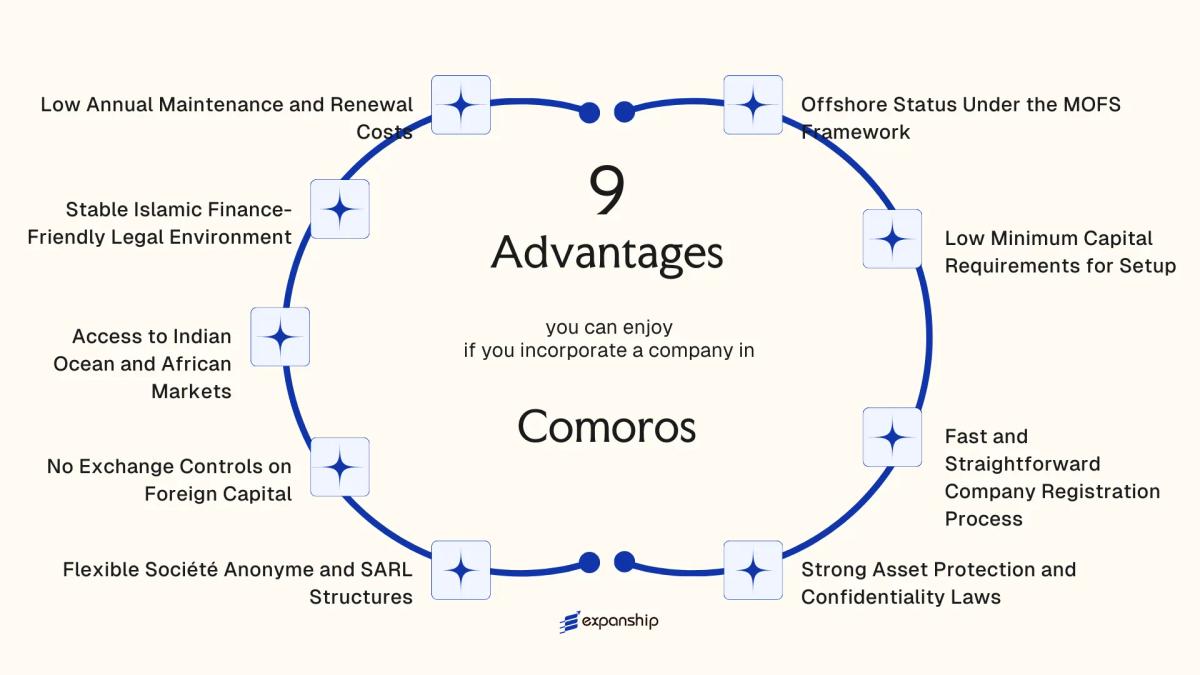
This article examines the principal advantages that make Comoros company formation a consideration for international investors and business operators.
Offshore Status Under the MOFS Framework
The Comoros MOFS offshore framework benefits foreign companies through the Mwali Offshore Finance Services authority, which operates under the autonomous island of Mohéli and issues licenses to non-resident entities conducting business exclusively outside the Union. Your company is legally separated from domestic commercial activity, which is the structural basis for the preferential treatment that follows.
How Regulatory Separation Creates Tax Efficiency
MOFS-licensed entities are not subject to standard Union tax obligations applicable to resident businesses. This exemption from local corporate tax is not incidental — it is a defined feature of the offshore licensing regime, allowing your business to retain earnings without Union-level taxation reducing distributions or reinvestment capacity.
What the License Actually Permits
A MOFS regulated company benefits from a recognized legal status that permits international trading, holding, and financial activities under a regulated framework. The authority issues licenses across several categories, including International Business Companies and holding structures, each carrying a defined scope of permitted operations that determines how the entity can be used across cross-border transactions.
Your offshore status under MOFS is a licensed legal position, not merely a registration — giving your entity verifiable regulatory standing for international counterparties.
Low Minimum Capital Requirements for Setup
Low minimum capital requirements in a Comoros company formation represent one of the most direct financial advantages for foreign incorporators, particularly those testing new markets or structuring holding entities with limited initial outlay.
Under the Mwali Offshore Finance Authority (MOFA) framework, offshore entities can be registered with a nominal share capital that imposes no meaningful financial barrier at the point of incorporation. For a SARL structure, the minimum capital threshold is deliberately set at a level that does not require significant capital commitment upfront, freeing working capital for operational use rather than locking it into a statutory account.
This matters in practical terms because capital does not need to be deposited into a local bank account before the entity becomes active. Your business can be legally constituted and operational without a significant cash reserve tied to registration compliance.
Several structural features explain why the Comoros low share capital advantage is genuinely accessible:
- No mandatory paid-up capital deposit with a local financial institution at registration
- Share capital can be denominated in foreign currency, removing conversion costs
- Nominal share values are flexible, allowing founders to calibrate equity structures without regulatory constraint
- No independent auditor certification of capital is required at the formation stage
These conditions apply to standard offshore entity types; regulated financial structures such as banking or insurance licenses carry separate capital adequacy requirements under Mwali law.

Company Incorporation in Comoros
Establish your Comoros offshore entity with nominal capital requirements and a straightforward registration process through Expanship.
Fast and Straightforward Company Registration Process
Registering a company under the Comoros MOFS (Mwali Offshore Finance Services) framework carries tangible fast company registration benefits Comoros-based structures are specifically designed to deliver. The legal architecture governing offshore entity formation on Mwali (Mohéli) island is built around administrative efficiency, meaning your business can be legally constituted within days rather than weeks or months.
| Stage | Estimated Timeframe |
|---|---|
| Document submission and verification | 1 to 2 business days |
| Authority review and approval | 1 to 3 business days |
| Certificate of incorporation issued | Within 5 business days (typical) |
| Company operational status | Same day as certificate issuance |
The MOFS authority processes incorporation applications with a defined administrative structure, reducing the back-and-forth that characterizes registrations in jurisdictions with multi-agency approval requirements. For a foreign business owner, this translates directly into reduced legal fees, faster access to banking, and an earlier start to commercial operations.
Physical presence is not required at any stage of registration. Incorporation is handled entirely through licensed registered agents authorized under Mwali offshore legislation, so your firm can be constituted remotely without travel or notarized in-person appearances.
Document requirements are minimal by design. Standard submissions typically include constitutional documents, shareholder identification, and a registered office declaration. Because the offshore framework limits the categories of permissible business activity, the authority does not need to conduct extended sectoral reviews, which is precisely what keeps approval timelines short.
Strong Asset Protection and Confidentiality Laws
Comoros asset protection and confidentiality benefits are grounded in the legal framework governing its Mwali International Services Authority (MISA) and the broader offshore regime. Under this framework, offshore companies are not required to disclose beneficial ownership details in any publicly accessible register. For foreign business owners, that distinction has direct consequences: your identity as a shareholder or director is not exposed through routine public searches.
The MISA framework separates offshore entities from domestic corporate records, which means the confidentiality protections apply structurally rather than by exception.
Shareholder privacy protections extend to nominee arrangements as well. Using a nominee shareholder is legally recognized, adding a further layer of separation between your personal identity and the registered entity.
Keep these points in mind:
- Beneficial ownership is not held in a public registry under the offshore regime
- Nominee shareholders and directors are permitted under MISA rules
- Offshore companies maintain separate standing from domestic corporate filings
- Confidentiality does not override obligations under a formal mutual legal assistance request
Asset protection benefits for a Comoros company also stem from the limited liability structure available to offshore entities, which ring-fences personal assets from corporate liabilities by law.
Comoros is one of the few African jurisdictions where the offshore authority operates from a separate island — Mwali (Mohéli) — under its own distinct legislative mandate, independent of the mainland regulatory apparatus.
Flexible Société Anonyme and SARL Structures
Comoros Société Anonyme and SARL structure benefits stem largely from how each entity type is calibrated to match different scales and styles of business operation. Under the Comorian Commercial Code, both the SA (Société Anonyme) and the SARL (Société à Responsabilité Limitée) are available to foreign incorporators, and each carries a liability framework that shields your personal assets from business obligations.
Structuring Ownership Without Unnecessary Friction
The SARL is the more commonly used vehicle for smaller international operations. It permits a single shareholder to constitute the entity in full, which removes the need to source multiple founding partners before registration can proceed. Ownership interests are held as parts sociales rather than freely tradable shares, giving you direct control over who can acquire a stake in the business.
The SA structure serves a different function. Designed for ventures requiring broader capital participation or institutional investment, it issues transferable shares and can accommodate a more distributed ownership model. This makes it suited to holding structures or businesses anticipating third-party equity at a later stage.
Operational Flexibility for Foreign Owners
Both entity types can be administered by non-resident directors, and neither structure mandates a local shareholder. Your registered agent in the Comoros handles statutory requirements on your behalf, so day-to-day management can remain entirely offshore. The SARL's flexible SARL structure advantages mean that internal governance can be configured through the articles of association with relatively few mandatory provisions imposed by statute.
Structure Your Comoros Entity the Right Way
Get expert guidance on choosing and setting up an SA or SARL in Comoros that matches your ownership model, investment goals, and operational requirements.
No Exchange Controls on Foreign Capital
Offshore entities incorporated under the Mwali International Services Authority (MISA) framework operate outside the domestic monetary control system. One of the no exchange controls benefits Comoros offshore structures offer is the unrestricted movement of capital across borders, meaning your business can send and receive funds internationally without seeking prior approval from a central authority or complying with mandatory conversion requirements.
- Funds transferred into or out of a MISA-registered entity are not subject to repatriation obligations, so profits generated abroad can remain offshore or be redirected to other jurisdictions without regulatory delay.
- Foreign currency accounts are permitted, removing the risk of forced conversion into the Comorian franc at unfavorable official rates.
- There are no caps on the volume of outbound transfers, which is significant for holding companies or investment vehicles that routinely move large sums between subsidiaries.
- Dividends, royalties, and loan repayments can be remitted to foreign shareholders or creditors without withholding procedures tied to exchange control approval.
- This free capital movement applies specifically to MISA-licensed offshore entities; it does not extend automatically to onshore domestic companies, so the distinction in licensing category is operationally material.
Access to Indian Ocean and African Markets
Comoros sits at the northern entrance of the Mozambique Channel, positioning any registered entity within proximity of East African coastal economies, Madagascar, Mozambique, and the broader Indian Ocean trade corridor. For businesses targeting sub-Saharan Africa or Indian Ocean rim markets, this geographic placement reduces logistical distance to ports in Dar es Salaam, Mombasa, and Mahajanga.
The archipelago is a member of the African Union and the Common Market for Eastern and Southern Africa (COMESA). COMESA membership is operationally significant: it gives your business a formal trade footing across a bloc of 21 member states representing over 600 million people and a combined GDP exceeding $1 trillion, without requiring separate bilateral arrangements for each market.
Membership in the Indian Ocean Commission (IOC) extends that reach into regional dialogue on trade facilitation, maritime cooperation, and economic integration among Indian Ocean island states.
A business registered in a COMESA member state can access preferential tariff treatment across participating markets under the COMESA Free Trade Area framework, reducing import duties on qualifying goods traded within the bloc compared to standard third-country tariff rates applied by individual member states.
Stable Islamic Finance-Friendly Legal Environment
Comoros operates under a legal framework that formally accommodates Islamic finance principles, making its Comoros Islamic finance friendly legal environment a practical consideration for businesses structured around Sharia-compliant operations. The country's majority-Muslim population has shaped both its regulatory culture and its openness to halal finance structures at the institutional level.
The Mwali International Services Authority (MISA) and the broader MOFS framework recognize financial instruments that align with Islamic law, including murabaha and musharaka arrangements. For investors seeking Sharia compliant business benefits, this means your corporate structure does not require workarounds or legal retrofitting to accommodate profit-sharing or asset-backed financing models.
Practically, this matters because many offshore jurisdictions require businesses to adapt Islamic financial products into conventional legal templates, creating structural friction. Here, the regulatory posture does not treat halal finance as an exception.
- Sharia-compliant financing arrangements are recognized within the offshore legal framework
- Profit-and-loss sharing models can be documented without defaulting to interest-based contract templates
- The jurisdiction's legal culture reduces compliance conflicts for Islamic institutional investors
Verify with your registered agent that your specific Islamic financial instrument is explicitly supported under the current MISA licensing category applicable to your entity type.
Low Annual Maintenance and Renewal Costs
Annual overhead is one of the most direct measures of whether an offshore structure remains viable over time. Low annual maintenance costs Comoros offshore companies carry are governed under the Mwali Offshore Finance Authority (MOFA) framework, which sets fixed, predictable fee schedules rather than variable or asset-based charges. For a foreign business owner, this means your annual obligations are known quantities from day one.
Renewal fees for an offshore entity registered under the Autonomous Island of Mwali remain materially lower than those typical of established offshore centers in Europe or the Caribbean. Comparable jurisdictions such as the British Virgin Islands or Luxembourg impose significantly higher annual government fees and mandatory auditing requirements. Mwali-registered firms are generally exempt from local audit requirements, removing a recurring professional services cost that compounds over time.
Ongoing compliance obligations for qualifying offshore companies under the MOFA regime are structured to be minimal. There is no requirement to file annual financial statements with a local regulatory authority, and no locally appointed auditor is mandated. The practical result is that your firm's annual professional fees cover little more than the registered agent retainer and the government renewal charge.
Key recurring cost items for a Mwali offshore company typically include:
- Annual government renewal fee payable to MOFA
- Registered agent fee for maintaining a local presence
- Registered office address maintenance
Eligibility for these reduced compliance obligations applies specifically to entities that conduct no business within the domestic Comorian economy and maintain their operational activities entirely outside the jurisdiction.
Why Comoros Stands Out Among Offshore Jurisdictions
Jurisdictions chosen for comparison here — Seychelles, Mauritius, and Vanuatu — share a similar profile: small island economies actively courting foreign incorporation, each offering some variant of territorial taxation, minimal capital requirements, and offshore-friendly legislation. A business owner evaluating the Comoros Mwali Offshore Finance Services (MOFS) framework would realistically be weighing these alternatives, making them the most relevant benchmarks.
What the comparison reveals is not that the Union of Comoros dominates every parameter, but that it holds a distinct combination of low entry costs, zero corporate tax under the MOFS regime, and no exchange controls — all within a single framework governed by the Mwali International Services Authority. Mauritius imposes a 15% headline corporate rate with partial exemptions, and Seychelles, while competitive, carries higher annual renewal fees for international business companies. Vanuatu has increased its regulatory burden in recent years following FATF-related reforms. That structural context matters when assessing where your entity's ongoing costs and compliance obligations will settle.
| Parameter | Comoros (MOFS) | Seychelles (IBC) | Mauritius (GBC) | Vanuatu (IBC) |
|---|---|---|---|---|
| Corporate Tax Rate | 0% (offshore entities) | 0% (IBCs) | 15% (exemptions apply) | 0% |
| Annual Renewal Cost | Low (under USD 500) | Moderate (USD 100–300+) | Higher (varies by structure) | Moderate |
| Exchange Controls | None | None | None | None |
| Minimum Share Capital | None mandated | None mandated | None mandated | None mandated |
| Regulatory Framework | MWALI ISA (MOFS) | FSA Seychelles | FSC Mauritius | VFSC |
| African Market Access | Direct (AU member) | Limited | Strong (SADC, COMESA) | Minimal |
Compliance Services for Comoros Entities
Maintain good standing under the MOFS framework with accurate filing, renewal, and regulatory support tailored to Comoros-registered companies.
Conclusion
Comoros offers a structurally coherent case for offshore incorporation, particularly for businesses that require capital mobility, confidentiality, and a low annual cost base. The MOFS framework provides a statutory foundation for offshore status, while the absence of exchange controls means retained earnings and capital distributions are not subject to repatriation restrictions. Together, these features reduce administrative friction that is common in higher-regulated jurisdictions.
The benefits of incorporating in Comoros are most pronounced for holding structures, asset protection vehicles, and businesses operating across Indian Ocean or African trade corridors. The legal treatment of offshore entities under the MOFS regime, combined with low renewal obligations, allows you to maintain a compliant structure without the overhead that comparable offshore registrations typically carry.
That said, the suitability of any jurisdiction depends on your business model, the location of your clients and counterparties, and the tax treatment in your home country. A structure that performs well for an international holding company may not suit an operationally active business with physical presence requirements. The right corporate configuration starts with understanding how local law applies to your specific circumstances, and how those rules interact with the regulatory environment you operate within.
Start Your Comoros Company with Expanship Today
To start a Comoros company formation with Expanship, you work with a team that understands the practical demands of the Mwali International Services Authority (MISA) framework, the structural requirements of the Société Anonyme and SARL entity types, and the ongoing compliance obligations that offshore entities must meet to retain their status under Comorian law.
Expanship's services across the Comoros incorporation process include:
- Preparation and legalization of all incorporation documents
- Registered agent and registered office provision under MISA requirements
- Filing and liaison with the relevant government registrar
- Post-incorporation compliance management, including annual renewals
- Banking introduction assistance for newly incorporated entities
Document preparation covers the foundational instruments required under Comorian corporate law, including statutes and shareholder registers. Registered office provision ensures your entity meets the physical address requirements that underpin offshore status. Once incorporated, annual compliance obligations are tracked and managed so your firm does not inadvertently lose its standing with the authority.
Reach out to Expanship Comoros to discuss your incorporation requirements.
Frequently Asked Questions (FAQ)
Yes, non-residents can fully own and incorporate a company under the Mwali Offshore Finance Services (MOFS) framework without establishing physical residency. The MOFS regime was specifically structured to accommodate foreign entrepreneurs and investors operating entirely outside the archipelago. A local registered agent is required, but personal presence during incorporation is generally not necessary.
Registration through the MOFS authority on Mwali (Mohéli) island is generally completed within a few business days once all required documentation is submitted. The process is administrative rather than judicial, which reduces delays associated with court filings or notarial procedures common in civil law systems. Timelines can vary depending on the completeness of the submitted documents and the registered agent's processing capacity.
Entities incorporated under the MOFS framework are generally exempt from local corporate income tax on profits derived outside Comoros. This exemption applies to qualifying offshore companies and is a structural feature of the MOFS regime rather than a discretionary benefit. Tax obligations in your home jurisdiction remain unaffected and must be assessed independently.
No exchange controls apply to offshore entities registered under the MOFS framework, meaning foreign currency can be moved in and out without regulatory restrictions at the Comorian level. This applies to dividends, loan repayments, and capital repatriation. Restrictions imposed by your country of residence or the counterparty's jurisdiction are separate considerations entirely.
The answer depends on ownership structure and governance preferences. A Société Anonyme (SA) is better suited to entities with multiple shareholders or those anticipating future equity distribution, as it accommodates share issuance more flexibly. A Société à Responsabilité Limitée (SARL) is generally simpler to administer and is commonly chosen by sole founders or small ownership groups seeking a lighter governance framework.
Under the MOFS framework, beneficial ownership information is not part of the public registry, providing a degree of confidentiality that is codified within the offshore regulatory structure of Mwali. Disclosure may still be required under international information exchange agreements or in response to formal legal proceedings. The practical scope of confidentiality should be assessed against your home jurisdiction's reporting obligations for foreign-held entities.
Annual costs for a MOFS-registered entity are structured to remain low compared to onshore jurisdictions, typically comprising a government renewal fee and a registered agent retainer. These figures are set by the MOFS authority and vary by entity type and registered agent. Unlike many European or Asian jurisdictions, there are no mandatory audit requirements for standard offshore entities, which removes a significant recurring cost.
A MOFS-registered entity that fails to meet its annual renewal obligations risks administrative dissolution or removal from the active register maintained by the MOFS authority. Reinstatement is possible in many cases, but involves additional fees and documentary requirements. Contracts and banking arrangements tied to a dissolved entity may become legally unenforceable until the company's standing is formally restored.
Legal Disclaimer
The information provided in this article is for general informational purposes only and does not constitute legal, tax, or professional advice. While we strive to ensure the accuracy and timeliness of the content, laws and regulations are subject to change, and the application of laws can vary widely based on specific facts and circumstances.
Readers should not act upon this information without seeking professional counsel tailored to their individual situation. Expanship and its authors disclaim any liability for actions taken or not taken based on the content of this article.
For specific advice regarding your business setup, compliance requirements, or any legal matters, please consult with qualified legal and tax professionals in the relevant jurisdiction.