
Key Takeaways
- Foreign investors must structure ownership in compliance with restrictions under Cambodia's 2021 Investment Law, which governs foreign participation across specific sectors and directly affects how shares are allocated at the point of incorporation.
- Companies incorporated in Cambodia are required to meet minimum share capital thresholds that vary according to entity type and industry sector, meaning a single fixed figure does not apply universally across all registration scenarios.
- Under the PRAKAS beneficial ownership disclosure framework, entities must identify and report ultimate beneficial owners to the Ministry of Commerce, adding a distinct compliance layer beyond standard registration filings.
- Director residency conditions applicable to Cambodian entities differ from those in many comparable jurisdictions, and failing to satisfy them at the time of registration can result in outright rejection of the business registration application.
Entity formation in Cambodia is governed by the Law on Commercial Enterprises, administered by the Ministry of Commerce through its Business Registration Department. Meeting the full range of incorporation requirements in Cambodia is a prerequisite for obtaining a valid business registration certificate and operating legally within the country.
Failure to satisfy these requirements can result in rejection of the registration application or inability to conduct lawful business activities.
The specific requirements that apply to your entity will depend on factors such as the chosen company type, the industry sector, and whether foreign ownership is involved. Cambodia company registration requirements are not uniform across all structures.
This article covers the structural and documentary requirements applicable to entity formation, addressing areas from share capital to beneficial ownership disclosure. It is most relevant to foreign investors and business owners seeking to establish a locally incorporated presence rather than operating through a branch or representative office.
Minimum Share Capital Requirements in Cambodia
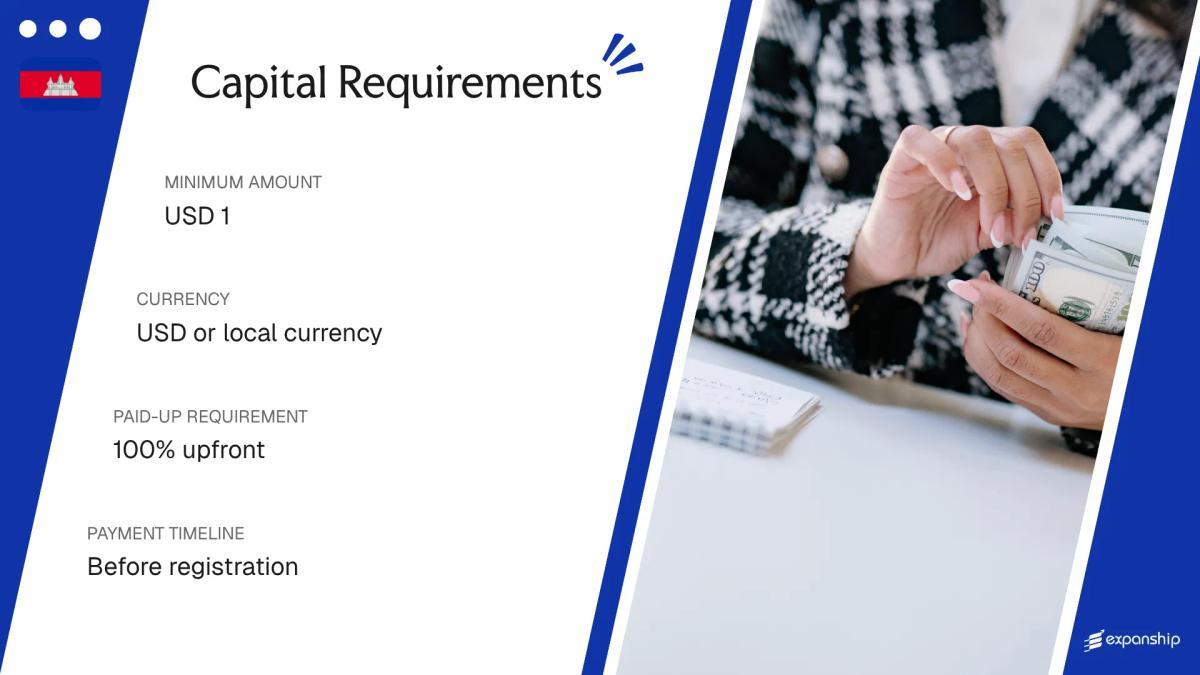
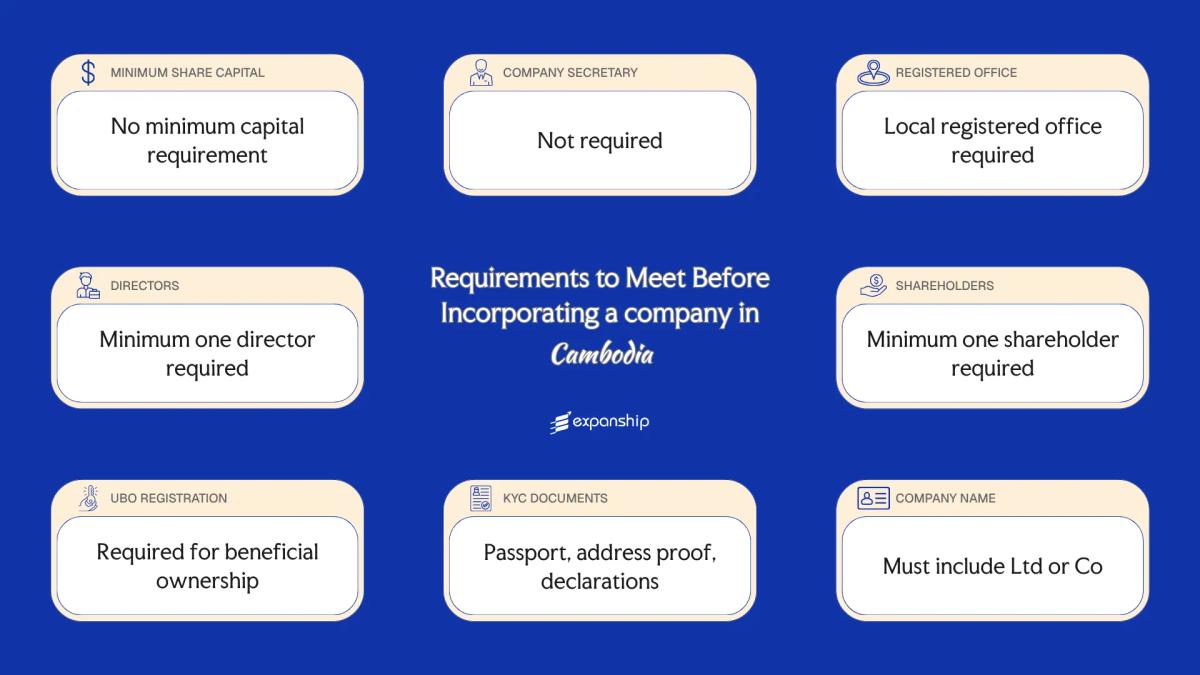
Under the Law on Commercial Enterprises (LCE), Cambodia minimum share capital requirements are relatively flexible, with no statutory minimum imposed on private limited companies (LLCs) at the point of registration. The entity is registered through the Ministry of Commerce (MoC), which does not mandate proof of capital deposit as a precondition for incorporation.
Share capital operates on a par value system, and the MoC is the authority responsible for verifying the declared capital structure during registration. Capital declarations form part of the articles of incorporation and are treated as an ongoing statutory record, not solely a one-time filing obligation.
| Parameter | Detail |
|---|---|
| Minimum Authorized Share Capital | No statutory minimum |
| Maximum Authorized Share Capital | No statutory maximum |
| Minimum Paid-Up Capital | No statutory minimum |
| Paid-Up Requirement at Incorporation | No statutory requirement |
| Accepted Currency | Cambodian Riel (KHR) or USD |
| Accepted Forms of Contribution | Cash or non-cash assets (in-kind contributions permissible) |
| Timeframe to Deposit Capital | No statutory deadline |
Even without a statutory minimum, your company must declare an authorized capital amount in its articles of incorporation. An undeclared or inconsistently recorded capital structure can create complications during licensing applications or regulatory reviews with sector-specific authorities.
Company Secretary Requirements in Cambodia
Under the Law on Commercial Enterprises, there is no mandatory requirement to appoint a company secretary for a private limited company (known locally as a Co., Ltd.) registered through the Ministry of Commerce. That said, larger entities and those seeking to maintain structured internal governance often appoint a secretary to handle statutory record-keeping and coordinate filings with the relevant authorities.
Cambodia corporate secretary obligations, where the role exists, typically include maintaining the register of shareholders, preparing minutes of board and general meetings, and ensuring timely submission of annual compliance documents to the Ministry of Commerce.
Qualification criteria for those serving in this capacity generally follow these principles:
- No statutory nationality or residency requirement applies to a company secretary in a Cambodian Co., Ltd.
- The role may be filled by an individual or, in some cases, a corporate entity.
- No mandatory professional licensing or minimum qualification is prescribed under the commercial enterprises framework.
- A serving director may concurrently hold the secretary position unless the company's articles restrict this.

Incorporate a Company in Cambodia
Set up your legal entity in Cambodia through the Ministry of Commerce with structured guidance on share structure, directorship, and ongoing compliance.
Registered Office Requirements in Cambodia
Registered office requirements in Cambodia are governed under the Law on Commercial Enterprises, which mandates that every registered company maintain a physical address within the country at all times. Failure to comply can result in administrative penalties or the suspension of the entity's operating status by the Ministry of Commerce.
- A physical address is required; virtual offices without a verifiable physical presence do not satisfy the legal address requirements Cambodia companies must meet.
- The address must be located within Cambodia; a foreign address cannot serve as the registered address for a locally incorporated entity.
- Either a property ownership document or a valid lease agreement must support the registered address obligation.
- The registered address is recorded in the Ministry of Commerce's business registry and is publicly accessible.
- Any change to the registered address must be formally notified to the Ministry of Commerce; the updated address must be reflected in the company's official registration records.
- The address must be operational during business hours to receive official correspondence and government notices.
Director Requirements in Cambodia
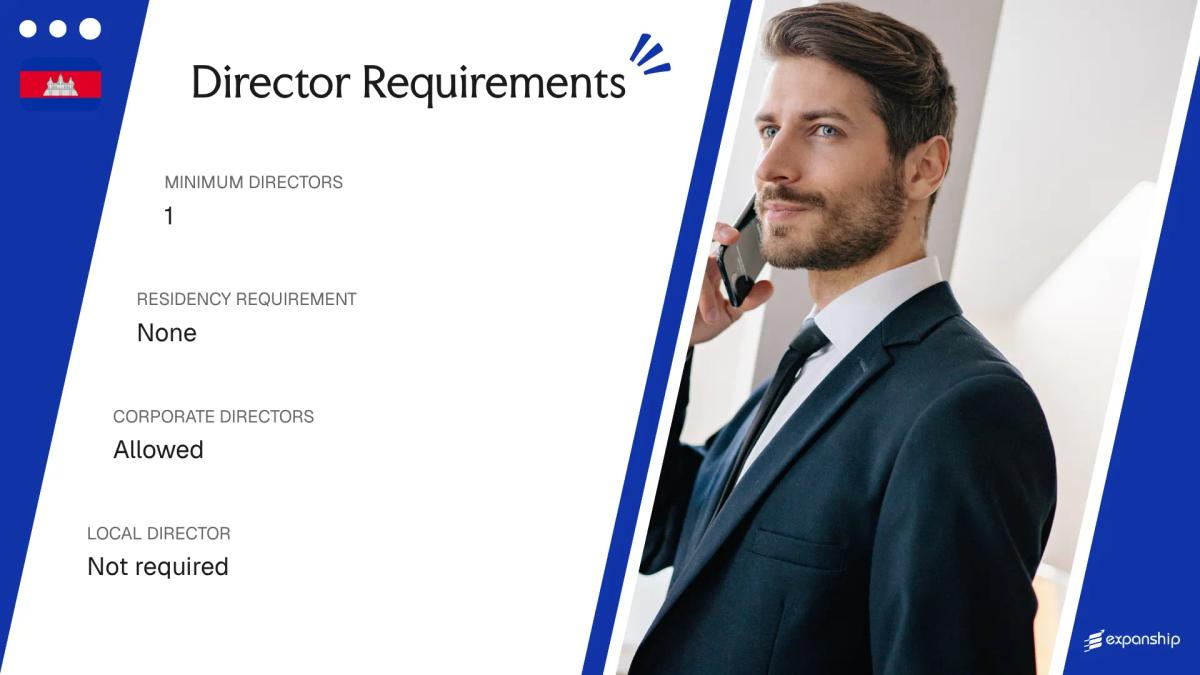
Under the Law on Commercial Enterprises (LCE), director requirements in Cambodia company formations are straightforward in terms of thresholds but carry substantive legal obligations once an individual assumes the role. Directors are personally accountable for acts of mismanagement, breaches of fiduciary duty, and non-compliance with the LCE, with liability extending to decisions that cause harm to the company or its shareholders.
| Parameter | Detail |
|---|---|
| Minimum Number of Directors | One director is required for a private limited company. |
| Maximum Number of Directors | No statutory maximum is prescribed under the LCE. |
| Local/Resident Director Required | No statutory requirement for a resident or locally domiciled director. |
| Nationality Restrictions | No nationality restrictions apply; foreign nationals may serve as directors. |
| Minimum Age Requirement | Directors must be at least 18 years of age. |
| Corporate Directors Permitted | Corporate directors are not permitted; only natural persons may serve. |
| Director Must Be a Shareholder | No requirement for a director to hold shares in the company. |
| Publicly Listed on Registry | Director information is filed with the Ministry of Commerce and appears on the commercial register. |
| Disqualification Conditions | Persons who have been declared bankrupt or convicted of fraud-related offences may be disqualified from serving. |
Despite having no residency requirement, all director appointments must be formally registered with the Ministry of Commerce, meaning a foreign director based entirely overseas is still a matter of public commercial record in Cambodia.
Shareholder Requirements in Cambodia
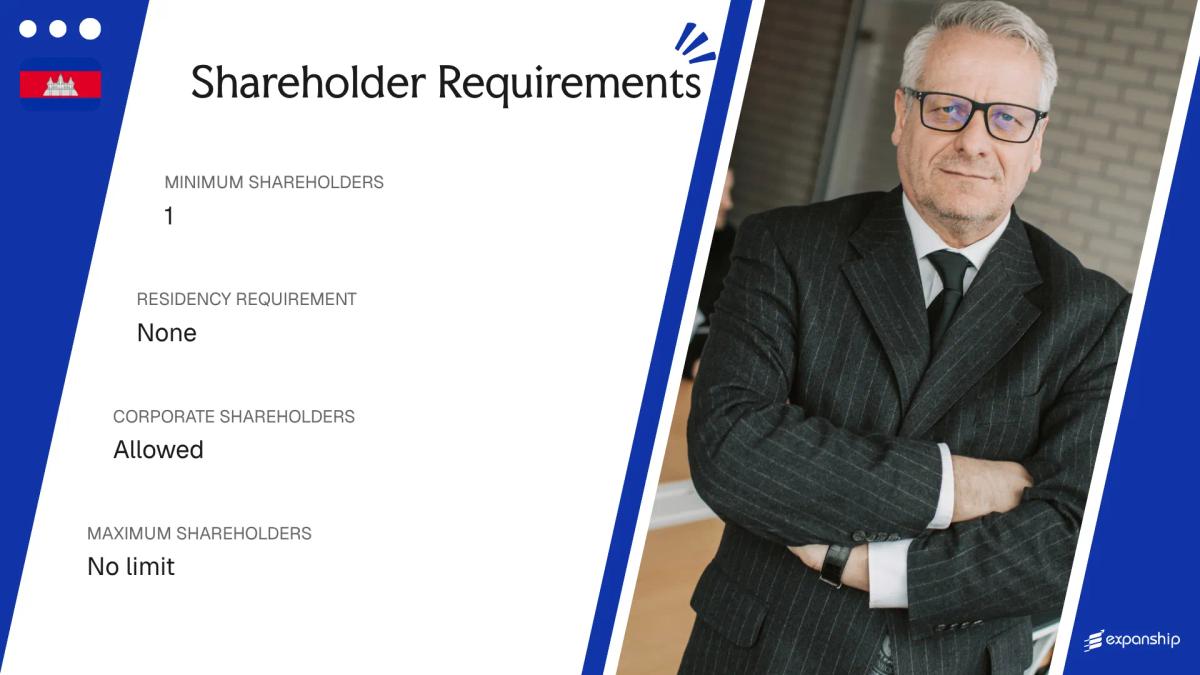
A private limited company (LLC) formed under Cambodia's Law on Commercial Enterprises requires a minimum of one shareholder and permits up to 30. A sole shareholder structure is fully permitted, making single-owner entities a recognised formation option.
Nationality and Residency Restrictions
Meeting the shareholder requirements Cambodia company law sets does not require shareholders to be Cambodian nationals or residents. Foreign individuals and entities may hold up to 100% of shares in most sectors, though land ownership restrictions under the Constitution effectively limit direct landholding by foreign shareholders.
Corporate Shareholders
Corporate entities are permitted to act as shareholders in a Cambodian LLC. No additional conditions specific to corporate shareholders are prescribed beyond standard registration and identification documentation.
Shareholder Liability
Liability is limited to each shareholder's contributed capital. No general circumstances under the Law on Commercial Enterprises extend personal liability beyond that contribution.
Register of Shareholders
An LLC must maintain an internal register of shareholders. This register is not publicly accessible, but the firm must keep it current and available for inspection by authorised parties upon request.
Set Up Your Shareholder Structure in Cambodia
Get guidance on structuring your ownership correctly from the outset, ensuring your shareholder arrangements meet Cambodia's regulatory requirements under the Law on Commercial Enterprises.
UBO / Beneficial Ownership Disclosure Requirements in Cambodia
Under Cambodia's anti-money laundering framework, beneficial ownership disclosure Cambodia requirements are governed by the Law on Anti-Money Laundering and Combating the Financing of Terrorism (AML/CFT Law) and enforced by the Financial Intelligence Unit (FIU) under the National Bank of Cambodia.
- Identify all natural persons who ultimately own or control 20% or more of the company's shares or voting rights.
- Declare UBO information to the relevant obliged entity (such as a bank or registered agent) as part of customer due diligence at the time of incorporation.
- Submit UBO data to the Ministry of Commerce upon company registration, where required under applicable sub-decrees.
- Maintain an internal UBO register, updated whenever ownership or control changes materially.
| Parameter | Detail |
|---|---|
| Ownership Threshold for UBO Status | 20% of shares or voting rights |
| Filing Authority | Ministry of Commerce; Financial Intelligence Unit (FIU) |
| Disclosure Deadline at Incorporation | At the time of company registration |
| Publicly Accessible Register | No publicly accessible register currently established |
| Penalties for Non-Disclosure | Penalties apply under the AML/CFT Law; specific fines subject to regulatory discretion |
| Ongoing Update Obligation | Yes; updates required upon material changes in ownership or control |
KYC / Document Requirements in Cambodia
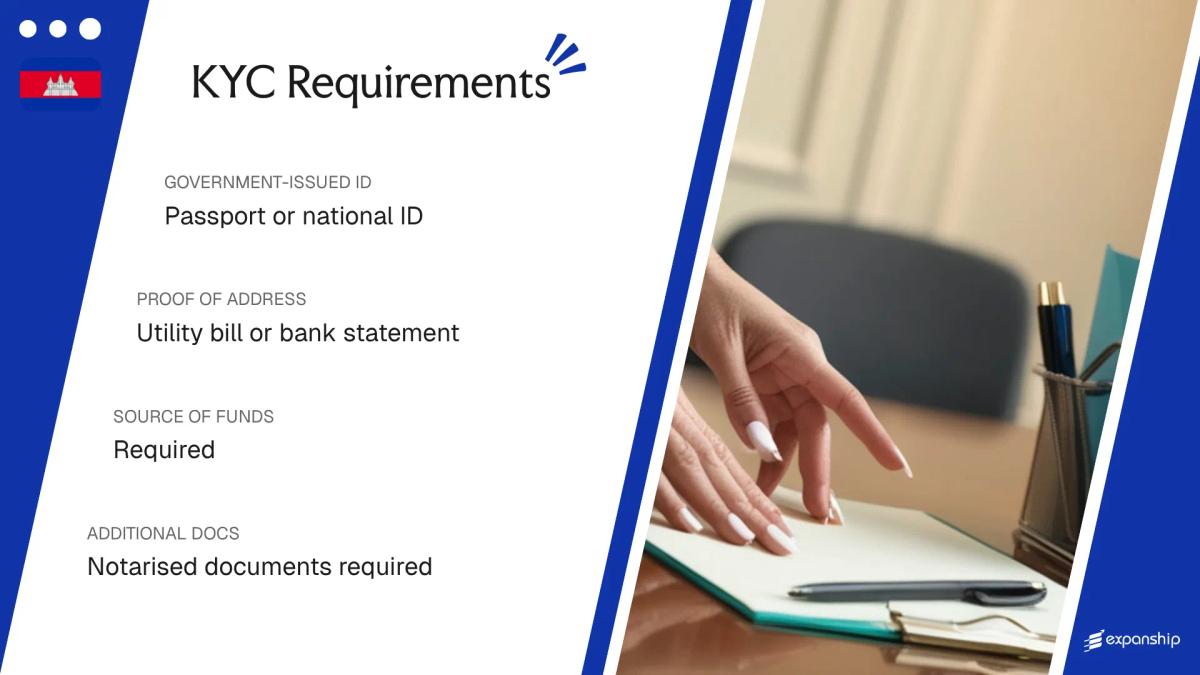
KYC document requirements Cambodia are governed by the Law on Anti-Money Laundering and Combating the Financing of Terrorism, enforced through the Financial Intelligence Unit operating under the General Commissariat of National Police.
Individual / Personal Documents
- Valid passport or national identity card for each director, shareholder, and beneficial owner
- Proof of residential address dated within three months, such as a utility bill or bank statement
- Completed KYC declaration form as required by the registration agent or Ministry of Commerce
- Recent passport-sized photograph may be requested depending on the filing channel
Corporate Documents
- Certificate of incorporation of the parent or corporate shareholder
- Constitutional documents, such as articles of association or equivalent
- Register of directors current at the time of submission
- Proof of registered address for the corporate entity
Source of Funds Documentation
- Bank statements covering a minimum of three to six months prior to incorporation
- Audited financial statements where the corporate shareholder has an established trading history
- Signed declaration of source of funds if bank documentation is unavailable
Notarisation and Apostille Requirements
- Foreign documents must generally be notarised in the country of origin
- Notarised documents require legalisation by the Cambodian embassy or consulate in that country
- Official translation into Khmer is required for all non-Khmer documents
Unsigned or undated source of funds declarations are among the most common causes of incorporation delay at the Ministry of Commerce.
Company Name Requirements in Cambodia
Company name requirements in Cambodia are assessed by the Ministry of Commerce at the point of incorporation. Proposed names must be unique and must not be identical or confusingly similar to any existing registered entity.
Names must be written in Khmer script, though a romanised transliteration may also be included. A legal suffix denoting the entity type, such as "Co., Ltd." for a private limited company, is mandatory.
Certain words are restricted. Terms implying government affiliation, royal patronage, or regulated industries such as banking and insurance require prior approval from the relevant authority before the Ministry of Commerce will accept the name.
Name reservation is available through the Ministry of Commerce prior to formal incorporation. Once reserved, the name is held for a defined period, allowing time to complete the remaining registration steps without risk of the name being taken by another applicant.
Compliance Services for Companies in Cambodia
Expanship supports registered entities in Cambodia with ongoing compliance obligations, including annual filings, regulatory reporting, and maintenance of good standing with the Ministry of Commerce.
Conclusion
Cambodia company incorporation requirements span several regulatory layers, governed primarily by the Law on Commercial Enterprises and administered through the Ministry of Commerce. Foreign investors must account for ownership restrictions under the 2021 Investment Law, minimum share capital thresholds tied to entity type and sector, and director residency conditions that differ from many comparable jurisdictions. Beneficial ownership disclosure obligations, introduced through the PRAKAS framework, add a further compliance dimension. Once these structural requirements are understood, the practical next step is coordinating document preparation, local registrations, and ongoing statutory filings.
Expanship's Corporate Services for Cambodia Expansion
Expanship's Cambodia company formation services cover the full scope of requirements outlined in this guide, from coordinating with the Ministry of Commerce for entity registration to ensuring your UBO declarations and share capital structures meet current regulatory expectations. Managing these obligations across a civil law system with Khmer-language documentation requirements adds a real administrative load, particularly for foreign principals operating remotely. Expanship helps carry that load without removing the compliance responsibilities that remain yours.
Beyond incorporation, our service scope across Cambodia business incorporation support includes:
- Preparing and filing all company registration documents with the relevant Cambodian authorities.
- Providing a registered agent and compliant local office address in-country.
- Handling government submissions and liaising with regulatory bodies on your behalf.
- Managing your post-incorporation compliance obligations as they fall due.
- Facilitating introductions to local banking institutions to support account opening.
- Registering your business for tax purposes and coordinating with local authorities.
To discuss your requirements, contact Expanship Cambodia.
Frequently Asked Questions (FAQ)
Cambodia does not require directors of a private limited company to be Cambodian residents or citizens, so your entire board can consist of foreign nationals. The Law on Commercial Enterprises sets a minimum of one director without imposing nationality or residency conditions. That said, at least one director must be a natural person; a corporate entity alone cannot fulfill the directorship requirement.
Beneficial ownership disclosure in Cambodia is an ongoing obligation, not a one-time registration event. The Ministry of Economy and Finance requires entities to update their UBO records whenever ownership or control structures change, and failure to maintain accurate records can result in compliance penalties. Annual reporting cycles and triggered updates upon structural change both apply.
If your registered office ceases to be a valid, physical address in Cambodia, you are required to notify the Ministry of Commerce and update the registration records promptly. Operating with an invalid or lapsed registered address is treated as a compliance breach and can affect the standing of your business with tax authorities and licensing bodies. The address on record must remain reachable for official correspondence at all times.
A foreign national can hold 100% of the shares in a Cambodian private limited company in most sectors, as the Law on Commercial Enterprises permits full foreign ownership. However, specific industries, including land ownership, certain agricultural activities, and some state-regulated services, impose foreign ownership caps or require a Cambodian co-shareholder. You should verify sector-specific restrictions under relevant concession laws or licensing frameworks before structuring your shareholding.
Foreign shareholders are generally required to submit a valid passport copy, proof of residential address, and a clean criminal background check as part of the KYC process administered through the Ministry of Commerce. These documents typically need to be certified or notarized, and in some cases apostilled, depending on the issuing country and the specific requirements of the reviewing authority. Original-language documents from non-English-speaking countries must be accompanied by a certified Khmer or English translation.
Submitting a name that duplicates or closely resembles an existing registered name will result in outright rejection by the Ministry of Commerce; the application cannot proceed until a compliant name is provided. Beyond rejection, using a trading name that infringes on a registered trademark can expose your business to civil liability under Cambodia's Law on Marks, Trade Names and Acts of Unfair Competition. Conducting a name search through the Ministry of Commerce's business registration portal before submission reduces this risk.
Cambodia does not impose a statutory requirement for a formally qualified company secretary in the same way that jurisdictions like Singapore or Malaysia do under their respective Companies Acts. Administrative and compliance filings are typically handled by a director or an authorized representative, though many foreign-owned entities engage a local professional firm to manage ongoing regulatory submissions. There is no prescribed professional certification that a company secretary in Cambodia must hold under the Law on Commercial Enterprises.
Legal Disclaimer
The information provided in this article is for general informational purposes only and does not constitute legal, tax, or professional advice. While we strive to ensure the accuracy and timeliness of the content, laws and regulations are subject to change, and the application of laws can vary widely based on specific facts and circumstances.
Readers should not act upon this information without seeking professional counsel tailored to their individual situation. Expanship and its authors disclaim any liability for actions taken or not taken based on the content of this article.
For specific advice regarding your business setup, compliance requirements, or any legal matters, please consult with qualified legal and tax professionals in the relevant jurisdiction.