

Key Takeaways
- Foreign investors are prohibited from owning land directly under Cambodian law, forcing reliance on long-term leases, concession structures, or locally held title arrangements that introduce ownership insecurity and counterparty risk.
- The Law on Commercial Enterprises, administered by the Ministry of Commerce, requires navigating a registration process that in practice involves administrative delays and unofficial facilitation costs that are difficult to budget or eliminate entirely.
- Sectors subject to foreign ownership caps compel investors to bring in a Cambodian national shareholder holding at least 51% equity, creating structural dependency on a local party whose interests may diverge over time.
- Cambodia's underdeveloped judiciary offers limited reliable recourse for commercial disputes, intellectual property infringement, or contractual breaches, leaving foreign-owned entities with materially weaker legal protections than they would have in more established legal systems.
Cambodia operates under an evolving regulatory framework, shaped significantly by the Law on Commercial Enterprises and overseen by the Ministry of Commerce. The framework has undergone structural reforms in recent years, though enforcement and administrative consistency remain uneven across sectors.
The disadvantages of incorporating in Cambodia span ownership restrictions, land rights, banking access, judicial reliability, and operational compliance burdens. How severely these affect your business depends on the industry, the chosen corporate structure, and whether the entity involves foreign capital or intellectual assets.
Foreign investors establishing a private limited company, joint venture, or branch entity under Cambodian law will find this article most directly relevant. The risks of setting up business in Cambodia are not uniform — a manufacturing operation faces a materially different compliance profile than a consulting firm or e-commerce entity.
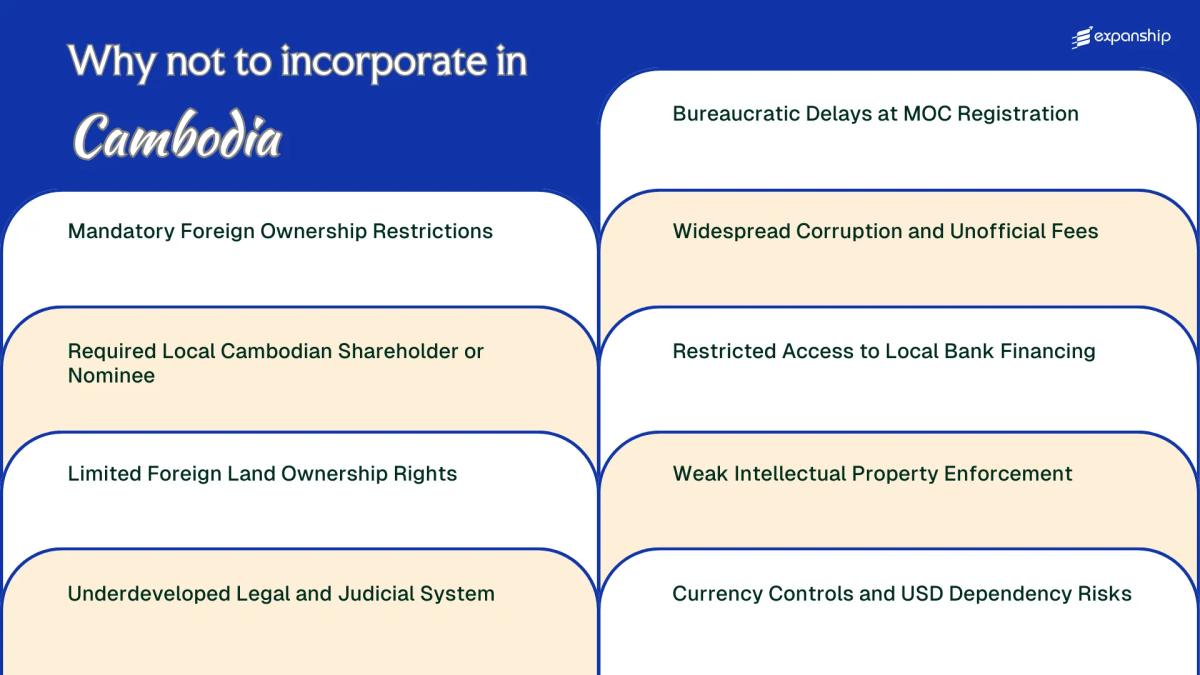
Mandatory Foreign Ownership Restrictions
Cambodia foreign ownership restrictions apply across a defined list of sectors, and the boundaries are set by law rather than by administrative discretion.
Sectors Closed or Capped for Foreign Investors
Under the Law on Investment and related sub-decrees, foreign entities are barred from full ownership in agriculture, land-holding businesses, and several services tied to domestic trade. Retail and wholesale businesses, for instance, require Cambodian nationals to hold a minimum equity stake, which means your business structure is dictated by nationality rules before commercial considerations are even addressed.
Certain sectors permit foreign participation but impose ownership ceilings. The restriction forces foreign investors to either accept a minority position or construct a more complex holding arrangement simply to operate legally.
The Qualified Investment Project Framework
The Council for the Development of Cambodia administers the QIP regime, which grants incentives but does not override sector-specific ownership caps. Even with QIP status, a foreign firm in a restricted sector cannot bypass the equity requirements established under the underlying sub-decrees.
Foreign ownership restrictions in Cambodia are sector-specific and legally fixed, meaning your chosen business activity determines your permissible ownership structure before negotiations with any local partner begin.
Required Local Cambodian Shareholder or Nominee
The Cambodia local shareholder requirement does not apply universally, but in sectors restricted under the Negative List established by the Law on Investment (2021), foreign investors cannot hold 100% ownership. This directly limits your ability to control the business you fund and operate.
Where a local partner is required, you are legally dependent on a Cambodian national whose interests may not align with yours. Nominee arrangements, though common in practice, sit in a legal grey area and carry no formal protection under Cambodian company law.
Relying on a nominee shareholder creates specific operational burdens:
- A nominee can exercise shareholder rights if supporting agreements are not drafted and enforced properly, exposing your equity to dispute
- Side agreements used to retain effective control are not recognised under the Law on Commercial Enterprises, leaving foreign owners with limited legal recourse
- Replacing a nominee requires their active cooperation, which gives them negotiating leverage at the worst possible moments
- Any dispute with a local partner routes through a judicial system with inconsistent enforcement, compounding the structural risk
Even where nominee arrangements function without incident, you bear the ongoing cost of legal maintenance, notarised agreements, and the practical impossibility of fully eliminating your exposure to a third party's conduct.

Company Incorporation in Cambodia
Set up your business in Cambodia with guidance on ownership structures, MOC registration, and compliance requirements.
Limited Foreign Land Ownership Rights
Under the 1993 Constitution and the 2001 Land Law, foreigners are prohibited from owning land in Cambodia. This is an absolute restriction, not a licensing threshold or a quota — your business cannot hold hard title (a "hard title" or Definitive Title issued under the Land Management and Administration Project, LMAP) to land regardless of the size of your investment.
The practical consequence is immediate: any foreign-owned entity that needs physical premises for operations, manufacturing, or retail must rely on leasehold arrangements or co-ownership structures involving Cambodian nationals, each of which introduces counterparty risk and long-term uncertainty.
| Restriction | Applicable Rule | Practical Impact on Foreign Investor |
|---|---|---|
| Direct land ownership | Prohibited under 2001 Land Law | Cannot hold hard title under any circumstances |
| Maximum leasehold term | 50 years (extendable once) | Long-term operational security is structurally limited |
| Condominium unit ownership | Permitted above ground floor only | Foreign firms cannot acquire ground-floor units |
| Nominee land holding | Common workaround but legally questionable | Exposes investor to asset loss if relationship breaks down |
Foreigners may legally own units in co-owned buildings (condominiums) up to 70% of any single building's units, but only on floors above the ground floor. This ceiling does not resolve the underlying problem for businesses that require dedicated land parcels.
Leasehold arrangements can span decades, yet the absence of outright ownership means a foreign firm cannot use land as collateral for financing, which directly compounds difficulties in accessing local credit.
Underdeveloped Legal and Judicial System
Cambodia's weak judicial system risks are well-documented and create direct, practical exposure for any foreign business operating under Cambodian jurisdiction. The legal framework is governed by a relatively recent body of commercial law, including the Law on Commercial Enterprises and the Civil Code promulgated in 2007, but enforcement mechanisms remain inconsistent and underdeveloped compared to regional peers like Singapore or Thailand.
Contract disputes are the most immediate concern. Even with a properly drafted agreement, securing judicial enforcement against a local counterparty through the Cambodian courts can take years, with outcomes that are difficult to predict based on legal merits alone.
Judicial independence is structurally limited. Judges are appointed through processes that critics and international observers have repeatedly flagged as susceptible to political and financial influence, which directly undermines the reliability of commercial dispute resolution.
Arbitration is available through the National Commercial Arbitration Centre (NCAC), but the enforceability of awards still depends on domestic courts, which reintroduces the same systemic weaknesses.
- Commercial contracts under Cambodian law carry material enforcement risk if a dispute arises locally
- The NCAC provides arbitration, but award enforcement requires court cooperation
- No independent regulatory body insulates commercial disputes from judicial inconsistency
- Foreign judgment recognition is not guaranteed and requires domestic court proceedings
Cambodia ratified the New York Convention on the Recognition and Enforcement of Foreign Arbitral Awards in 1960, yet domestic court capacity to process foreign arbitral awards remains a practical bottleneck that nullifies much of that treaty protection.
Bureaucratic Delays at MOC Registration
Cambodia MOC registration delays affect foreign businesses from the outset, as the Ministry of Commerce processes company incorporation applications through a system that frequently extends well beyond published timelines.
Structural Bottlenecks Within the MOC Process
The Ministry of Commerce requires document submission, name approval, and certificate issuance to pass through sequential review stages, and any missing or rejected document restarts portions of that sequence. For foreign-owned entities, additional scrutiny on ownership structure and authorized capital documentation compounds the delay.
Practical Cost to Your Business
Slow company registration processing time issues translate directly into deferred operational start dates, meaning your business cannot legally sign contracts, open a corporate bank account, or hire staff until the certificate of incorporation is issued. Registration timelines that stretch from several weeks to multiple months are not uncommon, particularly when submissions involve foreign shareholding arrangements requiring verification.
A private limited company registered under the Law on Commercial Enterprises may face additional back-and-forth with the MOC if the company's business activities require cross-referral to sector-specific ministries for approval.
Support for Overcoming Incorporation Challenges in Cambodia
If MOC registration delays or procedural setbacks are affecting your incorporation timeline, our team can help you manage documentation requirements and coordinate with the relevant authorities.
Widespread Corruption and Unofficial Fees
Cambodia corruption business risks are well-documented: the country ranked 162nd out of 180 countries in Transparency International's 2023 Corruption Perceptions Index, placing it among the lowest-ranked jurisdictions in Southeast Asia.
- Unofficial payments are frequently expected during the Ministry of Commerce registration process, adding unpredictable costs that formal fee schedules do not reflect.
- Foreign investors report solicited payments at multiple agency touchpoints, meaning your total setup cost can significantly exceed what licensed service providers quote upfront.
- Facilitation payments, while prohibited under Cambodia's Anti-Corruption Law (2010) administered by the Anti-Corruption Unit (ACU), carry legal exposure for your company if paid and documented.
- The ACU's enforcement capacity remains limited, which means bribery risks foreign investors face are rarely resolved through formal reporting channels.
- Budget allocations for government approvals involving foreign-owned entities often require informal contingency allowances that domestic firms, with established local networks, typically absorb more efficiently.
Restricted Access to Local Bank Financing
Cambodia bank financing restrictions on foreigners are structural, not incidental. Local commercial banks routinely require collateral in the form of land title deeds, and since foreign-owned entities cannot hold land under Cambodian law, your business is effectively disqualified from the most common form of secured lending.
Even where banks accept alternative collateral, foreign companies face heightened scrutiny under the National Bank of Cambodia's credit assessment standards. Loan approvals for foreign-owned SMEs can take months, and interest rates on commercial loans frequently exceed 12% per annum, substantially above regional peers such as Vietnam or Thailand.
The credit gap is particularly acute for firms without a Cambodian co-shareholder who holds titled property, as that individual's assets are typically what unlocks financing access in practice.
A foreign-owned company in Phnom Penh seeking a $150,000 working capital loan, without a local co-shareholder holding land title, would likely face outright rejection from most commercial lenders, forcing reliance on offshore financing at higher transactional cost and currency conversion risk.
Weak Intellectual Property Enforcement
Cambodia intellectual property enforcement problems stem from a legal framework that exists largely on paper. The Law on Marks, Trade Names and Acts of Unfair Competition (2002) and the Law on Patents, Utility Model Certificates and Industrial Designs (2003) establish IP protections in principle, but the Ministry of Commerce and courts lack the institutional capacity to enforce them consistently.
Trademark infringement is common across retail, manufacturing, and digital channels. Counterfeit goods bearing registered foreign marks circulate in markets without meaningful intervention, meaning your brand equity can erode before any legal process begins.
Civil litigation through Cambodian courts is slow and outcomes are unpredictable, particularly for foreign claimants with no local relationships. Criminal enforcement of IP violations is rare in practice.
Cambodia is not yet a member of the Madrid System for international trademark registration, which limits your procedural options for cross-border trademark protection.
- Registered marks receive no automatic market surveillance by any government body
- Border enforcement against counterfeit imports remains inconsistent
- IP disputes involving foreign firms rarely result in damages awards sufficient to deter infringement
Registering a trademark with the Ministry of Commerce does not trigger any active enforcement mechanism, meaning registration alone provides no practical deterrent against infringement without independent legal action.
Currency Controls and USD Dependency Risks
Cambodia USD dependency currency risks are structurally embedded in how the economy operates. The US dollar functions as the dominant transactional currency, with the National Bank of Cambodia estimating that USD accounts for roughly 80–90% of deposits and transactions. Your business has no meaningful ability to hedge against USD/KHR fluctuation through domestic instruments, since the local capital market is too underdeveloped to support standard currency risk products.
The Cambodian riel holds legal tender status but is rarely used for commercial contracts or payroll above subsistence level. This creates a dependency on a foreign currency your firm cannot influence, and any shift in US monetary policy directly transmits cost pressures to your operations.
Unlike jurisdictions with a managed float or central bank intervention mechanisms, the NBC does not operate a formal currency band. If the riel depreciates sharply, liabilities denominated in riel become mismatched against USD-priced inputs, creating real exposure with no domestic hedging infrastructure to absorb it.
Ways to Mitigate These Challenges
Mitigating Cambodia incorporation risks requires a structured approach that addresses ownership, compliance, and operational constraints before the business begins trading.
- Structure your investment through a private limited company (Co., Ltd) to access the maximum permitted foreign ownership thresholds under the Law on Investment.
- Appoint a qualified Cambodian national as a shareholder with a properly drafted shareholder agreement that includes share pledge arrangements, buyback clauses, and dividend controls.
- Register immovable property interests through a Cambodian nominee landholder with notarised agreements, given that foreign entities cannot hold hard title under the 2001 Land Law.
- File all Ministry of Commerce registration documents through the online business registration portal to reduce exposure to unofficial facilitation fees.
- Register trademarks and other intellectual property with the Department of Intellectual Property before commercial operations begin.
- Maintain USD-denominated accounts to manage transactional exposure given the riel's limited convertibility outside the domestic economy.
Cambodia company formation risk management ultimately operates within a regulatory environment where formal legal structures provide partial, not absolute, protection. The frameworks governing foreign ownership, land rights, and IP enforcement each carry implementation gaps that structural solutions can reduce but not eliminate.
Cambodia's Overall Investment Appeal
Cambodia's overall investment appeal despite drawbacks is real, but it is conditional. The country's low-cost operating environment, dollarized economy, and preferential trade access under frameworks like ASEAN and the RCEP give it a credible foundation for foreign investment. Those advantages, however, sit alongside structural risks that this blog has outlined in detail.
| Pros | Cons |
|---|---|
| No restrictions on profit repatriation and free flow of foreign currency | Mandatory local shareholding requirement limits full foreign ownership in most sectors |
| Dollarized economy reduces exchange rate exposure for USD-denominated businesses | Structural USD dependency creates vulnerability to external monetary shocks |
| Relatively low corporate tax rates and QIP incentives available through CDC | Bureaucratic delays at the Ministry of Commerce slow company registration timelines |
| ASEAN membership provides preferential market access across the region | Weak judicial system offers limited recourse in commercial disputes |
| Low labor costs compared to regional peers | Corruption and unofficial fees inflate the real cost of doing business |
| Established Special Economic Zones with infrastructure support | Intellectual property rights are difficult to enforce in practice |
Structural weaknesses in the legal system, land ownership rules, and financing access are not minor friction points. They are embedded features of the business environment that require deliberate planning to manage.
Compliance Services for Companies in Cambodia
Staying compliant with Cambodian corporate requirements involves ongoing obligations across the Ministry of Commerce, the General Department of Taxation, and relevant licensing authorities. This service covers what your entity needs to remain in good standing.
Conclusion
The cons of registering a company in Cambodia are real and should factor directly into your decision-making. Foreign ownership restrictions under the 1994 Investment Law, combined with the near-absence of freehold land rights for non-citizens, create structural constraints that affect how your business can be owned and what assets it can hold. Judicial unpredictability adds a further layer of exposure, particularly for contractual disputes. Structural preparation and local legal counsel reduce some of these risks, though they do not eliminate them entirely.
Expanship's Cambodia Expansion Services
Working with Cambodia company formation services, Expanship helps foreign investors manage the practical weight of incorporating under the Ministry of Commerce's registration framework, where nominee shareholder arrangements, land ownership restrictions, and IP enforcement gaps create ongoing compliance obligations rather than one-time hurdles. Our role is to reduce the operational burden those realities place on your business, not to suggest they can be avoided entirely.
Expanship supports international firms at every stage of establishing and maintaining a Cambodian entity. Our services cover:
- Preparing and filing company registration documents with the Ministry of Commerce on your behalf.
- Providing a registered agent and local office address to satisfy statutory presence requirements.
- Handling government filings and liaising with relevant Cambodian regulatory bodies directly.
- Managing post-incorporation compliance obligations to keep your entity in good standing.
- Introducing your business to local banking institutions suited to foreign-owned companies.
- Registering your entity for tax purposes and coordinating with the General Department of Taxation.
To discuss your incorporation requirements, contact Expanship Cambodia.
Frequently Asked Questions (FAQ)
The restriction does not apply uniformly to every structure. Wholly foreign-owned entities are permitted in many sectors, but activities touching on land ownership, agriculture, or industries reserved under Cambodia's negative list face the 49% ceiling. The specific sector your business operates in determines whether a local Cambodian shareholder is legally required or commercially advisable.
Nominee arrangements carry real legal exposure. If a nominee relationship is challenged in a Cambodian court and the underlying agreement is found to circumvent ownership laws, the structure can be unwound and the foreign investor may lose the assets held under the nominee's name. Cambodian contract law does not consistently recognize or enforce nominee trust deeds the way common law jurisdictions do.
No official figure exists because these payments fall outside the formal fee schedule. In practice, foreign investors report that unofficial costs during Ministry of Commerce registration can add several hundred to a few thousand US dollars depending on the complexity of the filing and the speed expected. These payments are not receipted, not recoverable, and expose your business to reputational risk if your home jurisdiction has anti-bribery statutes like the US Foreign Corrupt Practices Act or the UK Bribery Act.
Enforcement is among the weakest in the ASEAN region. Cambodia is a member of WIPO and has a trademark registration system under the Ministry of Commerce, but court enforcement of IP rights is inconsistent, slow, and subject to the same judicial reliability issues that affect commercial disputes broadly. Compared to Vietnam or Thailand, which have more developed IP enforcement mechanisms, Cambodia offers substantially less practical protection once infringement occurs.
Without a local bank account, your entity cannot receive payments from Cambodian clients through formal channels, process payroll compliantly, or meet the NBC's foreign exchange reporting requirements. Cambodian banks frequently require extensive documentation, in-person director appearances, and references before approving accounts for foreign-owned firms, and rejections are common for newly registered entities without an established local track record.
Cambodia's economy is highly dollarized, with the National Bank of Cambodia allowing the US dollar to circulate alongside the Khmer riel. While this reduces local currency conversion friction, it means your business has no natural hedge against USD strength if your revenues or costs are tied to another currency, and the NBC has limited tools to manage exchange rate shocks the way a fully sovereign monetary authority would. Any shift in US monetary policy that strengthens the dollar can compress your margins on goods priced in local-market terms.
Foreign nationals and foreign-owned companies are constitutionally prohibited from owning land in Cambodia under Article 44 of the Constitution, which restricts land ownership to Cambodian citizens. Your business can hold long-term leases, typically up to 50 years with renewal options, or use a concession arrangement, but outright freehold title is not available. This limitation affects collateral options, long-term site security, and the asset value of your investment if you plan to exit.
Legal Disclaimer
The information provided in this article is for general informational purposes only and does not constitute legal, tax, or professional advice. While we strive to ensure the accuracy and timeliness of the content, laws and regulations are subject to change, and the application of laws can vary widely based on specific facts and circumstances.
Readers should not act upon this information without seeking professional counsel tailored to their individual situation. Expanship and its authors disclaim any liability for actions taken or not taken based on the content of this article.
For specific advice regarding your business setup, compliance requirements, or any legal matters, please consult with qualified legal and tax professionals in the relevant jurisdiction.