

Key Takeaways
- Every private limited company in Hong Kong must appoint a locally resident company secretary under the Companies Ordinance (Cap. 622), adding a recurring operational cost that cannot be eliminated by using a foreign nominee.
- All Hong Kong private companies are subject to a statutory audit requirement regardless of size or revenue, meaning even dormant or minimal-activity entities must engage a certified public accountant each financial year.
- Director and shareholder information filed with the Companies Registry is publicly accessible, which removes the confidentiality protections that foreign investors may assume are standard in offshore-style holding structures.
- Incorporation in Hong Kong does not grant direct access to the Mainland China market, and businesses targeting cross-border operations must secure separate licensing and regulatory approvals under a distinct legal framework.
Hong Kong operates under a heavily regulated corporate framework, shaped primarily by the Companies Ordinance (Cap. 622) and overseen by the Companies Registry. The disadvantages of incorporating in Hong Kong span compliance obligations, disclosure requirements, cost structures, and market access limitations.
Not every drawback applies equally to all businesses. A small foreign-owned holding entity faces a different compliance burden than a financial services firm or a trading company with regional operations.
This article is most relevant to foreign investors and overseas entrepreneurs considering a private limited company in Hong Kong who have not yet accounted for the full scope of ongoing regulatory obligations. The cons of Hong Kong company formation outlined here are grounded in statutory requirements, not general offshore risks. Your specific business structure and industry will determine which of these drawbacks carry the most practical weight.
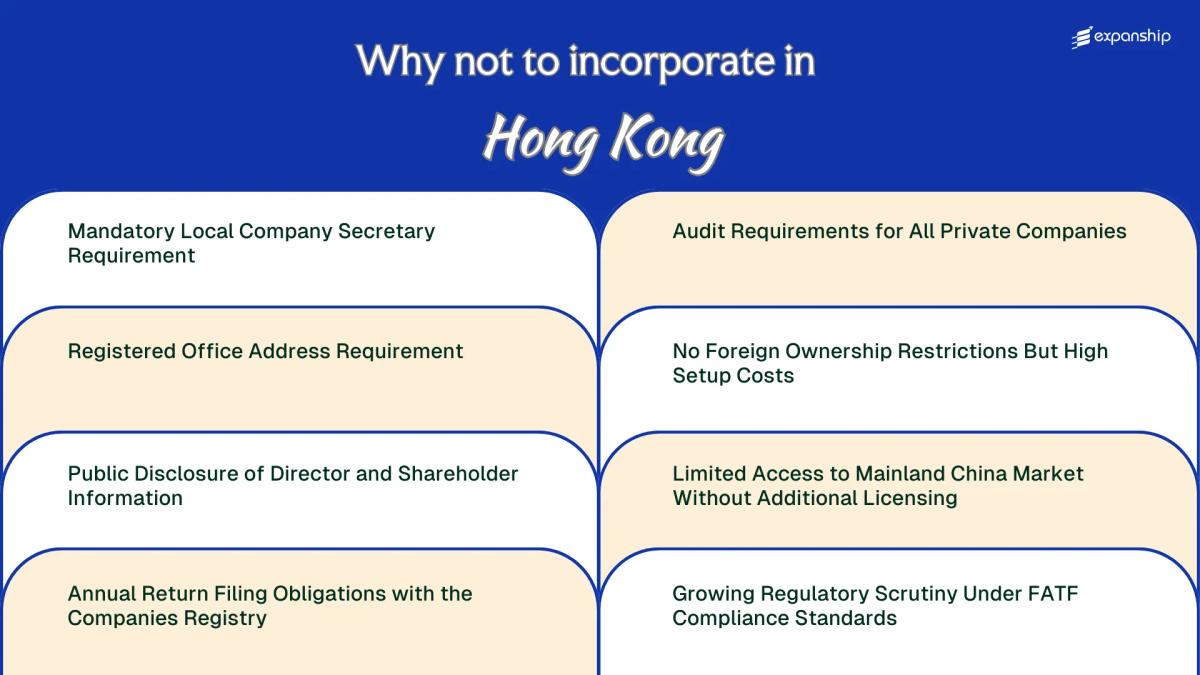
Mandatory Local Company Secretary Requirement
Under the Companies Ordinance (Cap. 622), every private company incorporated in Hong Kong must appoint a company secretary who is either a natural person ordinarily resident in the territory or a body corporate with a registered office there. For foreign founders, this is not a formality they can handle internally from abroad.
The Residency Restriction Creates a Structural Dependency
Because you cannot appoint a non-resident individual or a foreign-incorporated entity to fill this role, your business must engage a local professional service provider. This creates an ongoing contractual and financial dependency that does not exist in many other incorporation jurisdictions.
Annual fees for a corporate secretary in Hong Kong typically range from HKD 2,000 to HKD 10,000 or more, depending on the service scope. The deeper issue is that this arrangement transfers a degree of administrative control to a third party whose performance directly affects your firm's statutory compliance standing with the Companies Registry.
The sole-director restriction adds another layer: a company's sole director cannot also serve as its company secretary, which means even a single-founder entity must budget for this external appointment.
If your appointed company secretary fails to file required documents on time, the legal liability falls on your company, not the service provider, leaving your business directly exposed to penalties under the Companies Ordinance.
Registered Office Address Requirement
Under the Companies Ordinance (Cap. 622), every company incorporated in Hong Kong must maintain a registered office address within the territory. This address must be a physical location, not a P.O. box, and it must be operational during normal business hours. For foreign founders without an existing local presence, meeting this Hong Kong registered office address restriction means paying for a service you would not otherwise need.
The address is publicly filed with the Companies Registry, making it a permanent, searchable record. If you use your service provider's address, any change in that relationship triggers a formal amendment filing.
Practical burdens this creates for foreign business owners:
- You must source and contract a registered address provider before incorporation can proceed, adding a recurring annual cost with no operational benefit
- A change of address requires filing Form NR1 with the Companies Registry, creating administrative friction each time your service arrangement changes
- Using a residential address exposes personal location data through the public register
The Hong Kong local registered address requirement applies from the date of incorporation without exception, even for dormant companies with no active operations.

Company Incorporation in Hong Kong
Expanship handles your Hong Kong company formation, registered address, and Companies Registry filings from start to finish.
Public Disclosure of Director and Shareholder Information
Hong Kong director information public disclosure risks are a tangible concern for founders who value operational privacy. Under the Companies Ordinance (Cap. 622), every private limited company must file details of its directors and shareholders with the Companies Registry, where they become part of the public record.
Your director's full name, usual residential address (or correspondence address if a nominee is used), and nationality are accessible to anyone conducting a search. Shareholder names and their percentage holdings appear in the annual return, which is a publicly searchable document. For business owners from jurisdictions with personal security concerns or competitive sensitivity, this exposure carries direct risk.
| Data Field | Filed Document | Accessible To |
|---|---|---|
| Director's full name | NAR1 / Annual Return | Any member of the public |
| Director's correspondence or residential address | NAR1 / Annual Return | Any member of the public |
| Shareholder names and nationalities | Annual Return | Any member of the public |
| Shareholding percentages | Annual Return | Any member of the public |
| Significant controllers (UBOs) | Significant Controllers Register | Law enforcement and competent authorities only |
The Significant Controllers Register introduced under the Companies (Amendment) Ordinance 2018 requires disclosure of beneficial owners holding 25% or more. Unlike director and shareholder data, this register is not publicly searchable, but it remains available to law enforcement. That distinction offers partial relief, though it does not address the exposure of registered shareholders in public filings.
Annual Return Filing Obligations with the Companies Registry
Hong Kong annual return filing obligations apply to every private company incorporated under the Companies Ordinance (Cap. 622), regardless of whether the entity traded during the year. There is no dormancy exemption from this requirement, which means even a shelf company generates ongoing compliance costs.
Private companies must file an annual return with the Companies Registry within 42 days of the anniversary of incorporation. Missing this window triggers escalating late fees that increase the longer the return remains outstanding, with maximum penalties reaching HKD 50,000 in cases of prolonged default.
For foreign business owners managing multiple entities across jurisdictions, this fixed annual cycle adds a recurring administrative burden that cannot be deferred or consolidated with other filings.
- Filing must occur within 42 days of the incorporation anniversary each year
- Late filing penalties increase in tiers based on how overdue the return is
- No dormancy status exempts a private company from this filing obligation
- The annual return requires updated details on directors, shareholders, and registered office
- Non-compliance can result in the Registrar initiating striking-off proceedings against the entity
A Hong Kong private company that has never conducted a single transaction is still legally required to file an annual return and can face criminal prosecution for persistent non-compliance.
Audit Requirements for All Private Companies
Every private company incorporated in Hong Kong is legally required to have its financial statements audited annually. This obligation applies regardless of company size, revenue, or whether the business is actively trading.
A Statutory Requirement With No Size Exemption
Under the Companies Ordinance (Cap. 622), all private companies must appoint a practising certified public accountant registered with the Hong Kong Institute of Certified Public Accountants (HKICPA) to conduct the audit. Unlike the United Kingdom, which exempts small companies meeting certain thresholds from statutory audit, Hong Kong offers no equivalent small company exemption for private limited companies. For a foreign-owned business that generates modest local revenue, this creates a fixed compliance cost that cannot be avoided simply by remaining below a particular revenue benchmark.
What This Costs You in Practice
Audit fees in Hong Kong vary based on business complexity, but even straightforward engagements with minimal transactions typically start from HKD 8,000 to HKD 15,000 annually. Beyond the direct fee, your business must maintain orderly financial records throughout the year to support the audit, which often necessitates ongoing bookkeeping services as a prerequisite. The combined audit and accounting compliance costs represent a recurring mandatory expenditure that applies from the first financial year of incorporation.
Managing Audit Compliance Costs for Your Hong Kong Company
Understand the statutory audit obligations under the Companies Ordinance and how to structure your compliance calendar from year one.
No Foreign Ownership Restrictions But High Setup Costs
While Hong Kong imposes no restrictions on foreign ownership of local companies, high setup costs Hong Kong company formation structures can impose present a material financial burden that is often underestimated before incorporation.
- Government incorporation fees payable to the Companies Registry, combined with mandatory professional service fees, mean your initial outlay typically exceeds what equivalent jurisdictions in Southeast Asia require.
- The Business Registration Ordinance requires payment of a Business Registration Certificate fee, currently set by the Inland Revenue Department, adding a recurring annual cost on top of one-time setup expenses.
- Registered address providers, a mandatory local company secretary, and a Hong Kong-based bank account each carry separate fees, making the true first-year cost considerably higher than the headline government fee suggests.
- Banking setup alone can require significant minimum deposits or relationship fees, as major banks apply enhanced due diligence to newly incorporated foreign-owned entities under anti-money laundering obligations.
- Unlike some jurisdictions that offer shelf companies or expedited low-cost incorporation tracks, Hong Kong has no equivalent mechanism that reduces the professional service burden for foreign incorporators.
Limited Access to Mainland China Market Without Additional Licensing
A Hong Kong company does not automatically gain the right to conduct business operations on the Chinese mainland. Despite geographic proximity and the "One Country, Two Systems" framework, your entity is treated as a foreign business under mainland Chinese law, not a domestic one.
To sell goods or services directly to Chinese customers, collect renminbi revenue, or hire local staff on the mainland, you must establish a separate legal presence. The standard structure is a Wholly Foreign-Owned Enterprise (WFOE), which requires its own registration, registered capital, and ongoing compliance with Chinese corporate law — all independent of your Hong Kong registration.
This creates a structural duplication of costs. Your business effectively runs two separate legal entities, two sets of audits, and two compliance calendars across distinct regulatory regimes.
Certain sectors, including financial services and education, face additional licensing requirements beyond entity registration, further extending the timeline and cost before any revenue can be generated on the mainland.
A foreign-owned firm establishing a Hong Kong holding company and a mainland WFOE simultaneously could face combined setup costs exceeding USD 15,000–25,000, excluding sector-specific licensing fees, registered capital requirements, and ongoing dual-entity compliance costs.
Growing Regulatory Scrutiny Under FATF Compliance Standards
Hong Kong FATF compliance regulatory risks have intensified since the Financial Action Task Force's 2024 Mutual Evaluation Report, which identified deficiencies in the territory's anti-money laundering and counter-terrorist financing framework. For your business, this translates directly into heightened due diligence demands from banks, auditors, and counterparties who treat the jurisdiction as elevated-risk by default.
The Anti-Money Laundering and Counter-Terrorist Financing Ordinance (Cap. 615) imposes customer due diligence and record-keeping obligations on designated non-financial businesses and professions, including corporate service providers and accountants your firm will likely engage. When your service providers face stricter regulatory obligations, those costs and delays flow downstream to you.
Correspondent banking relationships have tightened in response to international scrutiny. Foreign-owned entities, particularly those with cross-border structures or beneficial owners from certain regions, report longer account opening timelines and more frequent transaction monitoring requests from licensed banks supervised by the Hong Kong Monetary Authority.
- Beneficial ownership information must be maintained in a Significant Controllers Register and made accessible to law enforcement.
- Companies in higher-risk sectors face enhanced due diligence requirements with no fixed resolution timeline.
- Non-compliance with Cap. 615 obligations can result in criminal liability for both the entity and its officers.
Even if your business operates in a low-risk sector, beneficial ownership transparency obligations under Cap. 615 apply universally, and failure to maintain accurate records exposes your company's officers to personal criminal liability.
Strategies to Overcome These Challenges
Overcoming Hong Kong incorporation challenges requires a structured approach built around the city's specific statutory obligations rather than generic compliance frameworks. The issues covered in this blog — from mandatory audit requirements to public director disclosure — each have defined procedural responses within existing law.
- Appoint a Hong Kong-resident individual or licensed corporate body as company secretary before submitting your incorporation application to the Companies Registry.
- Use a designated registered office address in Hong Kong that can receive official correspondence from the Companies Registry and the Inland Revenue Department.
- Engage a CPA-holder registered under the Hong Kong Institute of Certified Public Accountants to conduct the statutory annual audit required under the Companies Ordinance (Cap. 622).
- File your annual return within 42 days of your company's incorporation anniversary to avoid late filing penalties under the Companies Ordinance.
- Obtain a Separate business license or permit specific to your sector before conducting any regulated activity on the mainland under CEPA arrangements.
- Prepare a beneficial ownership register in compliance with the Anti-Money Laundering and Counter-Terrorist Financing Ordinance (Cap. 615) to meet current FATF-aligned disclosure standards.
These steps address the structural compliance requirements that apply to all private companies registered in the territory. The regulatory framework governing them is administered across multiple statutory bodies, including the Companies Registry, the Inland Revenue Department, and the Securities and Futures Commission.
Hong Kong's Overall Value for Businesses
Hong Kong company formation pros and cons tell a consistent story: the compliance burden is real, but the underlying legal and commercial architecture remains sound. The territorial tax system, absence of VAT, and access to an internationally recognized common law framework are structural features that continue to attract foreign-owned entities.
| Pros | Cons |
|---|---|
| Territorial tax system means only Hong Kong-sourced income is subject to profits tax | All private companies must appoint a locally resident company secretary |
| No restrictions on foreign ownership of shares or directorships | Director and shareholder details are publicly accessible through the Companies Registry |
| No VAT or goods and services tax | Annual audits by a Hong Kong-certified public accountant are mandatory regardless of company size |
| Common law legal system with an independent judiciary | Annual returns must be filed with the Companies Registry on a fixed schedule |
| No capital gains tax on investment or asset disposals | Accessing the Mainland China market requires separate licensing and regulatory approvals |
Satisfying FATF-driven due diligence requirements has increased onboarding timelines with banks and professional service providers. Whether those obligations outweigh the fiscal and structural advantages depends on your operational model and where your revenue originates.
Compliance Services for Hong Kong Companies
Maintain good standing with the Companies Registry and meet your annual statutory obligations under the Companies Ordinance.
Conclusion
The cons of Hong Kong company registration are real and measurable, even if the jurisdiction retains a well-established legal framework under the Companies Ordinance (Cap. 622). Mandatory annual audits for all private companies, regardless of size or revenue, add recurring costs that many founders underestimate at the outset. Public disclosure of director and shareholder details through the Companies Registry removes the confidentiality that some business structures depend on. Structural limitations on accessing the mainland China market further narrow the practical scope for certain operators. Professional guidance becomes less optional and more necessary when managing these obligations consistently.
Expanship's Services for Your Hong Kong Expansion
Incorporating in Hong Kong carries specific obligations — from appointing a qualified company secretary under the Companies Ordinance to filing annual returns with the Companies Registry and meeting mandatory audit requirements. Expanship's Hong Kong company formation compliance services are structured around these actual requirements, helping your business stay on top of each obligation without absorbing the full administrative burden in-house.
Beyond formation, Expanship offers a practical range of corporate services for ongoing operations in the territory.
- Preparing and filing your incorporation documents with the Companies Registry
- Providing a registered Hong Kong office address and acting as your local registered agent
- Handling government filings and liaising with the relevant regulatory authorities on your behalf
- Managing your post-incorporation compliance calendar, including annual returns and statutory records
- Introducing your entity to banking institutions with operations in Hong Kong
- Registering your business for tax purposes and coordinating with the Inland Revenue Department
Reach out to Expanship Hong Kong to discuss how we can support your incorporation.
Frequently Asked Questions (FAQ)
Yes, all directors of a Hong Kong company, whether Hong Kong residents or foreign nationals, are subject to disclosure requirements under the Companies Ordinance (Cap. 622). Particulars including name and correspondence address are accessible through the Companies Registry's public search system. Appointing a nominee director does not eliminate this requirement, as the beneficial owner's details may still be required under the Significant Controllers Register.
Late filing triggers financial penalties under the Companies Ordinance. The standard annual return fee increases significantly once the filing deadline is missed, and continued non-compliance can result in prosecution of both the company and its directors. Dormant companies are not exempt from this obligation.
Audit fees in Hong Kong vary based on transaction volume and complexity, but even a dormant or minimal-activity company can expect to pay several hundred to a few thousand US dollars annually for a compliant statutory audit. This cost is in addition to accounting and bookkeeping fees required to prepare auditable financial statements. For early-stage businesses with minimal revenue, this represents a disproportionate fixed compliance cost.
Legitimate businesses are directly affected. Hong Kong's enhanced compliance obligations under FATF standards have led to increased due diligence requirements from banks, meaning even established firms can face account opening delays or rejections. Corporate service providers and financial institutions are required to conduct more rigorous Know Your Customer checks, which adds administrative burden and timelines to routine banking setup.
No. The Companies Ordinance (Cap. 622) requires that the company secretary of a Hong Kong private company either be a Hong Kong resident individual or a body corporate with a registered office or place of business in Hong Kong. An overseas individual or foreign-incorporated entity does not satisfy this requirement, making the engagement of a local service provider effectively mandatory.
Failing to maintain an accurate Significant Controllers Register, or refusing to provide it to law enforcement upon request, is a criminal offence under the Companies Ordinance. Convicted parties face fines, and the obligation applies to all private Hong Kong companies regardless of size or activity level. The register must be kept at the company's registered office or at the office of a designated representative.
It is primarily a practical and regulatory barrier rather than an outright legal prohibition. A Hong Kong-incorporated entity does not automatically receive the licenses, approvals, or tax treaty benefits required to conduct business operations within Mainland China. Accessing the Mainland market typically requires establishing a separate foreign-invested enterprise structure, such as a Wholly Foreign-Owned Enterprise, which involves its own approval process under Chinese law.
Legal Disclaimer
The information provided in this article is for general informational purposes only and does not constitute legal, tax, or professional advice. While we strive to ensure the accuracy and timeliness of the content, laws and regulations are subject to change, and the application of laws can vary widely based on specific facts and circumstances.
Readers should not act upon this information without seeking professional counsel tailored to their individual situation. Expanship and its authors disclaim any liability for actions taken or not taken based on the content of this article.
For specific advice regarding your business setup, compliance requirements, or any legal matters, please consult with qualified legal and tax professionals in the relevant jurisdiction.