
Key Takeaways
- Hong Kong's territorial tax system under the Inland Revenue Ordinance taxes only profits sourced within the territory, meaning income generated from overseas operations falls entirely outside the charge to profits tax.
- The absence of withholding taxes on dividends, combined with no GST or VAT, allows capital to move across borders without the administrative and financial drag that characterises many competing jurisdictions.
- Foreign investors benefit from full ownership of a Hong Kong private company limited by shares under the Companies Ordinance (Cap. 622), eliminating the need for local partner arrangements or nominee structures that add cost and complexity.
- Operating under the Exchange Fund Ordinance, Hong Kong imposes no exchange controls, giving businesses direct control over cross-border treasury movements across subsidiaries and related entities.
Hong Kong is a Special Administrative Region of China, operating under a "one country, two systems" framework that gives it a distinct legal and regulatory identity separate from mainland China. Company registration is administered by the Companies Registry, which operates under the Companies Ordinance (Cap. 622). The most common legal vehicle used by foreign businesses entering the market is a private company limited by shares.
From a tax standpoint, the territory operates a territorial tax system, meaning only profits sourced within its borders are subject to taxation. Foreign ownership faces no statutory restrictions, and foreign direct investment is treated on broadly equal terms with domestic investment across most sectors.
The benefits of incorporating in Hong Kong draw interest from businesses across Asia, Europe, and North America alike. Whether you're a regional holding company or an e-commerce firm seeking access to Asian markets, understanding the specific structural and regulatory advantages this jurisdiction offers is essential to making an informed decision. This article examines those advantages in detail.
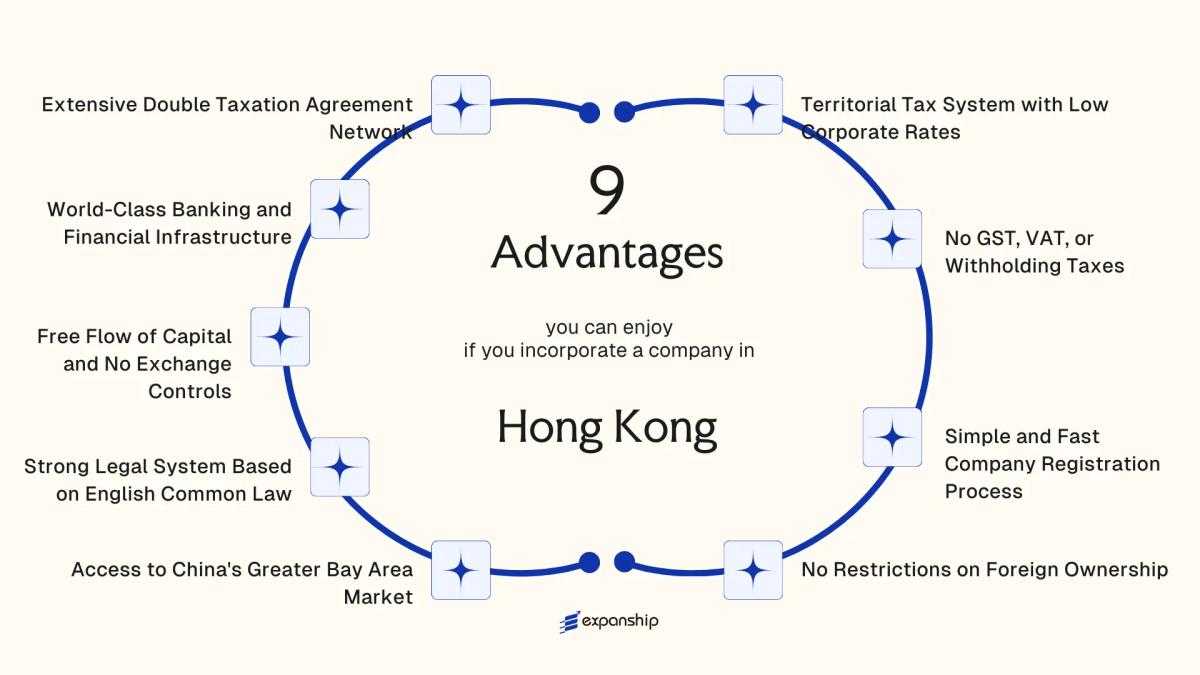
Territorial Tax System with Low Corporate Rates
Hong Kong's territorial tax system stands as one of the most structurally favorable features of its corporate environment. Under this framework, only profits sourced within Hong Kong are subject to tax — offshore income is outside the charge entirely.
How the Profits Tax Rate Works
Under the Inland Revenue Ordinance (Cap. 112), corporations pay a two-tier profits tax rate: 8.25% on the first HKD 2 million of assessable profits, and 16.5% on the remainder. For context, the global average corporate tax rate sits above 23%, making the Hong Kong rate considerably lower for most business structures.
What Offshore Income Exemption Means in Practice
If your firm generates revenue from contracts executed, services delivered, or transactions completed outside Hong Kong, those profits are not subject to profits tax. This distinction between onshore and offshore income means that a business with a genuinely international revenue base can significantly reduce its taxable exposure by design, not by artifice. Eligibility for offshore income exemption requires demonstrating that the profit-generating activities occurred outside the jurisdiction.
Profits earned from overseas clients or cross-border transactions may fall outside Hong Kong's taxable scope, reducing your effective corporate tax burden without requiring complex structures.
No GST, VAT, or Withholding Taxes
The no VAT or GST in Hong Kong advantage is structural, not incidental. No legislation has ever introduced a goods and services tax or value-added tax in the territory. Every sale, service, or transaction your business completes is free from the administrative and financial burden that indirect taxes impose in most developed economies, where VAT rates commonly range from 10% to 25%.
This absence has a direct operational consequence. Your firm does not need to register for indirect tax, file periodic VAT returns, or manage input tax recovery across supply chains. Compliance costs that consume accounting resources in other jurisdictions simply do not arise here.
Dividend distributions from a Hong Kong entity to foreign shareholders carry no withholding tax. Royalties and interest payments made offshore are equally unaffected. Under the Inland Revenue Ordinance, no withholding mechanism applies to these outflows, which means your group can repatriate profits or service intercompany arrangements without a tax cost at the point of payment.
The practical reasons this tax structure benefits foreign-owned entities:
- No indirect tax registration is required at any revenue threshold, removing an obligation that triggers compliance requirements in most other trading jurisdictions
- No withholding on dividends means profit extraction to foreign parent companies carries no additional tax layer beyond the corporate rate already paid
- Royalty and interest payments to non-resident recipients are not subject to deduction at source, preserving the intended economics of intercompany arrangements
- Zero GST exposure eliminates the cash flow timing issues that VAT refund cycles create in export-heavy businesses

Company Incorporation in Hong Kong
Incorporate your Hong Kong company with a structure designed to take full advantage of the territory's indirect tax-free environment and zero withholding framework.
Simple and Fast Company Registration Process
Registering a private limited company in Hong Kong is governed by the Companies Ordinance (Cap. 622), and the process is notably direct for foreign nationals. One of the core Hong Kong fast company registration benefits is that incorporation can typically be completed within one to two business days once documents are submitted to the Companies Registry. No in-person presence is required, which removes a logistical barrier that exists in many other jurisdictions.
| Requirement | Detail |
|---|---|
| Minimum Directors | 1 (individual, any nationality) |
| Minimum Shareholders | 1 (individual or corporate) |
| Company Secretary | Required (must be Hong Kong resident or local firm) |
| Registered Address | Must be a physical Hong Kong address |
| Minimum Share Capital | No statutory minimum |
| Registration Body | Companies Registry |
Your business does not need a local director, and there is no residency requirement for shareholders. A single individual can hold both director and shareholder roles simultaneously. The company secretary, however, must be either a Hong Kong resident or a locally incorporated firm, which is a straightforward compliance obligation to satisfy through a service provider.
The incorporation fee paid to the Companies Registry is fixed and modest. Once registered, your entity receives a Business Registration Certificate from the Inland Revenue Department, which is renewed annually. The entire structure allows a foreign-owned firm to move from application to operational status within days, not weeks.
No Restrictions on Foreign Ownership
The Hong Kong 100% foreign ownership advantage is one of the most structurally significant features of its corporate framework. Under the Companies Ordinance (Cap. 622), a non-resident can incorporate and wholly own a private limited company without any requirement for a local partner or minimum local shareholding. This applies across virtually all sectors open to private enterprise.
Most jurisdictions impose some form of ownership cap on foreign investors, whether sector-specific or general. Hong Kong imposes none at the company level. A sole foreign shareholder can hold 100% of issued shares from day one, with no government approval required beyond standard registration.
This structure has direct practical consequences. Your business retains full decision-making authority, dividend distribution rights, and exit flexibility without dilution to a mandatory local partner. Profit repatriation is unrestricted, and there are no forced joint-venture arrangements.
Keep the following in mind:
- Certain regulated activities (banking, insurance, securities dealing) require licensing from the relevant authority, such as the Securities and Futures Commission or the Hong Kong Monetary Authority.
- At least one company secretary must be a Hong Kong resident or a locally incorporated body corporate, but this is an administrative role, not an ownership condition.
- Shareholder identity must be disclosed in the Companies Registry; beneficial ownership registers apply under the Significant Controllers Register regime.
- Regulated industries may carry sector-specific foreign participation conditions separate from general company law.
A single foreign individual can incorporate and fully own a Hong Kong private company without ever physically visiting the territory, as the entire registration process can be completed remotely through a licensed company secretary.
Access to China's Greater Bay Area Market
Hong Kong Greater Bay Area market access benefits are among the most structurally significant advantages available to a foreign-incorporated entity. The Greater Bay Area (GBA) initiative connects Hong Kong with nine Guangdong cities and Macau, forming an economic zone with a combined GDP exceeding USD 2 trillion and a population of over 86 million.
A Distinct Legal Status That Opens a Controlled Door
Under the "one country, two systems" framework, your Hong Kong-registered company operates under a separate legal and customs jurisdiction from mainland China, yet qualifies for preferential cross-border arrangements unavailable to purely foreign entities. The Closer Economic Partnership Arrangement (CEPA), first signed in 2003 and expanded through subsequent protocols, allows Hong Kong-incorporated businesses to access mainland markets in services and goods at reduced or zero tariff rates that foreign firms from other jurisdictions cannot claim.
Business-Ready Infrastructure for Cross-Border Operations
Cross-boundary financial infrastructure under the GBA framework includes provisions for corporate bank account connectivity, cross-boundary wealth management products, and currency settlement mechanisms that reduce the friction of operating across two monetary systems. For a foreign business owner, this means your firm can maintain a fully convertible, USD-friendly operating environment in Hong Kong while still conducting RMB-denominated transactions with mainland counterparts. The Guangdong-Hong Kong-Macao Greater Bay Area Outline Development Plan, published by China's State Council, formally designates Hong Kong as the international finance and trade hub within this structure, which carries regulatory weight when your business seeks approvals or partnerships on the mainland side.
Unlock Your Greater Bay Area Advantage in Hong Kong
Speak with our corporate specialists to structure your Hong Kong entity for maximum access to GBA markets and cross-border commercial arrangements.
Strong Legal System Based on English Common Law
Hong Kong English common law business advantages run deeper than most jurisdictions with a shared legal heritage. The common law system, inherited from British rule and preserved under the Basic Law after 1997, means that contracts, corporate structures, and dispute resolution mechanisms function on principles that foreign businesses from the UK, US, Australia, Canada, and other common law countries will recognize immediately.
- Contracts governed under Hong Kong law carry predictable interpretation standards. Courts apply established precedent, which reduces ambiguity in commercial agreements and gives your legal counsel a reliable framework to draft enforceable terms.
- The Companies Ordinance (Cap. 622) codifies director duties, shareholder rights, and corporate governance obligations in clear statutory language. Foreign investors benefit from defined protections that are not subject to arbitrary administrative discretion.
- An independent judiciary operates separately from the executive branch. Judges are appointed on merit, and the Court of Final Appeal retains the ability to invite non-permanent judges from other common law jurisdictions, reinforcing legal continuity.
- Arbitration through the Hong Kong International Arbitration Centre (HKIAC) is widely recognized and enforceable in over 170 countries under the New York Convention. This gives cross-border commercial disputes a resolution path that holds weight internationally.
Free Flow of Capital and No Exchange Controls
Hong Kong free capital flow benefits are grounded in a straightforward legal reality: there are no exchange control regulations in force. The Exchange Fund Ordinance (Cap. 66) governs monetary policy, but it imposes no restrictions on moving money in or out of the territory. Your business can transfer profits, repay intercompany loans, or repatriate capital without seeking prior approval from any regulatory authority.
This matters because the absence of capital controls removes a layer of friction that businesses routinely face in other Asian markets. Funds can move in any currency, in any amount, at any time.
For foreign-owned entities, Hong Kong capital repatriation benefits are immediate and unconditional. There is no mandatory holding period before profits can be distributed to an overseas parent. No minimum local reinvestment requirement applies.
Hypothetical scenario: A Singapore-based parent company wholly owns a Hong Kong subsidiary that generates HKD 5,000,000 in profit. The full amount can be wired to the Singapore parent in the same financial year, in any currency, without withholding tax on the dividend and without filing for remittance approval. Net transfer cost is limited to bank fees alone.
Free currency movement for businesses operating across borders also means treasury functions can be managed centrally, without structuring workarounds that would otherwise be necessary in jurisdictions with capital account restrictions.
World-Class Banking and Financial Infrastructure
Hong Kong banking infrastructure advantages for companies stem directly from the city's position as one of the few jurisdictions where major global, regional, and Chinese banks all maintain full operational presences. Firms incorporated here can access institutions ranging from HSBC and Standard Chartered to Bank of China and Hang Seng, all regulated under the Hong Kong Monetary Authority (HKMA).
For foreign-owned businesses, this concentration has a concrete operational benefit: your company can hold accounts in multiple currencies, including USD, EUR, GBP, RMB, and HKD, within a single banking relationship. RMB settlement is particularly significant, as Hong Kong functions as the world's largest offshore RMB clearing centre.
The HKMA's regulatory framework requires licensed banks to maintain defined capital adequacy and liquidity standards under the Banking Ordinance (Cap. 155), which gives counterparties and investors confidence in the stability of local institutions.
- Access to international trade finance, letters of credit, and cross-border payment infrastructure
- Availability of corporate accounts that support multi-currency treasury operations
- Direct connectivity to China's domestic payment systems through licensed clearing banks
Opening a corporate bank account in Hong Kong requires passing the bank's own KYC and due diligence review, which can vary significantly in timeline and documentation requirements between institutions.
Extensive Double Taxation Agreement Network
Hong Kong double taxation agreement benefits stem from a treaty network that, as of 2024, covers over 50 Comprehensive Double Taxation Agreements (CDTAs) with jurisdictions including mainland China, the United Kingdom, Japan, France, Germany, the UAE, and Canada. Each CDTA is negotiated under the Inland Revenue Ordinance (Cap. 112) framework and allocates taxing rights between the two contracting jurisdictions to prevent the same income from being taxed twice.
For a foreign business owner, this matters because it directly reduces the tax cost of cross-border transactions. Dividends, royalties, and service fees paid to a Hong Kong entity from a treaty partner country may be subject to reduced withholding rates under the applicable CDTA, rather than the domestic rate that would otherwise apply in the source country.
The practical scope of this network extends beyond simple tax reduction:
- Treaty partners are required to share tax information under agreed exchange standards, which strengthens your entity's credibility with foreign tax authorities
- CDTAs with mainland China allow your firm to benefit from reduced withholding on dividends (as low as 5% under the China-HK CDTA for qualifying corporate shareholders with a 25% or greater stake)
- Treaty access can reduce the tax friction on intellectual property licensing arrangements routed through a Hong Kong holding structure
Eligibility for CDTA benefits generally requires that your company be a tax resident in Hong Kong, which means central management and control must be exercised within the territory. Substance requirements are not standardised across all treaties, so the applicable CDTA terms govern each specific situation.
Is Hong Kong Still a Top Business Hub?
Evaluated against its most direct regional competitors, the case for incorporation here becomes clearer when specific structural variables are placed side by side. Singapore, the British Virgin Islands, and the Cayman Islands are the jurisdictions most frequently considered alongside Hong Kong by international investors targeting Asia-Pacific exposure or offshore holding structures. Each serves a distinct purpose, but all compete for the same pool of foreign capital.
What the comparison surfaces is not that one jurisdiction dominates across every parameter, but that this SAR holds a consistently strong position across the metrics that matter most to an operating business: tax treatment, legal enforceability, banking access, and market proximity. The Companies Ordinance (Cap. 622) underpins a corporate framework that has remained stable through successive global shifts, which gives it an edge over offshore centres that offer tax neutrality but lack a functioning domestic legal and financial infrastructure.
| Parameter | Hong Kong | Singapore | British Virgin Islands | Cayman Islands |
|---|---|---|---|---|
| Corporate Tax Rate | 8.25% / 16.5% (two-tier) | 17% flat | 0% (no local operations) | 0% (no local operations) |
| Territorial Tax System | Yes | Yes | N/A | N/A |
| Foreign Ownership | 100% permitted | 100% permitted | 100% permitted | 100% permitted |
| Mainland China Market Access | Direct (GBA, CEPA) | Limited | None | None |
| Legal System | English Common Law | English Common Law | English Common Law | English Common Law |
| Exchange Controls | None | None | None | None |
| Double Tax Agreements | 45+ | 90+ | None | None |
| Physical Substance Required | Recommended for tax residency | Yes (for tax benefits) | Not required | Not required |
| Banking Infrastructure | Full onshore banking | Full onshore banking | Offshore only | Offshore only |
Compliance Services for Companies in Hong Kong
Keep your Hong Kong company in good standing with the Companies Registry and meet annual filing, audit, and statutory obligations on time.
Conclusion
The benefits of incorporating in Hong Kong converge on a single structural reality: the jurisdiction is built, at a legal and regulatory level, to facilitate international business with minimal friction. The territorial tax system under the Inland Revenue Ordinance means offshore-sourced profits remain outside the charge to profits tax, and the absence of withholding taxes on dividends allows capital to move across borders without administrative burden.
Two features distinguish this framework in practical terms. First, unrestricted foreign ownership under the Companies Ordinance (Cap. 622) means your business structure does not depend on finding a local partner or nominee arrangement. Second, the absence of exchange controls under the Exchange Fund Ordinance means funds can enter and exit freely, which directly affects how you manage treasury operations across subsidiaries or related entities.
Whether this jurisdiction suits your business depends on where your income is sourced, how your group is structured, and which markets you are serving. A firm generating primarily Hong Kong-sourced revenue faces a different tax position than one using the entity as a regional holding or trading vehicle. Understanding that distinction before incorporation determines whether the advantages of setting up a company in Hong Kong translate into measurable outcomes for your specific operation. Engaging qualified corporate and tax advisors early in the process ensures the structure is configured correctly from the outset.
Start Your Hong Kong Company with Expanship Today
Incorporating in Hong Kong through Expanship means having structured support across every stage of the process governed by the Companies Ordinance (Cap. 622) and administered by the Companies Registry. From selecting the right entity type — whether a private company limited by shares, a branch, or a representative office — through to annual compliance under the Business Registration Ordinance (Cap. 310), each step carries specific filing obligations that require accurate handling from the outset.
Expanship's scope of work covers the full formation and maintenance cycle:
- Preparation and legalization of incorporation documents, including the Articles of Association
- Provision of a registered office address and company secretary, both mandatory under Cap. 622
- Filing with the Companies Registry and liaison with the Inland Revenue Department where applicable
- Post-incorporation compliance management, including annual return filings and statutory record maintenance
- Banking introduction assistance to support account opening with local and international financial institutions
To work with Expanship Hong Kong, submit your inquiry directly through the contact page.
Frequently Asked Questions (FAQ)
Hong Kong applies a two-tier profits tax rate: 8.25% on the first HKD 2 million of assessable profits, and 16.5% on profits above that threshold. Critically, the Inland Revenue Ordinance (Cap. 112) taxes only profits that arise in or are derived from Hong Kong, meaning income generated entirely from operations outside the territory is generally not subject to profits tax. This offshore claim must be substantiated and is assessed by the Inland Revenue Department on a case-by-case basis.
The Companies Registry processes straightforward incorporation applications within one business day when submitted electronically through its e-Registry portal. Paper applications take longer, typically three to seven business days. Once incorporated, the business registration certificate issued by the Inland Revenue Department is generally provided concurrently or within a short processing window.
Hong Kong does not impose withholding tax on dividends distributed to shareholders, regardless of their country of residence. Interest payments and royalties paid to non-residents are also not subject to a general withholding tax regime, though royalties paid to non-residents for the use of intellectual property in Hong Kong may attract profits tax liability under specific provisions of the Inland Revenue Ordinance. This treatment makes the jurisdiction relatively straightforward for repatriating profits to foreign parent companies.
Hong Kong has concluded Comprehensive Avoidance of Double Taxation Agreements (CDTAs) with over 45 jurisdictions, including mainland China, the United Kingdom, Germany, Japan, and the United Arab Emirates. These treaties reduce or eliminate withholding taxes imposed by the treaty partner country on dividends, interest, and royalties paid to Hong Kong-resident entities. A company must meet the residency and beneficial ownership conditions specified in each individual CDTA to access reduced rates.
No exchange controls apply in Hong Kong. The territory operates under a free capital flow regime, meaning your business can transfer funds internationally without prior approval from any regulatory authority. The Hong Kong dollar is pegged to the US dollar under the Linked Exchange Rate System managed by the Hong Kong Monetary Authority, providing exchange rate stability for cross-border transactions.
Commercial disputes in Hong Kong are resolved under English common law principles, applied by an independent judiciary. The court system, including the Court of Final Appeal, operates separately from mainland China's legal system under the Basic Law. Hong Kong is also a signatory to the New York Convention on the Recognition and Enforcement of Foreign Arbitral Awards, meaning arbitral awards issued in Hong Kong are enforceable in over 170 contracting states.
Conducting business directly in mainland China generally requires a separate legal presence, such as a Wholly Foreign-Owned Enterprise or a joint venture established under PRC law. A Hong Kong company does not automatically confer the right to operate within mainland jurisdictions. However, agreements under the Closer Economic Partnership Arrangement (CEPA) provide preferential market access for qualifying Hong Kong service suppliers in certain sectors, which can reduce barriers to entry when establishing a mainland presence.
Legal Disclaimer
The information provided in this article is for general informational purposes only and does not constitute legal, tax, or professional advice. While we strive to ensure the accuracy and timeliness of the content, laws and regulations are subject to change, and the application of laws can vary widely based on specific facts and circumstances.
Readers should not act upon this information without seeking professional counsel tailored to their individual situation. Expanship and its authors disclaim any liability for actions taken or not taken based on the content of this article.
For specific advice regarding your business setup, compliance requirements, or any legal matters, please consult with qualified legal and tax professionals in the relevant jurisdiction.