

Key Takeaways
- Foreign investors operating under Guyana's Companies Act must maintain a mandatory local registered office, adding an ongoing administrative and cost burden that cannot be satisfied through a foreign address alone.
- Guyana's double taxation treaty network remains narrow, exposing cross-border businesses to the risk of being taxed on the same income in multiple jurisdictions without treaty-based relief mechanisms.
- Restricted foreign ownership rules in certain regulated sectors under the Investment Act create structural barriers that limit how multinational entities can configure their equity and control arrangements.
- The Deeds Registry's underdeveloped corporate infrastructure means that routine filing and registration processes can face procedural delays that compound compliance timelines for newly incorporating entities.
Guyana's corporate regulatory environment is still evolving, shaped by the Companies Act and overseen by the Deeds Registry, which serves as the primary registration authority. The framework sits between a developing administrative system and a jurisdiction under growing international scrutiny due to its expanding oil economy.
The disadvantages of incorporating in Guyana span several categories — regulatory, financial, legal, and operational — each presenting distinct friction points depending on how your business is structured.
Not every drawback will apply equally across all entity types or industries. A small services firm will face a different set of constraints than a foreign-owned enterprise operating in a regulated sector under the Investment Act.
This article is most relevant to foreign investors, multinational entities, and entrepreneurs considering the cons of registering a company here for the first time, particularly those without existing operational ties to the country.
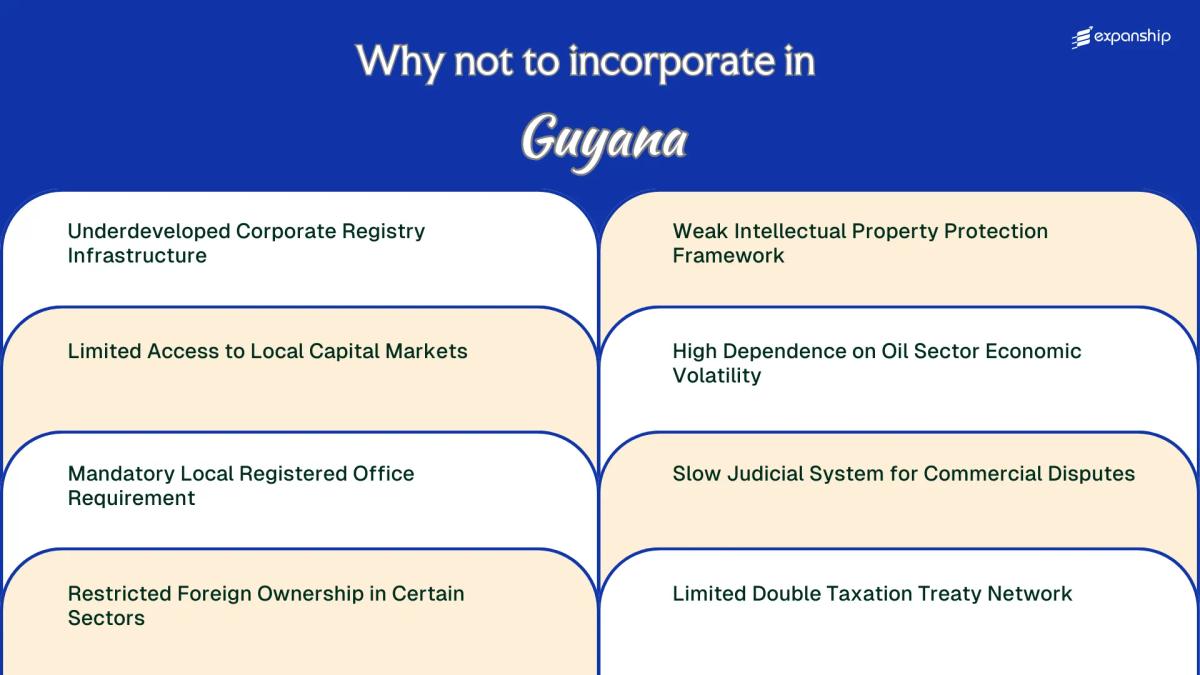
Underdeveloped Corporate Registry Infrastructure
Guyana corporate registry limitations create tangible operational friction for foreign businesses at the incorporation stage itself. Processing delays are systemic, not incidental.
Manual Processes and Outdated Filing Systems
The Deeds Registry, which handles company registrations under the Companies Act 1991, has historically relied on paper-based filing and manual record management. For a foreign investor, this means incorporation timelines can stretch considerably beyond what comparable Caribbean or Latin American jurisdictions require, adding unpredictability to your market entry schedule.
Digital verification of registered entities remains limited, making due diligence on local counterparties harder to conduct remotely.
Structural Gaps That Affect Ongoing Compliance
Guyana company registration infrastructure challenges extend beyond initial filing. Retrieving certified documents, updating registered particulars, or confirming good standing status can require in-person visits or reliance on local agents, generating recurring costs that similar jurisdictions with online registries do not impose.
This dependency on physical presence or intermediary agents introduces delays into routine compliance obligations that foreign-owned entities face throughout their operational life.
Foreign businesses should account for agent dependency costs and filing delays as fixed operational overheads, not one-time incorporation expenses.
Limited Access to Local Capital Markets
The limited capital markets in Guyana present a concrete structural barrier for incorporated businesses seeking to raise growth funding domestically. The Guyana Stock Exchange (GSE) lists only a small number of publicly traded companies, leaving most firms without a viable public equity route.
For a foreign-owned entity, this restricted environment creates friction at multiple stages of financial planning:
- Debt financing through local banks tends to come with elevated interest rates and collateral requirements that favour established domestic borrowers, placing newer foreign-registered entities at a disadvantage from the outset.
- The shallow bond market means your business cannot realistically raise capital through local debt instruments, forcing reliance on offshore financing that adds currency risk and transaction costs.
- Without a liquid secondary market, selling equity stakes to local investors is difficult, which complicates exit planning and minority investor arrangements.
The Securities Industry Act governs capital markets oversight, with the Securities Council of Guyana as the supervising authority. Its regulatory framework was not designed with deep capital market activity in mind, and that absence of market depth means foreign firms cannot depend on local financial markets as a supplementary funding source.

Company Incorporation in Guyana
Set up your company in Guyana with full compliance support, from registry filing to post-incorporation requirements.
Mandatory Local Registered Office Requirement
Under the Guyana Companies Act, every company incorporated in the country must maintain a registered office at a physical address within Guyana. This Guyana registered office requirement means a foreign business owner cannot simply list an overseas address or use a virtual mailbox outside the jurisdiction. The office must be a location where legal notices and official correspondence can be served during business hours.
| Requirement | Detail | Burden on Foreign Business |
|---|---|---|
| Physical address | Must be located within Guyana | Cannot use overseas or virtual address |
| Service of documents | Notices must be receivable during business hours | Requires staffed or agent-managed presence year-round |
| Registered agent obligation | Agent must maintain address on file with Companies Registry | Ongoing retainer costs even for dormant entities |
| Change notification | Address changes must be filed with the Deeds Registry | Administrative cost and processing delays apply |
For a foreign firm with no existing operations in the country, meeting this requirement means engaging a local registered agent or leasing physical space, both of which generate recurring costs before the business generates any revenue. Unlike jurisdictions where a nominee address is straightforward to obtain at minimal cost, local service providers in Guyana operate in a smaller market, which limits competition and keeps agent fees higher relative to comparable offshore-friendly jurisdictions.
The obligation applies continuously for the life of the entity, not only at the incorporation stage. Any lapse in maintaining a valid registered address can expose your company to administrative penalties under the Companies Act and may affect the firm's standing with the Deeds Registry of Guyana.
Restricted Foreign Ownership in Certain Sectors
Foreign ownership restrictions in Guyana affect a defined set of industries, and the legal boundaries are not always clearly codified in a single consolidated statute. The Investment Act 2004 governs the general framework for foreign investment, but sector-specific caps and prohibitions are scattered across separate legislation.
Certain industries — including broadcasting, coastal fishing, and some categories of land ownership — impose restrictions on foreign equity participation. This fragmentation means your legal team must audit multiple regulatory instruments before structuring any entity.
For foreign investors, the practical burden is significant. Identifying the applicable restriction requires engaging local counsel familiar with sector-specific regulations, which adds both cost and lead time to the incorporation process.
Some restrictions are administered by sector regulators rather than a central body, further complicating compliance for a foreign firm operating across more than one industry.
- Foreign equity caps apply per sector and are governed by separate legislation, not a unified foreign investment code.
- Broadcasting and coastal fishing sectors impose direct restrictions on foreign ownership percentages.
- No single regulatory window consolidates sector-specific foreign ownership rules for foreign applicants.
- Non-compliance with equity restrictions can affect the validity of the entity's operating license.
Guyana does not maintain a publicly available foreign ownership restriction register, meaning there is no single official document a foreign investor can consult to confirm all sector-level equity limits before incorporating.
Weak Intellectual Property Protection Framework
Intellectual property protection risks Guyana presents to foreign firms are substantial, stemming from both legislative gaps and the limited operational capacity of the Guyana Intellectual Property Office (GIPO).
Structural Gaps in the IP Framework
Guyana's primary IP legislation, including the Trade Marks Act and the Copyright Act, has not been substantively modernized to reflect international standards under the TRIPS Agreement, despite the country's WTO membership. Your trademarks and proprietary assets may lack the breadth of protection that a well-developed registry system would otherwise provide, creating direct exposure for brands entering the market.
Trademark registration problems Guyana businesses face are compounded by GIPO's limited resources, which affect processing times and examination quality. The office does not offer the procedural transparency or digital infrastructure common in more developed jurisdictions.
Enforcement Limitations and Business Exposure
Weak IP laws Guyana operates under mean that even registered rights can be difficult to enforce in practice. Guyana intellectual property enforcement challenges are rooted in limited judicial specialization and an absence of dedicated IP courts, meaning disputes are handled by general civil courts with varying levels of IP expertise.
Support for Managing Business Challenges in Guyana
Understand what incorporating in Guyana means for your intellectual property and compliance obligations before committing to the jurisdiction.
High Dependence on Oil Sector Economic Volatility
Guyana oil sector economic volatility risks are a direct concern for any foreign entity operating here, given that petroleum now accounts for the overwhelming majority of export revenues following ExxonMobil-led offshore production from the Stabroek Block. A single-commodity dependency of this scale exposes your business to fiscal instability that can shift government spending, procurement priorities, and regulatory attention within a budget cycle.
- Oil price downturns can trigger abrupt contractions in government revenue, reducing public contracts and infrastructure spending that many foreign firms depend on for local business activity.
- The Natural Resource Fund Act 2021 governs savings and withdrawals from petroleum revenues, but the rules governing drawdown thresholds mean fiscal buffers can be depleted during sustained price shocks.
- Currency stability under the Bank of Guyana is indirectly tied to petroleum inflows, so a prolonged oil downturn can affect exchange rate predictability for your cross-border transactions.
- Non-oil sectors remain underdeveloped relative to the petroleum economy, limiting revenue diversification options for businesses seeking insulation from commodity cycles.
Slow Judicial System for Commercial Disputes
Guyana judicial system commercial disputes delays represent a structural risk that foreign businesses often underestimate until they are already embedded in a local contractual relationship. The court system operates under significant backlogs, and commercial cases can take years to reach resolution at the High Court level.
The Commercial Division of the High Court handles business disputes, but resource constraints, limited judicial capacity, and procedural bottlenecks slow proceedings considerably. For a foreign firm waiting on a contract enforcement ruling or a debt recovery action, that timeline translates directly into frozen capital and unresolved liability.
Arbitration exists as an alternative under the Arbitration Act, Chapter 7:03, but its adoption in commercial contracts is inconsistent. Without a clear arbitration clause in your agreements, your dispute defaults into the general court queue.
- Enforcement of foreign arbitral awards follows the New York Convention, to which Guyana is a party, but domestic procedural delays can still affect execution timelines.
- Interim remedies such as injunctions are available but subject to the same court scheduling constraints.
A foreign supplier waiting 36 months for a High Court judgment on an unpaid GYD 15 million contract faces not only legal costs but currency depreciation risk on the underlying claim, effectively reducing the real value of any eventual award.
Limited Double Taxation Treaty Network
Guyana double taxation treaty limitations present a direct cost problem for foreign businesses. The country has a narrow DTT network, with treaties in force with only a small number of jurisdictions, including Canada and the CARICOM member states under the Caribbean Community's regional tax arrangement.
Without a treaty between your home country and Guyana, income flows such as dividends, interest, and royalties are subject to withholding tax under the Income Tax Act without reduction or exemption. For businesses structured to repatriate profits to jurisdictions like the United States, Germany, or Singapore, this creates an unavoidable tax drag on cross-border income.
The withholding tax on dividends paid to non-resident shareholders stands at 20% under domestic rules. Where no DTT applies, your firm absorbs this in full, with no mechanism under Guyanese domestic law to unilaterally reduce the rate.
Royalty payments face similar exposure, a concern for any entity holding intellectual property outside the jurisdiction and licensing it into a Guyanese subsidiary. The absence of treaty protection means your effective tax cost on these payments can significantly exceed projections built on treaty assumptions.
If your holding structure routes ownership through a jurisdiction that has no DTT with Guyana, the full 20% domestic withholding tax rate applies to all dividend distributions with no treaty-based reduction available.
Overcoming Incorporation Challenges in Guyana
Overcoming Guyana incorporation challenges requires structural preparation before the company registration process begins, not after. The disadvantages covered in this blog are not isolated issues; they reflect systemic conditions within the current regulatory and economic environment.
- Register a physical local office address with the Deeds Registry to satisfy the mandatory registered office requirement under the Companies Act 1991.
- Conduct a pre-entry sector review to identify whether your intended business activity falls under foreign ownership restrictions governed by the relevant licensing authorities.
- File all intellectual property rights with the Guyana Intellectual Property Office before commencing commercial operations.
- Establish alternative international dispute resolution clauses in commercial contracts to account for delays in the domestic court system.
- Assess your home jurisdiction's bilateral tax arrangements, given the limited treaty network, before structuring cross-border transactions.
Mitigating risks of registering in Guyana depends heavily on understanding how the Companies Act 1991 and sector-specific regulations interact with your chosen business structure. These steps address known friction points but do not eliminate the underlying structural constraints.
Guyana's Investment Potential Despite the Drawbacks
Guyana's oil discovery has drawn sustained international attention, and the structural drawbacks covered in this blog are real constraints rather than minor friction. For businesses whose operating model can absorb those constraints, the country remains a credible destination.
| Consideration | Opportunity | Drawback |
|---|---|---|
| Economic trajectory | Rapid GDP growth driven by offshore oil production creates expanding demand across sectors | Concentration in oil exposes the broader economy to commodity price volatility |
| Foreign ownership | Wholly foreign-owned companies are permitted in most commercial sectors | Restricted ownership thresholds apply in specific regulated industries |
| Registry access | The Deeds Registry accepts company registrations from foreign applicants | Registry processes remain paper-heavy, with delays that extend incorporation timelines |
| Capital access | The economy is growing, increasing activity in project finance | Local capital markets are shallow, limiting debt and equity financing options for foreign firms |
| Dispute resolution | Guyanese courts do recognize commercial contracts and foreign judgments | Case backlogs in the judiciary mean commercial disputes can take years to resolve |
| Tax treaties | No tax on dividends applies in certain structures | The treaty network is narrow, increasing withholding tax exposure on cross-border payments |
Understanding these trade-offs is a precondition for any sound incorporation decision. The Guyana investment risks vs opportunities calculation ultimately depends on your firm's sector, capital structure, and tolerance for regulatory uncertainty.
Compliance Services for Companies in Guyana
Maintain good standing with Guyana's regulatory requirements, including annual filings with the Deeds Registry and ongoing statutory obligations under the Companies Act.
Conclusion
The cons of Guyana company registration are real and operationally significant. The underdeveloped state of the Deeds Registry and Companies Registry creates procedural delays that affect timelines from incorporation through to ongoing compliance. Limited treaty coverage exposes foreign-owned entities to elevated withholding tax exposure, while the judiciary's slow resolution of commercial disputes adds legal risk to contractual relationships. Your firm's position in this market will depend on how precisely these structural factors are assessed before committing to a corporate structure under the Companies Act 1991.
Expanship's Services for Your Guyana Expansion
Guyana company expansion challenges support extends well beyond the initial filing. From coordinating with the Deeds Registry and Guyana Revenue Authority to maintaining post-incorporation compliance obligations, the administrative burden on a foreign company can accumulate quickly. Expanship works alongside your business to manage these specific procedural and regulatory touchpoints, reducing the time and internal resources your team has to commit.
Our corporate services for Guyana cover the full operational cycle of establishing and maintaining your entity:
- We prepare and submit all company registration documents with the relevant Guyanese authorities.
- We provide a local registered agent and office address to satisfy the statutory requirement under the Companies Act.
- We handle government filings and liaise directly with regulatory bodies on your behalf.
- We manage ongoing compliance obligations following incorporation.
- We facilitate introductions to local banking institutions.
- We assist with tax registration and coordinate with the Guyana Revenue Authority.
Reach out to Expanship Guyana to discuss your specific requirements.
Frequently Asked Questions (FAQ)
Yes, the delay applies equally regardless of ownership structure. The commercial court system in Guyana does not have a dedicated fast-track mechanism for foreign investor disputes, and cases can take years to resolve through the High Court under the current civil procedure framework. Foreign firms without arbitration clauses in their contracts are particularly exposed, since there is no guarantee of expedited resolution through an alternative channel.
Guyana has a very narrow treaty network, with agreements in force covering only a small number of jurisdictions, which means withholding taxes on dividends, royalties, and interest payments to foreign parent companies are often applied at the full domestic rate. This directly increases the cost of repatriating profits, particularly for businesses structured with holding entities in high-treaty jurisdictions like the Netherlands or Singapore. Without a relevant treaty in place, your effective tax burden on cross-border payments will be higher than in many comparable incorporation destinations.
Under the Companies Act of Guyana, every company must maintain a registered office within the country, and failure to do so can result in the company being struck off the register by the Deeds Registry Authority. Reinstatement is possible but requires a formal application, payment of outstanding fees, and proof of compliance, which adds administrative cost and delays your ability to operate legally. The requirement cannot be satisfied by a foreign address, so you must engage a local agent or maintain a physical presence.
The restrictions are defined across multiple sector-specific statutes rather than a single consolidated foreign investment law, which creates ambiguity in practice. Sectors such as broadcasting, coastal fishing, and some land ownership categories carry explicit limitations on foreign participation, but the application of those rules can involve discretionary approvals from line ministries. That interpretive flexibility increases regulatory risk for foreign investors who cannot predict how a restriction will be applied in a borderline case.
Yes, relative to jurisdictions like Trinidad and Tobago or Barbados, Guyana's intellectual property enforcement framework is materially weaker. The country has ratified key international conventions, but domestic enforcement capacity, including the availability of trained IP judges and a functioning patent and trademark registry, remains underdeveloped. A rights holder whose trademark or patent is infringed in Guyana faces longer resolution timelines and less predictable outcomes than in more developed regional markets.
The Guyana Stock Exchange remains very thinly traded with a small number of listed companies, which means equity financing through public markets is not a realistic option for most incorporated businesses. Debt financing from local commercial banks is available but typically requires significant collateral, and interest rates tend to be higher than in more developed financial centres. For capital-intensive operations, this means your funding structure will need to rely almost entirely on foreign equity or international debt instruments, which carries its own currency and compliance considerations.
Legal Disclaimer
The information provided in this article is for general informational purposes only and does not constitute legal, tax, or professional advice. While we strive to ensure the accuracy and timeliness of the content, laws and regulations are subject to change, and the application of laws can vary widely based on specific facts and circumstances.
Readers should not act upon this information without seeking professional counsel tailored to their individual situation. Expanship and its authors disclaim any liability for actions taken or not taken based on the content of this article.
For specific advice regarding your business setup, compliance requirements, or any legal matters, please consult with qualified legal and tax professionals in the relevant jurisdiction.