

Key Takeaways
- Foreign investors benefit from 100% ownership rights in most sectors under Guyana's Companies Act Cap. 89:01, eliminating the need for local partnership arrangements that are common in comparable regional jurisdictions.
- The 25% corporate tax rate applicable to non-commercial companies, combined with no minimum capital requirement for private company registration, lowers both the ongoing tax burden and the initial cost of market entry.
- Bilateral investment treaties extend a layer of legal predictability to foreign capital by establishing enforceable protections that sit outside the domestic regulatory framework administered by the Guyana Revenue Authority.
- Guyana's CARICOM access and its position on the northeastern coast of South America, bordering Brazil and Venezuela, give registered entities a dual-market foothold across both Caribbean and Latin American trade corridors.
Guyana is an independent republic on the northeastern coast of South America, bordered by Venezuela, Brazil, and Suriname, and holds associate membership in CARICOM. Company registration falls under the jurisdiction of the Deeds Registry, which administers business incorporation under the Companies Act of 1991. Foreign businesses most commonly establish a private company limited by shares when entering the local market.
The benefits of incorporating in Guyana have attracted increasing attention from international investors, particularly as the country's legal framework permits 100% foreign ownership in most sectors without mandatory local partnership requirements. Its tax posture is broadly territorial, with rates varying by industry and activity type.
Foreign direct investment is formally encouraged through the Guyana Office for Investment (Go-Invest), which operates as the government's primary investment promotion and facilitation body. Openness to external capital is reflected in policy rather than restricted by structural barriers to entry.
This article outlines the principal advantages of Guyana company formation for foreign businesses and investors considering establishing a presence in this jurisdiction.
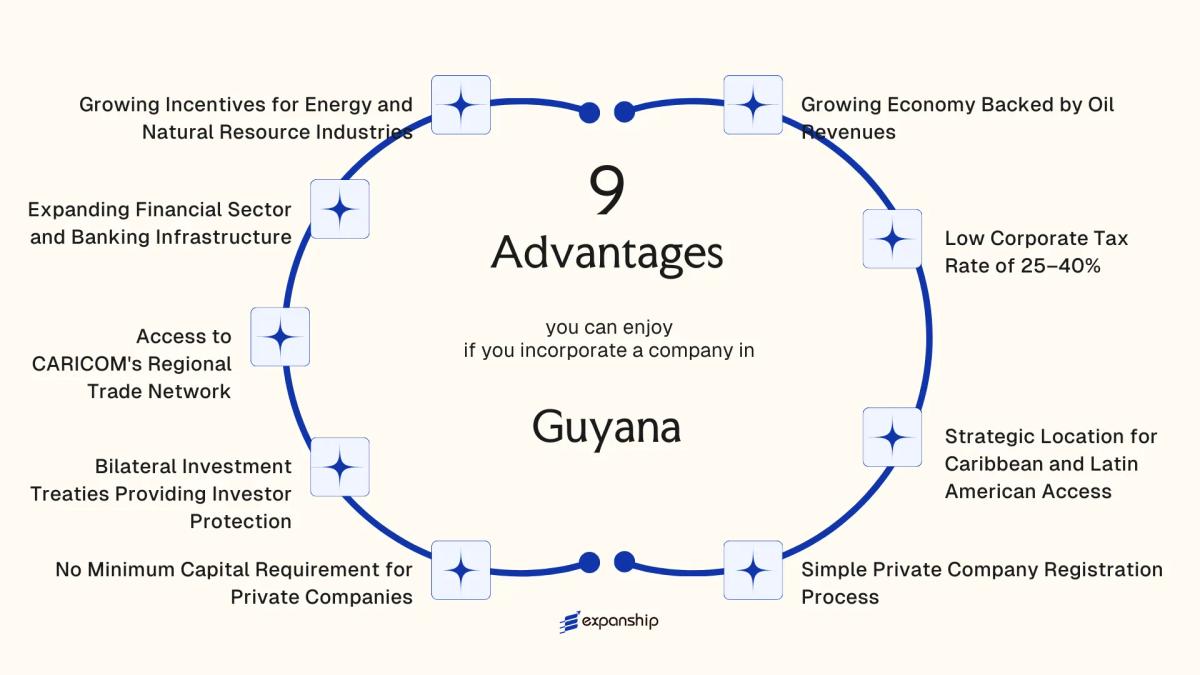
Growing Economy Backed by Oil Revenues
Guyana's GDP growth rate ranked among the fastest in the world following the 2015 ExxonMobil-led offshore oil discovery in the Stabroek Block. For businesses establishing a presence here, that trajectory translates into an expanding commercial base with rising consumer demand and increasing government capital expenditure.
What the Oil Revenue Surge Means for Market Conditions
Production from the Stabroek Block surpassed 600,000 barrels per day by late 2024, generating fiscal inflows that the government has channeled into infrastructure, public services, and industrial development. Sectors outside energy — construction, logistics, professional services, and retail — have expanded in direct response to this spending.
Why GDP Growth Creates Operational Advantages for Foreign Firms
The Guyana oil boom economy has pulled international banks, contractors, and service providers into the market, which means your business enters an environment with growing supplier networks and a more sophisticated procurement ecosystem. The Natural Resource Fund Act of 2021 governs how oil revenues are saved and deployed, providing a degree of fiscal predictability that supports medium-term business planning.
GDP growth driven by structured oil revenue management reduces the demand volatility that typically affects early-stage market entry in emerging economies.
Low Corporate Tax Rate of 25–40%
Guyana's corporate tax rate advantages stem directly from how the Income Tax Act categorizes resident companies. The standard rate for non-commercial companies sits at 25 percent, while commercial companies — broadly defined as those deriving income primarily from trading activities — are taxed at 40 percent. For many manufacturing, technology, or service-oriented entities, the 25 percent bracket applies, placing the effective tax burden below that of several OECD member states and regional peers such as Trinidad and Tobago, where commercial rates reach 30 percent.
The distinction between commercial and non-commercial classification under the Income Tax Act is consequential for structuring. A foreign-owned entity engaged in professional services or manufacturing may qualify for the lower 25 percent rate, meaningfully reducing annual tax liability compared to a purely trading operation.
The Guyana Revenue Authority administers these classifications, and the determination is made based on the nature of income rather than the type of corporate vehicle used. This means structuring decisions made at incorporation can directly influence which rate applies to your business.
Several features of this framework make the rate structure practically accessible:
- The 25 percent rate applies without requiring a minimum investment threshold
- Non-commercial classification covers a broad range of service and production activities
- The rate applies to resident companies, which a locally incorporated entity automatically qualifies as

Incorporate a Company in Guyana
Set up your Guyana-registered company with full compliance support from Expanship.
Strategic Location for Caribbean and Latin American Access
Guyana's strategic location for regional business stems from a straightforward geographic fact: the country sits at the northeastern corner of South America, sharing borders with Brazil, Venezuela, and Suriname, while its Atlantic coastline places it within close maritime range of the Caribbean island states.
For a business operating across multiple markets, this positioning has concrete operational value. Georgetown serves as a functional base from which companies can maintain supply chains, distribute goods, or coordinate services across both South American territories and CARICOM member states without routing operations through a distant hub.
| Destination | Approximate Distance | Primary Access Mode |
|---|---|---|
| Barbados | ~1,900 km | Air / Maritime |
| Trinidad & Tobago | ~800 km | Air / Maritime |
| Manaus, Brazil | ~1,100 km | Air / River |
| Paramaribo, Suriname | ~285 km | Air / Road |
| Caracas, Venezuela | ~870 km | Air |
Suriname is accessible overland, while Brazil's northern Amazon region connects through river and road corridors. This multi-modal connectivity reduces logistical friction for firms moving goods or personnel across the region.
Entities registered under the Companies Act of Guyana can conduct cross-border transactions with legal standing recognized within CARICOM's treaty framework. For a firm seeking Guyana trade access advantages without establishing separate entities in multiple jurisdictions, this single registration provides a functionally central operating point for the wider Atlantic-facing South American market.
Simple Private Company Registration Process
Private company registration in Guyana carries a procedural simplicity that translates directly into faster market entry for foreign investors. Under the Companies Act Cap. 89:01, a private company requires a minimum of one shareholder and one director, with no residency requirement imposed on either. Your business can therefore be structured and controlled entirely from abroad without the need to appoint a local nominee director as a legal formality.
Registration is handled through the Deeds Registry, which functions as the primary authority for company formation. The filing requirements center on submitting Articles of Incorporation, a notice of directors, and a registered office address within Guyana. This limited documentation threshold means your legal team spends less time assembling paperwork and more time structuring the actual business operation.
For foreign-owned entities, the absence of a nationality restriction on ownership removes a barrier that exists in several other regional jurisdictions, where foreign shareholding caps or pre-approval requirements apply.
Keep the following in mind:
- A registered office address within Guyana is mandatory at the time of incorporation
- At least one director must be named, though no local residency is required
- Articles of Incorporation must comply with Cap. 89:01 formatting requirements
- The Deeds Registry is the filing authority; submissions are not routed through a separate foreign investment body
- Confirm current filing fees directly with the Deeds Registry, as these are subject to revision
A single individual can simultaneously serve as the sole shareholder and sole director of a Guyanese private company, making sole-founder structures legally permissible without any additional corporate officer requirement.
No Minimum Capital Requirement for Private Companies
Guyana imposes no statutory minimum capital requirement on private companies incorporated under the Companies Act of 1991. The Guyana no minimum capital requirement benefit means your business can be registered with whatever share capital suits its actual operating model, without meeting an arbitrary financial threshold before the entity is legally recognized.
Capital Structure on Your Terms
Under the Companies Act, a private company can issue shares of any par value or no par value, and the total authorized capital is set by the incorporators at the time of registration. This structural flexibility is especially relevant for foreign investors testing a new market, where committing large amounts of paid-up capital upfront carries unnecessary financial exposure before the business generates local revenue.
Jurisdictions such as the United Kingdom and several EU member states have historically required minimum share capital for certain company types, even after reforms reduced those thresholds. Guyana places no such floor, which removes a friction point that can delay incorporation timelines and lock up working capital.
Practical Implications for Foreign Operators
A foreign firm entering Guyana can allocate its actual operating funds where they are most productive rather than holding idle statutory capital in a local account. The Companies Registry does not impose a minimum deposit requirement as a condition of incorporation, so the barrier to entry is administrative rather than financial.
This design also accommodates scalable growth. An entity can increase its authorized share capital through a resolution and filing with the Deeds Registry, adjusting its capital structure as the business expands without re-incorporating.
Structure Your Guyana Company the Right Way
Speak with an Expanship specialist about setting up your private company in Guyana with a capital structure that fits your actual business needs.
Bilateral Investment Treaties Providing Investor Protection
Guyana bilateral investment treaties investor protection gives foreign investors a formal legal basis for resolving disputes outside the domestic court system. The country has signed BITs with several nations, including the United Kingdom and China, which extend standard protections to qualifying investors from those jurisdictions.
- Fair and equitable treatment obligations under these agreements require the host state to treat your investment without arbitrary or discriminatory interference, reducing exposure to sudden regulatory reversals that can erode asset value.
- Expropriation protections under signed BITs mandate that any state acquisition of foreign-owned assets must be accompanied by prompt, adequate, and effective compensation, giving you a defined legal remedy rather than leaving the matter to domestic discretion.
- Access to international arbitration, typically through ICSID or UNCITRAL rules depending on the treaty, means disputes bypass local courts entirely, a structural advantage when your business has limited familiarity with Guyanese civil procedure.
- Most-favored-nation clauses found in several of these treaties allow you to claim treatment no less favorable than that extended to investors from third countries, which can effectively expand your protections beyond what the specific bilateral text provides.
Treaty eligibility generally depends on the nationality of the investing entity, so corporate structure and ownership routing are relevant factors before relying on a specific agreement.
Access to CARICOM's Regional Trade Network
Guyana CARICOM trade network advantages stem directly from the country's full membership in the Caribbean Community, which operates under the Revised Treaty of Chaguaramas (2001). Under the CARICOM Single Market and Economy (CSME), goods originating from member states move across participating territories free of customs duties, giving your business preferential access to a combined market of approximately 16 million consumers.
For a company incorporated here, this means products manufactured or substantially processed locally can enter markets like Trinidad and Tobago, Barbados, and Jamaica without the tariff friction that applies to third-country exporters. Services firms benefit as well: the CSME's provisions on the right of establishment allow qualifying entities to set up operations across member states under harmonised conditions.
The CARICOM Rules of Origin determine which goods qualify for duty-free treatment, so your supply chain and production structure must meet those criteria to access the preference.
A business exporting manufactured goods from Guyana to three CARICOM markets, each with a standard external tariff of 20%, would eliminate that tariff cost entirely on qualifying shipments, directly reducing landed costs and improving price competitiveness against non-CARICOM suppliers.
Expanding Financial Sector and Banking Infrastructure
Guyana's financial sector advantages for businesses are increasingly tangible, driven by oil-linked economic growth that has prompted direct investment in banking capacity and payment infrastructure. The Bank of Guyana, operating under the Financial Institutions Act, supervises commercial banks, trust companies, and non-bank financial institutions, giving foreign firms a regulated environment with clear oversight authority.
Several commercial banks now offer multi-currency accounts and trade finance facilities, which matters for companies conducting cross-border transactions across Latin America and the Caribbean. Correspondent banking relationships with international institutions have expanded alongside the petroleum sector, improving access to USD-denominated accounts and foreign currency transfers.
For foreign companies, the practical implication is reduced friction in moving capital in and out of the jurisdiction. Regulatory oversight through the Bank of Guyana provides a defined compliance structure, so your firm operates within a recognized institutional framework rather than an informal one.
- Commercial banking services include trade finance, letters of credit, and foreign currency accounts
- The Financial Institutions Act governs licensing and conduct of regulated financial entities
- Anti-money laundering obligations are administered under the Anti-Money Laundering and Countering the Financing of Terrorism Act
Correspondent banking access and multi-currency account availability vary by individual bank; confirm specific services directly with your chosen institution before structuring cross-border payment flows.
Growing Incentives for Energy and Natural Resource Industries
Guyana energy sector incentives for investors have expanded significantly alongside the country's post-2015 offshore oil discoveries. The legislative framework governing these benefits draws primarily from the Petroleum (Exploration and Production) Act, along with fiscal terms negotiated through production sharing agreements with the Guyana government.
Fiscal Terms Under Production Sharing Agreements
Foreign companies operating under production sharing agreements with the government retain a defined share of production output after cost recovery. This structure reduces upfront tax exposure during the capital-intensive exploration and development phase, which matters directly to investors managing long project timelines before revenue materializes.
GO-Invest Facilitation for Energy Projects
The Guyana Office for Investment (GO-Invest) serves as the primary government body facilitating entry for businesses in priority sectors, including energy and natural resources. GO-Invest assists qualifying firms in accessing available concessions and coordinating with sector-specific agencies, reducing administrative friction when establishing a new entity in the country.
Incentives Under the Investment Act
The Investment Act of Guyana provides a framework under which businesses in targeted industries, including energy and resource extraction, may qualify for exemptions on import duties for capital equipment and concessions on corporate income tax. Your firm's eligibility typically depends on the scale of investment, the nature of operations, and formal registration with GO-Invest.
- Import duty exemptions on qualifying capital equipment
- Potential corporate tax concessions for approved energy projects
- Access to government-facilitated land and resource agreements for qualifying operations
How Guyana Stacks Up Against Other Regional Jurisdictions
Comparing Guyana against regional alternatives helps clarify where it sits in practical terms for foreign investors evaluating the wider Caribbean and Latin American incorporation market. The jurisdictions most worth measuring it against are Trinidad and Tobago, Barbados, and Panama — each targets a broadly similar investor profile and sits within the same regional economic orbit. What the comparison reveals is that on key structural parameters, the country holds its ground without relying on the offshore or zero-tax model that defines many competitors.
Barbados and Panama both carry stronger brand recognition as incorporation hubs, but that recognition comes partly from regulatory frameworks built around tax neutrality for non-resident entities — a model facing increasing pressure from OECD compliance requirements. Trinidad and Tobago shares CARICOM membership and a comparable legal tradition, yet its corporate tax rate sits at 30% for most companies. For businesses that prioritise substance, CARICOM market access, a functioning banking sector, and a growing domestic economy over pure tax minimisation, the structural picture here differs in ways that matter operationally.
| Parameter | Guyana | Trinidad & Tobago | Barbados | Panama |
|---|---|---|---|---|
| Standard Corporate Tax Rate | 25% (non-extractive) | 30% | 9% (domestic) / 5.5% (small business) | 25% |
| CARICOM Membership | Yes | Yes | Yes | No |
| Minimum Share Capital | None (private companies) | None | None | None |
| Legal System | Common law | Common law | Common law | Civil law |
| BIT Network | Active | Active | Active | Extensive |
| Oil & Gas Sector Incentives | Yes | Yes | Limited | Limited |
Compliance Services for Companies in Guyana
Maintain good standing under the Companies Act 1991 and meet all statutory filing obligations with Guyana's Deeds Registry and tax authority.
Conclusion
Guyana's case as a business destination rests on a convergence of structural factors that are rare in the wider Caribbean and Latin American region. Oil-driven GDP growth has reshaped the country's fiscal position, while the 25% corporate tax rate for non-commercial companies and the absence of a minimum capital requirement reduce both the tax burden and the entry cost for foreign-incorporated entities. Protection under bilateral investment treaties adds a legal dimension that makes the position of foreign capital more predictable over time.
Not every foreign business will extract equal value from these conditions. A firm targeting CARICOM's regional trade network benefits differently than one operating in the energy supply chain or financial services sector. The Companies Act Cap. 89:01 and the Guyana Revenue Authority's administrative framework are the same for all registered entities, but how those rules interact with your specific industry and ownership structure determines how much of the jurisdictional advantage is actually realised.
For businesses whose operations align with the country's current investment priorities, the regulatory and fiscal environment provides a foundation that is worth assessing against your long-term corporate structure. The next step is translating that general case into a formation and compliance plan specific to your entity type, shareholder profile, and operational scope.
Let Expanship Handle Your Guyana Company Formation
Expanship provides Guyana company formation services that cover the full scope of what foreign investors encounter when incorporating under the Companies Act, Cap. 89:01. From private company registration with the Deeds Registry to meeting the ongoing compliance obligations imposed by the Guyana Revenue Authority, each stage involves jurisdiction-specific documentation and procedural requirements that vary depending on your business structure and sector.
Our service scope includes:
- Preparation and legalization of incorporation documents, including the Articles of Incorporation and company bylaws
- Registered agent and registered office provision as required under the Companies Act
- Filing coordination and direct liaison with the Deeds Registry of Guyana
- Post-incorporation compliance management, including annual returns and tax registration
- Banking introduction assistance to support your account opening with local financial institutions
Businesses seeking professional Guyana company registration assistance, or those with more complex structures that intersect with CARICOM trade obligations or sector-specific licensing, will find that preparation significantly reduces delays at the registration stage.
Expanship Guyana is available to advise on the structure that fits your intended operations.
Frequently Asked Questions (FAQ)
The rate depends on the nature of your business activity. Under the Guyana tax regime, commercial companies are taxed at 40%, while non-commercial companies face a 25% rate. The Guyana Revenue Authority administers corporate income tax, and companies engaged in qualifying sectors such as energy or manufacturing may be eligible for concessions under the Investment Act of 2004.
Guyana has signed bilateral investment treaties with several countries that provide protections against expropriation without compensation, guarantee fair and equitable treatment, and allow for international arbitration in the event of a dispute with the state. The specific protections available to your business depend on whether a treaty exists between Guyana and your home country. Reviewing the applicable treaty before structuring your investment is advisable.
As a CARICOM member state, goods produced by a Guyana-registered company may qualify for preferential tariff treatment when exported to other member states under the Caribbean Community's common external tariff framework. This applies to goods that meet the applicable rules of origin criteria. Services trade within the region is also supported through the CARICOM Single Market and Economy provisions.
No minimum capital requirement applies to private companies incorporated under the Companies Act (Cap. 89:01). You can register a company with a nominal share capital structure suited to your operational needs. This differs from certain other regional jurisdictions that impose statutory minimum capital thresholds before a company can be incorporated or begin trading.
Processing times at the Deeds Registry Authority can vary, but straightforward private company incorporations are generally completed within a few weeks of submitting a complete application. Delays typically arise from incomplete documentation or name reservation issues. The timeline does not account for any additional licensing or sector-specific approvals your business may require after incorporation.
The Petroleum Commission of Guyana oversees licensing and regulatory matters for the oil and gas sector, while broader investment incentives are governed by the Investment Act of 2004 and administered in part through the Guyana Office for Investment (GO-Invest). Qualifying energy-sector entities may access concessions on import duties, corporate tax holidays, and other fiscal benefits. The specific terms are negotiated based on project scope and sector classification.
Legal Disclaimer
The information provided in this article is for general informational purposes only and does not constitute legal, tax, or professional advice. While we strive to ensure the accuracy and timeliness of the content, laws and regulations are subject to change, and the application of laws can vary widely based on specific facts and circumstances.
Readers should not act upon this information without seeking professional counsel tailored to their individual situation. Expanship and its authors disclaim any liability for actions taken or not taken based on the content of this article.
For specific advice regarding your business setup, compliance requirements, or any legal matters, please consult with qualified legal and tax professionals in the relevant jurisdiction.