

Key Takeaways
- Guinea's business registration process through the RCCM (Registre du Commerce et du Crédit Mobilier) introduces procedural delays that extend incorporation timelines beyond what investors typically encounter in more administratively efficient OHADA member states.
- Under Guinea's applicable regulatory framework, foreign investors in sectors such as extractive industries and financial services face ownership restrictions that materially limit equity control and complicate standard corporate governance arrangements.
- Persistent weaknesses in Guinea's tax administration create a high likelihood of disputes with fiscal authorities, adding compliance costs and operational uncertainty that are difficult to fully price into pre-entry financial projections.
- Despite Guinea's adherence to the Acte Uniforme OHADA, which provides a standardized commercial legal foundation, the country's weak institutional enforcement capacity means that intellectual property protections and contractual rights remain difficult to assert in practice.
Guinea operates under an evolving regulatory framework, shaped significantly by its adherence to the OHADA (Organisation pour l'Harmonisation en Afrique du Droit des Affaires) uniform acts, which govern commercial law across member states. The primary disadvantages of incorporating in Guinea span procedural, financial, institutional, and political dimensions.
Not every foreign investor will encounter all of these challenges equally. The specific disadvantages a business faces depend on its legal structure, the sector it operates in, and the scale of its intended operations.
This article is most relevant to foreign entrepreneurs, mid-sized multinationals, and sector-specific investors — particularly those in extractive industries, financial services, or professional services — who are assessing the practical risks of doing business in Guinea before committing capital. The Acte Uniforme OHADA provides the foundational commercial legal framework applicable to entity formation and governance across the jurisdiction.
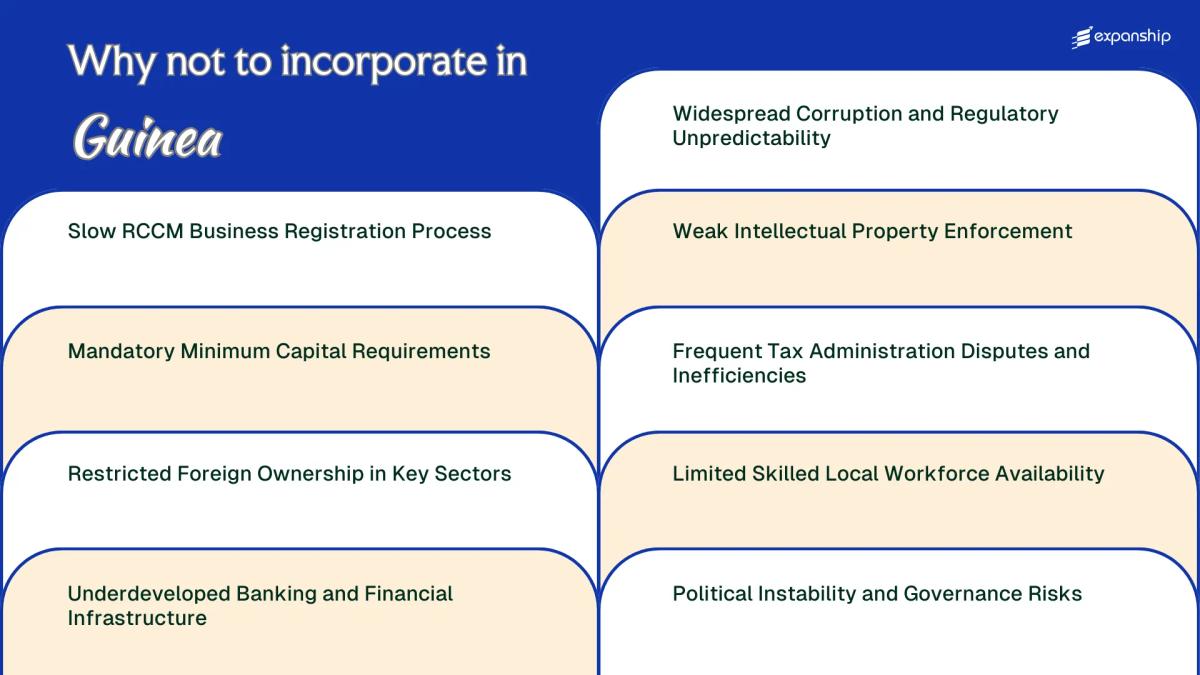
Slow RCCM Business Registration Process
Guinea RCCM registration challenges begin before your business generates a single franc. The Registre du Commerce et du Crédit Mobilier process is administered through the tribunal de commerce, and chronic procedural backlogs mean incorporation timelines routinely extend well beyond official estimates.
Administrative Bottlenecks Within the RCCM System
Registration requires notarized statutes, tax identification from the Direction Nationale des Impôts, and deposit confirmation from an approved bank, each handled by separate institutions with no coordinated processing. Delays compound when any single document requires re-submission, which is common given inconsistent guidance from registry officers.
Slow business registration in Guinea creates direct financial exposure for your firm, as costs like office leases, staff contracts, and supplier agreements may begin accruing before legal incorporation is confirmed.
Impact on Operational Timelines
RCCM Guinea incorporation delays push back every downstream obligation, from opening a corporate bank account to obtaining sector-specific approvals. A business that cannot present a valid RCCM number cannot sign enforceable commercial contracts under Guinean law.
Your entity has no legal standing to operate, hire formally, or sign binding contracts until RCCM registration is fully completed, making any pre-incorporation commitments a significant financial and legal risk.
Mandatory Minimum Capital Requirements
Guinea minimum capital requirements restrictions present a concrete financial barrier before your business can legally operate. Under the OHADA Uniform Act on Commercial Companies, which Guinea applies as a member state, a Société à Responsabilité Limitée (SARL) requires a minimum share capital of 1,000,000 Guinean francs. While that figure may appear modest in isolation, the requirement to fully deposit this capital at formation means funds are tied up and unavailable during the critical early operating period.
For foreign founders, this upfront lock-up creates immediate liquidity pressure at precisely the moment cash is most needed.
The mandatory share capital in a Guinea company must be deposited with an approved bank, and given the constraints of the local banking sector, accessing and transferring those funds through compliant channels adds both time and transaction costs.
Practical burdens this requirement creates include:
- Capital deposited at incorporation cannot be redirected toward startup operational costs, forcing founders to source parallel funding
- Banking delays in confirming capital deposit can stall registration with the Registre du Commerce et du Crédit Mobilier (RCCM)
- Foreign currency conversion into Guinean francs exposes your firm to exchange rate losses before the entity is even active
- Verifying capital adequacy through local notarization adds professional fees that compound the initial outlay
The capital requirements drawbacks in a Guinea SARL are less about the sum itself and more about the structural rigidity surrounding its deposit and release.

Company Incorporation in Guinea
Understand the capital requirements and registration steps for establishing a compliant business entity in Guinea.
Restricted Foreign Ownership in Key Sectors
Foreign ownership restrictions in Guinea represent a direct structural barrier for foreign investors entering the market. Under the Investment Code (Loi L/2015/011/AN) and sector-specific legislation, certain industries reserve partial or full ownership for Guinean nationals, limiting the equity stake your business can hold.
| Sector | Restriction Type | Practical Impact on Foreign Investor |
|---|---|---|
| Artisanal Mining | Reserved for Guinean nationals | Foreign firms legally barred from ownership |
| Media and Broadcasting | Majority local ownership required | Foreign entity capped below controlling interest |
| Agriculture (smallholder) | Priority allocation to nationals | Foreign access to land titles heavily constrained |
| Fishing and Aquaculture | License restrictions favoring nationals | Foreign operators face quota and permit ceilings |
Mining is the most commercially significant sector affected. The Mining Code (Loi L/2013/053/CNT) grants the Guinean state an automatic 15% free-carried interest in any mining convention, with the option to acquire an additional 20% at fair market value, leaving your equity position substantially diluted before operations begin.
These ownership caps are not merely regulatory formalities. They directly affect dividend rights, governance control, and exit valuations, making it difficult to structure a foreign-held entity with full operational authority.
Limited foreign investment in Guinea's sectors also creates complications for securing financing, since lenders typically require unencumbered majority ownership as collateral. Exceptions exist for special economic zones, but the framework governing those zones remains underdeveloped and inconsistently applied.
Underdeveloped Banking and Financial Infrastructure
Guinea banking infrastructure problems create direct operational friction for foreign businesses from the moment a corporate account is needed.
The country's banking sector is supervised by the Banque Centrale de la République de Guinée (BCRG), yet the number of licensed commercial banks remains limited, and branch presence outside Conakry is thin. Your business may find that even basic services like wire transfers, trade financing, or multi-currency accounts require significant lead time or are simply unavailable through local institutions.
Correspondent banking relationships between Guinean banks and major international networks are constrained. This means cross-border payments can face delays, added intermediary fees, and compliance scrutiny that slows down ordinary transactions.
Banking access risks in Guinea extend to foreign currency conversion as well. Repatriating profits or settling international invoices in USD or EUR is subject to BCRG foreign exchange regulations, which can restrict the timing and volume of outflows.
- Foreign businesses must open a local corporate account before completing certain post-registration filings
- Foreign exchange transactions require BCRG compliance under applicable monetary regulations
- Correspondent banking delays can affect payroll, supplier payments, and capital transfers
- Access to trade finance products is limited and varies by bank
Guinea has one of the lowest rates of formal banking penetration in West Africa, meaning a significant portion of commercial transactions still occur outside the regulated financial system entirely.
Widespread Corruption and Regulatory Unpredictability
Corruption risks doing business in Guinea affect foreign entities from the moment of registration onward. Transparency International consistently ranks Guinea near the bottom of its Corruption Perceptions Index, reflecting systemic integrity failures across both public institutions and regulatory bodies.
Structural Corruption Across Regulatory Agencies
Unofficial payments to officials within agencies such as the Direction Nationale des Impôts and sector-specific licensing bodies are widely reported as a practical requirement rather than an exception. This creates an unpredictable cost layer that cannot be formally budgeted, exposing your firm to both financial loss and legal liability under foreign anti-bribery statutes such as the U.S. FCPA or the UK Bribery Act.
Regulatory Unpredictability and Its Operational Consequences
Regulatory unpredictability in Guinea stems partly from inconsistent enforcement of the OHADA Uniform Acts, which technically govern commercial law across member states but are applied unevenly at the national level. Decisions on permits, tax assessments, and operating licenses can shift without formal notice, making long-term operational planning unreliable for any foreign-owned entity.
A single contract or license can be subjected to renegotiation pressure following changes in ministerial personnel, a risk that applies even where agreements carry formal government backing.
Managing Regulatory and Compliance Challenges in Guinea
Get guidance on structuring your business presence in Guinea while addressing the compliance and regulatory risks that affect foreign-owned entities.
Weak Intellectual Property Enforcement
Guinea intellectual property enforcement risks are a practical concern for any business holding trademarks, proprietary software, or trade secrets in the country. Registered IP rights offer limited protection when the courts and administrative bodies responsible for enforcement lack the capacity to act effectively.
- Guinea is a member of the African Intellectual Property Organization (OAPI), meaning IP rights are registered regionally rather than through a domestic office, but local enforcement of those rights still depends on Guinean courts, which have limited technical expertise in IP matters.
- Civil litigation for IP infringement can take years to resolve, leaving your business without a timely remedy while counterfeit or unauthorized use continues.
- Weak IP protection Guinea-side means that even a valid OAPI registration does not guarantee injunctive relief will be granted or enforced promptly.
- Customs authorities lack the specialized resources to intercept infringing goods at the border, increasing exposure for businesses in manufacturing or branded consumer goods.
- Damages awarded in IP cases, where judgments are reached at all, tend to be low relative to the commercial harm suffered.
Frequent Tax Administration Disputes and Inefficiencies
Guinea tax administration inefficiencies create measurable operational risk for foreign businesses, primarily through unpredictable enforcement by the Direction Nationale des Impôts (DNI). Tax assessments are frequently inconsistent, with auditors applying discretionary interpretations of the General Tax Code rather than standardized criteria.
Disputes over corporate income tax, VAT reconciliation, and withholding obligations can remain unresolved for extended periods. The absence of a reliable administrative appeals mechanism means your firm may face prolonged uncertainty over its actual tax liability.
Penalties and surcharges accrue during contested assessments, increasing the financial exposure beyond the original disputed amount. For foreign entities without local legal representation familiar with DNI procedures, Guinea DNI tax compliance challenges compound quickly.
Tax dispute risks in Guinea business contexts are heightened by infrequent publication of official guidance and limited advance ruling mechanisms. You cannot easily obtain binding pre-clearance on structuring decisions, which removes a key tool that multinationals rely on in more developed jurisdictions.
A foreign firm disputing a VAT reassessment of GNF 500 million could realistically accumulate penalty surcharges of 25–50% on the contested amount while the case remains administratively unresolved, effectively doubling the financial exposure before any court involvement.
Limited Skilled Local Workforce Availability
Guinea skilled workforce limitations affect foreign businesses from the earliest stages of operations. The country's tertiary enrollment rate remains low relative to regional peers, and technical and vocational training institutions lack both capacity and industry alignment. For a foreign firm requiring trained finance, engineering, or compliance personnel, this creates a direct dependency on expatriate hires.
Sourcing expatriate staff introduces costs that compound quickly. Work permit fees, housing allowances, relocation packages, and the administrative requirements under Guinea's Labour Code (Code du Travail) add overhead that many businesses underestimate before market entry.
Certain regulated sectors, including mining and telecommunications, face additional pressure because roles requiring specific technical certifications rarely have a sufficient local candidate pool. Filling those positions locally is structurally difficult, not just a short-term gap.
Talent availability challenges in Guinea are also uneven by geography. Most qualified professionals concentrate in Conakry, meaning firms operating in interior or extractive regions face more acute shortages and higher retention risks.
- Qualified accountants familiar with OHADA accounting standards are scarce.
- Bilingual (French/English) professionals with international business experience are limited.
- Mid-level management candidates with verifiable credentials are difficult to assess due to inconsistent institutional standards.
Guinea's Labour Code imposes local hiring quotas for certain sectors, and non-compliance can expose your entity to penalties and operating license conditions even before full-scale operations begin.
Political Instability and Governance Risks
Guinea political instability business risks are not abstract concerns — the country has experienced multiple coups since independence, including the September 2021 military takeover that dissolved the government and suspended the constitution. The ruling Rassemblement des Forces Démocratiques de Guinée (RFDG) junta, operating through the Comité National du Rassemblement et du Développement (CNRD), continues to govern by decree.
For a foreign investor, this structure means that regulatory frameworks, licensing conditions, and investment agreements can be altered without legislative process or judicial review. Contracts signed under one administration carry no guaranteed continuity under the next.
Governance risks in Guinea incorporation extend to the mining sector specifically, where the 2011 Mining Code has been subject to renegotiation pressure under successive governments. Your entity's operating terms are vulnerable to unilateral revision if the state determines strategic interest overrides the original agreement.
Transition timelines remain undefined, creating sustained uncertainty around long-term capital commitments.
Overcoming Key Incorporation Obstacles in Guinea
Overcoming Key Incorporation Obstacles in Guinea
Overcoming Guinea incorporation obstacles requires structural preparation before the entity is registered, not after problems arise. The challenges covered in this blog span registration delays, capital thresholds, sector restrictions, and governance risks — each demanding a distinct compliance posture.
- Engage the RCCM registration process with complete notarised documentation to reduce the likelihood of procedural rejection and delay.
- Confirm sector classification against Guinea's foreign investment codes before structuring ownership, particularly for mining, telecommunications, and media activities.
- Deposit the required minimum share capital in a licensed Guinean bank account prior to the RCCM application to satisfy statutory formation conditions.
- Register with the Direction Nationale des Impôts early to establish a tax file and reduce exposure to administrative disputes during the initial operating period.
- File for any applicable intellectual property protections through OAPI, the regional IP body covering Guinea, at the point of incorporation rather than retrospectively.
Mitigating risks during company formation in Guinea does not eliminate the structural limitations of the jurisdiction's regulatory environment. The measures above address documented formation barriers but do not resolve systemic issues tied to political governance or banking infrastructure.
Guinea's Overall Investment Potential
Guinea presents genuine investment potential, primarily through its extraordinary mineral wealth — bauxite, iron ore, gold, and diamonds position the country as a resource-significant destination. That said, the guinea investment risks and potential must be weighed honestly: structural barriers, institutional weaknesses, and governance deficits are real and documented, not peripheral concerns.
| Pros | Cons |
|---|---|
| Significant natural resource endowments create viable commercial opportunities in extractive and related sectors. | The RCCM registration process is slow and subject to administrative delays outside the investor's control. |
| OHADA membership provides a recognized regional legal framework that applies across Guinea's commercial law. | Widespread corruption and regulatory unpredictability increase the cost and uncertainty of doing business. |
| A young, growing population represents a long-term consumer and labor market. | Underdeveloped banking infrastructure limits financing options and complicates capital movement. |
| Geographic positioning along the West African coast supports regional trade access. | Political instability and military governance create an unpredictable operating environment. |
| Sector-specific investment codes offer formal protections in targeted industries. | Intellectual property enforcement remains weak, with limited practical recourse through local courts. |
The cons of investing in Guinea documented throughout this blog reflect systemic conditions, not isolated incidents. Tax administration disputes, foreign ownership restrictions, and workforce limitations add further operational friction that compounds over time.
Corporate Compliance Services in Guinea
Maintain your company's good standing in Guinea with structured compliance support covering annual filings, regulatory reporting, and statutory obligations under Guinean law.
Conclusion
Guinea company incorporation drawbacks are well-documented across registration, banking, and governance categories. The RCCM process remains slow, financial infrastructure is underdeveloped, and corruption within regulatory bodies continues to create unpredictability for foreign-owned entities. These are structural conditions, not isolated incidents.
Forming a business here requires tolerance for procedural delays and institutional opacity. External legal and compliance support significantly reduces exposure to administrative disputes and misdirected tax assessments. Firms that enter without local knowledge of the OHADA framework and Guinea-specific regulatory practice consistently encounter avoidable setbacks.
Expanship's Guinea Expansion Services
Dealing with RCCM registration delays, minimum capital obligations, sector-specific foreign ownership restrictions, and an unpredictable tax administration environment creates real operational weight for any foreign business entering Guinea. Expanship's Guinea expansion services help your firm manage the compliance burden that these specific challenges generate, from initial entity formation through to ongoing regulatory obligations.
Beyond setup, our service scope covers the full incorporation cycle and its aftermath.
- We prepare and file all company registration documents with the relevant Guinean authorities on your behalf.
- A registered agent and local office address are provided to satisfy in-country presence requirements.
- Our team handles direct liaison with government bodies, including regulatory agencies involved in sector approvals.
- Post-incorporation compliance management keeps your entity in good standing over time.
- We facilitate introductions to local banking contacts to support account opening.
- Tax registration and coordination with Guinean fiscal authorities are handled as part of the process.
Reach out through Expanship Guinea to discuss your specific incorporation requirements.
Frequently Asked Questions (FAQ)
Restrictions on foreign ownership apply specifically to sectors designated as strategic under Guinean law, including mining, telecommunications, and certain agricultural activities. Outside these sectors, foreign entities can generally hold full ownership, but the definition of "strategic" has been applied inconsistently by regulators, which creates compliance uncertainty even in sectors not explicitly listed. Before structuring your entity, you need a current legal assessment, as administrative interpretation can shift without formal legislative change.
Guinea operates under the OHADA Uniform Act on Commercial Companies, which sets a minimum share capital of XOF 1,000,000 (approximately USD 1,600) for a Société à Responsabilité Limitée (SARL) and XOF 10,000,000 for a Société Anonyme (SA). These figures must be deposited in a local bank account before registration is completed, which is complicated by Guinea's underdeveloped banking infrastructure. Account opening delays alone can stall your incorporation timeline by weeks.
Among OHADA member states, Guinea ranks near the bottom on regulatory transparency and consistency, performing significantly below regional peers such as Côte d'Ivoire and Senegal on the World Bank's Doing Business indicators. While the OHADA framework provides a shared legal foundation across member states, Guinea's domestic administrative institutions apply that framework with considerably less consistency. The gap between written law and actual regulatory practice is wider here than in most comparable jurisdictions in the region.
Non-compliance with Guinea's Direction Nationale des Impôts (DNI) can result in penalties, forced audits, and asset freezes, but the more immediate risk is arbitrary reassessment of your tax liability outside of the standard process. Tax disputes in Guinea frequently arise not from deliberate evasion but from inconsistent rulings by different tax officers on identical fact patterns. Resolving these disputes through formal channels is slow, and the administrative appeals process offers limited practical protection.
Guinea is a member of the Organisation Africaine de la Propriété Intellectuelle (OAPI), which provides regional trademark and patent registration through a single filing. Registration through OAPI is procedurally straightforward, but enforcement against infringement within Guinea's borders is weak due to limited judicial capacity and low prioritization by law enforcement. Holding a valid OAPI registration does not translate reliably into practical protection if a local party infringes your rights.
Since the 2021 military coup, Guinea has operated under a transitional government that has suspended the constitution and governs by decree, which means the legal framework for business can be altered without parliamentary process or predictable notice. This directly affects contractual certainty, licensing renewals, and the enforceability of agreements with state entities or in regulated sectors. Foreign investors with existing operations have faced retroactive changes to mining and concession agreements under the current transitional authority.
Sourcing qualified local professionals in finance, law, and technical fields is genuinely difficult in Guinea, which means most foreign firms must rely on expatriate staff for senior and specialist roles. Expatriate employment triggers work permit requirements and higher salary costs that can significantly increase your operating overhead compared to projections built on regional averages. This constraint is not easily solved by training programs in the short term, as the structural gap in vocational and tertiary education is a long-standing issue.
Legal Disclaimer
The information provided in this article is for general informational purposes only and does not constitute legal, tax, or professional advice. While we strive to ensure the accuracy and timeliness of the content, laws and regulations are subject to change, and the application of laws can vary widely based on specific facts and circumstances.
Readers should not act upon this information without seeking professional counsel tailored to their individual situation. Expanship and its authors disclaim any liability for actions taken or not taken based on the content of this article.
For specific advice regarding your business setup, compliance requirements, or any legal matters, please consult with qualified legal and tax professionals in the relevant jurisdiction.