

Key Takeaways
- Guinea's membership in the OHADA framework — governing commercial law across 17 member states — gives foreign investors a codified, regionally harmonised legal environment that reduces the uncertainty typical of standalone West African jurisdictions.
- Structuring through a Société à Responsabilité Limitée under the OHADA Uniform Act on Commercial Companies limits personal liability while keeping administrative obligations lighter than those imposed by more rigid corporate forms in comparable markets.
- A territorial tax posture means corporate tax applies only to income sourced within Guinea, allowing businesses with multi-jurisdiction operations to contain their domestic tax exposure to locally generated earnings.
- ECOWAS membership extends the commercial reach of a Guinea-registered entity across a broader regional trading bloc, giving companies preferential access to member state markets that a purely domestic registration would not provide.
Situated on the Atlantic coast of West Africa, Guinea is an independent sovereign republic bordered by six countries, positioning it at a geographic crossroads of regional trade and commerce. The benefits of incorporating in Guinea draw interest from investors targeting the broader West African market, particularly those with exposure to extractive industries and regional supply chains.
Company registration falls under the oversight of the RCCM — the Registre du Commerce et du Crédit Mobilier — which operates within the OHADA legal framework adopted across 17 member states. Foreign businesses typically establish a presence through a Société à Responsabilité Limitée. Guinea maintains a standard territorial tax posture, applying corporate tax to income sourced within its borders rather than on worldwide earnings.
The country's investment code formally permits full foreign ownership across most sectors, reflecting a general openness to foreign direct investment. This article examines the concrete advantages your business gains by registering a corporate entity here.
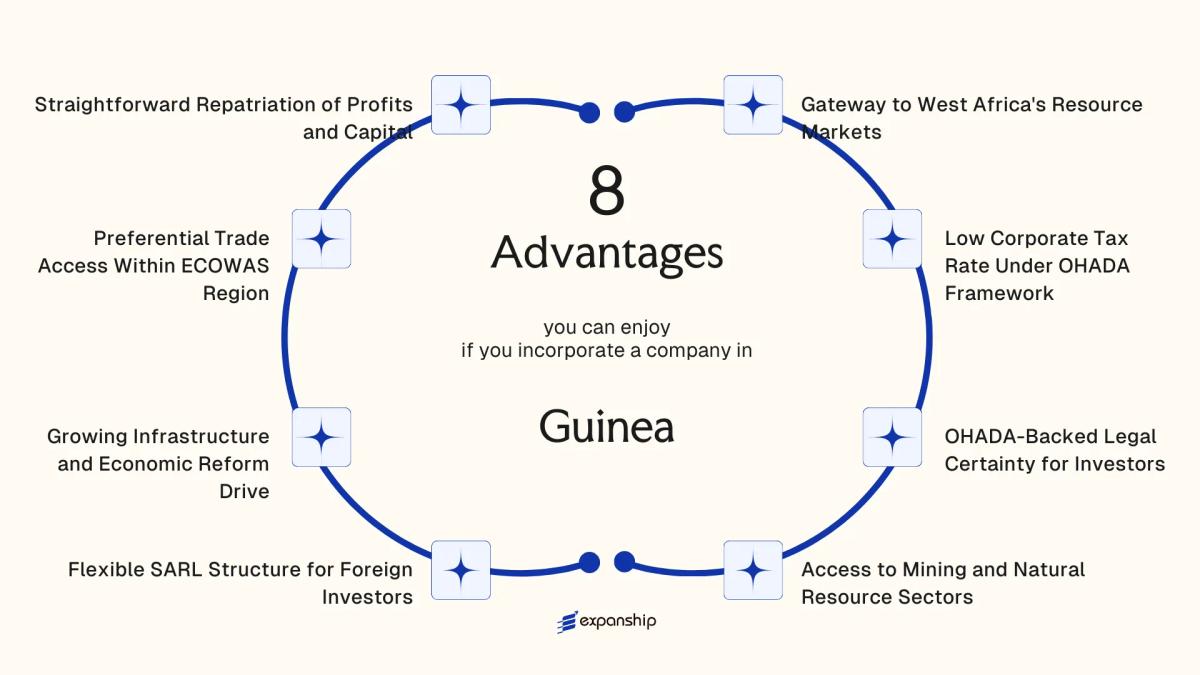
Gateway to West Africa's Resource Markets
Guinea serves as a practical entry point for businesses targeting West Africa's resource economy, given its geographic position and trade connectivity. As a Guinea gateway to West Africa markets, a registered entity here can access a regional consumer base of over 400 million people through established economic corridors.
Proximity to Regional Trade Routes
Conakry's port infrastructure connects your business to maritime trade lanes running along the West African coastline. For firms in extractive industries or commodities distribution, this geographic access reduces transit dependency on landlocked alternatives.
Regional Market Integration Through ECOWAS Membership
Guinea's membership in the Economic Community of West African States positions a locally registered firm to engage suppliers, distributors, and buyers across 15 member states under a common trade protocol framework. This reduces the structural friction of cross-border commercial operations that would otherwise require separate market-entry arrangements in each territory.
West Africa market access through a Guinea-registered entity also benefits from the ECOWAS Trade Liberalization Scheme, which provides preferential terms for goods of regional origin. The scheme's origin certification requirements mean that your products must meet local value-addition thresholds to qualify.
A Guinea-registered entity gives you formal standing to trade across 15 ECOWAS member states under a single regional trade framework.
Low Corporate Tax Rate Under OHADA Framework
Guinea's standard corporate income tax rate sits at 35%, applied to net profits earned by resident entities. While that headline figure is not the lowest in the region, the OHADA framework introduces structural advantages that directly affect your effective tax position. Guinea corporate tax rate OHADA framework interactions matter here because OHADA's Uniform Act on General Commercial Law governs how taxable income is calculated, how expenses are recognized, and how capital contributions are treated — creating predictability that reduces unplanned tax exposure.
For a foreign-owned entity, this predictability has a concrete value. Tax assessments under OHADA-aligned accounting rules follow the SYSCOHADA Revised chart of accounts, which standardizes how profits are reported across member states. Your business is not subject to an opaque local interpretation of income; the accounting methodology is codified and externally audited against a regional standard.
Certain investment regimes under Guinea's Investment Code can also reduce the effective rate for qualifying sectors, though specific thresholds depend on project classification.
Tax treatment under this structure offers several practical advantages:
- Expense deductibility follows uniform OHADA rules, not discretionary local practice
- Depreciation schedules are standardized, reducing disputes over asset treatment
- Profit recognition timing is governed by SYSCOHADA Revised, limiting arbitrary reassessment
- Dividend distributions from a properly structured entity follow documented procedures under the Uniform Act

Incorporate a Company in Guinea
Set up your Guinea entity under the OHADA framework with Expanship's incorporation service.
OHADA-Backed Legal Certainty for Investors
OHADA legal certainty Guinea investors represents one of the more concrete structural advantages available to foreign business owners operating in Francophone West Africa. Guinea is a member state of the Organisation for the Harmonisation of Business Law in Africa (OHADA), a treaty-based legal framework that standardises commercial law across 17 member states. The governing instrument, the OHADA Treaty signed in Port-Louis in 1993, establishes uniform acts that take direct precedence over conflicting national legislation.
For foreign investors, this matters because the applicable commercial rules are not subject to unilateral revision by the national legislature. Uniform Acts covering company formation, insolvency, securities, arbitration, and commercial contracts apply automatically. Your contractual rights and corporate governance obligations are defined by supranational instruments, not solely by domestic statutory discretion.
| Uniform Act | Subject Matter | Practical Relevance |
|---|---|---|
| AUDSC-GIE (Revised 2014) | Commercial companies and GIE | Governs SARL and SA formation, shareholder rights |
| AUA (Revised 2010) | Arbitration | Provides neutral dispute resolution outside domestic courts |
| AUPC (Revised 2015) | Insolvency proceedings | Defines creditor protections and restructuring procedures |
| AUS (Revised 2010) | Securities and collateral | Enforceability of pledges and charges over assets |
Dispute resolution carries equal weight. The OHADA Common Court of Justice and Arbitration (CCJA), seated in Abidjan, serves as the final cassation court for commercial matters arising under OHADA law. Access to a supranational court reduces dependence on domestic judicial outcomes, which carries direct implications for contract enforceability and investor confidence in multi-party transactions.
Access to Mining and Natural Resource Sectors
Guinea mining sector access for investors is governed primarily by the Mining Code (Loi L/2013/053/CNT and its subsequent amendments), which establishes the legal framework for prospecting, research, and exploitation rights. Foreign-owned entities can hold mining titles directly, meaning your firm does not require a local partner to secure a permit.
The country holds the world's largest known reserves of bauxite and substantial deposits of iron ore, gold, and diamonds. For any entity targeting mineral extraction or supply chain participation, this concentration of resources within a single jurisdiction reduces the cost and complexity of multi-country operations.
Under the Mining Code, industrial mining permits are issued by the Ministry of Mines and Geology. Fiscal stabilization clauses within mining conventions protect your business from adverse changes in tax rates during the permit period, giving contractual certainty that purely legislative protections cannot provide.
Keep these points in mind:
- Mining titles are transferable but require ministerial approval
- Environmental impact assessments are mandatory before exploitation permits are granted
- Local content obligations apply, including workforce and procurement requirements
- Mining conventions with the state can override general tax law provisions
Guinea's bauxite exports represent over 25% of global supply, meaning a registered entity there sits inside one of the most strategically significant single-mineral corridors on earth.
Flexible SARL Structure for Foreign Investors
The Guinea SARL structure for foreign investors sits within the OHADA Uniform Act on Commercial Companies (AUSCGIE), which standardizes the legal framework across 17 member states. That regional standardization means the rules governing your entity are not subject to ad hoc domestic interpretation — they are codified at a supranational level, giving your structure predictability that a purely Guinea-specific law might not.
Ownership and Capital Flexibility
Under the AUSCGIE, a SARL can be formed by a single shareholder, which allows foreign investors to establish a wholly owned subsidiary without requiring a local partner. The minimum share capital is set at 100,000 XOF (approximately USD 160), a threshold low enough that it does not function as a meaningful barrier to entry for most investment sizes.
Shares in a SARL are not freely transferable without shareholder consent, which provides protection against unwanted third-party entry into your ownership structure. For a foreign firm operating in a market where partnership dynamics can be sensitive, that built-in consent mechanism offers a structural layer of control.
Management and Liability Structure
A SARL is managed by one or more gérants (managers), who may be foreign nationals. There is no requirement for a locally resident director, which reduces administrative overhead for companies managing operations remotely or from a regional hub. Liability is limited to each associate's capital contribution, so your personal or parent-company assets remain separated from the entity's obligations under Guinean law.
Structure Your Guinea SARL the Right Way
Get expert guidance on setting up a fully compliant SARL in Guinea, from ownership structuring to regulatory registration.
Growing Infrastructure and Economic Reform Drive
Guinea's economic reform agenda creates conditions that directly affect your ability to establish and operate a business with reasonable predictability. Guinea economic reform business advantages are most visible in the government's push to diversify revenue beyond extractive industries, which has accelerated regulatory updates affecting foreign-owned entities.
- The 2011 Investment Code, administered by the Agence de Promotion des Investissements (API-Guinea), grants qualifying foreign firms tax stabilization clauses for defined periods. This means your tax exposure is fixed contractually, reducing the risk that mid-project legislative changes will alter your cost structure.
- Conakry's port expansion and road rehabilitation programs under successive national development plans have reduced logistics friction for import-dependent businesses. Lower transit times translate directly into working capital efficiency.
- Guinea infrastructure development investment benefits extend to energy access, with the Souapiti and Kaleta hydroelectric projects increasing grid availability for commercial operations. Reliable power reduces the capital burden of operating private generators.
- Ongoing digitization of government services, including business registration through API-Guinea, has shortened administrative processing timelines. Faster registration means your entity can begin contracting and opening accounts sooner.
- Guinea's economic growth opportunities for businesses are reinforced by IMF-supported fiscal reform programs that encourage macroeconomic stability, giving foreign investors a clearer basis for multi-year financial planning.
Preferential Trade Access Within ECOWAS Region
Guinea's membership in the Economic Community of West African States (ECOWAS) gives incorporated entities access to a regional market of approximately 400 million people under the ECOWAS Trade Liberalisation Scheme (ETLS). Under the ETLS, qualifying goods of ECOWAS origin move between member states free of import duties and non-tariff barriers. For your business, this means products manufactured or substantially processed within Guinea can enter markets like Nigeria, Senegal, and Côte d'Ivoire without the tariff costs that non-member exporters face.
To benefit from ETLS provisions, a company must register its products under the scheme through the national approval process and meet defined rules of origin criteria. This requirement does create a compliance step, but it also establishes a formal, treaty-backed entitlement rather than a discretionary exemption.
Beyond goods trade, the ECOWAS Common External Tariff (CET) framework shapes how your entity interacts with imports from outside the region, establishing predictable duty bands across five tariff categories.
A business incorporated in Guinea and exporting ETLS-approved manufactured goods to Nigeria avoids import duties that a non-ECOWAS-based competitor would pay, representing a direct cost advantage on every cross-border transaction into the region's largest economy.
Straightforward Repatriation of Profits and Capital
Guinea profit repatriation advantages investors largely through the provisions embedded in its Investment Code, which affirms the right of foreign investors to transfer profits, dividends, and capital abroad without restriction, subject to tax obligations being met.
Under the Investment Code, once your entity has satisfied applicable withholding taxes and fulfilled its declared fiscal obligations, funds can be converted and transferred through authorized banking institutions operating within the Guinean financial system. This applies to both income generated from operations and the proceeds from liquidation or sale of assets.
The practical advantage is straightforward: your business is not locked into reinvesting locally or navigating discretionary approvals from a central authority before moving funds. Transfers are conducted through the banking system under the oversight of the Banque Centrale de la République de Guinée (BCRG), which provides a regulated, institutionally grounded process.
- Profits, dividends, and capital gains are covered under repatriation rights
- Proceeds from full or partial divestment are included
- All transfers must pass through BCRG-authorized financial institutions
Repatriation rights apply only after all domestic tax liabilities, including applicable withholding tax on dividends, have been formally settled with the Direction Nationale des Impôts.
Why Guinea Stands Apart from Neighboring Jurisdictions
Comparing Guinea's incorporation profile against its immediate neighbors reveals a consistent advantage rooted in legal architecture rather than geography alone. Senegal, Côte d'Ivoire, and Sierra Leone are realistic alternatives for foreign investors targeting West Africa, yet each presents structural differences that affect how a business operates day to day. Senegal and Côte d'Ivoire share the OHADA framework with Guinea, but Guinea's mining code and ECOWAS membership together create a combination that few neighbors can match for resource-sector entry.
The comparison is not purely about tax rates. Sierra Leone, outside the OHADA zone, requires foreign investors to navigate a separate common law corporate regime, adding friction for firms already structured around civil law entities. Within OHADA jurisdictions, Guinea's SARL minimum capital requirements and the absence of restrictions on full foreign ownership give it a practical edge over markets where sector-specific ownership caps or higher formation thresholds apply. These structural factors matter most when a firm is deciding where to anchor its West African holding or operating entity.
| Parameter | Guinea | Senegal | Côte d'Ivoire | Sierra Leone |
|---|---|---|---|---|
| Corporate Legal Framework | OHADA | OHADA | OHADA | Common Law |
| Foreign Ownership (SARL) | 100% permitted | 100% permitted | Sector restrictions apply | 100% permitted |
| ECOWAS Member | Yes | Yes | Yes | Yes |
| Mining Sector Access | Dedicated Mining Code | General investment code | General investment code | Dedicated Mines and Minerals Act |
| Profit Repatriation | Permitted under OHADA rules | Permitted | Permitted | Permitted under domestic law |
Compliance Services for Companies in Guinea
Maintain your Guinea entity in good standing with local regulatory requirements, filing obligations, and ongoing corporate governance support.
Conclusion
Guinea's position as a founding OHADA member state gives foreign-incorporated entities a degree of legal predictability that is rare across the wider West African region. Combined with ECOWAS preferential trade access, a business registered here holds structural advantages that extend well beyond its domestic market. The Société à Responsabilité Limitée, governed under the OHADA Uniform Act on Commercial Companies, further reduces the administrative weight typically associated with establishing a foreign presence on the continent.
The benefits of incorporating in Guinea are most pronounced for firms targeting natural resources, regional trade, or sectors where physical proximity to key extraction zones matters operationally. Profit repatriation rights, anchored in the national investment framework, remove a friction point that constrains returns in many comparable markets.
These advantages do not apply uniformly. Your sector, ownership structure, and intended activity will determine how much weight each regulatory feature carries for your specific situation. A mining-focused entity will engage differently with the country's legal framework than a regional trading firm would. Assessing which structural and fiscal features align with your business model is the necessary step before formation decisions can be made with confidence.
Start Your Guinea Company Formation With Expanship
Guinea company formation with Expanship covers the full span of corporate activity described throughout this blog, from registering a Société à Responsabilité Limitée (SARL) under the OHADA Uniform Act on Commercial Companies to maintaining ongoing compliance with the Centre de Formalités des Entreprises (CFE). Each engagement is structured around the actual regulatory requirements your business will face, not a generic template applied across jurisdictions.
Expanship's service scope for Guinea-based entities includes:
- Preparation and legalization of incorporation documents, including statutes and shareholder agreements, in accordance with OHADA requirements
- Registered agent and registered office provision in Conakry for entities without a physical presence
- Government filing and direct liaison with the CFE and the Registre du Commerce et du Crédit Mobilier (RCCM)
- Post-incorporation compliance management, including annual filings and statutory updates
- Banking introduction assistance to support corporate account establishment with locally operating financial institutions
- Ongoing secretarial support for resolutions, director changes, and capital modifications
Your point of contact remains consistent from incorporation through to operational compliance, which reduces coordination gaps when dealing with multiple regulatory bodies simultaneously.
Reach out to Expanship Guinea to discuss your incorporation requirements.
Frequently Asked Questions (FAQ)
Yes, foreign nationals can hold 100% ownership of a SARL (Société à Responsabilité Limitée) registered in Guinea under the OHADA Uniform Act on Commercial Companies. There is no statutory requirement for local equity participation in most sectors. Certain regulated industries, particularly mining, may impose specific partnership or licensing conditions under the 2011 Mining Code and its subsequent revisions.
Under the revised OHADA Uniform Act on Commercial Companies and Economic Interest Groups, the minimum share capital for a SARL is set at 100,000 XOF (West African CFA francs). This threshold is relatively low compared to many jurisdictions, which reduces the initial financial commitment for foreign investors establishing a presence in the country. Capital must be fully subscribed at the time of incorporation, though not necessarily fully paid up immediately.
The standard corporate income tax rate in Guinea is 35%, applied to net taxable profits. Companies operating in priority sectors or within specific investment frameworks may qualify for reduced rates or temporary exemptions under the Investment Code. The applicable rate and any incentives should be confirmed against the current General Tax Code, as rates can be subject to legislative amendment.
Registration through the Centre de Formalités des Entreprises (CFE) in Conakry generally takes between five and fifteen business days, depending on document completeness and administrative processing times. Delays can occur if notarised incorporation documents require apostille or legalisation from the investor's home country. Engaging a locally registered agent familiar with CFE procedures can reduce processing time.
Guinea's membership in the Economic Community of West African States (ECOWAS) entitles companies registered there to benefit from the ECOWAS Trade Liberalisation Scheme (ETLS), which reduces or eliminates tariffs on qualifying goods traded among member states. To access these benefits, a firm must obtain ETLS approval and meet rules-of-origin requirements. This can be commercially relevant for businesses using Guinea as a regional distribution or manufacturing base.
Disputes involving commercial entities in Guinea fall under the jurisdiction of OHADA's harmonised arbitration and commercial litigation framework, which allows parties to refer matters to the Common Court of Justice and Arbitration (CCJA) based in Abidjan. This provides a supranational dispute resolution mechanism that operates independently of Guinea's domestic court system. Foreign investors generally regard CCJA access as a material risk mitigation feature, given its established procedural rules and enforcement record across OHADA member states.
Guinea operates within the West African CFA franc zone, and capital transfers are subject to the regulations of the Banque Centrale de la République de Guinée (BCRG) as well as applicable exchange control rules. In principle, repatriation of dividends and profits is permitted for foreign investors, provided the underlying tax obligations have been settled. Any transfer must be executed through an authorised financial institution and comply with documentation requirements set by the BCRG.
Yes. As an OHADA member state, Guinea applies uniform commercial acts that standardise how contracts, corporate structures, and insolvency proceedings are interpreted and enforced across the 17-member bloc. The OHADA Uniform Acts take precedence over conflicting domestic legislation in matters they govern, which provides a degree of legal predictability that purely domestic legal systems in the region may not offer. Foreign investors familiar with OHADA frameworks can apply that knowledge directly when structuring operations through a Guinean entity.
Legal Disclaimer
The information provided in this article is for general informational purposes only and does not constitute legal, tax, or professional advice. While we strive to ensure the accuracy and timeliness of the content, laws and regulations are subject to change, and the application of laws can vary widely based on specific facts and circumstances.
Readers should not act upon this information without seeking professional counsel tailored to their individual situation. Expanship and its authors disclaim any liability for actions taken or not taken based on the content of this article.
For specific advice regarding your business setup, compliance requirements, or any legal matters, please consult with qualified legal and tax professionals in the relevant jurisdiction.