

Key Takeaways
- Gibraltar's Companies Act 2014 imposes ongoing compliance obligations that generate recurring administrative costs beyond the initial incorporation, including mandatory annual government fees that can erode the cost efficiency of using the territory as a holding structure.
- With a treaty network covering fewer jurisdictions than most comparable European territories, Gibraltar-registered entities frequently face withholding taxes on cross-border income flows that a more treaty-connected jurisdiction would reduce or eliminate.
- Oversight by the Gibraltar Financial Services Commission subjects regulated entities — particularly those in fintech and crypto — to a licensing and reporting burden that requires sustained local compliance resources.
- Persistent international scrutiny of Gibraltar's tax regime, including its exposure to EU and OECD monitoring processes, creates reputational and operational risk for businesses where counterparty perception of the jurisdiction could affect banking access or commercial relationships.
Gibraltar operates under a defined regulatory framework governed primarily by the Companies Act, which places clear compliance obligations on registered entities. The territory is subject to active oversight by bodies including the Gibraltar Financial Services Commission, and its status as a British Overseas Territory means it aligns with UK and international regulatory standards in several respects.
The disadvantages of incorporating in Gibraltar span costs, regulatory demands, market constraints, and external perception risks. Not all of these will apply equally to every business; a firm operating solely in financial services faces a different set of friction points than one using Gibraltar purely as a holding structure.
This article is most relevant to foreign investors and business owners considering Gibraltar for holding companies, fintech ventures, or tax-efficient structures, as these are the business types most likely to encounter the specific drawbacks covered here.
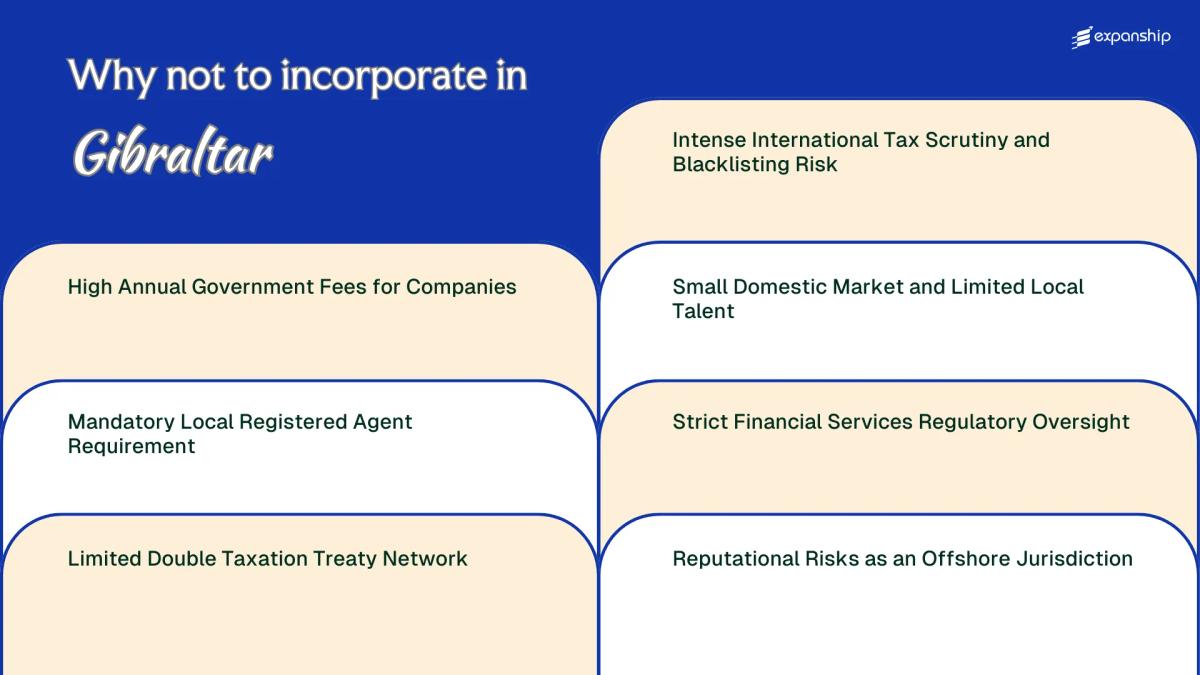
High Annual Government Fees for Companies
Under the Companies Act 2014, companies incorporated in Gibraltar are subject to annual government fees that many foreign business owners underestimate when calculating ongoing operating costs. These charges apply regardless of trading activity or revenue.
Annual Fee Structure and Its Financial Weight
The annual return fee payable to Companies House Gibraltar is tied to the company's share capital, meaning higher-capitalised entities face proportionally steeper charges. For a foreign founder running a holding structure or a dormant entity, this creates a recurring Gibraltar annual government fees burden that generates no operational return.
Private companies with nominal share capital still face base-level fees that, combined with mandatory registered agent retainers and compliance filing costs, push total annual maintenance well above what comparable offshore centres charge.
Cumulative Cost Against Operational Output
High company maintenance costs in Gibraltar become particularly acute for businesses that generate limited local revenue. The fixed nature of government fees means your cost-per-jurisdiction does not scale down during low-activity periods.
Foreign business owners should account for the full stack of annual statutory charges before committing to Gibraltar as a holding or operational base, since fees accrue irrespective of whether the company transacts any business during the year.
Mandatory Local Registered Agent Requirement
Every company incorporated under the Companies Act 2014 must maintain a registered office in Gibraltar and appoint a locally licensed company secretary or registered agent. This isn't optional or provisional — it's a statutory condition of formation and ongoing compliance.
For foreign owners operating remotely, this creates a structural dependency on a third-party service provider whose fees recur regardless of whether your business generates any revenue in the territory.
The practical friction this generates includes:
- Paying annual retainer fees to a licensed agent without any guarantee of service quality, since the market of approved providers is small and alternatives are limited
- Losing operational flexibility when your registered agent relationship breaks down, as replacing them requires formal notification to Companies House Gibraltar and updating statutory records
- Absorbing compliance delays if your agent misfiles or misses deadlines, even though your company bears the legal responsibility
- Surrendering a degree of administrative control over your company's official correspondence and regulatory submissions
The company secretary obligation extends beyond a formality. Agents in Gibraltar are responsible for maintaining statutory registers and filing annual returns, meaning any lapse on their part triggers direct consequences for your entity's standing.

Company Incorporation in Gibraltar
Understand the statutory requirements and ongoing obligations before registering a company in Gibraltar.
Limited Double Taxation Treaty Network
Gibraltar's limited tax treaty network is one of the more consequential structural gaps for foreign businesses operating across borders. As of current records, Gibraltar has signed very few double taxation agreements, leaving most cross-border income flows without treaty protection. Your business will typically be subject to full withholding taxes in the source country, with no reciprocal relief mechanism available.
For a holding company or trading entity receiving dividends, royalties, or interest from abroad, this absence forces reliance on unilateral domestic exemptions in the counterpart country, which are neither guaranteed nor consistent.
| Income Type | Without DTA Protection | Practical Burden |
|---|---|---|
| Dividends received from EU source | Subject to source-country withholding (often 15-25%) | No treaty reduction available |
| Royalty payments into Gibraltar | Full withholding rate applies in paying country | Erodes net IP income significantly |
| Interest income from foreign lenders | Taxed at source under domestic rules | No reciprocal offset or reduction |
| Capital gains from foreign disposals | Treated under source-country law exclusively | No treaty tie-breaker or exemption |
Many jurisdictions that have signed extensive treaty networks, including EU member states, benefit from reduced withholding rates of 0-5% on qualifying payments. Without comparable agreements, a Gibraltar-registered firm faces materially higher tax friction on the same transactions.
The lack of DTAs also creates double taxation exposure that Gibraltar's domestic 10% corporate rate alone cannot resolve.
Intense International Tax Scrutiny and Blacklisting Risk
Gibraltar international tax scrutiny risks are not theoretical. The territory has faced sustained pressure from both the OECD and the EU over its tax practices, and that pressure has direct consequences for how your company is perceived by banks, counterparties, and regulators abroad.
Under the Income Tax Act 2010, Gibraltar applies a territorial tax system, taxing only income accrued in or derived from the territory. While this is a lawful framework, it has attracted scrutiny from the EU's Code of Conduct Group on Business Taxation, which has historically flagged the territory for potentially harmful tax practices.
The EU's listing process creates tangible risk. If Gibraltar were placed on the EU list of non-cooperative jurisdictions, your entity could face withholding tax penalties on payments from EU-based entities and automatic enhanced due diligence requirements from European financial institutions.
- EU financial institutions may apply enhanced due diligence to Gibraltar-registered entities under AMLD frameworks
- The OECD's BEPS framework requires substance requirements your company must meet to avoid being reclassified
- Correspondent banking relationships may be refused or terminated based on jurisdiction-level risk ratings
- Any deferred or territorial income structure requires documented economic substance under Gibraltar's Economic Substance Regulations
This disadvantage is partially qualified by Gibraltar's commitments to the OECD's Common Reporting Standard and automatic exchange of information, but those commitments do not eliminate reputational risk at the counterparty level.
Gibraltar has committed to OECD transparency standards, yet several major European banks still apply enhanced due diligence to Gibraltar-registered companies as a matter of internal policy, regardless of the entity's actual tax structure.
Small Domestic Market and Limited Local Talent
Gibraltar's small domestic market drawbacks extend beyond low consumer demand — the territory's resident population of roughly 34,000 creates structural constraints that affect how foreign-owned companies can actually operate day-to-day.
A Workforce Too Small to Scale From
The local talent pool is narrow across most professional and technical disciplines, and firms requiring skilled hires in finance, technology, or operations frequently find themselves competing for the same limited pool of licensed professionals. This scarcity drives salary expectations upward relative to what comparable roles command in larger nearby markets such as Spain or the UK.
Recruiting from outside requires navigating Gibraltar's work permit and residency requirements under the Employment (Amendment) Act and related immigration rules, which adds administrative lead time and cost to staffing decisions.
Operational Dependency on External Markets
Your business will likely depend on importing both talent and services from abroad, meaning Gibraltar functions as a registered base rather than a genuine operational hub for most foreign entities. That structural dependency raises overheads without delivering the market access that would typically justify it.
The domestic economy is heavily concentrated in financial services, online gaming, and tourism, so businesses operating outside these sectors have limited access to relevant local suppliers, partners, or industry networks.
Addressing Operational Challenges for Your Gibraltar Entity
Understand the practical constraints of operating from Gibraltar and how to structure your company around them effectively.
Strict Financial Services Regulatory Oversight
Gibraltar financial services regulatory challenges stem primarily from the Gibraltar Financial Services Commission (GFSC), which applies a licensing and supervision framework that imposes significant ongoing obligations on regulated entities.
- Firms requiring a GFSC licence must meet detailed fit-and-proper requirements, submit ongoing regulatory returns, and maintain minimum capital adequacy thresholds, all of which generate recurring professional and compliance costs.
- The GFSC's authorisation process for financial services activities can be lengthy, creating delayed market entry for foreign businesses that need regulatory approval before generating revenue.
- Crypto asset and DLT businesses operating under the Distributed Ledger Technology Providers Act 2017 face a dedicated GFSC compliance burden that many comparable jurisdictions have yet to introduce.
- Regulated firms must appoint locally approved compliance officers and money laundering reporting officers, adding fixed overhead costs that disproportionately affect smaller foreign-owned entities.
- GFSC compliance burden on companies extends to periodic supervisory examinations, which can disrupt operations and require dedicated internal resource allocation.
Reputational Risks as an Offshore Jurisdiction
Gibraltar offshore jurisdiction reputational risks are a practical concern for businesses that depend on banking relationships, investor confidence, or partnerships with regulated counterparties. Despite being a British Overseas Territory operating under UK-aligned legal standards, the territory is still categorized by some foreign institutions as a tax haven or low-tax jurisdiction.
This perception creates friction. Correspondent banks in the EU and US often apply heightened due diligence to companies registered in Gibraltar, which can delay account openings or result in outright refusals.
Your firm may also face scrutiny from potential investors or clients in jurisdictions where associations with offshore structures trigger reputational red flags. That scrutiny is not always rooted in legal non-compliance — it reflects how counterparties perceive the territory's tax environment rather than its actual regulatory standards.
The EU's continued monitoring of Gibraltar's tax framework through bodies such as the European Commission adds an institutional dimension to this perception risk.
A foreign-owned holding company incorporated in Gibraltar may encounter a scenario where three successive EU-based banks decline to open accounts, citing internal policies on offshore-registered entities, forcing the business to use a less accessible banking jurisdiction — adding an estimated €3,000–€6,000 in setup costs and several months of delay.
Overcoming Gibraltar's Incorporation Challenges
Overcoming Gibraltar's Incorporation Challenges
Overcoming Gibraltar incorporation challenges requires a structured approach to entity setup, tax positioning, and regulatory compliance rather than a reactive one. The disadvantages covered in this blog are real constraints, and addressing them starts before incorporation.
- Appoint a locally licensed registered agent through the Companies House registry process before submitting your incorporation application.
- Budget for the annual government fee obligations applicable to your company type under the Companies Act 2014.
- Assess your firm's cross-border income flows early, since the territory's limited tax treaty network will affect how foreign-source income is taxed in your home jurisdiction.
- Obtain the relevant Financial Services Commission licence before conducting any regulated activity, including crypto-asset operations.
- Establish transparent beneficial ownership records in compliance with the territory's public register requirements to reduce blacklisting exposure.
These steps operate within a regulatory framework that the Gibraltar Financial Services Commission and Companies House jointly oversee. Structural preparation does not eliminate the inherent constraints of this jurisdiction, but it reduces the risk of non-compliance.
Gibraltar's Overall Value for Businesses
Gibraltar's overall position, when weighing the Gibraltar company formation pros and cons, is that of a well-regulated, low-tax jurisdiction with genuine legal substance — but one that carries real structural limitations. The disadvantages covered throughout this blog are not theoretical; they affect operating costs, market access, and international perception in measurable ways.
| Pros | Cons |
|---|---|
| Corporate income tax is capped at 10% under the Income Tax Act 2010 | Annual government fees and maintenance costs are comparatively high for a small jurisdiction |
| Gibraltar operates under English common law with an independent judiciary | No comprehensive double taxation treaty network limits cross-border tax relief |
| The Financial Services Commission provides a recognised regulatory framework for licensed activities | FSC-regulated entities face detailed ongoing compliance obligations and supervisory costs |
| EU market access remains available for certain financial products under legacy arrangements | The jurisdiction's offshore reputation can complicate banking and counterparty relationships |
| A local registered agent is required, which ensures regulatory accountability | That same requirement adds a recurring operational cost that cannot be avoided |
Deciding whether Gibraltar suits your business depends heavily on how its tax rate and regulatory credibility weigh against the reputational scrutiny, treaty limitations, and compliance overhead your specific structure would carry. The jurisdiction is credible, but it is not cost-free or frictionless.
Corporate Compliance Services in Gibraltar
Stay compliant with Gibraltar's Companies Act, annual return obligations, and Financial Services Commission requirements through structured compliance support.
Conclusion
The cons of Gibraltar company registration are concentrated in a few areas that carry real operational and reputational weight. The limited double taxation treaty network restricts how efficiently cross-border income flows can be structured, while sustained international scrutiny from bodies such as the FATF and EU creates ongoing compliance exposure. Reputational risk tied to the jurisdiction's offshore history also affects banking access and counterparty relationships. Firms considering formation here should enter with a clear-eyed view of these structural constraints and appropriate professional guidance in place.
Expanship's Gibraltar Company Formation Support
Expanship's Gibraltar company formation support addresses the specific compliance obligations that make this jurisdiction operationally demanding for foreign businesses. From satisfying the Companies House Gibraltar registration requirements to maintaining a locally appointed registered agent and managing ongoing obligations under the Income Tax Act 2010, the practical burden falls on your business from day one. Expanship's role is to reduce that burden, not to change how Gibraltar's regulatory framework operates.
Our service scope covers the full formation and maintenance cycle:
- We prepare and submit your company registration documents to Companies House Gibraltar.
- A registered agent and registered office address in Gibraltar are provided on your behalf.
- We liaise directly with government bodies and regulatory authorities for filings and correspondence.
- Post-incorporation compliance management keeps your entity in good standing over time.
- Banking introduction assistance connects your business with suitable financial institutions.
- Tax registration and liaison with the Gibraltar Finance Centre Division are handled as part of the process.
Reach out through Expanship Gibraltar to discuss your incorporation requirements.
Frequently Asked Questions (FAQ)
It disproportionately affects companies with significant cross-border trading activity or international dividend flows. Gibraltar has very few double taxation agreements in force, so businesses that regularly receive income from multiple foreign jurisdictions face withholding taxes without treaty relief, increasing the effective tax cost compared to jurisdictions with broader treaty networks such as the Netherlands or Singapore.
Non-compliance with Gibraltar's DLT Provider Regulations, enforced by the Gibraltar Financial Services Commission (GFSC), can result in licence revocation, financial penalties, and public censure. The GFSC has demonstrated willingness to act against non-compliant firms, and a revoked licence is a matter of public record, compounding both operational and reputational damage.
Annual government fees for a standard Gibraltar private company are several hundred pounds per year, and these fees apply regardless of whether the entity trades or generates revenue. Combined with mandatory registered agent fees, the fixed annual overhead is higher than in many comparable offshore jurisdictions.
It is broadly comparable to requirements in jurisdictions like the British Virgin Islands or Cayman Islands, but the pool of licensed agents in Gibraltar is smaller, which reduces competitive pricing. Under the Companies Act 2014, every Gibraltar company must maintain a registered agent licensed by the GFSC, and there is no provision to self-appoint unless your business itself holds the relevant licence.
Avoiding it entirely is not realistic given Gibraltar's offshore classification. Some businesses mitigate the issue by maintaining a genuine operational presence in Gibraltar and providing extensive documentation, but correspondent banking relationships remain difficult, particularly for fintech and crypto-related entities, which face the most intensive scrutiny from risk-averse banking institutions.
Failure to file annual returns under the Companies Act 2014 results in administrative penalties and can lead to the company being struck off the register by the Registrar of Companies. Restoration after striking off requires a court application and payment of outstanding fees and penalties, making non-compliance a costly administrative failure rather than a minor oversight.
It affects more than consumer businesses. The limited local talent pool means professional services firms, financial institutions, and tech companies all face recruitment constraints, often needing to bring in staff from Spain or the UK. This adds costs through relocation, immigration processes, and higher salary expectations for qualified professionals willing to base themselves in a territory of approximately 35,000 residents.
Legal Disclaimer
The information provided in this article is for general informational purposes only and does not constitute legal, tax, or professional advice. While we strive to ensure the accuracy and timeliness of the content, laws and regulations are subject to change, and the application of laws can vary widely based on specific facts and circumstances.
Readers should not act upon this information without seeking professional counsel tailored to their individual situation. Expanship and its authors disclaim any liability for actions taken or not taken based on the content of this article.
For specific advice regarding your business setup, compliance requirements, or any legal matters, please consult with qualified legal and tax professionals in the relevant jurisdiction.