

Key Takeaways
- Gibraltar's territorial tax system means foreign-sourced profits fall entirely outside the scope of its 10% corporate tax rate, making the effective liability significantly lower than the headline figure for internationally structured businesses.
- The complete absence of capital gains tax, VAT, inheritance tax, and wealth tax removes several cost layers that would otherwise apply in most European jurisdictions.
- Under the Financial Services (DLT Providers) Act 2020, companies operating in blockchain and digital assets can obtain a defined regulatory licence from the Gibraltar Financial Services Commission — a framework established earlier and with greater legal clarity than most comparable jurisdictions.
- Operated under British sovereignty with an English common law legal system and Companies House Gibraltar overseeing corporate compliance, the territory offers a level of institutional credibility that distinguishes it from lower-regulation offshore alternatives.
Gibraltar is a British Overseas Territory situated at the southern tip of the Iberian Peninsula, sharing a land border with Spain and occupying a position at the entrance to the Mediterranean Sea. It operates under British sovereignty while maintaining its own legislature, legal system, and fiscal autonomy. Company registration and ongoing corporate compliance fall under the oversight of the Companies House Gibraltar, with financial services regulation handled separately by the Gibraltar Financial Services Commission.
Foreign investors face no restrictions on ownership, and the territory maintains an open posture toward foreign direct investment across most sectors. The most common legal vehicle used by international businesses is the private company limited by shares. From a tax standpoint, the jurisdiction operates on a territorial basis, meaning liability generally attaches only to profits accrued in or derived from Gibraltar.
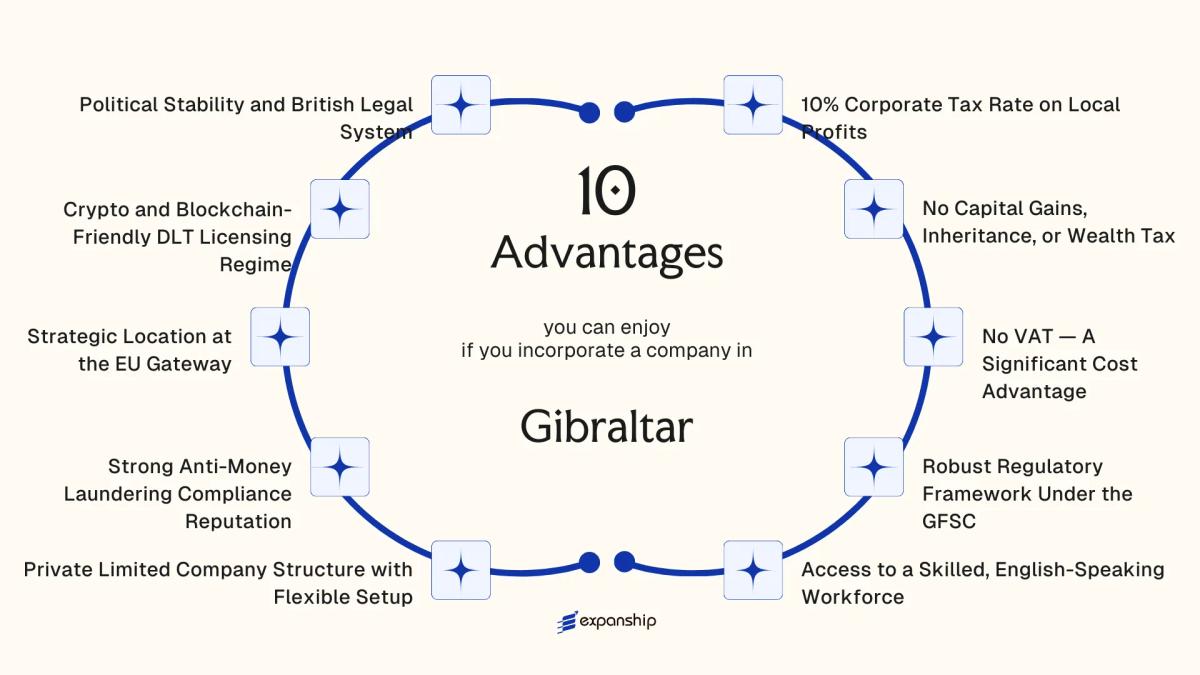
The benefits of incorporating in Gibraltar span tax efficiency, regulatory credibility, and sector-specific licensing frameworks. This article examines those advantages in detail across the sections that follow.
10% Corporate Tax Rate on Local Profits
Gibraltar's corporate tax rate stands at 10%, applied only to profits accrued in or derived from Gibraltar under the Income Tax Act 2010. For a foreign business owner, that jurisdictional boundary matters as much as the rate itself.
What the Rate Covers
Tax liability is determined by the source of income, not the residence of the company. Profits generated from activities conducted outside Gibraltar fall outside the scope of this tax, which means an international trading entity can operate through a Gibraltar-registered company while keeping its foreign-sourced income untaxed locally.
Why the 10% Rate Has Practical Weight
The EU average corporate tax rate sits above 21%, making Gibraltar's 10% rate a material difference in retained earnings over time. Your firm's tax exposure is governed by a clearly defined statutory framework rather than discretionary rulings, which gives structuring decisions a predictable legal foundation.
A Gibraltar company generating profits exclusively from international operations may face zero local corporate tax liability under the territorial source principle of the Income Tax Act 2010.
No Capital Gains, Inheritance, or Wealth Tax
Gibraltar imposes no capital gains tax on the disposal of assets. For a business holding shares, property, or financial instruments, gains realised on sale are not taxed at the point of disposal. This applies equally to resident and non-resident shareholders, meaning foreign investors can exit positions without a tax event in Gibraltar on the appreciation itself.
Inheritance tax was abolished, and no wealth tax exists under Gibraltar's domestic legislation. For family-owned enterprises or holding structures passing assets between generations, the absence of these levies means accumulated business value is not eroded at the point of transfer or simply by virtue of holding assets over time.
These absences are structural, not discretionary. They are not exemptions subject to annual renewal or income thresholds. Your firm is not managing a compliance position around these taxes; they simply do not apply.
For foreign investors, the practical result is:
- Gains on the sale of a Gibraltar-incorporated entity are not subject to local tax, keeping exit proceeds intact
- Long-term asset accumulation within a holding company does not attract periodic wealth-based charges
- Estate planning for business assets held through a Gibraltar entity operates without an inheritance tax layer at the local level

Company Incorporation in Gibraltar
Register your company in Gibraltar and take advantage of its zero capital gains, inheritance, and wealth tax framework for businesses and investors.
No VAT — A Significant Cost Advantage
Gibraltar does not impose value added tax. That single structural feature has a direct and measurable effect on the cost of doing business, because every transaction your company processes, every service it sells, and every product it supplies is free from the administrative and financial burden that VAT creates in most developed economies.
Across EU member states, standard VAT rates typically range from 17% to 27%. For a trading company or a service-based business operating across multiple markets, the absence of this tax means your pricing is not inflated at the point of sale, and your accounts team is not managing complex input/output reconciliation each quarter.
| Factor | With VAT (typical EU jurisdiction) | Without VAT (Gibraltar) |
|---|---|---|
| Consumer pricing | Includes statutory tax component | No tax component added |
| Quarterly compliance | VAT return filings required | No VAT return obligation |
| Cross-border invoicing | Requires VAT registration checks | No VAT registration needed |
| Cash flow impact | Input tax tied up until reclaimed | No deferred tax on purchases |
There is no VAT legislation in force under Gibraltar law, and no equivalent goods and services tax applies. Your firm does not need to register for, collect, or remit consumption tax on domestic transactions. For foreign entrepreneurs selling digitally delivered services or physical goods through a Gibraltar-registered entity, this removes an entire compliance layer that would otherwise require local tax agent support, software integration, and periodic government filings.
Robust Regulatory Framework Under the GFSC
The Gibraltar Financial Services Commission (GFSC) is the statutory body responsible for licensing and supervising financial services businesses in Gibraltar. For foreign operators, the Gibraltar GFSC regulatory framework benefits extend beyond local credibility — being regulated by the GFSC signals institutional-grade oversight to banks, investors, and counterparties in other jurisdictions.
Established under the Financial Services Commission Act 2007, the GFSC operates as an independent regulator. Its licensing categories cover banking, investment firms, insurance, payment services, and distributed ledger technology, among others. Each category carries defined capital requirements, conduct obligations, and ongoing reporting standards. This specificity reduces regulatory ambiguity for incoming businesses.
For a foreign firm establishing a GFSC regulated business in Gibraltar, the supervised status can simplify due diligence processes with international partners. Regulated entities are required to maintain substance on the ground, which supports the legitimacy of your structure in cross-border transactions.
Keep in mind:
- Licensing requirements vary by activity type under the Financial Services Act 2019
- Minimum capital thresholds apply per licence category
- Ongoing compliance obligations include annual audits and regulatory returns
- Operating without the appropriate GFSC licence where one is required carries criminal liability
The GFSC was among the first regulators globally to publish a formal framework for cryptocurrency businesses, predating many G20 member-state equivalents.
Access to a Skilled, English-Speaking Workforce
The Gibraltar English-speaking workforce advantage is one of the more practical, day-to-day benefits for any foreign business owner setting up operations there. English is the official language, used across government, courts, and commercial life, which means corporate documentation, regulatory correspondence, and employment contracts all operate in the same language as your business.
A Small but Professionally Concentrated Talent Pool
The territory's population sits at approximately 34,000, yet the workforce punches above its size in specific sectors. Financial services, legal, insurance, and digital technology have historically attracted qualified professionals, partly because the Gibraltar Financial Services Commission sets licensing standards that require technical competence from regulated firms. That regulatory baseline has shaped a local employment culture where professional qualifications are a practical necessity, not a formality.
Cross-Border Labour Mobility Adds Depth
Much of the working population commutes daily from Spain, meaning your business draws from a wider regional labour market while operating within a British legal framework. Employment relations in Gibraltar are governed by the Employment Act 2006, which provides a structured set of rights and obligations that will be familiar to any employer accustomed to UK-style labour law. That cross-border dynamic also means your team can include bilingual talent with Spanish fluency, which carries practical value for any firm with Iberian commercial interests.
Make the Most of Gibraltar's Business Advantages
Speak with our team about structuring your Gibraltar company to take full advantage of the jurisdiction's workforce, regulatory environment, and operational benefits.
Private Limited Company Structure with Flexible Setup
Under the Companies Act 2014, a Gibraltar private limited company can be incorporated with a single shareholder and a single director, who may be the same person. There is no requirement for a local director, which means you can manage the entity entirely from abroad. Minimum share capital requirements are nominal, removing a common barrier that other jurisdictions impose at the formation stage.
This structural flexibility has a direct practical consequence: your business can be operational without first establishing a local management presence or committing significant capital. For founders testing a new market or consolidating an international holding structure, that reduces both setup time and initial overhead.
- A sole director and sole shareholder arrangement is fully permissible, simplifying governance for small or founder-led businesses.
- No mandatory local director requirement means you retain full operational control from your home jurisdiction.
- Nominee shareholder and director services are permitted under Gibraltar law, offering privacy where needed without creating illegal structures.
- Annual general meeting requirements can be dispensed with by written resolution, reducing administrative burden on distributed teams.
- The company name must include "Limited" or "Ltd," and the firm must maintain a registered office address within Gibraltar, but these requirements are straightforward to satisfy through licensed corporate service providers.
Strong Anti-Money Laundering Compliance Reputation
Gibraltar's AML compliance reputation advantage is grounded in statute, not convention. The Proceeds of Crime Act 2015 and the Anti-Money Laundering and Terrorist Financing Regulations 2007 establish the primary legislative framework, requiring firms to maintain documented customer due diligence, transaction monitoring, and suspicious activity reporting procedures.
The Gibraltar Financial Intelligence Unit (GFIU) operates as the territory's financial intelligence body, receiving and analysing suspicious transaction reports. Businesses incorporated here are subject to oversight that aligns with Financial Action Task Force (FATF) standards, which reduces counterparty friction when dealing with European or US-based financial institutions that screen for jurisdictional risk.
For your business, this has a direct operational consequence. Banks, payment processors, and institutional partners apply lower due diligence burdens to entities incorporated in FATF-compliant jurisdictions. That translates into faster account opening, fewer documentation requests, and reduced compliance overhead when transacting internationally.
Gibraltar was assessed by MONEYVAL, the Council of Europe's anti-money laundering body, and its evaluation reports are publicly available through the Council of Europe. The territory's compliance with FATF recommendations places it in a category of jurisdictions that international financial institutions treat as lower risk for correspondent banking purposes.
Strategic Location at the EU Gateway
Gibraltar occupies a unique geographic position at the southern tip of the Iberian Peninsula, sitting at the entrance to the Mediterranean Sea. This placement has direct consequences for how a business incorporated there connects to European and global trade corridors.
Physically adjacent to Spain and within close proximity to North Africa, the territory sits at a junction point between Atlantic and Mediterranean shipping routes. For firms with supply chains, logistics operations, or client bases spanning multiple continents, that positioning reduces transit times and operational friction in ways that a mid-European address cannot replicate.
The Gibraltar strategic location EU gateway advantage carries particular weight for businesses that conduct cross-border operations without requiring EU passporting. Since Gibraltar is a British Overseas Territory, your firm operates under a familiar common law system while maintaining physical access to European markets through land border connectivity with Spain.
- Time zone alignment with Western Europe (GMT/BST) supports real-time coordination with EU-based counterparties.
- Proximity to Malaga Airport and the Port of Gibraltar expands logistical reach without requiring a mainland European presence.
- Direct land access to Spain provides a practical entry point for goods and personnel moving into the EU single market.
Gibraltar is not an EU member state, so your business incorporated there does not automatically benefit from EU single market passporting rights.
Crypto and Blockchain-Friendly DLT Licensing Regime
Gibraltar introduced the world's first dedicated regulatory framework for distributed ledger technology businesses when the Financial Services (Distributed Ledger Technology Providers) Regulations 2018 came into force. The Gibraltar DLT licensing regime benefits firms operating in this space by giving them a defined legal status rather than forcing them into regulatory categories designed for traditional financial services.
Under these regulations, any firm using DLT to store or transmit value belonging to others must obtain a DLT Provider Licence from the Gibraltar Financial Services Commission (GFSC). This licensing requirement applies to crypto exchanges, custodians, and payment platforms. Operating under a recognised licence rather than in a grey zone has direct consequences for your firm's banking relationships, institutional partnerships, and cross-border credibility.
The GFSC evaluates applicants against nine core regulatory principles, covering areas such as financial crime prevention, market integrity, and customer asset protection. These principles give regulators discretion to apply requirements proportionately, which means smaller or early-stage businesses are not held to the same compliance burden as systemically significant operators.
Key structural advantages of the DLT framework include:
- Statutory legal clarity on what constitutes a regulated crypto activity
- A dedicated supervisory body with specific DLT expertise rather than general financial regulators applying adapted rules
- A licensing process that produces a credential recognised in other well-regarded financial centres
- No restriction on serving clients outside Gibraltar, subject to applicable foreign regulations
This regulatory architecture gives blockchain-based businesses a foundation that satisfies due diligence requirements from institutional counterparties and correspondent banks.
Political Stability and British Legal System
Gibraltar's legal system traces directly to English common law, and that foundation is one of the most consequential features of the territory for foreign business owners. The Gibraltar British legal system business advantage is structural: contracts, corporate governance, and dispute resolution all operate within a framework that international investors and financial institutions already understand. For a business owner from outside the territory, this eliminates a significant layer of legal uncertainty that exists in civil law jurisdictions.
Courts in Gibraltar apply English case law precedent where local statute does not provide specific guidance, and the territory's final court of appeal is the Judicial Committee of the Privy Council in London. That appellate structure means your firm's legal disputes are ultimately adjudicated within one of the most established judicial systems in the world. For creditors, counterparties, and institutional investors, that accountability carries weight.
Gibraltar has maintained British Overseas Territory status since the Treaty of Utrecht in 1713, and its constitutional relationship with the United Kingdom remains stable. Political continuity of this kind matters when you are making multi-year decisions about where to domicile an entity or hold assets.
Key features relevant to your business include:
- Companies are governed by the Companies Act 2014, which follows English company law principles closely
- The legal language is English, removing translation risk from contracts and filings
- Gibraltar political stability for investors is underpinned by a functioning parliament, independent judiciary, and consistent rule of law
- Gibraltar common law jurisdiction benefits extend to the enforceability of standard Anglo-American contract structures
Why Gibraltar Stands Out Among Offshore Jurisdictions
Businesses evaluating Gibraltar for incorporation typically compare it against jurisdictions with a similar offshore profile: the British Virgin Islands, Malta, and the Isle of Man. These three attract the same categories of foreign investors — holding companies, fintech firms, and internationally mobile businesses — making them the most relevant reference points. What the comparison reveals is not that Gibraltar offers the lowest tax rate or the fewest requirements, but that it occupies a specific position where regulatory credibility, legal predictability, and tax efficiency converge in a way that few similarly sized jurisdictions can match.
Jurisdictions like the BVI operate with near-zero tax but carry elevated FATF scrutiny and limited access to substance frameworks. Malta offers EU membership but imposes a standard 35% corporate tax rate before refund mechanisms apply, adding administrative layers. The Isle of Man shares many structural similarities with Gibraltar — a British legal system, no capital gains tax, and a 0% standard corporate rate — yet lacks a purpose-built DLT licensing framework equivalent to the GFSC's regime under the Financial Services Act 2019.
| Parameter | Gibraltar | British Virgin Islands | Malta | Isle of Man |
|---|---|---|---|---|
| Corporate Tax Rate | 10% on local profits | 0% | 35% (refund mechanism applies) | 0% standard; 10% for banking |
| VAT | None | None | 18% standard rate | 20% standard rate |
| DLT/Crypto Licensing | Yes, GFSC DLT framework | No dedicated regime | MiCA-aligned framework | Virtual Asset framework |
| Legal System | English common law | English common law | Civil law (EU) | English common law |
| Capital Gains Tax | None | None | None | None |
| FATF Status | Not grey-listed | Previously grey-listed (2021) | Previously grey-listed (2022) | Compliant |
Compliance Services for Companies in Gibraltar
Maintain your Gibraltar company's good standing with ongoing compliance support, including confirmation statements, registered office maintenance, and regulatory filings under the Companies Act 2014.
Conclusion
Gibraltar presents a coherent case for foreign business owners who want a low-tax, English-law jurisdiction with genuine regulatory credibility. The 10% corporate tax rate applied only to locally sourced profits, combined with the complete absence of capital gains and VAT obligations, means your effective tax burden can be substantially lower than what most European jurisdictions impose. The Gibraltar Financial Services Commission provides regulatory oversight that international banks and partners recognise, which translates directly into operational access rather than friction.
For businesses operating in digital assets, the Distributed Ledger Technology Provider framework under the Financial Services (DLT Providers) Act 2020 gives companies a defined legal footing that few jurisdictions offered as early or as clearly. That regulatory clarity reduces the compliance uncertainty that typically accompanies early-stage fintech or blockchain ventures.
The benefits of incorporating in Gibraltar are most material when your business model aligns with what the jurisdiction structurally supports: tax efficiency on profits generated outside the territory, operations that benefit from English common law contracts and dispute resolution, or activities that fall within the GFSC's licensing scope. A business with purely domestic EU market ambitions or one requiring passporting rights will need to assess fit carefully. For those whose structure and strategy align, the next step is translating these structural advantages into a correctly formed and compliantly maintained entity.
Start Your Gibraltar Company Formation with Expanship Today
Gibraltar company formation with Expanship covers the full arc of what this blog has outlined: registering a private company limited by shares under the Companies Act 2014, meeting the Gibraltar Financial Services Commission's licensing requirements where applicable, and maintaining the ongoing statutory obligations that keep an entity in good standing with the Companies Registry at Suite 761, Europort.
Expanship's services across this process include:
- Preparation and legalization of incorporation documents, including the Memorandum and Articles of Association
- Registered agent and registered office provision within Gibraltar
- Filing submissions and direct liaison with the Companies Registry
- Post-incorporation compliance management, covering annual returns and company secretarial obligations
- Assistance with opening a corporate bank account through relevant introductions
- Support with DLT Provider registration applications to the GFSC where your business model requires it
Your corporate structure, tax position, and licensing obligations will depend on the specific nature of your business activities. Expanship works within those parameters to ensure documentation is correctly prepared and filings are submitted in accordance with local procedural requirements.
To discuss your incorporation requirements, contact Expanship Gibraltar directly.
Frequently Asked Questions (FAQ)
The corporate tax rate is 10%, applied only to profits accruing in or derived from Gibraltar under the Income Tax Act 2010's territorial basis of taxation. Income generated outside Gibraltar is not subject to this tax. This makes the structure particularly relevant for businesses whose trading activity or clients are located in other jurisdictions.
The Gibraltar Financial Services Commission requires DLT providers operating by way of business in or from Gibraltar to hold a licence under the Financial Services (Distributed Ledger Technology Providers) Regulations 2020. Applicants must demonstrate adequate substance, including appropriate local governance and operational capacity, rather than simply registering a shell entity.
Incorporation through the Companies House Gibraltar generally takes between one and five business days once all required documentation is submitted. The timeline can extend if additional due diligence or name approval is needed. Delays most commonly arise from incomplete identity verification documents rather than administrative processing times.
Gibraltar was never part of the EU VAT area, even before Brexit, so EU VAT directives do not apply. The territory has no VAT system of its own, meaning businesses registered there do not charge or account for VAT on goods and services. This distinction is relevant when assessing the cost structure for B2B or e-commerce operations.
A company that fails to file annual returns or pay the annual registration fee risks being struck off the register maintained by Companies House Gibraltar under the Companies Act 2014. Restoration is possible but involves an application process and the payment of outstanding fees. Prolonged non-compliance can result in the company being dissolved and its assets treated as bona vacantia.
Tax residency in Gibraltar is determined by where management and control of the company is exercised, consistent with the principles set out under the Income Tax Act 2010. A local director alone does not automatically establish tax residency; the board must genuinely conduct its decision-making from Gibraltar. Appointing a nominee director without corresponding substance is unlikely to satisfy the standard applied by the Gibraltar tax authorities.
Legal Disclaimer
The information provided in this article is for general informational purposes only and does not constitute legal, tax, or professional advice. While we strive to ensure the accuracy and timeliness of the content, laws and regulations are subject to change, and the application of laws can vary widely based on specific facts and circumstances.
Readers should not act upon this information without seeking professional counsel tailored to their individual situation. Expanship and its authors disclaim any liability for actions taken or not taken based on the content of this article.
For specific advice regarding your business setup, compliance requirements, or any legal matters, please consult with qualified legal and tax professionals in the relevant jurisdiction.