

Key Takeaways
- Entities incorporating in French Guiana must register through the Centre de Formalités des Entreprises and the Greffe du Tribunal de Commerce de Cayenne, as the territory falls under the French Commercial Code (Code de commerce) rather than a separate local legal framework.
- Foreign investors are required to disclose ultimate beneficial ownership information in compliance with French anti-money laundering directives, making UBO registration a mandatory step in the formation process rather than an optional disclosure.
- The legal form selected — whether a SARL, SAS, or SA — determines the applicable minimum share capital threshold and structural requirements that must be satisfied before registration can be completed.
- A physical registered office address within French Guiana is a mandatory formation requirement, and failure to establish one will prevent successful registration of the entity.
French Guiana operates under French law as an overseas department and region of France, meaning incorporation requirements French Guiana businesses must satisfy are governed by the French Commercial Code (Code de commerce). The Centre de Formalités des Entreprises (CFE) and the Greffe du Tribunal de Commerce handle entity registration at the local level.
This article addresses the structural, documentary, and compliance requirements that apply across the formation process. Failure to satisfy these requirements results in rejection of the registration application or the inability to legally operate within the territory.
Requirements can vary based on the legal form selected, such as a SARL, SAS, or SA, as well as the nature of the business activity and the applicant's residency status.
This article is most directly relevant to foreign investors and non-resident business owners planning to establish a formally registered entity under French commercial law in the territory.
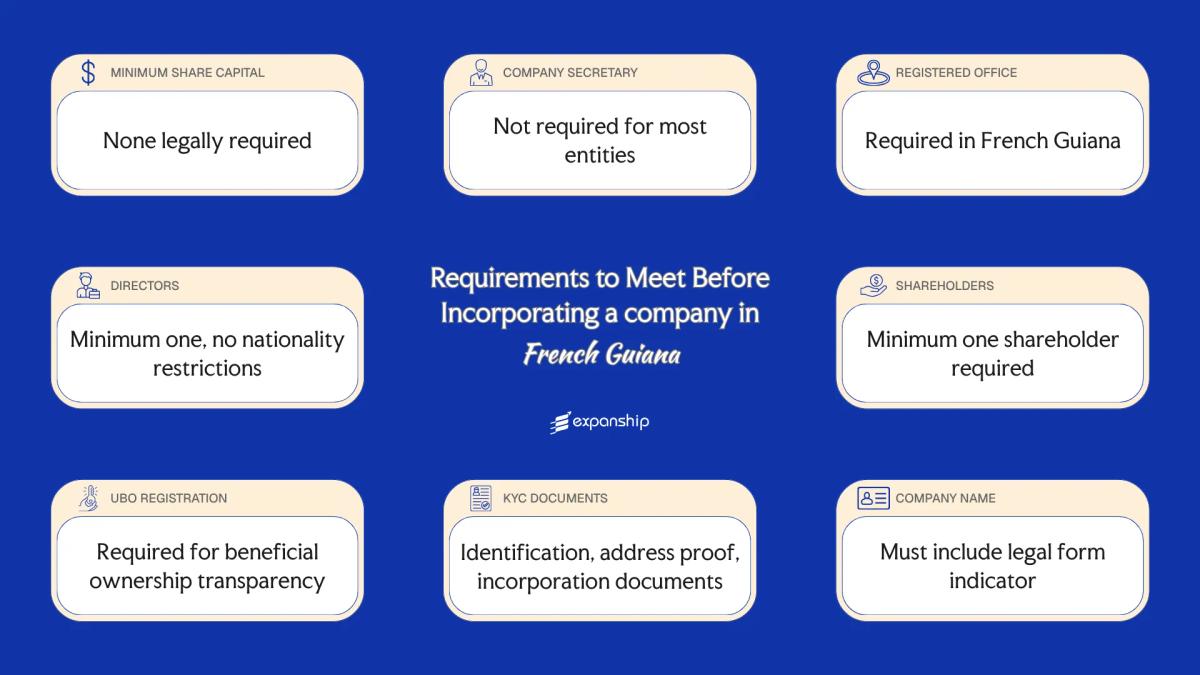
Minimum Share Capital Requirements in French Guiana
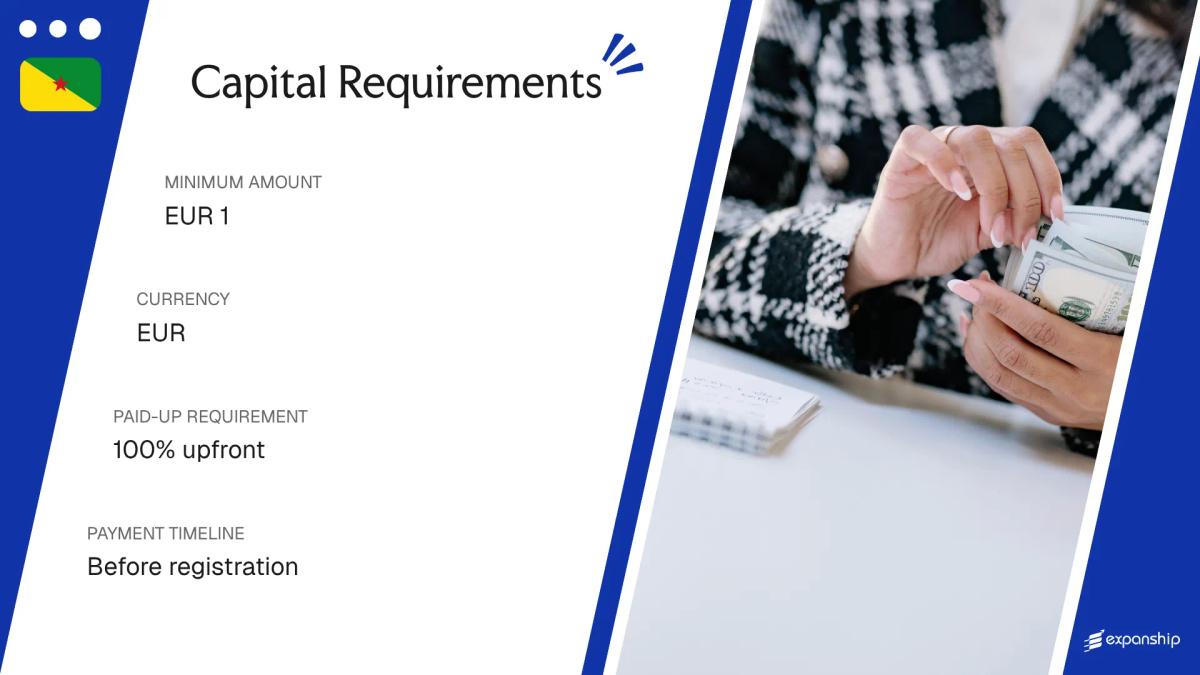
As an overseas territory of France, share capital requirements in French Guiana follow metropolitan French commercial law, principally the Code de commerce. The Greffe du Tribunal de Commerce handles company registration and verifies capital declarations at the point of incorporation.
For a Société à Responsabilité Limitée, French law sets no statutory minimum share capital, though the articles of association must define an authorized amount. A Société par Actions Simplifiée operates under the same no-minimum rule, with capital freely determined by the founders and recorded in the statutes filed with the Greffe.
| Parameter | Detail |
|---|---|
| Minimum Authorized Share Capital | No statutory minimum for SARL or SAS; must be defined in the statutes |
| Maximum Authorized Share Capital | No statutory maximum |
| Minimum Paid-Up Capital | No statutory minimum |
| Paid-Up Requirement at Incorporation | Contributions must be deposited before registration; release follows Kbis extract issuance |
| Accepted Currency | Euro (EUR) |
| Accepted Forms of Contribution | Cash contributions and contributions in kind; contributions in industry permitted for SARL |
| Timeframe to Deposit Capital | Prior to filing with the Greffe du Tribunal de Commerce |
Even with no statutory floor, your statutes must specify a capital figure. A blank or undefined capital amount will result in rejection of the registration dossier by the Greffe.
Company Secretary Requirements in French Guiana
French Guiana operates under French law as an overseas region, and the company secretary requirements French Guiana businesses must follow are governed by the French Commercial Code (Code de commerce) as applied locally. Unlike common law jurisdictions, French corporate law does not mandate a formally designated "company secretary" role for most entity types.
French Guiana corporate secretary obligations are generally absorbed into the responsibilities of statutory managers (gérants) or the board, depending on the structure. These duties include maintaining statutory registers, filing annual accounts with the Greffe du Tribunal de Commerce, and ensuring that shareholders receive required notices and documentation.
Qualification criteria for those fulfilling the statutory corporate administrative function:
- No mandatory licensing requirement exists; the role is typically assumed by a gérant or designated officer of the entity.
- Natural persons must have legal capacity under French civil law and must not be subject to a professional disqualification order.
- Corporate entities may fulfil the function, provided a natural person representative is formally identified.
- No residency requirement applies under French corporate law for this role.

Incorporate a Company in French Guiana
Set up your legal entity in French Guiana with guidance on structure, registration, and ongoing compliance obligations.
Registered Office Requirements in French Guiana
As an overseas territory of France, registered office requirements in French Guiana follow French corporate law, meaning your company's siège social must be a genuine, functional address located within the territory. Using a false or non-compliant address exposes the entity to administrative sanctions under the French Commercial Code, including potential nullity of acts performed in the company's name and possible deregistration from the Registre du Commerce et des Sociétés (RCS).
- A physical address is required; a mere postal box does not satisfy the siège social requirement.
- The registered address must be situated within French Guiana or elsewhere in French territory, consistent with the jurisdiction of incorporation.
- Virtual office addresses are permissible provided the service includes a genuine right of occupancy, as recognised under French case law.
- Proof of occupancy is required at registration, typically a lease agreement, property title, or a domiciliation contract with an accredited provider.
- The registered address is publicly listed on the RCS and accessible through the Institut National de la Propriété Industrielle (INPI) company search portal.
- Any change to the siège social must be formally notified to the greffe du tribunal de commerce and updated in the RCS; failure to do so can result in third-party liability for the directors.
Director Requirements in French Guiana
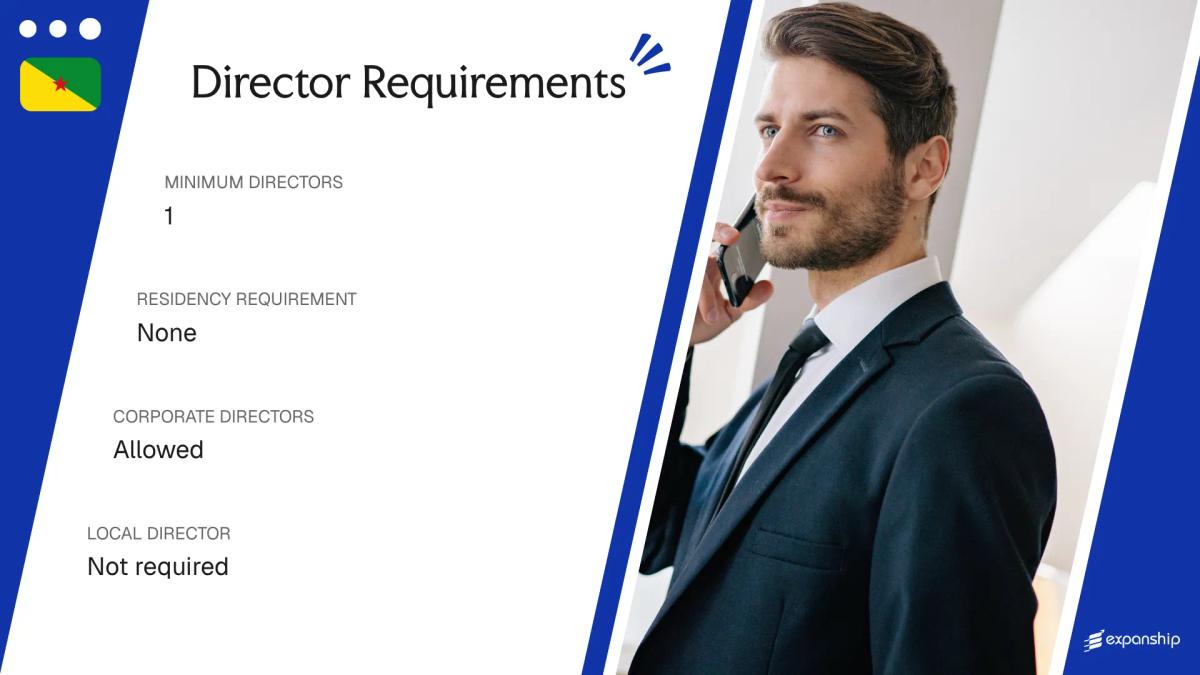
Under French law as applied in French Guiana, director requirements follow the metropolitan French commercial code, meaning appointments carry statutory duties of loyalty, prudence, and active management under the Code de commerce. Upon appointment, a gérant or directeur général assumes personal civil and criminal liability for breaches of legal obligations, mismanagement, or failure to file required documents with the Tribunal de Commerce de Cayenne.
| Parameter | Detail |
|---|---|
| Minimum Number of Directors | One director is required for a SARL (gérant) and one for a SAS (président). |
| Maximum Number of Directors | No statutory maximum applies to a SARL; SAS bylaws govern the upper limit. |
| Local/Resident Director Required | No statutory residency requirement exists under French commercial law. |
| Nationality Restrictions | Non-EU nationals must hold a valid titre de séjour autorisant l'exercice d'une activité commerciale before acting as director. |
| Minimum Age Requirement | Directors must be at least 18 years of age. |
| Corporate Directors Permitted | A legal entity may serve as director in a SAS but not as gérant of a SARL. |
| Director Must Be a Shareholder | No statutory requirement; gérants of a SARL need not hold shares unless the bylaws specify otherwise. |
| Publicly Listed on Registry | Directors are listed publicly on the Registre du Commerce et des Sociétés held at the Tribunal de Commerce de Cayenne. |
| Disqualification Conditions | Persons subject to a faillite personnelle, interdiction de gérer, or criminal conviction involving dishonesty are barred from directorship under the Code de commerce. |
A foreign national can serve as sole director of a French Guiana-registered company without any local co-director, provided they hold the appropriate commercial activity permit — there is no mandatory local director requirement despite French Guiana being an overseas territory of France.
Shareholder Requirements in French Guiana
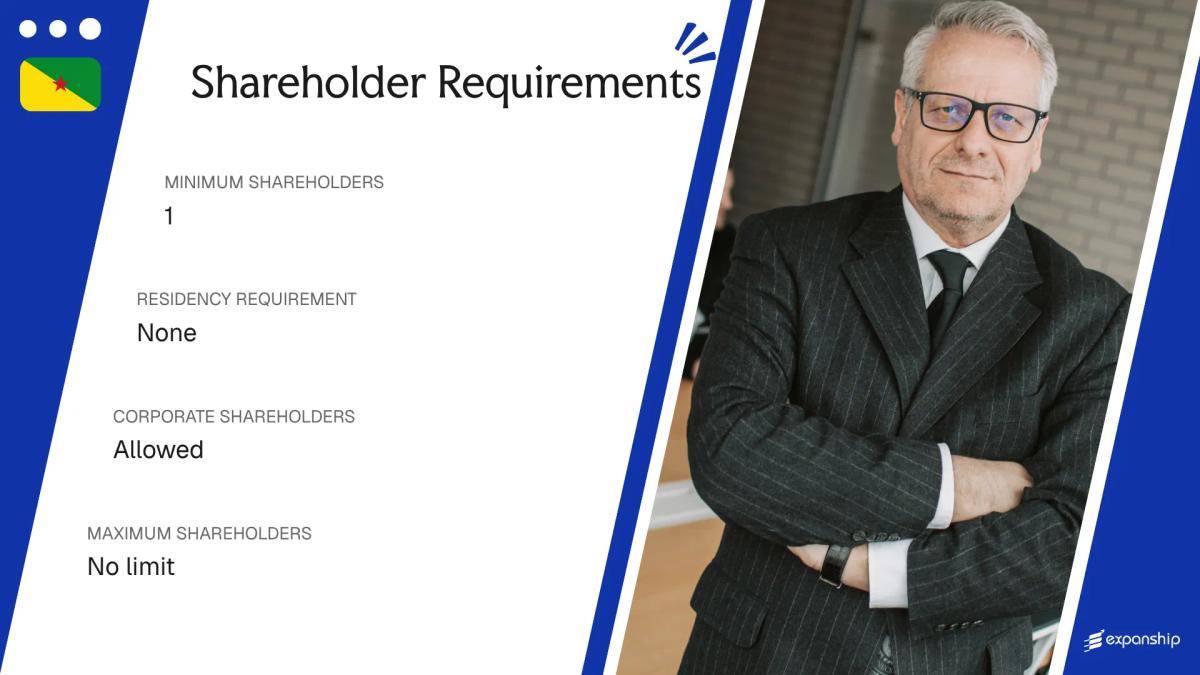
French Guiana follows French metropolitan law, so the rules governing société à responsabilité limitée (SARL) formation apply. A SARL requires a minimum of one associé and permits up to 100, making single-shareholder structures (EURL) permissible.
Nationality and Residency Restrictions
No nationality or residency requirement applies to shareholders under French commercial law. Foreign individuals and entities may hold shares without restriction on ownership percentage.
Corporate Shareholders
Corporate entities are permitted to act as shareholders in a SARL. No additional conditions specific to corporate associés are imposed beyond standard identification and KYC obligations.
Shareholder Liability
Liability is limited to each associé's capital contribution. Under exceptional circumstances, French courts may pierce the corporate veil where fraud or asset commingling is established.
Register of Shareholders
A SARL must maintain a register of associés, recording transfers and share movements. This register is not publicly accessible but must be produced upon request by authorised authorities or during legal proceedings.
Set Up Your Company Structure in French Guiana
Get guidance on meeting shareholder and ownership requirements when incorporating your entity under French Guiana's legal framework.
UBO / Beneficial Ownership Disclosure Requirements in French Guiana
French Guiana follows French national law, meaning beneficial ownership requirements French Guiana entities must meet are governed by the French Commercial Code (Code de commerce) and anti-money laundering legislation transposing the EU's 4th and 5th Anti-Money Laundering Directives. A beneficial owner (bénéficiaire effectif) is any natural person holding, directly or indirectly, more than 25% of the capital or voting rights, or exercising effective control by other means.
- At incorporation, the legal representative must declare the bénéficiaire effectif to the clerk of the Commercial Court (greffe du tribunal de commerce).
- The declaration is submitted via the Guichet unique (single business formalities window) operated by the Institut National de la Propriété Industrielle (INPI).
- Supporting identification documents for each declared beneficial owner must accompany the filing.
- Any change in UBO information must be reported within 30 days of the change occurring.
| Parameter | Detail |
|---|---|
| Ownership Threshold for UBO Status | Above 25% of capital or voting rights, directly or indirectly |
| Filing Authority | Greffe du tribunal de commerce via INPI Guichet unique |
| Disclosure Deadline at Incorporation | At time of registration |
| Publicly Accessible Register | Partially; accessible to competent authorities and persons with legitimate interest |
| Penalties for Non-Disclosure | Criminal penalties under French law, including fines and imprisonment |
| Ongoing Update Obligation | Within 30 days of any change |
KYC / Document Requirements in French Guiana
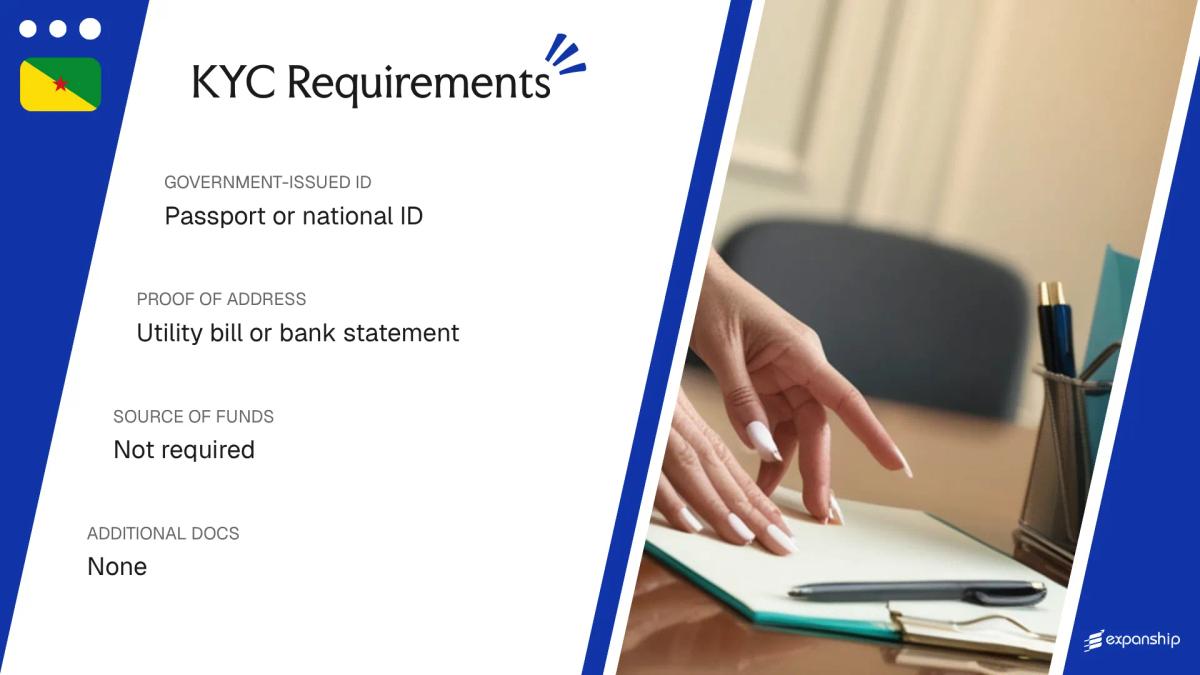
As an overseas territory of France, KYC requirements for French Guiana company formation are governed by French AML law, specifically the Code monétaire et financier, which transposes EU Anti-Money Laundering Directives into domestic legislation. The Autorité de contrôle prudentiel et de résolution oversees compliance at the supervisory level.
Individual / Personal Documents
- Valid government-issued photo identity document (passport or national identity card) for each individual director, shareholder, and beneficial owner
- Proof of residential address dated within three months, such as a utility bill or official bank correspondence
- Completed and signed declaration of beneficial ownership where the individual holds more than 25% of shares or voting rights
- A specimen signature may be required by the greffe (commercial court registry) at the point of filing
Corporate Documents
- Certificate of incorporation or equivalent constitutional document for any corporate shareholder or director
- Up-to-date articles of association or statutes of the corporate entity
- Current register of directors confirming the identity of authorised representatives
- Proof of registered address for the corporate entity, such as a recent official document issued by the relevant national registry
Source of Funds Documentation
- Recent bank statements (typically covering the last three months) evidencing the origin of capital to be contributed
- Audited financial accounts where the contributing entity is a corporate body
- A written declaration explaining the source of funds may be requested by the notaire handling the deed of incorporation
Notarisation and Apostille Requirements
- Foreign-issued identity and corporate documents must generally be apostilled under the Hague Convention of 1961 if originating from a signatory state
- Documents not in French must be accompanied by a certified translation prepared by a sworn translator (traducteur assermenté)
- Notarisation by a French notaire is required for the constitutive deed (acte constitutif) of certain company forms, including the SAS and SARL
Incorporation filings are commonly delayed at the greffe when foreign corporate documents are submitted without a certified French translation from a traducteur assermenté.
Company Name Requirements in French Guiana
Company name requirements in French Guiana follow the same approval framework as mainland France, since the territory operates under French civil and commercial law. Names are assessed for availability and distinctiveness at the point of registration.
Your dénomination sociale must be written in French, and the legal suffix must correspond to the chosen corporate form, such as SARL or SAS. No formal minimum or maximum character length applies under general rules.
Certain words are prohibited outright or require prior administrative authorisation. Terms implying governmental affiliation, financial regulation, or professional licensing fall into restricted categories and cannot be adopted freely.
Name reservation is generally available through the French commercial registry system prior to formal incorporation. Reservations are time-limited, and the application is submitted through the appropriate filing channel before the final registration dossier is lodged.
Compliance Services for Companies in French Guiana
Maintain good standing under French commercial law with ongoing compliance support tailored to entities registered in French Guiana.
Conclusion
French Guiana operates under French metropolitan law, meaning incorporation requirements French Guiana businesses must satisfy are drawn from the French Commercial Code and enforced through the Tribunal de Commerce de Cayenne. Among the requirements covered, UBO disclosure obligations under French anti-money laundering directives and the physical registered office requirement carry particular weight for foreign investors structuring an entity here. Once these obligations are understood, the practical next step is engaging local legal and administrative support to execute registration through the Centre de Formalités des Entreprises.
Expanship's Corporate Services for French Guiana Expansion
French Guiana's incorporation requirements sit within French metropolitan law, meaning your obligations around registered offices, director appointments, and beneficial ownership disclosure follow the same legal standards applied in mainland France. Expanship's French Guiana company formation services are structured to help your business meet those requirements accurately from the outset, reducing the administrative burden that comes with operating under a European regulatory framework in an overseas territory.
Beyond formation, our team supports the full scope of your entry into the territory:
- We prepare and file all registration documents with the relevant commercial registry on your behalf.
- Our registered agent and office provision ensures your entity meets French Guiana's local address requirements.
- We handle all government filings and liaise directly with regulatory authorities throughout the process.
- Post-incorporation compliance, including ongoing statutory obligations, is managed so your business remains in good standing.
- Banking introduction assistance is available to help your firm establish a functional account in the territory.
- We coordinate tax registration and engage with local fiscal authorities as required for your structure.
To discuss your requirements, contact Expanship French Guiana.
Frequently Asked Questions (FAQ)
The €1 statutory minimum capital for a SARL applies across most commercial sectors, but regulated industries, such as financial services or insurance, impose sector-specific minimum capital thresholds set by their supervising authorities. These requirements sit outside the general commercial code and override the default €1 floor. You should confirm applicable thresholds with the relevant sectoral regulator before filing.
Failure to file or maintain accurate beneficial ownership information in the Registre des Bénéficiaires Effectifs, as required under Article L. 561-46 of the French Monetary and Financial Code, can result in criminal penalties including fines and imprisonment for the gérant. The obligation applies to any legal entity registered in French Guiana, with no de minimis exemption based on company size. Inaccurate or incomplete filings carry the same liability exposure as a total failure to file.
Yes, a single individual can simultaneously hold the role of associé unique (sole shareholder) and gérant, forming what is structured as a SARL unipersonnelle. This structure is fully recognised under French commercial law and does not require a separate corporate secretary appointment. The gérant's identity and powers must still be formally recorded in the statuts and filed with the Greffe du Tribunal de Commerce.
French Guiana does not legally prohibit foreign-language words in a company name, but the registered legal name and all official filings must comply with the Toubon Law, which mandates the use of French in official commercial communications and documentation. A brand or trade name can incorporate foreign-language elements, but the formal denomination deposited with the Greffe must not rely on foreign-language terms that obscure the entity's legal identity. A name availability check through the Institut National de la Propriété Industrielle (INPI) is advisable before submission.
Corporate shareholders must provide certified copies of their constitutional documents, a certificate of good standing or equivalent from their jurisdiction of incorporation, and identification documents for their own beneficial owners, tracing ownership up to the natural persons who ultimately control the entity. French anti-money laundering rules, derived from EU directives transposed into national law, require this chain of ownership to be fully documented before the CFE will process the registration. Where documents are issued in a foreign language, certified French translations are required.
The process is substantively the same, as French Guiana operates under the same legal and administrative framework as metropolitan France. Name searches and reservations are conducted through INPI's national database, which covers the whole French territory including overseas departments. There is no separate territorial registry or local approval step unique to French Guiana for company name clearance.
Legal Disclaimer
The information provided in this article is for general informational purposes only and does not constitute legal, tax, or professional advice. While we strive to ensure the accuracy and timeliness of the content, laws and regulations are subject to change, and the application of laws can vary widely based on specific facts and circumstances.
Readers should not act upon this information without seeking professional counsel tailored to their individual situation. Expanship and its authors disclaim any liability for actions taken or not taken based on the content of this article.
For specific advice regarding your business setup, compliance requirements, or any legal matters, please consult with qualified legal and tax professionals in the relevant jurisdiction.