
Key Takeaways
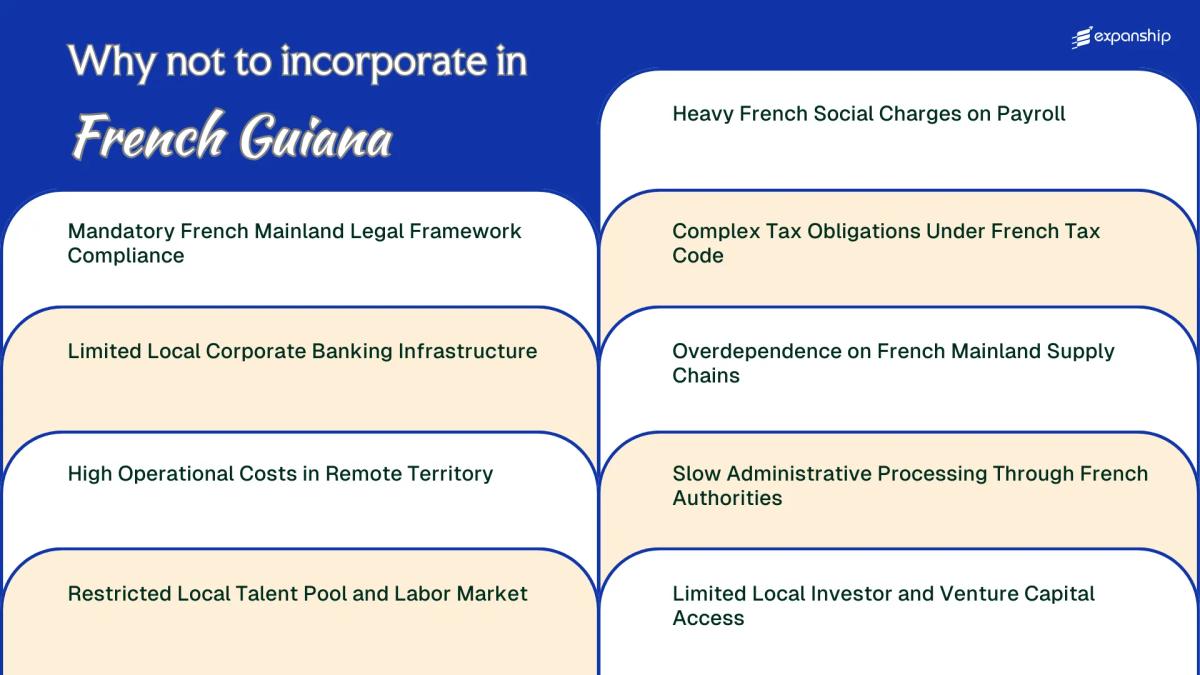
- Entities incorporated in French Guiana are bound by the full French Commercial Code and metropolitan regulatory framework, imposing compliance burdens more commonly associated with EU-headquartered corporations than with regional Latin American operations.
- French social charges on payroll — among the highest in the world — apply in full to locally registered employers, significantly increasing the true cost of hiring beyond gross salary figures.
- The territory's remote geography and structural dependence on French mainland supply chains expose businesses to elevated logistics costs and input price volatility that onshore European or regional competitors do not face at comparable scale.
- Administrative processing for corporate filings and regulatory approvals runs through French metropolitan authorities, creating procedural delays that can materially extend timelines for incorporation, licensing, and ongoing compliance obligations.
French Guiana operates under one of the most heavily regulated corporate frameworks in Latin America, not by design of its own legislature, but because it functions as an overseas department of France, subject to the full body of French metropolitan law. The disadvantages of incorporating in French Guiana stem from this unique constitutional status, which imposes obligations rarely encountered in comparable regional jurisdictions.
This article covers structural, fiscal, administrative, and operational drawbacks that affect foreign-owned entities registered in the territory. The French Commercial Code governs company formation and ongoing compliance, as applied through local administrative channels.
Not every disadvantage will apply equally across all sectors or entity types. A services firm with no local payroll faces a different risk profile than a manufacturing operation dependent on imported inputs.
This article is most relevant to foreign investors, non-EU founders, and multinational firms evaluating French Guiana as a primary incorporation or operational base rather than as a secondary presence.
Mandatory French Mainland Legal Framework Compliance
Incorporating in French Guiana means accepting the French Guiana French mainland legal compliance burden in full, with no jurisdictional carve-outs or simplified overseas regime for foreign businesses.
Full Application of the Code de Commerce
As an overseas department under Article 73 of the French Constitution, French Guiana operates under the same legal framework as metropolitan France. Your entity must comply with the Code de Commerce in its entirety, including registration through the Registre du Commerce et des Sociétés, statutory accounting obligations, and mandatory corporate governance requirements applicable to French SAS, SARL, or SA structures.
French commercial law restrictions in French Guiana apply identically to those in Paris, yet the local institutional capacity to support compliance is considerably thinner. A foreign founder faces metropolitan-level legal obligations without the density of specialist advisors, notaries, or compliance service providers available in mainland urban centers.
Regulatory Oversight Without Local Flexibility
The Autorité des Marchés Financiers and sector-specific French regulators extend their jurisdiction fully into the territory. Regulatory correspondence, filings, and disputes are processed through French mainland channels, adding procedural distance.
Foreign business owners must budget for mainland-equivalent legal and compliance costs while operating in a market that generates significantly lower commercial activity to offset those costs.
Limited Local Corporate Banking Infrastructure
French Guiana corporate banking limitations stem directly from the territory's peripheral status within the French financial system. While it operates under French law and the euro, the physical banking presence in Cayenne and surrounding areas is thin, meaning your business cannot rely on the same institutional density found in metropolitan France.
Only a handful of banks operate locally, with BNP Paribas and Caisse d'Epargne maintaining limited branches. Opening a corporate account often requires in-person procedures that are difficult for foreign founders to complete remotely, adding time and travel costs before operations even begin.
The practical friction this creates for a foreign business owner includes:
- Delays in account opening that can stall post-incorporation steps such as depositing share capital
- Limited access to structured trade finance or credit facilities suited to import-dependent businesses
- Restricted digital banking functionality compared to metropolitan French branches, slowing routine treasury operations
Correspondent banking relationships with non-EU institutions are also harder to establish from this territory, which directly complicates cross-border payments for firms with international supplier networks.

Company Incorporation in French Guiana
Understand the full process of registering a company in French Guiana, including banking requirements and legal obligations under the French corporate framework.
High Operational Costs in Remote Territory
High business operating costs in French Guiana stem from a structural reality: the territory sits on the northeastern coast of South America, separated from metropolitan France by roughly 7,000 kilometers. Physical distance alone drives up the price of almost everything your business depends on.
Most manufactured goods, raw materials, and specialized equipment must be imported, typically through the port of Dégrad des Cannes near Kourou or via air freight through Félix Eboué Airport. Freight costs compound quickly, and import duties under EU customs rules still apply to goods arriving from non-EU countries, adding layers of cost that firms operating on the European mainland do not face.
| Cost Category | Approximate Premium vs. Metropolitan France | Driver |
|---|---|---|
| Consumer goods and supplies | 30–50% higher | Freight, handling, and distribution markups |
| Commercial real estate (Cayenne) | Limited stock, elevated per-sqm rates | Scarce developed land, construction import costs |
| Air freight (per kg, Europe-GF) | Significantly above EU intra-zone rates | Long-haul distance, limited cargo operators |
| Diesel and energy costs | Above EU average | No domestic energy production at scale |
Energy costs present a separate pressure. The territory has no significant domestic energy production, meaning electricity tariffs for commercial premises are structurally elevated.
For a foreign-owned entity, expensive company operations in French Guiana translate directly into higher break-even thresholds. Overhead cost challenges here are not temporary or cyclical; they reflect fixed geographic and infrastructural conditions that pricing strategies cannot easily offset.
Restricted Local Talent Pool and Labor Market
French Guiana labor market restrictions present a structural challenge that few foreign investors anticipate before establishing a presence. The territory's population sits at roughly 300,000, and the proportion holding advanced professional or technical qualifications remains low relative to the operational demands of most internationally oriented businesses.
Proximity to the Guiana Space Centre in Kourou does concentrate aerospace and engineering expertise locally. That specialization is narrow, however, and firms outside that sector gain little from it.
Sourcing qualified accountants, legal professionals, or senior managers locally is difficult. Recruiting from the French mainland or abroad introduces relocation costs, visa considerations under French immigration law, and longer hiring timelines that directly affect your operational launch schedule.
The French Labour Code (Code du travail) applies in full as an overseas department, meaning employment obligations mirror those of metropolitan France without any territorial concession for the limited talent supply.
- Skilled roles unfilled locally must be sourced from metropolitan France or third countries, each carrying distinct administrative requirements
- Employment contracts must comply with French Labour Code provisions, including collective bargaining agreements (conventions collectives) relevant to your sector
- Work authorizations for non-EU nationals follow French immigration procedures administered through the préfecture de Guyane
- Sector-specific professional qualifications recognized in metropolitan France are required even when local candidates are unavailable
Despite being in South America, French Guiana operates under the same labor market rules as Paris, meaning a business hiring a local worker faces identical dismissal procedures and notice period obligations as an employer on the French mainland.
Heavy French Social Charges on Payroll
French Guiana payroll social charges burden ranks among the most significant cost pressures for any employer operating in this overseas department. Because the territory follows French metropolitan labor law under the Code du Travail, your business faces the same payroll contribution architecture applied across mainland France.
Scale of Employer Contribution Rates
Employer cotisations sociales in France cover health insurance (Assurance Maladie), retirement (CNAV), unemployment (Assurance Chômage via France Travail), and supplementary pension (AGIRC-ARRCO), among others. Combined employer contributions routinely reach 40 to 45 percent of gross salary, a figure that substantially inflates total employment cost beyond the contracted wage.
Implications for Foreign Business Owners
High employer social contributions in French Guiana apply from the first hire, with no startup grace period that would allow a foreign-owned entity to defer this obligation. For a small or mid-sized firm testing market entry, this creates an immediate structural cost that makes hiring locally more expensive than comparable positions in many other emerging-market jurisdictions. Partial exemptions exist under the LODEOM (Loi pour le Développement Économique des Outre-Mer), but these apply only to specific sectors and wage thresholds.
Managing Payroll Compliance Challenges in French Guiana
Get specialist guidance on employer contribution obligations, LODEOM exemption eligibility, and structuring your workforce costs under French Guiana's payroll framework.
Complex Tax Obligations Under French Tax Code
French Guiana tax code compliance challenges stem directly from the full application of the Code Général des Impôts (CGI), the same tax code governing metropolitan France, with minimal territorial adaptation.
- Corporate income tax is levied at the standard French rate of 25%, with no reduced rate specific to overseas territories, meaning your entity carries the same fiscal burden as a Paris-based firm without equivalent market access.
- The CGI imposes strict transfer pricing documentation requirements under Article 57, creating significant compliance costs for foreign-owned entities transacting with related parties abroad.
- Value-added tax applies under standard French VAT rules, obligating your business to register, file periodic declarations, and manage reclaim procedures through the Direction Générale des Finances Publiques (DGFiP).
- French Guiana companies must comply with the same annual tax filing calendar and accounting standards (Plan Comptable Général) as mainland entities, requiring French-qualified accountants whose local availability is limited.
- French tax obligations on foreign-sourced income apply without a locally tailored exemption regime, unlike certain other French overseas collectivities that benefit from specific fiscal derogations under the CGI.
Overdependence on French Mainland Supply Chains
French Guiana supply chain dependency problems stem from a structural reality: the territory produces very little of what businesses consume. Nearly all manufactured goods, industrial inputs, and commercial equipment must be imported, predominantly from metropolitan France.
Shipping from mainland France involves transit through Atlantic routes, adding lead times that commonly extend several weeks. For a business that requires reliable inventory cycles, this delay compresses operational flexibility and raises minimum stock requirements.
Holding larger buffer inventories ties up working capital that could otherwise fund operations or expansion. Warehouse costs in the territory are already elevated due to limited commercial real estate supply.
Air freight exists as an alternative for urgent goods, but the cost differential compared to sea freight is substantial. That premium falls directly on your firm's operating budget.
- Sourcing alternatives from neighboring Brazil or Suriname is constrained by customs rules, as French Guiana applies EU trade regulations rather than regional agreements.
- Local manufacturing capacity across most sectors remains insufficient to substitute for imported inputs.
A hypothetical scenario: a mid-sized construction firm importing materials from Bordeaux to Cayenne faces an estimated 3 to 5 week delivery window per shipment cycle. If a project delay triggers a second order, the compounded lead time can extend a contract timeline by two months, generating penalty exposure under fixed-deadline agreements.
Slow Administrative Processing Through French Authorities
French Guiana slow administrative processing challenges stem directly from the territory's dependent status. As an overseas department, its commercial registration procedures run through the Greffe du Tribunal de Commerce de Cayenne, which operates under the same procedural framework as mainland French commercial courts but without equivalent staffing depth or administrative capacity.
Processing timelines at the Greffe can extend well beyond what foreign investors anticipate, particularly for filings requiring validation from multiple mainland bodies. Your business formation cannot proceed until the Kbis extract is issued, and delays at this stage freeze every downstream step, from opening corporate bank accounts to executing contracts.
Filings that require coordination with INPI (Institut National de la Propriété Industrielle) or INSEE for SIRET number attribution add further latency. These are centralized mainland systems, and backlogs there are outside the territory's control entirely.
- Registration delays can push your operational start date back by several weeks
- Amendments to corporate statutes face the same queue, creating friction for businesses that need to restructure quickly
- Apostilles and cross-border document authentication involve additional processing layers
Any foreign business owner assuming they can accelerate timelines by using a local agent should be aware that the Greffe du Tribunal de Commerce de Cayenne's processing capacity is a hard constraint no intermediary can bypass.
Limited Local Investor and Venture Capital Access
French Guiana limited investor access challenges stem directly from the territory's small population of roughly 300,000 and its geographic isolation from metropolitan France. No dedicated venture capital ecosystem exists locally, meaning early-stage firms cannot source growth capital from within the territory itself.
Startup funding limitations are compounded by the absence of a regional stock exchange or formal angel investor network operating within the department. Institutional investors based in Paris generally treat overseas departments as peripheral markets, applying stricter risk assessments than they would to mainland French firms.
Bpifrance, France's public investment bank, does extend some financing instruments to overseas departments, but access remains uneven in practice. Eligibility thresholds and administrative requirements tied to metropolitan France timelines create delays that disadvantage time-sensitive funding rounds.
For foreign founders, this means your capitalization strategy must rely almost entirely on mainland French institutions or international sources, neither of which treats the territory as a primary investment market.
Overcoming These Incorporation Challenges
Overcoming French Guiana incorporation challenges requires structural preparation before entity registration, not reactive adjustments after problems emerge. The jurisdiction's integration into French administrative and legal systems means that solutions are generally found within French national frameworks rather than local ones.
- Register your entity under a structure suited to foreign ownership, such as the SAS (Société par Actions Simplifiée), which offers flexible governance under the French Commercial Code.
- Open a non-resident business account with a French metropolitan bank that operates in overseas territories, bypassing limited local banking capacity.
- Apply for applicable ZFA (Zone Franche Amazonie) tax exemptions through the Direction Générale des Finances Publiques to partially offset the French tax burden.
- Budget payroll around French social contribution rates set by URSSAF before hiring, rather than adjusting after contracts are signed.
- Source suppliers with established French overseas territory logistics networks to reduce supply chain disruption risk.
Mitigation steps operate within the French regulatory system, which applies uniformly across overseas departments. Administrative timelines and compliance thresholds remain fixed regardless of the measures a foreign business puts in place.
French Guiana's Overall Business Viability
French Guiana business viability risks assessment points to a jurisdiction that carries structural limitations but remains a credible option for businesses requiring a formal EU-recognized entity with access to French legal protections and the euro currency zone. The disadvantages covered in this blog are not incidental; they are built into the territory's legal, geographic, and administrative character. For the right business profile, those constraints are manageable.
| Pros | Cons |
|---|---|
| EU membership provides access to European markets and legal recognition | All company activity is governed by French mainland law under the Code de commerce, with no locally adapted corporate framework |
| The euro is the official currency, removing exchange rate risk within the eurozone | French social charges on payroll are among the highest in the world, significantly increasing employment costs |
| French legal protections apply, including creditor rights and contract enforcement | Banking infrastructure is limited, with few institutions offering multi-currency or international trade accounts locally |
| Businesses qualify for certain French overseas territory tax incentives under the Code général des impôts | Operational costs are elevated due to geographic remoteness and near-total dependence on mainland supply chains |
| French Guiana holds EU Outermost Region status, which unlocks specific EU structural funding | Administrative processing runs through French metropolitan authorities, extending timelines for registration and compliance |
Corporate Compliance Services in French Guiana
Maintain your company's standing under French Guiana's regulatory framework, covering annual filings, tax obligations under the Code général des impôts, and ongoing compliance with French commercial law.
Conclusion
The French Guiana incorporation drawbacks summary is straightforward: operating here means accepting the full weight of French metropolitan law, administered at a distance, with limited local infrastructure to ease that burden. Payroll costs under the French social charge system and the territory's dependence on mainland supply chains represent two of the most structurally persistent constraints your business will face. These are not transitional issues. Firms willing to operate under these conditions typically do so for specific strategic reasons. External guidance from specialists in French overseas territorial compliance remains the practical starting point for any serious formation effort.
Expanship's French Guiana Business Support Services
From filing your entity with the Greffe du Tribunal de Commerce de Cayenne to managing URSSAF contributions and navigating CFE-CGC labor obligations, incorporating in French Guiana carries a specific administrative weight that generic French Guiana business support incorporation services rarely account for in full. Expanship works alongside your business to reduce the operational burden of these obligations, from social charge management to regulatory filings under the French Tax Code as applied in Guiana.
Our team supports your entity at every stage of the corporate lifecycle.
- We prepare and register your company documents with the relevant commercial registry.
- A registered agent and local office address are provided for your entity's ongoing compliance needs.
- We handle government filings and liaise directly with French Guianese and mainland regulatory bodies on your behalf.
- Post-incorporation compliance management keeps your business in good standing year-round.
- Banking introduction assistance connects your firm with institutions familiar with the territory's financial environment.
- Tax registration and liaison with local fiscal authorities ensure your obligations are properly established from day one.
Reach out to Expanship French Guiana to discuss how we can support your incorporation.
Frequently Asked Questions (FAQ)
French social charges apply from the first employee you hire in French Guiana, regardless of headcount. Employer contributions under the French social security system can reach approximately 40-45% of gross salary, covering health insurance, pension, unemployment, and family allowance funds. Certain temporary reductions exist for businesses operating in overseas territories under the LODEOM framework, but these are conditional on sector eligibility and payroll thresholds.
Late or missed filings with the Cayenne commercial court registry can result in financial penalties and, in some cases, the suspension of your company's legal standing. The Greffe operates on the same procedural rules as mainland French commercial registries, meaning non-compliance triggers the same sanctions framework. Repeated failures to file statutory accounts can expose directors to personal liability under French company law.
French Guiana has fewer active commercial banks than comparable French overseas territories such as Martinique or Réunion, making it harder to open a business account promptly. The limited presence of international banking institutions means you may be restricted to local branches of BNP Paribas or Crédit Agricole, both of which apply mainland French due diligence standards that can slow account opening for foreign-owned entities. Martinique and Réunion both have broader correspondent banking relationships, giving them a practical edge for internationally active firms.
Consumer and business prices in French Guiana run roughly 10-20% higher than metropolitan France for comparable goods and services, driven primarily by import dependency and transport costs. Most manufactured inputs, equipment, and professional services must be shipped from mainland France or imported through third countries, and logistics chains regularly experience delays at the Port of Dégrad des Cannes. These structural cost premiums affect everything from office supplies to construction materials and directly compress operating margins.
Using contractors rather than employees does not automatically remove your exposure to French social charges if those contractors are later reclassified as employees under French labor law. French courts apply a substance-over-form test, and the Code du travail's criteria for employment relationships are broadly interpreted, meaning that sustained, exclusive working arrangements are frequently recharacterized. If reclassification occurs, back-payment of employer contributions plus penalties can be substantial.
Standard SAS or SARL registration in French Guiana takes longer in practice than the nominal timelines suggest, often running four to eight weeks when local administrative backlogs are factored in. Applications pass through the Centre de Formalités des Entreprises and are forwarded to the Greffe in Cayenne, INSEE for SIREN allocation, and the relevant tax authority, each step adding processing time. Distance from Paris and limited local administrative staffing compound delays compared to metropolitan registration centers.
Yes. While French Guiana falls under the French Code général des impôts, it holds a distinct status under EU VAT law, meaning standard French VAT does not automatically apply. Your business must account for the local equivalent, the Octroi de Mer, a customs and production levy administered regionally, and reconcile it with French corporate income tax obligations. This creates a dual compliance layer that requires local tax counsel familiar with both the national code and the regional fiscal regime.
Legal Disclaimer
The information provided in this article is for general informational purposes only and does not constitute legal, tax, or professional advice. While we strive to ensure the accuracy and timeliness of the content, laws and regulations are subject to change, and the application of laws can vary widely based on specific facts and circumstances.
Readers should not act upon this information without seeking professional counsel tailored to their individual situation. Expanship and its authors disclaim any liability for actions taken or not taken based on the content of this article.
For specific advice regarding your business setup, compliance requirements, or any legal matters, please consult with qualified legal and tax professionals in the relevant jurisdiction.