
Key Takeaways
- Businesses incorporated under Løgtingslóg nr. 16 frá 2006 must navigate a regulatory framework shaped primarily by Danish legal tradition, creating compliance dependencies on a foreign jurisdiction's legislative evolution rather than an autonomous local system.
- The Faroe Islands' population of approximately 55,000 constrains domestic revenue potential to a degree that forces most incorporated entities to build export-oriented models from the outset simply to reach viable market scale.
- Because the Faroe Islands sits outside the European Union, companies registered there cannot access the EU Single Market's passporting rights or benefit from EU-level trade agreements, placing them at a structural disadvantage relative to entities incorporated in EU member states.
- The territory's limited bilateral double taxation treaty network means cross-border business activity is more likely to encounter withholding tax exposure and legal uncertainty in counterparty jurisdictions than would apply to entities incorporated in more treaty-connected locations.
Incorporating a business in the Faroe Islands places your entity within a self-governing territory operating under a distinct but Danish-influenced regulatory framework, where compliance obligations are defined and enforced through local authorities such as Skráseting Føroya (the Faroese Business Authority). The regulatory environment is structured rather than lightly regulated, and foreign investors should expect defined procedural requirements from the outset.
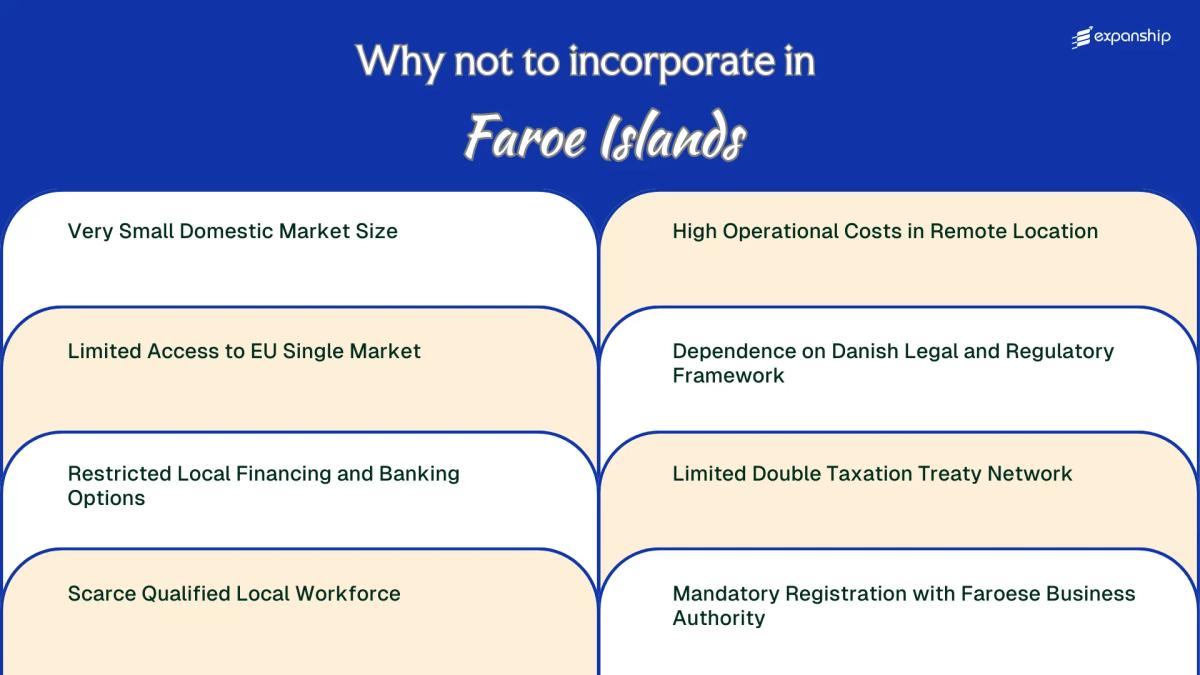
The disadvantages of incorporating in the Faroe Islands span several operational, financial, and structural categories, each examined individually across this article. Not all of these drawbacks will affect every business equally — a firm targeting Nordic export markets faces a different risk profile than one dependent on local consumer demand or EU regulatory access.
This article is most directly relevant to foreign entrepreneurs, holding company operators, and internationally active businesses considering the territory as a base for commercial or investment activity. Governing company law in the jurisdiction is set out in Løgtingslóg nr. 16 frá 2006, the primary legislation regulating business entities registered there.
Very Small Domestic Market Size
With roughly 54,000 residents, the Faroe Islands small market limitations are immediate and structural. Your total addressable domestic audience is smaller than many mid-sized European cities.
A Consumer Base Too Narrow for Scale
Demand across most product and service categories is simply insufficient to sustain a commercially viable operation on local sales alone. A firm targeting Faroese consumers faces a ceiling that cannot be raised through marketing or pricing strategy, only through exports.
Sectors requiring critical mass, such as retail, financial services, or consumer technology, cannot generate the transaction volume needed to recover standard setup and operational costs.
Revenue Dependency Forces Outward Exposure
Any business incorporated locally that relies on domestic revenue will almost certainly require export markets to remain solvent. That dependency introduces foreign distribution costs, currency exposure, and logistics complexity that would not exist in a larger home market.
Even fishing and aquaculture, the two dominant industries, derive their commercial value almost entirely from international demand rather than internal consumption.
Your business model must account for export dependency from the outset, since domestic sales volume alone is unlikely to recover incorporation and operational costs in this jurisdiction.
Limited Access to EU Single Market
Faroe Islands EU single market restrictions stem from the archipelago's constitutional position outside the European Union. Despite being a self-governing territory under Danish sovereignty, the Faroes are explicitly excluded from the EU by Protocol 2 of Denmark's 1972 Accession Treaty. Your business incorporated there cannot passport financial services into EU member states, cannot benefit from EU procurement frameworks, and holds no automatic right to sell goods or services across the bloc without customs and trade barriers applying.
Trade between the Faroes and the EU is governed by a bilateral fisheries and trade agreement, not full single market participation. That agreement covers certain goods, particularly fish products, but leaves significant gaps for companies operating in services, digital commerce, or manufacturing.
For foreign businesses, this creates concrete operational friction:
- Exporting goods to EU markets requires customs declarations and compliance with EU rules of origin, adding administrative cost and processing delays that EU-incorporated entities avoid entirely.
- Service businesses cannot rely on mutual recognition of professional qualifications or regulated service licenses across EU member states.
- Financial firms face no passporting rights, meaning separate licensing in each target EU jurisdiction becomes necessary.
- Digital businesses selling to EU consumers must still comply with EU VAT rules under the OSS scheme without the streamlined domestic access an EU-based entity would carry.
Businesses with a customer base concentrated in continental Europe will find this structural exclusion a persistent cost and complexity factor rather than an occasional administrative inconvenience.

Company Incorporation in the Faroe Islands
Understand the full regulatory and structural implications before incorporating in the Faroe Islands.
Restricted Local Financing and Banking Options
Faroe Islands banking limitations for businesses stem from a financial sector that is both geographically isolated and structurally narrow. The islands are served by a small number of domestic banks, primarily Betri Banki and BankNordik, neither of which offers the product depth or international credit facilities that foreign-owned entities typically require.
| Financing Factor | Practical Constraint |
|---|---|
| Number of active domestic commercial banks | Two primary institutions; minimal competitive lending pressure |
| Access to EU banking frameworks | Not available; the Faroe Islands are outside the EU financial regulatory perimeter |
| International credit lines for foreign firms | Typically require Danish parent bank intermediation |
| Venture capital and private equity market | Effectively absent at institutional scale |
| Capital markets access | No domestic stock exchange; no local bond market for corporate issuance |
Your firm cannot access EU-passported financial products or benefit from the European Investment Bank instruments available to businesses incorporated within EU member states. Restricted financing options for a Faroe Islands company therefore extend beyond interest rates to the structural absence of funding instruments altogether.
Securing startup or growth capital generally requires engaging Danish banking relationships, which adds currency considerations and counterparty complexity. Because the Faroese króna is pegged to the Danish krone and not independently traded, cross-border financial arrangements carry an additional layer of institutional friction that Danish-domiciled competitors do not face.
Scarce Qualified Local Workforce
The Faroe Islands skilled workforce shortage is a structural constraint that directly limits your ability to staff a local operation without importing talent. The total population sits at approximately 54,000, which produces a narrow labor pool across virtually every professional category.
Sectors requiring specialized skills — finance, engineering, IT, and legal services — are particularly constrained. Many qualified Faroese nationals work abroad or are already absorbed by dominant industries such as aquaculture and maritime services, leaving limited availability for new entrants in other sectors.
Recruiting internationally compounds the difficulty. Work permit applications for non-Nordic nationals must be processed through the Faroese authorities, and approval timelines create operational delays that affect hiring plans and project schedules.
Even Nordic citizens who qualify for free movement under the Nordic Passport Union may not have the specific technical credentials your business requires. Talent recruitment challenges in the Faroe Islands mean that reliance on remote or expatriate staff often becomes unavoidable, adding to payroll and relocation costs.
- Work permits for non-Nordic hires require formal application through Faroese immigration authorities
- No large urban professional center exists to draw from; the capital Tórshavn has a population under 25,000
- Hiring for senior or specialized roles typically requires international recruitment, triggering additional visa and relocation obligations
- Local labor law obligations still apply to foreign employees once based in the jurisdiction
Despite its small population, the Faroe Islands has one of the highest labor participation rates in the world, meaning the workforce is nearly fully employed and offers little slack capacity for new employers.
High Operational Costs in Remote Location
High operational costs in the Faroe Islands business environment stem directly from the archipelago's geographic position: 18 islands situated in the North Atlantic, roughly equidistant between Norway and Iceland, with no land connection to any major market.
Freight, Infrastructure, and the Cost of Distance
All physical goods, raw materials, and equipment must arrive by sea or air, with Atlantic Cargo and Atlantic Airways operating the primary freight routes. This dependency means your supply chain carries a structural cost premium that no operational decision can fully eliminate.
Shipping delays are common during severe weather periods, which directly affects inventory planning for any firm reliant on physical stock.
Energy and Operational Overhead
Electricity in the Faroe Islands is supplied by SEV (Streymoy Electricity Company), and while renewable generation has expanded, per-unit energy costs for commercial consumers remain above what a comparable business would face in mainland Northern Europe. For energy-intensive operations, this difference compounds across annual operating budgets.
Office and commercial property costs are also elevated relative to the available supply, given the constrained land area and concentrated economic activity around Tórshavn.
Assessing Operational Viability for Your Business in the Faroe Islands
Our team can walk you through the real cost structure of running a company in the Faroe Islands, including freight dependencies, energy considerations, and overhead benchmarks relevant to your sector.
Dependence on Danish Legal and Regulatory Framework
The Faroe Islands Danish legal framework dependency means your business operates under a layered system where Faroese autonomy is real but incomplete. Danish law continues to govern significant areas, including certain financial regulations and constitutional matters, creating jurisdictional ambiguity that adds complexity for foreign-owned entities.
- Because the Faroe Islands have not fully legislated across all commercial law domains, Danish statutory provisions can apply by default, requiring your legal counsel to hold competency in two distinct legal systems simultaneously.
- The Løgting (Faroese Parliament) has authority over many local matters, but gaps in local legislation mean Danish courts and precedents can influence dispute resolution outcomes in ways that are difficult to anticipate from the outset.
- Regulatory alignment with Denmark does not extend to EU membership, so your firm cannot assume that Danish-origin rules carry the same cross-border enforceability they would within the EU.
- Engaging advisors qualified under both Faroese and Danish law increases your compliance costs compared to jurisdictions with a single, self-contained legal system.
Limited Double Taxation Treaty Network
Faroe Islands double tax treaty limitations present a direct structural problem for foreign-owned businesses generating cross-border income. The territory operates a narrow treaty network, covering only a handful of bilateral agreements rather than the extensive frameworks maintained by EU member states or even nearby Iceland and Denmark.
Without treaty protection, dividend payments, royalties, and service fees flowing between a Faroese entity and a foreign parent or client may be subject to withholding tax in both jurisdictions simultaneously. Your business bears that full cost with no treaty mechanism to cap rates or allocate taxing rights.
Denmark's treaty network does not automatically extend to the Faroe Islands. As an autonomous territory outside the Kingdom of Denmark's international agreements for tax purposes, the islands negotiate separately, limiting the scope of available relief for businesses with operations across multiple countries.
- Businesses structuring regional holding arrangements may find the limited DTT coverage disqualifying.
- Sectors relying on cross-border royalty flows, such as software or IP licensing, face the highest exposure.
A foreign software firm routing licensing fees from a non-treaty country through a Faroese entity could face withholding tax of 15-25% at source with no offsetting relief available domestically, resulting in effective double taxation on the same income stream.
Mandatory Registration with Faroese Business Authority
Faroese Business Authority registration challenges begin before your company conducts a single transaction. All businesses operating in the territory must register with Skráseting Føroya, the official commercial register, and this requirement applies regardless of the foreign owner's country of residence or the size of the intended operation.
Registration documentation must typically be submitted in Faroese or Danish, which immediately creates a translation burden for foreign directors unfamiliar with either language. Engaging a local agent or certified translator adds cost and delays that would not exist in jurisdictions with multilingual submission pathways.
The registry operates under rules derived from the Faroese Companies Act, and any subsequent structural changes — share transfers, director appointments, or amendments to articles of association — require separate filings. Each change generates its own administrative timeline, meaning ongoing compliance consumes time and professional fees well beyond the initial incorporation.
Foreign-owned entities are also subject to annual reporting obligations filed through the registry. Failure to meet these deadlines can trigger penalties or de-registration, with no grace period tailored to overseas-based management teams operating across different time zones.
All entities registered with Skráseting Føroya must maintain a registered address within the Faroe Islands, which means foreign owners without a physical local presence must contract a registered agent, adding a recurring cost that is non-negotiable under current registration rules.
Overcoming These Incorporation Challenges
Overcoming these incorporation challenges begins with accepting that structural solutions must be built into your company's setup from the outset, not added as corrections later.
- Register your entity through the Faroese Business Authority to ensure compliance with mandatory formation requirements under Faroese company law.
- Establish banking relationships with Danish or Nordic institutions early, given the constrained local financial sector.
- Structure your workforce plan around cross-border or remote hiring to offset the limited pool of qualified local professionals.
- Engage tax counsel familiar with Denmark's treaty network to manage withholding tax exposure arising from the jurisdiction's narrow double taxation agreements.
- Account for elevated freight and logistics costs within your operational budget from incorporation, reflecting the remote geographic position.
- Align your entity's governance documentation with Danish legal principles, which underpin the Faroese regulatory framework.
Addressing these points does not eliminate the structural constraints inherent to operating here. Each mitigation step operates within a framework where Faroese autonomy coexists with Danish legal oversight, which itself introduces a layer of regulatory dependency that cannot be designed away entirely.
Weighing the Faroe Islands as a Business Destination
The Faroe Islands present a credible but narrow incorporation case. The disadvantages documented across this blog are structural, not incidental, and they reflect the territory's size, geopolitical position, and economic architecture. For the right business profile, those constraints are manageable; for others, they represent material barriers worth examining before committing to setup.
| Pros | Cons |
|---|---|
| Faroese corporate tax rates are comparatively low, offering a cost advantage over many European jurisdictions. | The domestic market is one of the smallest globally, with a population of approximately 55,000 people. |
| The legal system draws on a well-established Danish framework, providing a degree of institutional predictability. | The territory is not an EU member, so EU single market access and passporting rights are not available to entities incorporated here. |
| Faroese society has high general literacy and a stable, low-crime operating environment. | Local banking options are limited, and international banks largely do not operate branches in the territory. |
| Regulatory registration through the Faroese Business Authority (Skráseting Føroya) follows a defined, transparent process. | The qualified local talent pool is small, and specialized professional roles typically require recruitment from abroad. |
| Geographic stability and a distinct legal identity from Denmark can serve specific structural purposes. | The double taxation treaty network is limited, creating potential tax friction for cross-border operations. |
Operating costs remain elevated due to the territory's remote North Atlantic location, and reliance on imported goods, logistics, and professional services compounds that pressure for foreign-owned firms.
Compliance Services for Companies in the Faroe Islands
Maintain your Faroese company's standing with ongoing compliance support, from annual filings with Skráseting Føroya to regulatory reporting obligations.
Conclusion
Faroe Islands company incorporation drawbacks are real and measurable. The territory's limited domestic market, restricted access to EU frameworks following its non-membership, and a shallow double taxation treaty network each create structural constraints that affect long-term commercial viability. These are not incidental obstacles but characteristics tied directly to the jurisdiction's legal and geographic position. Understanding them in full allows your business to make a grounded assessment of whether registration with the Faroese Business Authority aligns with your operational objectives. Professional guidance specific to Faroese corporate requirements remains the practical next step.
Expanship's Support for Faroe Islands Expansion
Expanship Faroe Islands incorporation support covers the specific friction points this jurisdiction creates — from registering with the Løgmansskrivstovan and satisfying Faroese Business Authority requirements to managing ongoing compliance under a legal framework that sits outside standard EU structures. Your business carries that operational weight whether or not you have local expertise; Expanship's role is to reduce how heavily it falls on your team.
Our services address the full incorporation and post-setup cycle across the Faroe Islands.
- We prepare and submit all company registration documents required by the Faroese authorities.
- A registered agent and local office address are provided to satisfy domicile requirements.
- We handle government filings and liaise directly with the relevant regulatory bodies on your behalf.
- Post-incorporation compliance obligations are managed on an ongoing basis.
- We facilitate introductions to banking institutions familiar with Faroese-registered entities.
- Tax registration and coordination with local fiscal authorities are included in our scope.
Reach out to Expanship Faroe Islands to discuss your incorporation requirements.
Frequently Asked Questions (FAQ)
It affects trading and financial services firms most acutely. Because the Faroe Islands is not an EU member state and operates under separate agreements with the EU, your entity cannot passport financial services into EU member states or benefit from EU free movement of goods in the same way an Irish or Estonian firm would. Service businesses with purely digital or non-EU-dependent operations face comparatively less exposure to this restriction.
Operating without completing mandatory registration through the Faroese Business Authority means your company has no legal standing in the jurisdiction, rendering contracts potentially unenforceable and exposing your business to administrative penalties. Registration is not a formality that can be deferred, and the authority can take enforcement action against unregistered commercial activity.
The constraint is sharper than in comparable jurisdictions with larger populations. With a total population under 55,000, the pool of candidates with specialist legal, financial, or technical qualifications is structurally limited, and competing for that talent against established local industries such as aquaculture drives compensation costs higher than you would typically encounter in, say, Malta or Cyprus.
Freight costs, limited direct air connections, and the absence of large local supplier networks all compound to raise baseline operating expenses beyond what you would face in a continental European jurisdiction. For businesses that require regular physical presence, regular travel through Copenhagen adds both time and cost that should be budgeted explicitly. These are ongoing structural costs, not one-time setup expenses.
Yes, particularly when Danish law is amended or when the scope of autonomous Faroese legislation diverges from expectations. Certain areas of commercial law fall under Danish jurisdiction rather than the Faroese løgting, which means your legal counsel must be competent in both frameworks to advise accurately. Misidentifying which body of law governs a specific obligation is a practical and material compliance risk.
The concentration of banking activity among a small number of local institutions, primarily Føroya Banki and BankNordik, means you have limited options if your business profile is considered higher-risk or non-standard. Access to credit lines and trade finance facilities is more constrained than in financial centres with competitive multi-bank environments, and correspondent banking relationships for non-Nordic currencies may require additional due diligence delays.
The small domestic market creates indirect disadvantages even for export-oriented businesses. Local professional service providers, regulatory infrastructure, and support ecosystems are sized for an economy of under 55,000 people, meaning that sourcing auditors, corporate lawyers, and compliance specialists with international experience is harder and often more expensive than in larger jurisdictions. Your operational capacity can be constrained by the ecosystem regardless of where your end customers are located.
Legal Disclaimer
The information provided in this article is for general informational purposes only and does not constitute legal, tax, or professional advice. While we strive to ensure the accuracy and timeliness of the content, laws and regulations are subject to change, and the application of laws can vary widely based on specific facts and circumstances.
Readers should not act upon this information without seeking professional counsel tailored to their individual situation. Expanship and its authors disclaim any liability for actions taken or not taken based on the content of this article.
For specific advice regarding your business setup, compliance requirements, or any legal matters, please consult with qualified legal and tax professionals in the relevant jurisdiction.