
Key Takeaways
- The Faroe Islands operates a low corporate tax regime that sits below the rates of most European counterparts, giving foreign-incorporated entities a measurable cost advantage over jurisdictions with standard EU-aligned tax burdens.
- Companies engaged in fisheries, aquaculture, or Atlantic maritime operations benefit from a regulatory framework purpose-built around those industries, creating structural alignment that generic incorporation jurisdictions cannot replicate.
- Registering through the Faroese Business Authority using the P/F (Partafelag) corporate form provides a legally recognized entity structure without the procedural overhead common to larger European jurisdictions.
- As a self-governing territory under Danish sovereignty with autonomous authority over its own corporate and tax legislation, the Faroe Islands offers a stable, independent legal environment that functions separately from EU regulatory constraints while remaining connected to Nordic commercial networks.
The benefits of incorporating in the Faroe Islands draw from a jurisdiction that occupies a distinctive position in the North Atlantic — a self-governing territory under Danish sovereignty, operating with considerable legislative autonomy. Company registration is administered through the Faroese Business Authority, known locally as Føroya Løgtingsskrivstovan in broader administrative contexts, though business registration falls under dedicated national oversight. Foreign businesses typically establish a presence through the P/F, or Partafelag, as their primary vehicle.
From a tax posture perspective, the territory operates a low-tax regime rather than a zero-tax or purely territorial one, with rates that sit below many European counterparts. Foreign ownership is generally permitted across most sectors, and the regulatory environment does not impose broad restrictions on inbound foreign direct investment.
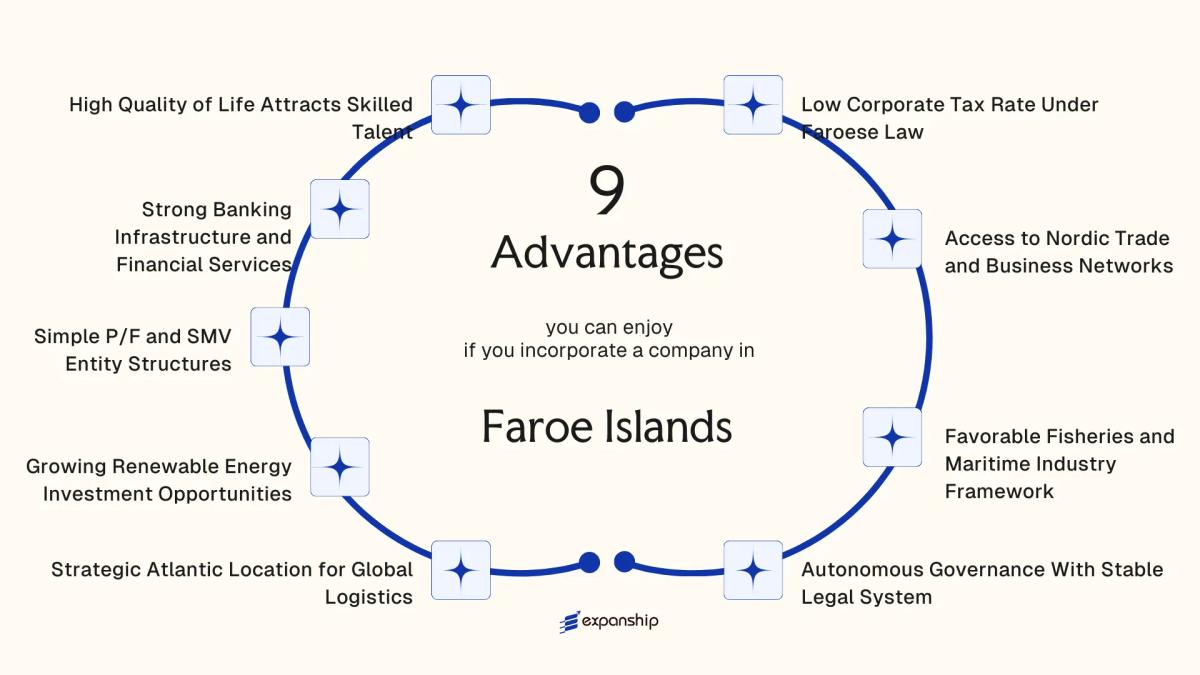
This article examines the concrete advantages your business stands to gain by forming a company in this jurisdiction, drawing on the specific legal, geographic, and economic conditions that shape how firms operate here.
Low Corporate Tax Rate Under Faroese Law
The Faroe Islands low corporate tax rate advantages are concrete and quantifiable. Corporate profit tax is set at 18%, which sits well below the OECD average of approximately 23%.
What the Rate Structure Means in Practice
This rate applies to resident companies on their taxable profits, meaning a foreign investor establishing a Faroese entity retains a significantly larger share of earnings than in many comparable European jurisdictions. The Faroese tax administration operates under rules that are distinct from Danish law, as the islands hold autonomous fiscal authority — your company is taxed under Faroese legislation, not Danish national tax code.
Eligibility and Structural Conditions
Tax residency is determined by place of incorporation and effective management, so a properly registered P/F or SMV entity with genuine local management qualifies for this rate. Foreign-owned firms are not excluded from this treatment, which makes the structure directly accessible to international investors without requiring a local majority shareholder.
An 18% corporate tax rate on Faroese-sourced profits gives your firm a measurable cost advantage over entities structured in higher-tax Nordic or EU jurisdictions.
Access to Nordic Trade and Business Networks
Faroe Islands Nordic trade network benefits stem from the territory's unique political position: while outside the EU and EEA, it maintains close institutional ties to Denmark and participates in the Nordic Council framework alongside Denmark, Norway, Sweden, Finland, and Iceland. For a foreign business owner, this creates access to a well-connected regional bloc without the full regulatory burden of EU membership.
Trade relations with the EU are governed by a bilateral fisheries and goods agreement, meaning businesses operating here can engage with European counterparts under structured terms. Scandinavian market advantages extend further through the Nordic Passport Union and shared administrative conventions, which reduce friction when coordinating operations across the region.
Practical reasons this network access works in your favour:
- Nordic counterparts recognise Faroese commercial structures without requiring extensive re-registration
- Danish legal conventions underpin local contract law, making documentation familiar to Scandinavian partners
- Shared banking infrastructure across the Nordics supports cross-border transactions between member states
- Cultural and linguistic proximity to Denmark reduces negotiation barriers with regional firms
Your entity is effectively positioned between Atlantic markets and the Scandinavian core, without being subject to EU state aid restrictions or the full compliance architecture of EEA membership.

Company Incorporation in the Faroe Islands
Register your business in the Faroe Islands and access Nordic trade networks through a recognised, stable jurisdiction.
Favorable Fisheries and Maritime Industry Framework
Fishing is the economic foundation of the Faroe Islands, and the Faroe Islands fisheries industry framework advantages extend directly to businesses incorporated there. The fishing sector accounts for roughly 90% of total export revenue, meaning the regulatory environment, infrastructure, and institutional knowledge surrounding this industry are far more developed than in most jurisdictions of comparable size.
The Fisheries Administration under the Faroese Home Rule government issues fishing licenses and manages quota allocations through a system designed to support commercially structured fishing entities. For a foreign investor establishing a fisheries or seafood processing company, this means direct access to a licensing regime that recognizes corporate structures rather than requiring individual fisherman status.
| Indicator | Detail |
|---|---|
| Export share from fisheries | ~90% of total exports |
| Primary regulatory body | Faroese Fisheries Administration |
| Main export products | Atlantic cod, salmon, herring, shrimp |
| Exclusive Economic Zone (EEZ) | 200 nautical miles |
Faroese seafood sector incorporation benefits also include proximity to some of the North Atlantic's most productive fishing grounds within a 200-nautical-mile exclusive economic zone, giving licensed entities access to commercially significant stocks. Processing facilities operate under Faroese food safety regulations that align with EU standards, which simplifies export certification into European markets without requiring the Faroe Islands to be an EU member. Your business gains market access without the full regulatory burden of EU membership.
Autonomous Governance With Stable Legal System
Faroe Islands autonomous governance stable legal system gives foreign business owners something many offshore alternatives cannot: predictable legal conditions backed by a distinct constitutional arrangement with Denmark.
Under the Home Rule Act of 1948, later expanded by the 2005 Takeover Act, the Faroese government holds legislative authority over most domestic matters, including company law, tax, and trade regulation. This means local rules are set by the Løgting (the Faroese parliament), not delegated from Copenhagen on a case-by-case basis. For your business, that separation translates to a more coherent, locally administered regulatory environment rather than one subject to shifting priorities from a distant central government.
Political continuity has remained stable across administrations, with commercial legislation applied consistently through the Faroese court system, which operates under its own judiciary distinct from Danish courts. That structural separation reduces jurisdictional ambiguity when disputes arise.
Keep the following in mind:
- Company registration and compliance fall under Faroese domestic law, not Danish law
- The Løgting can amend commercial statutes independently of Danish parliamentary action
- Court proceedings for commercial disputes are handled locally within the Faroese judiciary
- Foreign investors should verify whether specific treaty arrangements apply given the jurisdiction's non-EU status
Despite Denmark's EU membership, the Faroe Islands are not part of the European Union, meaning your company is not subject to EU regulatory directives or GDPR enforcement through European supervisory channels.
Strategic Atlantic Location for Global Logistics
Positioned between Europe, North America, and the Arctic, the Faroe Islands Atlantic location logistics advantages are geographic rather than manufactured. The archipelago sits roughly equidistant from the coasts of Norway, Iceland, Scotland, and Canada, placing any registered business within practical reach of the North Atlantic's primary shipping corridors without the congestion associated with major European port hubs.
Mid-Atlantic Access Without Port Bottlenecks
Vessels transiting the North Atlantic regularly pass through Faroese waters under established international maritime routing. For shipping companies or logistics operators, registration here means your firm operates from a jurisdiction whose territorial waters intersect natural transatlantic routes, rather than diverting to reach them. Tórshavn's port infrastructure handles both commercial freight and offshore supply operations, giving businesses a functional base rather than a nominal address.
Practical Relevance for Logistics-Oriented Entities
The Faroe Islands fall outside the European Union customs union, which means goods transiting through do not automatically trigger EU customs processing. For a trading or freight management entity, this structural separation from EU customs rules can reduce administrative handling at intermediate stages of a supply chain. Combined with the territory's own aviation links to Copenhagen, Edinburgh, and Reykjavik, companies requiring regular physical access to multiple markets find the location operationally workable rather than remote. Air connectivity supports personnel movement and time-sensitive document logistics where maritime transport alone would be insufficient.
Plan Your Faroe Islands Market Entry Strategy
Speak with an Expanship advisor about structuring your logistics or trading entity to take full advantage of the Faroe Islands' Atlantic position.
Growing Renewable Energy Investment Opportunities
Faroe Islands renewable energy investment opportunities have expanded considerably as the territory pursues an ambitious target of 100% renewable electricity generation. Delivered through SEV, the public electricity utility, the energy transition is already well advanced, with wind and hydropower supplying the majority of domestic electricity. That progress creates a concrete opening for private capital.
- SEV actively works with private developers on wind, tidal, and battery storage projects, meaning your firm enters a market where the institutional framework for private participation already exists rather than needing to be established.
- Tidal energy, given the strong currents of the North Atlantic surrounding the islands, presents a generation resource that few jurisdictions can replicate at comparable scale relative to land area.
- Because the territory operates its own energy policy independently of Denmark under the Home Rule framework, regulatory decisions move through a single autonomous authority rather than layers of EU energy directives, shortening the approval timeline for project development.
- A small, self-contained grid means pilot projects produce measurable, exportable data quickly, which holds particular value for firms developing technology that requires documented proof of commercial performance before scaling to larger markets.
The combination of clear institutional ownership, a defined public utility counterpart, and geophysical resource abundance makes the sector structurally accessible for foreign energy businesses.
Simple P/F and SMV Entity Structures
The Faroe Islands P/F SMV entity structure benefits foreign owners primarily through low formation complexity and defined liability boundaries. Two legal forms dominate for foreign investors: the P/F (Partafelag), equivalent to a limited liability company, and the SMV (Samlagsfelag med avmarkada vanheidd), a partnership with limited liability for passive partners.
Both forms are registered through the Faroese Business Authority (Skráseting Føroya). Neither requires a resident director as a statutory default under Faroese company law, which reduces the administrative overhead typically associated with establishing a foreign presence.
- The P/F requires a minimum share capital of DKK 50,000
- The SMV suits structures where one active partner manages operations while investors hold limited exposure
For a foreign business owner, the practical implication is direct: you can establish a locally registered entity without appointing local management or navigating multi-layer holding requirements common in Nordic EU member states.
A foreign investor forming a P/F with DKK 50,000 in share capital (approximately USD 7,200) gains full limited liability status and Faroese legal personhood — at a threshold considerably lower than the NOK 30,000 minimum required for a Norwegian AS under the Norwegian Companies Act (aksjeloven).
Strong Banking Infrastructure and Financial Services
Faroe Islands banking infrastructure advantages for businesses rest on a small but well-capitalized domestic banking sector. The two principal commercial banks, Búðabanki (BankNordik) and Betri Banki, operate under Faroese financial regulation with oversight coordinated through the Danish Financial Supervisory Authority (Finanstilsynet), given the islands' constitutional relationship with Denmark. This dual-layer oversight means your accounts are held within a system that meets Nordic regulatory standards.
Corporate banking accounts are accessible to locally registered entities, including the P/F (Partafelag) structure. Foreign-owned firms can open accounts without the prolonged onboarding delays common in many offshore jurisdictions.
Key practical advantages for foreign business owners include:
- Access to multi-currency accounts suited to Atlantic trade routes
- Payment infrastructure connected to the Danish krone (DKK) monetary system, which provides exchange rate stability relative to the Euro
- Correspondent banking relationships with major Nordic and European institutions, supporting cross-border transactions
Because the Faroe Islands operate under Danish monetary policy, your business avoids currency volatility that affects independent small-nation jurisdictions while retaining autonomous corporate governance.
Account opening eligibility and documentation requirements vary by bank and entity type; confirm directly with the institution whether your specific ownership structure qualifies before proceeding with incorporation.
High Quality of Life Attracts Skilled Talent
The Faroe Islands quality of life skilled talent advantages stem from a society that consistently reports low crime rates, universal healthcare access, and fully subsidized secondary education. For a foreign business owner, this translates into a local workforce that is educated, stable, and relatively low in turnover compared to larger Nordic economies where housing costs and urban congestion drive attrition.
A Small but Highly Educated Labor Pool
The archipelago's population of approximately 55,000 is served by the University of the Faroe Islands (Fróðskaparsetur Føroya), which produces graduates across natural sciences, Faroese language, and technical disciplines. Secondary and vocational education falls under the national education authority, and participation rates are high. A business hiring locally can access workers who carry internationally transferable qualifications without competing against the salary inflation common in Copenhagen or Reykjavik.
Social Stability as a Retention Factor
Housing in the Faroe Islands is affordable relative to mainland Scandinavian cities, and the public social security system provides residents with a safety net that reduces financial anxiety among employees. Workers do not need inflated compensation packages to offset the cost of living pressures seen in larger Nordic capitals. For a firm that needs to attract skilled labor from abroad, the combination of clean environment, short commute times, and accessible public services functions as a non-cash retention benefit:
- Low urban density means minimal commute friction
- Access to outdoor recreation and coastal environment supports work-life balance
- Public healthcare removes private insurance as a hiring negotiation variable
Why the Faroe Islands Outperforms Comparable Jurisdictions
Assessed against Nordic and Atlantic peer jurisdictions, the Faroe Islands advantages over comparable jurisdictions become clearest when you examine autonomy, sector-specific regulation, and cost of establishment together. Jurisdictions such as Iceland, Jersey, and mainland Denmark are the realistic alternatives a foreign investor would evaluate, given overlapping geographic positioning and similar business profiles. Each offers distinct strengths, yet each also carries structural constraints that the Faroese framework does not.
Iceland operates under full EU-adjacent EEA obligations, which introduces regulatory layers absent in Faroese law. Jersey, while offering low tax rates, requires demonstrating economic substance and carries higher professional service costs. Mainland Denmark applies corporate tax at 22% with full EU compliance obligations attached. The Faroe Islands, governed under the Home Rule Act with its own fiscal autonomy, sets its own corporate rate and maintains sector frameworks, particularly in fisheries and maritime, that are calibrated locally rather than harmonised to EU directives. For businesses where regulatory agility and sector specificity matter, that distinction carries practical weight.
| Parameter | Faroe Islands | Iceland | Jersey | Denmark |
|---|---|---|---|---|
| Corporate Tax Rate | ~18% | 20% | 0% (substance rules apply) | 22% |
| EU Regulatory Obligation | None | EEA-aligned | None | Full EU member |
| Fisheries-Specific Framework | Dedicated domestic law | General EEA rules | Not applicable | EU Common Fisheries Policy |
| Entity Formation Complexity | Low (P/F, SMV structures) | Moderate | Moderate | Moderate |
| Fiscal Autonomy | Full (separate from Denmark) | Full | Full (Crown Dependency) | None (EU fiscal rules) |
Compliance Services for Companies in the Faroe Islands
Maintain good standing under Faroese law with support across annual filings, regulatory reporting, and ongoing statutory obligations.
Conclusion
Situated in the North Atlantic with autonomous authority over its tax and corporate laws, the Faroe Islands offers a structurally coherent case for foreign incorporation. The combination of a competitive corporate tax rate, direct access to Nordic commercial networks, and a legal framework purpose-built for maritime and energy sectors means the benefits of incorporating in Faroe Islands are concentrated rather than diluted across generic incentives.
For firms operating in fisheries, aquaculture, or Atlantic logistics, the alignment between industry activity and regulatory design is direct. The P/F structure under Faroese company law provides a recognized corporate form without the procedural complexity common in larger European jurisdictions. These are structural features, not incidental ones.
Faroe Islands company formation advantages are most pronounced for businesses whose operations match what the jurisdiction was built to support. A holding entity with no maritime or renewable energy exposure may find less operational synergy than a firm actively engaged in those sectors. Identifying that alignment before formation is the practical starting point.
The right legal structure, tax positioning, and registration pathway depends on your specific business model and home jurisdiction. Engaging qualified legal and corporate service professionals familiar with the Business Registration Authority and Faroese tax administration ensures that formation decisions are grounded in current regulatory requirements rather than general assumptions.
Start Your Faroe Islands Company With Expanship Today
Expanship's corporate services cover the full formation process for both P/F (Partafelag) and SMV (Samlagsfelag med avmarkad avbyrgd) structures, handling engagement with Skráseting Føroya, the Faroese Business Register, from initial documentation through to certificate of incorporation. The benefits outlined across this blog, from the 18% corporate tax rate to the fisheries licensing framework and the archipelago's Atlantic logistics position, each carry specific compliance obligations that require accurate filings with the relevant Faroese authorities.
To start a Faroe Islands company with Expanship, the following services are available:
- Preparation and legalization of incorporation documents, including articles of association
- Registered agent and registered office provision within the Faroe Islands
- Filing and liaison with Skráseting Føroya on your behalf
- Post-incorporation compliance management, including annual reporting obligations
- Banking introduction assistance with Faroese financial institutions
- Ongoing corporate secretarial support for maintaining good standing
For structured guidance on how Expanship Faroe Islands company formation services apply to your specific business activity or entity type, contact the team directly through Expanship Faroe Islands.
Frequently Asked Questions (FAQ)
The Faroe Islands operates its own tax regime independently of Denmark, with a corporate income tax rate that has historically been set below the OECD average. Because the territory administers its own fiscal legislation through the Løgting, rates are subject to local parliamentary decisions rather than Danish tax law. Consulting the current rate directly with TAKS, the Faroese tax authority, is necessary to confirm the figure applicable to your entity.
Incorporation timelines through Skráseting Føroya vary based on document completeness and entity type, but standard registrations are generally processed within a few business days once all required filings are submitted. The SMV structure, designed for smaller businesses, tends to have lower minimum capital requirements, which can simplify the preparatory phase. Delays most commonly arise from incomplete articles of association or missing identification documentation.
The Faroe Islands has concluded a limited number of tax agreements, including a Nordic tax treaty arrangement covering Denmark, Iceland, Norway, Sweden, and Finland, which can affect how dividend, interest, and royalty income is treated across those jurisdictions. These agreements are negotiated by the Faroese government under its autonomous competence over taxation, separate from Denmark's broader treaty network. A company incorporated locally does not automatically benefit from Denmark's bilateral tax treaties with non-Nordic countries.
Aquaculture, maritime services, and renewable energy, particularly tidal and wind generation, operate under dedicated Faroese regulatory structures administered through the Home Rule government. The fisheries licensing regime is governed by Faroese law rather than EU regulations, since the territory is not a member of the European Union, giving the local government direct control over quota allocation and vessel registration. Businesses in these sectors benefit from regulations tailored to Atlantic operating conditions rather than frameworks designed for continental European markets.
Failure to file annual accounts or maintain registration with Skráseting Føroya can result in administrative strike-off, which dissolves the entity and may expose directors to personal liability for obligations incurred after the company became non-compliant. Reinstatement procedures exist but require settling outstanding filings and fees before the entity is restored to the register. Directors of a P/F carry specific statutory duties under Faroese company legislation, and negligent administration can attract personal liability in cases of wrongful trading.
Both jurisdictions offer strong frameworks for maritime and fisheries businesses, but they differ materially in regulatory structure and market access. The Faroe Islands operates outside the EU and the European Economic Area, giving it independent control over fisheries quotas and bilateral trade agreements, while Iceland, as an EEA member, is subject to certain EU internal market rules. The choice depends on the specific operational footprint, flag state preferences, and the markets the vessel or business intends to serve.
A registered address within the Faroe Islands is required for incorporation through Skráseting Føroya, as the registered office serves as the official point of contact for regulatory correspondence and legal notices. This does not necessarily require a fully staffed operational office, but the address must be a genuine, reachable location within the territory. Using a professional registered address service is a common approach for foreign-owned entities that do not initially maintain a physical presence in Tórshavn or elsewhere in the islands.
Legal Disclaimer
The information provided in this article is for general informational purposes only and does not constitute legal, tax, or professional advice. While we strive to ensure the accuracy and timeliness of the content, laws and regulations are subject to change, and the application of laws can vary widely based on specific facts and circumstances.
Readers should not act upon this information without seeking professional counsel tailored to their individual situation. Expanship and its authors disclaim any liability for actions taken or not taken based on the content of this article.
For specific advice regarding your business setup, compliance requirements, or any legal matters, please consult with qualified legal and tax professionals in the relevant jurisdiction.