
Key Takeaways
- The Falkland Islands Registry of Companies administers all business incorporations under the Companies Ordinance, operating within a legal framework distinct from UK domestic law.
- Private companies limited by shares are the most common registered entity form in the Falkland Islands, offering flexibility on member numbers alongside limited liability protection.
- General partnerships carry unlimited liability for all partners, making them a less practical choice for commercial ventures with meaningful risk exposure.
- Companies limited by guarantee are structurally unsuited to profit-distributing ventures, as they are designed for non-commercial purposes where member returns are not the objective.
Introduction to Entity Types in Falkland Islands
Located in the South Atlantic Ocean, approximately 300 miles east of the southern tip of Argentina, the Falkland Islands is a British Overseas Territory. Governance of the islands operates under the Falkland Islands Constitution Order 2008, with the territory maintaining its own legal and regulatory framework distinct from UK domestic law.
Company registration falls under the oversight of the Falkland Islands Registry of Companies, which administers the incorporation and ongoing compliance of business entities under the Companies Ordinance. The tax environment is low-rate rather than zero-tax, with corporate income subject to local taxation at comparatively modest levels.
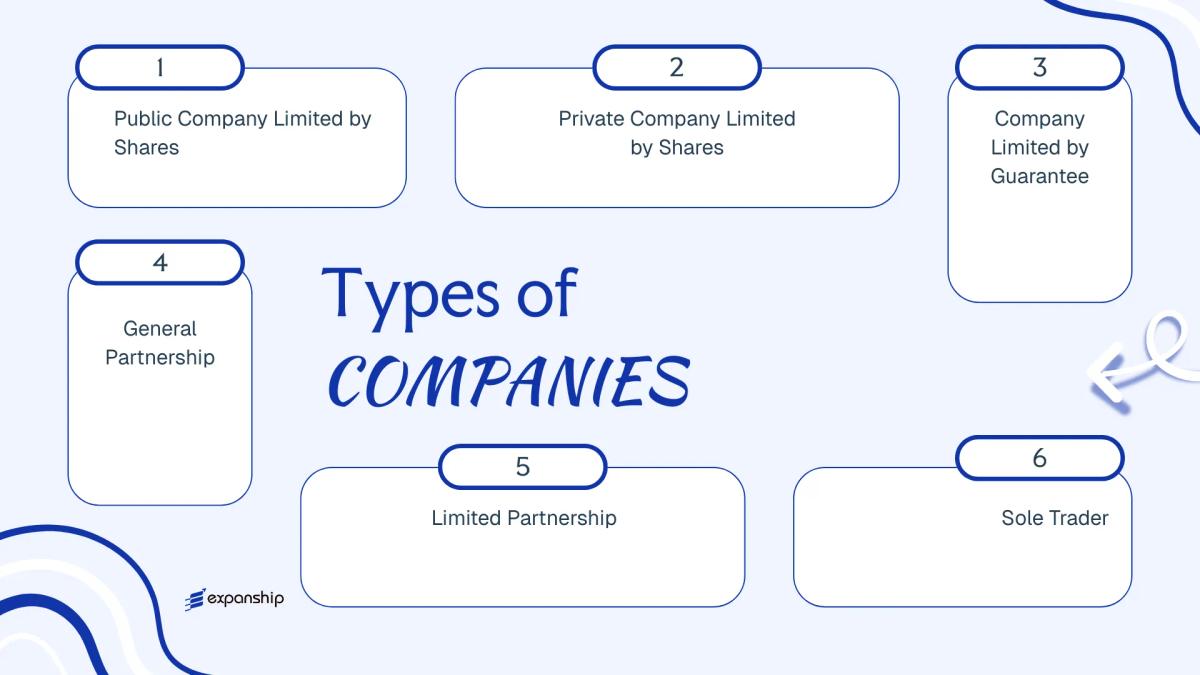
Several business entity types Falkland Islands legislation recognises are available to both resident and non-resident operators. These include the Public Company Limited by Shares, Private Company Limited by Shares, Company Limited by Guarantee, General Partnership, Limited Partnership, and Sole Trader. Each structure carries distinct implications for liability, governance, and how your business is treated under local law. This article examines each of these Falkland Islands company structures in turn, covering formation requirements, ownership rules, and applicable compliance obligations.
An Overview of Business Structures in Falkland Islands
The Falkland Islands business structures overview encompasses a relatively small but clearly defined set of options, each governed primarily by the Companies Ordinance (as applicable to the Falkland Islands). Separate provisions under partnership and sole trader law cover non-corporate forms of business. Each structure carries distinct implications for liability, governance, and commercial purpose.
Business Structures at a Glance
| Entity Type | Legal Form | Liability | Tax Status | Local Trading | Minimum Members | Regulatory Authority | Governing Legislation |
|---|---|---|---|---|---|---|---|
| Public Company Limited by Shares | Corporate body | Limited to shares | Taxable | Permitted | 2 shareholders | Falkland Islands Registry | Companies Ordinance |
| Private Company Limited by Shares | Corporate body | Limited to shares | Taxable | Permitted | 1 shareholder | Falkland Islands Registry | Companies Ordinance |
| Company Limited by Guarantee | Corporate body | Limited to guarantee | Taxable | Permitted | 1 member | Falkland Islands Registry | Companies Ordinance |
| General Partnership | Unincorporated | Joint and several | Taxable | Permitted | 2 partners | Falkland Islands Registry | Partnership law |
| Limited Partnership | Unincorporated | Mixed (general/limited) | Taxable | Permitted | 2 partners | Falkland Islands Registry | Partnership law |
| Sole Trader | Unincorporated | Unlimited personal | Taxable | Permitted | 1 individual | Falkland Islands Registry | General business law |
Each of these structures is examined in full in the sections below.
Public Company Limited by Shares
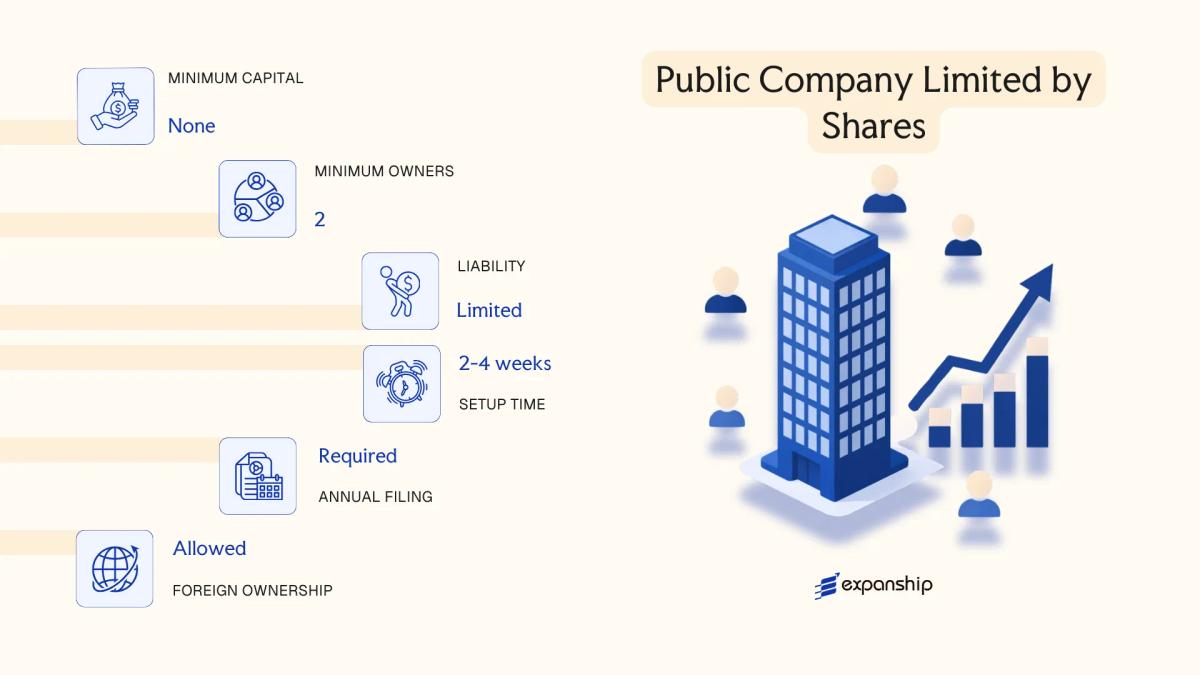
A Falkland Islands public company limited by shares is incorporated under the Companies Ordinance 2012, which governs the formation, management, and dissolution of companies across the territory. The entity carries separate legal personality, meaning it can own assets, enter contracts, and incur liabilities in its own name, distinct from its shareholders.
Shareholder liability is capped at the nominal value of shares held. Unlike a private company, a public company may offer its shares to the general public, making it the appropriate structure when external capital raising or a public listing is intended.
Key Characteristics
| Requirement | Detail | Notes |
|---|---|---|
| Legal Form | Public Company Limited by Shares | Incorporated under the Companies Ordinance 2012 |
| Members | Shareholders; minimum 2, no maximum | Directors: minimum 1; no residency requirement specified under general rules |
| Local Presence | Registered office in the Falkland Islands required | Must maintain a registered address; a registered agent is advisable |
| Capital | No statutory minimum share capital under the Ordinance; denominated in GBP (£) | Shares must be fully or partly paid on allotment |
| Privacy | Director and shareholder details filed with the Companies Registry | Information is on public record |
Focus Points
- Taxation: The Falkland Islands operate a territorial tax system; corporate income tax applies to locally sourced profits, and there is no VAT, capital gains tax, or withholding tax on dividends.
- Annual Compliance: Companies must file annual returns and financial statements with the Companies Registry; audited accounts may be required depending on size.
- Economic Substance: No formal economic substance regime comparable to Crown Dependencies currently applies, though local regulatory expectations are evolving.
- Treaty Access: The territory has limited double tax treaty coverage; UK treaty access is not automatically available to Falkland Islands-incorporated entities.
- Conversion: A public company may be re-registered as a private company through a special resolution and filing with the Registrar of Companies.
Closing
A public company structure suits businesses seeking to raise capital from the public or accommodate a wide shareholder base, such as trading companies or infrastructure ventures; the main constraint is the increased disclosure obligation and compliance burden relative to a private company.
This structure is most appropriate for businesses intending to issue shares publicly, accommodate institutional investors, or operate at a scale requiring formal external capital access.

Company Incorporation in the Falkland Islands
Expanship assists with the full incorporation process for public and private companies under the Companies Ordinance 2012.
Private Company Limited by Shares
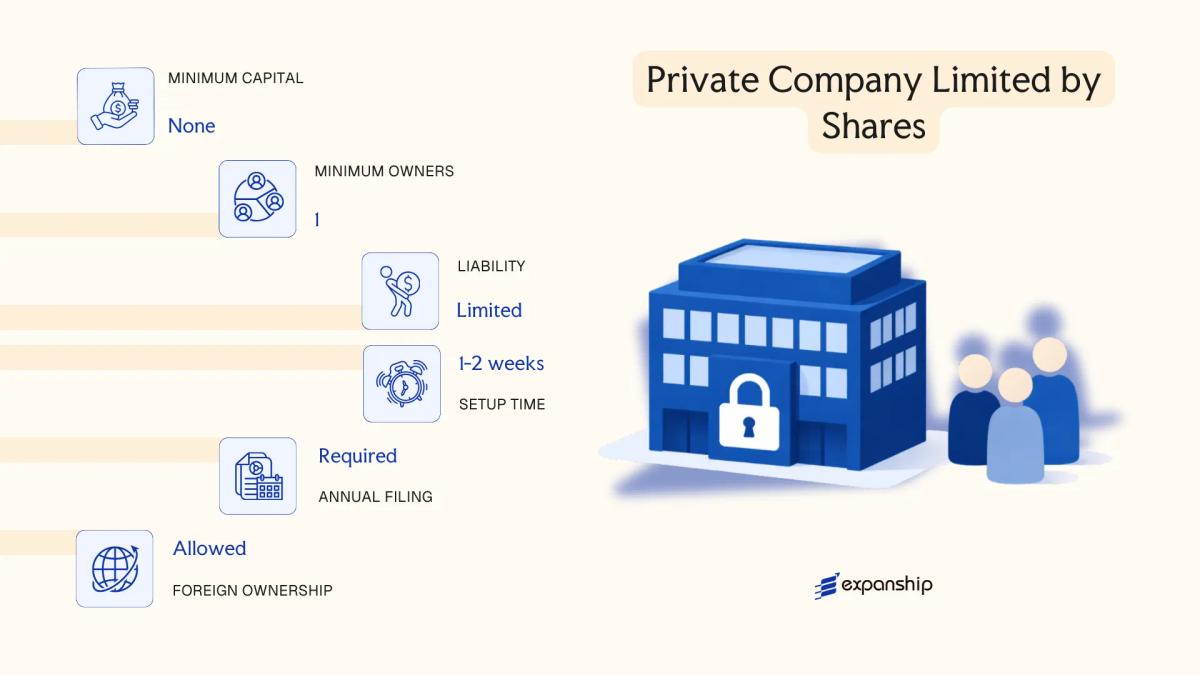
A Falkland Islands private company limited by shares is governed by the Companies Ordinance 2006, which establishes the foundational rules for incorporation, governance, and dissolution. The entity carries separate legal personality, meaning it exists independently from its shareholders, and liability is confined to the amount unpaid on shares held.
Registration is administered through the Falkland Islands Registry of Companies. This structure is by far the most commonly used vehicle for private commercial activity in the territory, available to both resident and non-resident promoters.
Key Characteristics
| Requirement | Detail | Notes |
|---|---|---|
| Legal Form | Private Company Limited by Shares | Abbreviated as "Ltd" |
| Members & Officers | Min. 1 shareholder, min. 1 director; no maximum specified | Director and shareholder may be the same person |
| Local Presence | Registered office address required within the Falkland Islands | Registered agent not mandatorily prescribed by statute, but a local registered office must be maintained |
| Capital | No statutory minimum share capital; denominated in GBP | Shares must be fully or partly paid on allotment |
| Privacy | Director and shareholder details filed at the Registry | Public register; limited privacy on beneficial ownership |
| Share Transfer | Transfers restricted by articles of association | Private placement only; no public offering permitted |
Focus Points
- Taxation: No corporate income tax, capital gains tax, withholding tax, or VAT applies to companies operating outside the Falkland Islands; locally trading companies are subject to Falkland Islands income tax under the Income Tax Ordinance.
- Annual Compliance: Annual return filing with the Registry of Companies is required, along with maintenance of statutory registers.
- Economic Substance: No formal economic substance regime currently enacted in the Falkland Islands.
- Treaty Access: The territory has limited double tax treaty coverage, which may affect cross-border structuring.
- Conversion: A private company may re-register as a public company subject to satisfying the relevant conditions under the Companies Ordinance 2006.
Closing Paragraph
A private limited company in the Falkland Islands suits trading operations, holding structures, and locally licensed businesses where limited liability and corporate permanence are required. The absence of a statutory minimum capital requirement lowers the entry threshold, though the public nature of the Registry means beneficial ownership has limited confidentiality protection.
This structure is most appropriate for small to mid-sized businesses, foreign investors establishing a local operational presence, or entrepreneurs seeking a straightforward corporate vehicle with limited liability under Falkland Islands law.
Company Limited by Guarantee
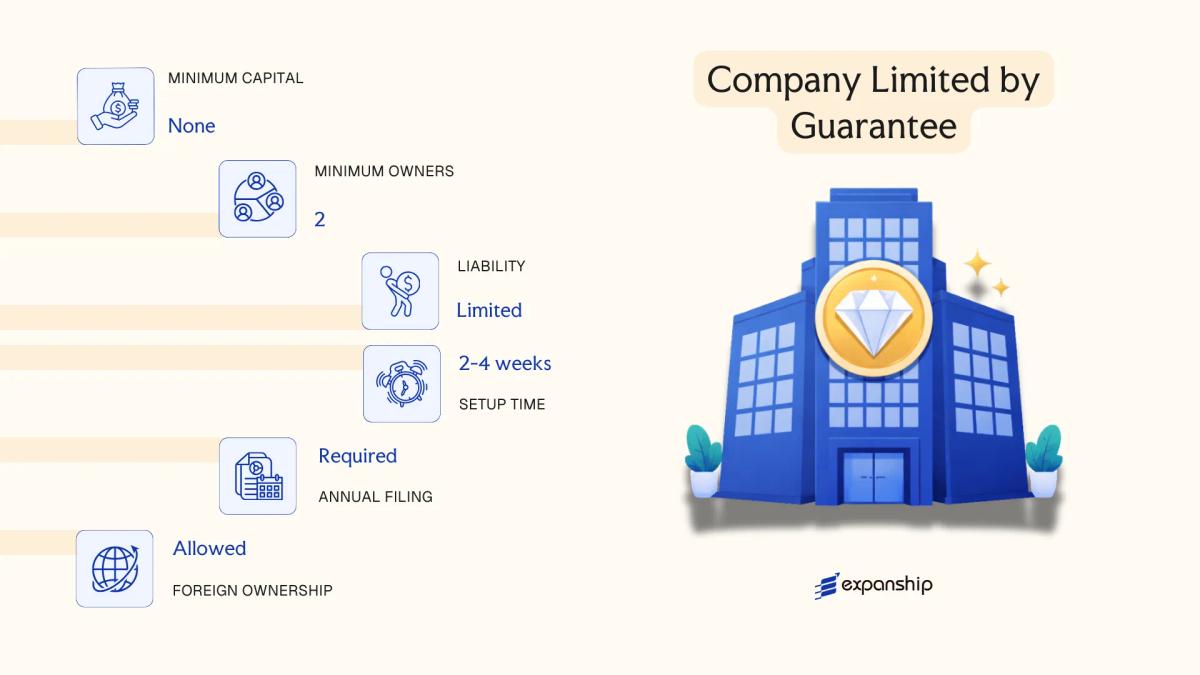
A company limited by guarantee in the Falkland Islands is governed by the Companies Ordinance and operates without share capital. Instead of shareholders, it has members who each provide a nominal guarantee — a fixed sum they agree to contribute toward the company's debts if it is wound up.
This structure carries separate legal personality, meaning the entity can enter contracts, hold assets, and incur liabilities in its own name. Member liability is capped at the guarantee amount, which is typically a token figure such as £1 or £10. The form is most common among non-profit organisations, associations, and charities operating within the territory.
Key Characteristics
| Requirement | Detail | Notes |
|---|---|---|
| Legal Form | Company limited by guarantee (non-share capital) | Registered under the Companies Ordinance |
| Members | Minimum 1 member; no statutory maximum | Members hold no equity stake |
| Officers | Minimum 1 director | Secretary appointment is generally required |
| Local Presence | Registered office required within the Falkland Islands | Must maintain a physical address on the islands |
| Guarantee Amount | Typically £1–£10 per member | Fixed in the memorandum; payable only on winding up |
| Privacy | Director and member details filed with the Registry | Limited privacy; records are accessible |
Focus Points
- Taxation: The Falkland Islands does not levy VAT or withholding tax; a guarantee company engaged in non-profit activities may have reduced or no corporate tax exposure, though specific exemption status depends on the entity's activities and formal registration with local authorities.
- Annual Compliance: Annual returns and financial statements must be filed with the Companies Registry; failure to file attracts penalties.
- Economic Substance: Substance obligations are generally more relevant to commercial entities; non-profit guarantee companies should confirm applicability with local advisors.
- Conversion: Conversion from a guarantee company to a share-capital company is not a standard procedure and would typically require dissolution and re-incorporation.
- Restrictions: The entity cannot distribute profits or surplus assets to members; any surplus must be applied toward the organisation's stated objects.
Closing Paragraph
A guarantee company suits non-profit organisations, community bodies, sports clubs, and professional associations that require a formal legal structure without distributing profits to members. The key advantage is that members face no financial exposure beyond their nominal guarantee amount; the principal limitation is that the structure cannot raise equity capital or offer financial returns to its members.
Best suited for charities, membership associations, and non-governmental organisations that need a recognised legal entity in the Falkland Islands without a share-based ownership structure.
Partnerships in the Falkland Islands [General Partnership, Limited Partnership]
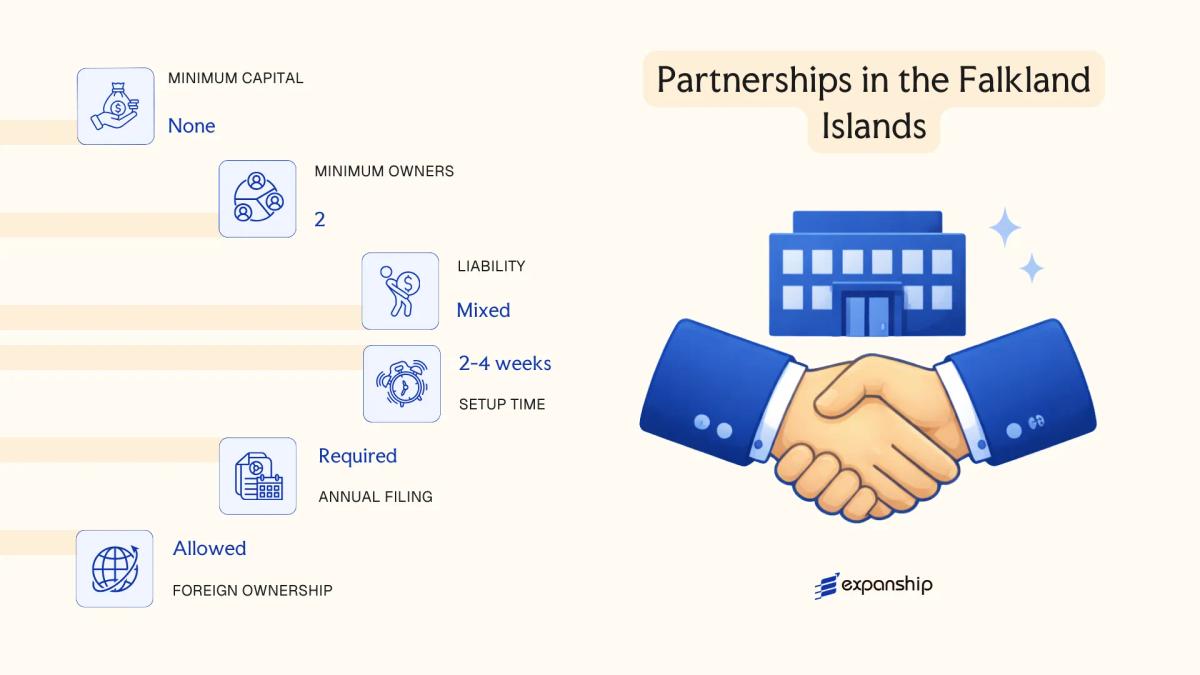
Falkland Islands partnership registration is governed by the Companies Ordinance and associated partnership legislation applicable within the territory. Partnerships do not carry separate legal personality in the same manner as limited companies, meaning partners generally bear direct legal responsibility for the obligations of the business.
Under a general partnership, all partners carry unlimited joint and several liability for debts and obligations. A limited partnership structure allows at least one general partner to assume management and unlimited liability, while limited partners contribute capital and remain liable only to the extent of their investment, provided they do not participate in management.
Key Characteristics
| Requirement | Detail | Notes |
|---|---|---|
| Legal Form | Unincorporated association | No separate legal personality |
| Members | Partners (general and/or limited) | GP: min. 2 partners, no statutory maximum; LP: min. 1 GP + 1 LP |
| Local Presence | Registered address in the Falkland Islands | A local registered agent is advisable |
| Capital | No prescribed minimum; FKP (Falkland Islands pound) | Capital contributions defined by partnership agreement |
| Privacy | Partnership agreements are generally private | Registration details may be publicly accessible |
Focus Points
- Taxation: Partnerships are typically treated as fiscally transparent; partners are taxed individually on their share of profits under Falkland Islands income tax rules, with no separate corporate tax at entity level.
- Annual Compliance: Filing obligations are limited compared to incorporated entities, though financial records must be maintained.
- Economic Substance: Substance requirements are less formalised for partnerships, but trading activity conducted locally is subject to standard regulatory oversight.
- Restrictions: Limited partners who actively participate in management risk losing their liability protection and may be treated as general partners.
- Conversion: Conversion from a partnership to a limited company is possible but requires a formal incorporation process rather than a simple structural change.
Sub-Types
General Partnership
Every partner holds equal management rights and unlimited personal liability unless the partnership agreement specifies otherwise. This structure suits small professional practices or joint ventures where all participants take an active role.
Limited Partnership
At least one general partner manages the business and bears unlimited liability, while one or more limited partners contribute capital passively. This arrangement is commonly used for investment vehicles or project-specific structures where passive investors require defined liability exposure.
Closing Paragraph
Partnerships suit joint ventures, professional services arrangements, and investment structures where pass-through taxation and flexible governance outweigh the absence of limited liability at the entity level. The primary drawback for a general partnership is the unlimited personal exposure of each partner to business debts.
A limited partnership is best suited to investors or project sponsors seeking passive participation with defined liability, provided a capable general partner manages operational responsibilities.
Sole Trader
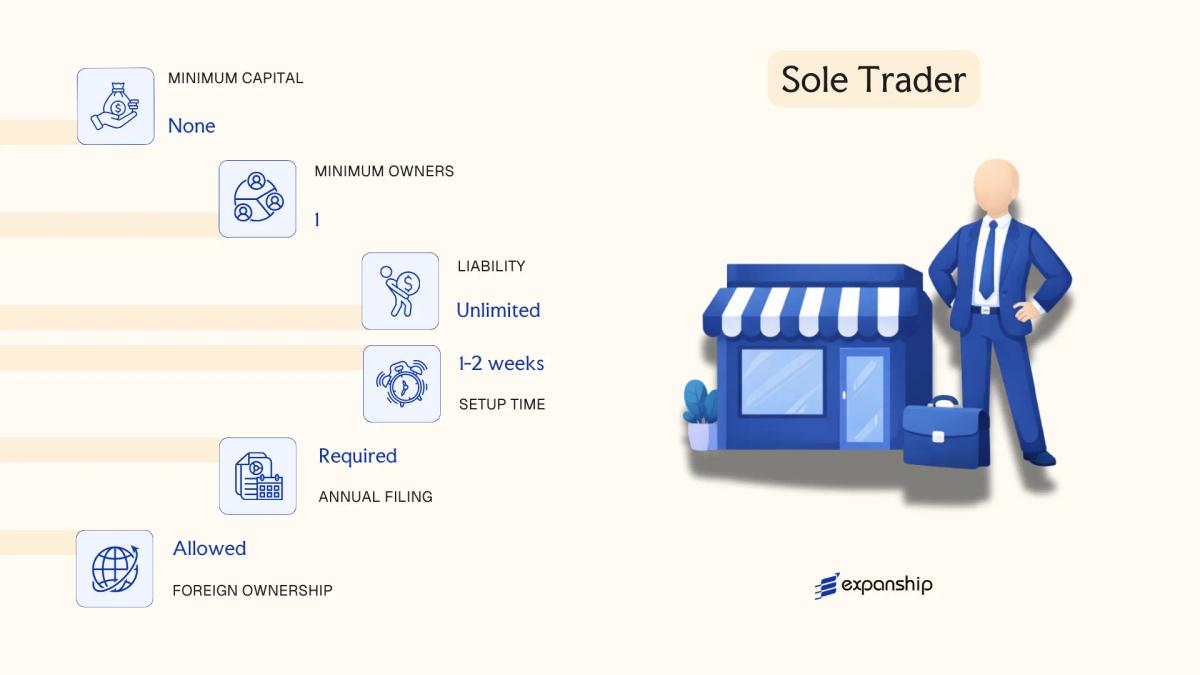
Sole trader Falkland Islands registration is governed under local business licensing requirements administered by the Falkland Islands Government, rather than through the Companies Ordinance framework that applies to incorporated entities. This structure carries no separate legal personality — you and the business are treated as one and the same in law.
As a self-employed Falkland Islands business setup, there is no liability shield between your personal assets and business obligations. Creditors can pursue your personal property to settle debts incurred by the business.
Key Characteristics
| Requirement | Detail | Notes |
|---|---|---|
| Legal Form | Unincorporated individual trader | No separate legal personality from the owner |
| Referred To As | Sole trader / proprietor | No formal member or director designation |
| Ownership | Single individual only | Cannot have co-owners; unlimited |
| Local Presence | Trading address required | No statutory registered agent requirement |
| Capital | No minimum capital | Denominated in Falkland Islands pounds (FKP) |
| Privacy | Limited | Name and trading details may be publicly associated with the individual |
Focus Points
- Taxation: Subject to personal income tax on business profits; no corporate tax applies; VAT registration may be required above a trading threshold.
- Annual Compliance: Business licence renewal required; no annual return filing with a companies registry.
- Liability: Unlimited personal liability for all business debts and obligations.
- Conversion: Can convert to a limited company by incorporating a new entity and transferring assets; no statutory conversion mechanism exists.
- Treaty Access: No access to double tax treaties as an unincorporated individual trader.
Closing
This structure suits small-scale local trading or service provision where operating costs are low and incorporation is not warranted. The absence of formation formalities is a practical advantage, but unlimited personal liability remains a significant exposure for any business carrying financial risk.
Individual traders operating locally at small scale, with minimal financial risk and no requirement for external investment or liability separation.
How to Choose the Right Entity Type in Falkland Islands
Choosing the right business entity in the Falkland Islands has direct legal and financial consequences — the wrong choice can trigger compliance failures, unnecessary costs, or structural limitations that are difficult to unwind.
Why Your Entity Choice Matters
The Companies Ordinance governs formation and ongoing obligations for registered entities. Selecting the wrong structure under this framework can produce concrete outcomes:
- Registering an entity intended for offshore activity and then trading locally places your business in breach of the Ordinance, which can result in penalties or striking off the register.
- Choosing a structure without the capacity to maintain local substance — employees, office presence, local decision-making — can trigger reporting failures and associated regulatory sanctions.
- Forming a company with mandatory shareholder obligations when the underlying purpose is asset protection or estate planning locks you into annual governance requirements that a trust or similar arrangement would not impose.
- Selecting an entity that requires audited financial statements when your operation is a sole consultancy adds recurring professional costs that are avoidable under a simpler structure.
Key Factors to Consider
- Business Activity: Active trading, passive asset holding, and regulated sectors each point toward different entity structures under local law.
- Ownership and Management: Single-owner operations may suit a sole trader or private company, while multi-party arrangements may require a partnership agreement or share structure.
- Tax Objectives: Your liability to Falkland Islands income tax and any withholding considerations should align with the chosen entity's tax treatment.
- Substance Capacity: If you cannot maintain a genuine local presence, your entity choice should reflect that operational reality.
- Privacy Requirements: Director and shareholder information filed with the Companies Registry carries disclosure implications you should assess in advance.
- Exit Strategy: Redomiciliation, conversion, or voluntary winding-up procedures vary by entity type — confirm your intended structure supports your long-term plans before registering.
Compliance Services for Companies in the Falkland Islands
Ongoing compliance support for registered entities, including annual return filing, record-keeping obligations, and regulatory reporting under the Companies Ordinance.
Conclusion
Selecting the right structure is the first substantive decision in any Falkland Islands company formation. Private companies limited by shares suit most trading and investment ventures, given their flexibility on member numbers and limited liability protection. Public companies limited by shares are reserved for entities seeking broader capital access. Companies limited by guarantee serve non-commercial purposes where profit distribution is not the objective. General partnerships carry unlimited liability, making them less common for commercial risk-bearing activity, while limited partnerships allow passive investors a degree of liability protection. Sole traders remain the simplest option for individual operators with modest risk exposure.
Private companies limited by shares represent the most common registered entity form. The regulatory framework, administered under the Companies Ordinance, has remained stable, and the territory's overseas territory status continues to shape its compliance expectations. Professional advice tied to local registration requirements helps ensure your business structure aligns with both commercial objectives and applicable local obligations.
How Expanship Can Assist You
Expanship's Falkland Islands company registration services are built around the specific structures and obligations covered in this guide — from private companies limited by shares registered under the Companies Ordinance to partnerships governed by local statute. Every engagement accounts for the Falkland Islands Government's registry requirements and the procedural expectations of the Financial Services Commission where applicable.
Setting up correctly from the start reduces friction with regulators and banking institutions down the line. Expanship handles the full scope of formation and ongoing obligations:
- Document preparation and notarization
- Registered agent and registered office provision
- Government filing and Companies Registry liaison
- Post-incorporation compliance management
- Banking introduction assistance
Reach out to the team directly through Expanship Falkland Islands to discuss your incorporation requirements.
Frequently Asked Questions (FAQ)
The private company limited by shares is the most frequently incorporated structure. Its combination of limited liability, flexible shareholding arrangements, and suitability for both local trading and foreign ownership makes it the default choice across most commercial activities.
A private company limited by shares is structured for profit-generating activity, with ownership divided among shareholders. A company limited by guarantee holds no share capital and is typically used for non-profit or membership-based purposes. The compliance obligations broadly mirror each other, but their commercial applications differ entirely.
Among the available entity types, the private company limited by shares can offer a degree of confidentiality through the use of nominee directors and shareholders, though the beneficial ownership register maintained under Falkland Islands law imposes disclosure requirements. Publicly accessible information is limited compared to what beneficial ownership registers hold internally.
A sole trader requires only one individual by definition. A private company limited by shares and a company limited by guarantee can each be formed with a single member. General and limited partnerships, however, require a minimum of two parties to constitute a valid partnership under Falkland Islands law.
Foreign nationals may register a private company limited by shares or a company limited by guarantee without a residency requirement. Sole trader status is typically pursued by individuals physically present and operating locally. Partnerships involving foreign partners are permissible, though the practical and regulatory context of operating from abroad should be considered.
The Companies Ordinance provides a general framework for re-registration and structural changes, though conversion between fundamentally different entity categories, such as from a company to a partnership, does not follow a straightforward statutory path. Re-registration of a private company to a public company limited by shares is the most clearly defined conversion route. Professional legal advice is required before initiating any structural change.
Companies incorporated under the Companies Ordinance, whether limited by shares or guarantee, possess separate legal personality distinct from their members. Partnerships and sole traders do not carry this characteristic, meaning personal assets may be exposed to business liabilities. This distinction is one of the primary factors when selecting a structure.
Legal Disclaimer
The information provided in this article is for general informational purposes only and does not constitute legal, tax, or professional advice. While we strive to ensure the accuracy and timeliness of the content, laws and regulations are subject to change, and the application of laws can vary widely based on specific facts and circumstances.
Readers should not act upon this information without seeking professional counsel tailored to their individual situation. Expanship and its authors disclaim any liability for actions taken or not taken based on the content of this article.
For specific advice regarding your business setup, compliance requirements, or any legal matters, please consult with qualified legal and tax professionals in the relevant jurisdiction.