
Key Takeaways
- Businesses incorporating under the Falkland Islands Companies Ordinance must navigate a compliance framework that mirrors full UK company law standards, imposing a regulatory burden more typical of a major onshore jurisdiction than a small territory with under 4,000 residents.
- The extreme geographic isolation of the islands drives up operational costs substantially, as virtually all goods, equipment, and specialist services must be imported over long supply chains from the UK or South America.
- Foreign investors should expect a severely constrained local talent pool, making it difficult to meet any substance or staffing requirements without relocating personnel from abroad at considerable expense.
- Key economic sectors — particularly fisheries and land use — are subject to restricted foreign access, limiting the range of commercially viable structures available to international investors considering the territory as a primary operating base.
Incorporating in the Falkland Islands operates under a regulatory framework that mirrors UK company law, with corporate activity governed primarily by the Companies Ordinance. This alignment with British legal standards means compliance obligations follow a structured, rules-based approach rather than a light-touch offshore model.
The disadvantages of incorporating in the Falkland Islands span several distinct categories, from infrastructure constraints to sectoral access limitations.
How significantly these affect your business depends on your industry, intended structure, and operational requirements. A trading company, a fishing venture, and a holding entity will each encounter a different set of friction points.
This article is most relevant to foreign investors and internationally operating business owners who are evaluating the territory as a primary base of operations rather than as a passive holding structure.
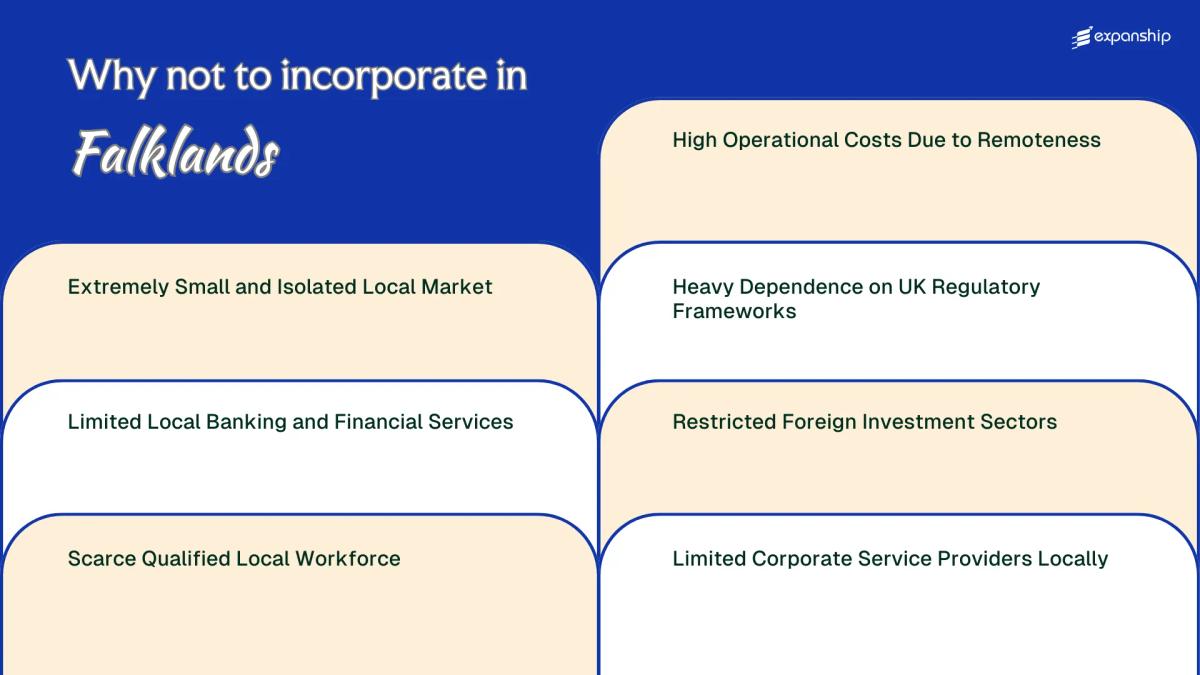
Extremely Small and Isolated Local Market
Falkland Islands small market limitations present one of the most concrete structural barriers for any foreign business seeking commercial returns from local sales. With a resident population of approximately 3,500 people, the addressable consumer base is among the smallest of any incorporated jurisdiction globally.
A Consumer Base Too Small for Most Business Models
Domestic demand across most sectors, including retail, professional services, and hospitality, is severely constrained by this population ceiling. Any business model that depends on local revenue to cover fixed operating costs will find the economics difficult to justify.
The limited consumer base in the Falkland Islands means that B2C ventures are particularly exposed, as market saturation can occur with even a single competitor present. Niche sectors such as fishing and government contracting offer some activity, but access to these is often tied to existing local relationships or licensing conditions.
Geographic Isolation Compounds the Market Size Problem
Situated approximately 8,000 miles from the UK and 1,200 miles from mainland South America, the islands' physical remoteness restricts supply chain efficiency and limits organic business growth. Isolated market challenges extend beyond sales volume to affect distribution, logistics, and the ability to scale.
Your business cannot realistically rely on local revenues to sustain operations; any entity incorporated here requires an externally oriented revenue model to remain financially viable.
Limited Local Banking and Financial Services
Falkland Islands banking limitations for companies begin with a fundamental structural reality: the territory is served by a single retail banking institution, Standard Chartered Bank, operating through its Stanley branch. That concentration means your business has no competitive alternatives locally, which removes any negotiating leverage over fees, account conditions, or service terms.
Opening a corporate account often requires physical presence or notarised documentation submitted through correspondent banking channels, adding time and cost that foreign directors based outside the territory absorb directly.
Limited financial services in the Falkland Islands create operational friction across several practical areas:
- Outgoing international transfers are subject to correspondent banking intermediaries, increasing transaction costs and processing delays for routine supplier payments
- The absence of local investment banking or trade finance products forces firms to source structured financing entirely from overseas institutions
- Currency exchange outside GBP involves routing through UK-based clearing, which adds conversion costs on transactions denominated in other currencies
- No local card acquiring infrastructure means e-commerce or retail payment processing cannot be established domestically
Corporate banking challenges extend to credit facilities. Local lending capacity is limited, so debt financing for capital expenditure or working capital must be arranged through foreign banks, which typically require additional legal structuring to recognise Falklands-registered entities.

Company Incorporation in the Falkland Islands
Understand the structural requirements and procedural steps for registering a company in the Falkland Islands, including documentation, compliance obligations, and ongoing maintenance.
Scarce Qualified Local Workforce
Falkland Islands workforce scarcity problems stem directly from a population that sits below 3,500 residents. That figure includes retirees, dependants, and military personnel stationed at MPA, leaving an exceptionally thin base of working-age adults from which any business can recruit.
Skilled professionals in accounting, legal services, engineering, and IT are either absent or available in single digits across the territory. Your firm cannot simply post a vacancy and expect qualified candidates to surface locally.
| Factor | Reality in the Falklands | Operational Implication |
|---|---|---|
| Total resident population | Under 3,500 | Negligible talent pool for specialist roles |
| Registered local employers | Dominated by government and fishing sector | Private sector competes against state wages |
| Work permit processing (non-UK nationals) | Required via Falkland Islands Government Immigration | Adds lead time before staff can legally start |
| Remote recruitment premium | Significant above-market salaries typically required | Raises staffing costs well beyond UK mainland rates |
Filling a mid-level finance or compliance role almost always means recruiting from overseas, which triggers the Falkland Islands Government's immigration and work permit process. That adds administrative lead time and cost before an employee can legally begin work.
Reliance on expatriate staff also creates retention instability. The territory's geographic isolation means professionals frequently return home after short contracts, forcing repeated hiring cycles that drain management time and budget.
High Operational Costs Due to Remoteness
Running a business in the Falkland Islands means accepting that geography will translate directly into cost. The islands sit roughly 8,000 miles from the United Kingdom and approximately 1,200 miles from the nearest South American landmass, making supply chains structurally expensive for any firm requiring regular imports of goods, equipment, or materials. High operational costs Falkland Islands business owners face are not incidental — they are built into the physical reality of operating here.
Nearly all commercial goods arrive by sea or air, with freight options constrained by infrequent schedules and limited carrier competition. This means longer lead times, higher per-unit shipping costs, and greater inventory requirements — all of which tie up working capital that would otherwise remain liquid.
Fuel costs follow the same pattern. Because the islands depend on imported fuel, energy expenses for operations, heating, and transport run consistently above what a comparable business would pay in a well-connected jurisdiction. There is no pipeline infrastructure or domestic fuel production serving commercial needs at scale.
- All major equipment and consumables must be sourced externally, with delivery times measured in weeks rather than days
- Energy and fuel costs apply regardless of business size or sector
- Emergency procurement or replacement parts carry premium air freight charges
- Inventory buffers must be maintained at higher levels to offset supply disruptions
- Cold-chain and perishable goods face additional constraints due to irregular freight schedules
The Falkland Islands has no deep-water commercial port capable of handling large container vessels directly, meaning most cargo is lightered ashore from ships anchored offshore, adding handling costs that do not exist in most other jurisdictions.
Heavy Dependence on UK Regulatory Frameworks
Falkland Islands UK regulatory framework risks extend beyond surface-level compliance. Your business inherits a layered system of obligations shaped by British law, with limited local capacity to interpret or apply them efficiently.
Structural Dependence on UK Law
Corporate governance in the territory operates under frameworks derived from English law, including companies legislation modelled on UK statutes and oversight connected to the Foreign, Commonwealth and Development Office. This alignment means your entity is subject to legal standards designed for a very different economic environment, not one with fewer than 4,000 residents and a narrow commercial base.
Compliance obligations that reflect UK regulatory thinking can require specialist legal input from practitioners familiar with both the local ordinances and their British source material. That dual-layer requirement adds cost and time to routine corporate maintenance.
Practical Consequences for Foreign Entities
British Overseas Territory compliance challenges here are compounded by the absence of an independent financial regulator. Decisions affecting your firm's regulatory standing can involve processes that reference UK bodies or standards, reducing local predictability.
Any significant shift in UK domestic legislation or policy can carry through to the Falkland Islands corporate framework, exposing your business to regulatory changes that originate entirely outside the jurisdiction where you operate.
Support for Managing Regulatory Complexity in the Falkland Islands
Our team can help you assess compliance obligations under Falkland Islands corporate law and understand how UK-derived regulatory frameworks affect your business structure.
Restricted Foreign Investment Sectors
Falkland Islands foreign investment restrictions apply most acutely in sectors tied to the territory's core economic activities, where foreign ownership faces structural and regulatory barriers. Your ability to operate freely as a non-resident entity depends heavily on which industry your business falls within.
- Fishing licences, which generate the majority of government revenue, are issued under the Falkland Islands Fishing Licensing regime and are subject to strict government discretion, meaning foreign firms cannot acquire them as a matter of right.
- Land ownership restrictions effectively limit foreign entities from purchasing agricultural or pastoral property, concentrating control of the sheep farming sector among established local interests.
- Hydrocarbon exploration rights in Falkland Islands territorial waters are regulated by the government under licensing frameworks that favour joint ventures with approved operators, creating a structural barrier for independent foreign entrants.
- Any entity operating in these sectors without prior government approval risks operating outside its permitted scope, which can result in licence revocation or legal sanction.
Limited Corporate Service Providers Locally
Finding qualified limited corporate service providers in the Falkland Islands is a structural problem, not an occasional inconvenience. The territory's total population sits below 4,000, which means the professional services sector is correspondingly thin.
Registered agent services, company secretarial support, and local legal counsel are available through only a handful of firms. This scarcity creates a near-monopoly dynamic, where limited competition produces slower response times, reduced service flexibility, and little room to negotiate fees.
Falkland Islands registered agent scarcity has a direct compliance consequence. Corporate service providers locally are typically generalist practices rather than specialists in cross-border structuring, meaning foreign firms with complex holding arrangements or multi-jurisdictional reporting requirements may find local providers unable to assist adequately.
- No dedicated financial services regulatory hub exists, unlike in jurisdictions such as Jersey or Cayman.
- Specialist functions like transfer pricing documentation or FATCA compliance coordination often require engaging external UK-based advisers.
A foreign business owner requiring both registered agent services and ongoing corporate secretarial support in the Falkland Islands could realistically face annual service fees exceeding £3,000 to £5,000, sourced from a single provider with no competing quote available locally to benchmark against.
Overcoming Incorporation Challenges in the Falkland Islands
Overcoming Falkland Islands incorporation challenges requires structural preparation before any registration steps are taken. The obstacles outlined in this blog are not incidental — they reflect the territory's geographic, economic, and regulatory realities.
- Register your entity under the Companies Ordinance and confirm sector eligibility before committing capital, given restrictions on foreign ownership in certain industries.
- Open correspondent banking relationships through UK-based institutions in advance, accounting for the absence of a developed local financial services sector.
- Source staffing through mainland UK or international recruitment channels, given the constrained local labour pool.
- Budget for elevated freight, logistics, and operational costs inherent to the territory's remote supply chains.
- Structure governance and compliance obligations in alignment with UK frameworks, which underpin the territory's legal and regulatory environment.
Mitigation steps here operate within a framework shaped by both local ordinances and UK-derived legislation. The Falkland Islands Government's oversight means that compliance obligations extend beyond local registration formalities alone.
The Falkland Islands as a Business Destination
The Falkland Islands present a credible, legally transparent incorporation environment underpinned by British common law and the Companies Ordinance 2006. That said, the Falkland Islands business destination drawbacks documented throughout this blog are real operational constraints, not minor friction points.
| Pros | Cons |
|---|---|
| Legal framework derived from UK common law provides predictability and enforceability. | The local market of roughly 3,500 residents offers negligible domestic commercial opportunity. |
| Political stability as a British Overseas Territory reduces sovereign risk. | Geographic remoteness from South America and the UK drives persistently high operational costs. |
| English is the official language and legal system, reducing compliance complexity for UK-connected businesses. | Local banking infrastructure is limited, with restricted access to international financial products. |
| Fishing and energy licensing regimes are established and regulated under defined ordinances. | Qualified professional and technical labour must largely be sourced and relocated from overseas. |
| No exchange controls under current territory policy. | Corporate service providers are scarce locally, limiting administrative support options. |
Regulatory alignment with UK frameworks does provide legal predictability. At the same time, that dependency means your entity has limited ability to diverge from UK-influenced compliance requirements, even where local conditions would warrant a different approach.
Compliance Services for Companies in the Falkland Islands
Maintain your Falkland Islands company in good standing under the Companies Ordinance 2006 and applicable territory regulations.
Conclusion
The Falkland Islands incorporation cons summary reflects a jurisdiction with legitimate legal standing under UK-derived company law, but one where structural limitations carry real weight. Geographic isolation drives up operational costs substantially, the local banking infrastructure remains thin, and the available pool of qualified residents is too small to staff most business functions. These are not marginal concerns. For your business to function here, most professional services, financial relationships, and skilled personnel will need to be sourced externally. Specialist guidance on local registration requirements and ongoing compliance obligations under Falkland Islands law is not optional.
Expanship's Falkland Islands Incorporation Support
Falkland Islands incorporation support services from Expanship are built around the specific friction points this jurisdiction creates — from satisfying the Companies Ordinance registration requirements under the Falkland Islands Government to managing the compliance obligations that come with operating under a UK-derived regulatory framework. Expanship reduces the operational burden of working across a thinly resourced business environment where local corporate service providers are scarce and banking introductions require careful groundwork.
Beyond registration, Expanship supports your business across the full incorporation and post-incorporation cycle:
- Your company is registered with all required documentation prepared to the Falkland Islands Government's standards.
- A registered agent and local office address are provided to satisfy statutory presence requirements.
- Government filings are handled and regulatory body liaison is managed on your behalf.
- Ongoing compliance obligations are monitored and maintained after incorporation.
- Banking introduction support is provided to help your entity establish a functional account.
- Tax registration and liaison with local authorities are coordinated as part of the setup process.
Reach out to Expanship Falkland Islands to discuss your incorporation requirements.
Frequently Asked Questions (FAQ)
UK regulatory frameworks apply broadly across the territory, but the impact is felt most acutely in sectors subject to financial oversight and environmental controls. The Falkland Islands operates under UK-aligned company law, meaning compliance obligations can mirror those of a far larger, more complex jurisdiction despite the local economy's modest scale. Businesses in fishing, oil exploration, and financial services face the most direct exposure to these frameworks.
Operating costs in the Falkland Islands are materially higher than in most offshore centres due to the territory's geographic isolation in the South Atlantic. Freight, logistics, and the import of almost all consumables and equipment carry significant cost premiums that a business incorporated in, say, the Channel Islands or Cayman Islands would not face. There is no large-scale local supply chain to offset these costs.
Foreign ownership in key natural resource sectors, particularly fishing and hydrocarbons, is subject to licensing controls administered by the Falkland Islands Government. These restrictions are not blanket prohibitions, but they create meaningful barriers to entry for foreign firms seeking majority control in those industries. Approval processes can be protracted, and there is no guarantee of a licence being granted regardless of the capital invested.
Recruiting qualified personnel locally is genuinely difficult given the small labour pool, which means most businesses must rely on expatriate workers. Bringing in overseas staff involves immigration processes under Falkland Islands immigration rules, and the associated costs of relocation, housing, and retention allowances add substantially to payroll. Remote location also makes it harder to attract and retain skilled professionals compared to jurisdictions with larger urban centres.
The Falkland Islands has fewer locally based corporate service providers than comparable small jurisdictions such as Gibraltar or the Isle of Man, both of which have established professional services industries. This means that company secretarial, legal, and accounting support may be harder to source locally, and firms often need to engage service providers based in the UK or elsewhere. That dependency introduces time zone considerations, additional fees, and potential gaps in locally specific regulatory knowledge.
Banking options within the Falkland Islands are extremely limited, with Standard Chartered historically being one of the few commercial banks operating in the territory. Opening and maintaining a corporate bank account can be difficult, and international wire transfers may involve correspondent banking arrangements that add cost and processing time. For businesses that require multi-currency accounts or rapid cross-border transactions, this is a practical operational constraint rather than a minor inconvenience.
The Falkland Islands carries low name recognition as a corporate domicile compared to established offshore centres, which can create friction when dealing with overseas banks, counterparties, or institutional investors conducting due diligence. Some foreign counterparties may be unfamiliar with Falkland Islands company law or question the jurisdiction's regulatory standing, even though it operates under UK-aligned frameworks. This reputational ambiguity is a distinct risk from the legal risks and should factor into any decision about whether incorporating there serves your firm's broader commercial objectives.
Legal Disclaimer
The information provided in this article is for general informational purposes only and does not constitute legal, tax, or professional advice. While we strive to ensure the accuracy and timeliness of the content, laws and regulations are subject to change, and the application of laws can vary widely based on specific facts and circumstances.
Readers should not act upon this information without seeking professional counsel tailored to their individual situation. Expanship and its authors disclaim any liability for actions taken or not taken based on the content of this article.
For specific advice regarding your business setup, compliance requirements, or any legal matters, please consult with qualified legal and tax professionals in the relevant jurisdiction.